
How Much Does It Cost to Replace a Flat Roof? Real Figures You Can Work With
You already know flat roof replacement isn't cheap - but the number that actually matters is harder to pin down than most contractors admit. In Queens, most straightforward residential flat roof replacements land around $9,000-$18,000, while complex jobs with hidden damage or difficult access can push to $18,000-$30,000 or more. Two roofs with the exact same footprint can still land thousands apart, because the real cost lives in hidden layers, drainage problems, access conditions, and what's sitting underneath the membrane - not just square footage.
Real Queens Price Ranges Before You Compare Quotes
In Queens, I've seen a 1,200-square-foot flat roof come in at two very different numbers before lunch. Most straightforward residential jobs - single layer, accessible roof, no major substrate damage - fall in that $9,000-$18,000 range. The moment you add multiple buried layers, soaked insulation, or drain corrections, you're looking at a different job entirely, and the number reflects that.
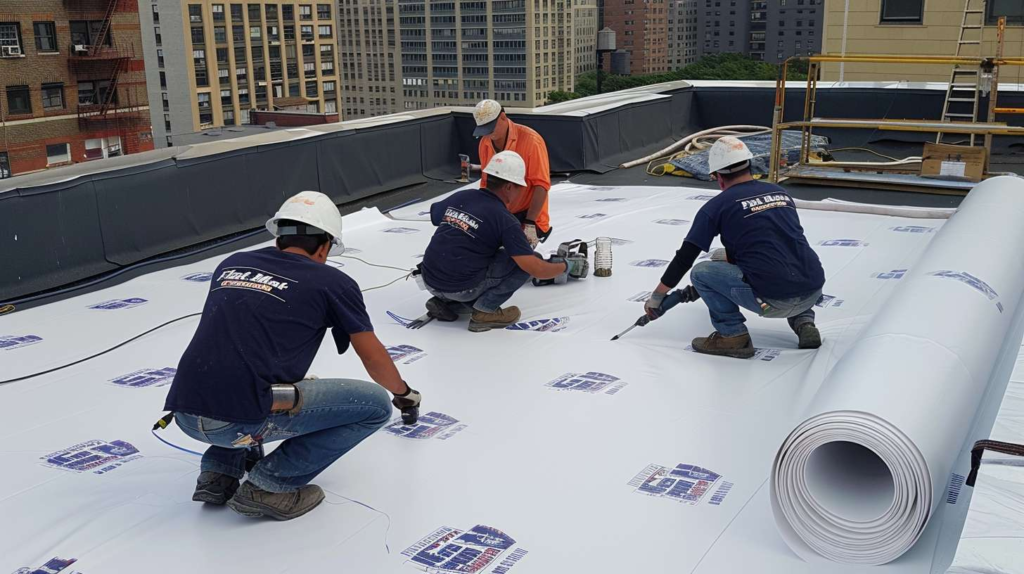
Think of it this way: square footage is the control in the experiment. Layers, access, drainage, and substrate condition are the variables - and variables are what change the result. Honestly, quotes given over the phone without anyone setting foot on the roof aren't serious pricing. They're guesses dressed up like estimates, and you can't make a sound decision with bad data.
Queens Flat Roofing Replacement - Quick Snapshot
Typical Small Residential Range
$9,000 - $18,000
Complex or Damaged Roofs
$18,000 - $30,000+
Quote Accuracy Rule
On-site inspection beats any phone estimate - every time
Biggest Price Swing Factors
Tear-off layers, roof access, deck repair, insulation condition
Variables That Push One Roof Thousands Higher Than Another
First Variable: What Has to Come Off
Here's the part people usually don't enjoy hearing. Old layers don't just add weight - they add hours. Saturated insulation is heavy, slow to cut, and expensive to haul. Buried repairs from previous contractors can mean running into hidden fasteners, failed seams, or wood filler sitting under three cap sheets. Darlene Velez, with 19 years of flat roofing experience in Queens, specializes in diagnosing failure points before replacement - because what's already on the roof shapes almost everything about what the job will actually cost.
Second Variable: How Materials and Crews Reach the Roof
I remember a sticky August afternoon in Ridgewood when a landlord kept insisting two quotes should match because the roofs were "the same size." I climbed both buildings, and by 3:40 p.m. I was showing him that one roof had three hidden layers under the cap sheet while the other had clean, easy stair access and a single membrane. Same block, same square footage - completely different job. This is exactly what happens across older parts of Queens. In Ridgewood, Glendale, and Maspeth especially, you'll run into buildings with multiple prior overlays where nobody pulled a permit to tear off the old roof, just laid new over old. That adds weight, labor, and disposal cost that never shows up in a phone estimate.
I was on a small commercial job in Astoria at 6:15 a.m. when a delivery driver asked why one building paid nearly double what the neighboring building paid the year before. Same block, same rough dimensions. But this one needed a crane lift because the alley off 31st Street was blocked, and half the deck near the rear parapet had rotted through. Same-size footprint, completely different site reality. That morning is the reason I never discuss flat roofing replacement cost without talking about access and substrate condition in the same breath. That's the final result of bad assumptions meeting real site conditions - a number that surprises nobody except the person who skipped the inspection.
If two roofs measure the same, what exactly are you assuming is equal?
What Are You Actually Buying in a Replacement Estimate?
Before I price anything, I ask one question: what are we really replacing? A complete flat roof replacement covers tear-off labor, deck inspection and any required repairs, insulation removal and reinstallation, the new membrane system, all flashing and parapet work, drain and scupper detailing, edge metal, and full cleanup and disposal. That's a lot of line items - and any one of them can disappear from a low bid. Worth doing: ask every contractor whether their estimate includes replacing wet insulation around penetrations and drain bowls specifically, because that's the exclusion that almost always shows up as a change order six weeks into the job.
I had a homeowner in Maspeth say this to me once - that the lower estimate "should be enough" because the roof "looks mostly fine from the street." And look, I understand that instinct. But low bids that hold up under pressure usually got there by leaving something out. Missing line items for substrate repair, proper flashing at the HVAC curbs, or disposal weight charges aren't savings - they're costs you haven't been told about yet. A roof that looks fine from the ground can hide a decade of water movement that the membrane was quietly managing until it couldn't anymore.
What a Complete Flat Roof Replacement Quote Should Include
- ✅ Tear-off scope - how many layers, what's included in removal
- ✅ Disposal fees - weight estimates, dumpster placement, haul-away schedule
- ✅ Deck inspection - scope of visual and probe inspection, repair trigger conditions
- ✅ Insulation thickness and type - R-value, board count, replacement of wet sections
- ✅ Membrane system and thickness - TPO/PVC/Modified Bitumen, mil spec, attachment method
- ✅ Flashing and parapet work - detail at walls, curbs, penetrations, and edges
- ✅ Drain and scupper detailing - bowl condition, clamping ring replacement, overflow capacity
- ✅ Warranty terms - manufacturer warranty, workmanship warranty, what voids each
⚠️ The Low-Bid Estimate Trap
Don't compare bids by final number alone. A proposal that omits line items for wet insulation replacement, wood deck repair, drain correction, and haul-away weight isn't cheaper - it's incomplete. Those costs don't disappear. They show up as change orders after the job starts, when you have the least negotiating leverage.
Bad Data Usually Hides in the Cheapest Number
Blunt truth: the cheapest roof on paper can become the most expensive roof by winter. One February morning, just after sleet, I met a retired couple in Bayside who had been given a suspiciously low flat roofing replacement cost over the phone - no one had seen the roof. When we got up there, both drains were sitting in shallow bowls of ice, and the insulation around two HVAC curbs was completely saturated. The appealing number they'd been holding onto was based on a roof that didn't actually exist. The contractor quoting it had assumed a clean, simple job without stepping foot on the building. That's not an estimate - that's a guess with a dollar sign in front of it. In Queens winters, that kind of bad data turns into emergency calls, interior damage, and a bill that's far higher than what a proper inspection-based quote would have been in the first place.
Use This Short Test Before You Approve Any Proposal
A flat roof estimate works more like a science lab than a takeout menu. Every variable has to be identified, every assumption has to be stated, and what happens if hidden damage appears needs to be documented before anyone signs anything. When you review competing bids, check whether the contractor identified the specific conditions on your roof, stated what they're assuming about the deck and insulation, and spelled out the process for handling surprises. If a proposal reads like it could describe any roof on any block in Queens, it probably wasn't written for yours.
Before You Call a Contractor
Have these ready before your first conversation - it'll make every estimate more accurate.
- Roof size if known - even a rough square footage helps
- Leak history - where, when, and how often water has appeared inside
- Prior repairs or overlays - any patches, coatings, or full re-covers you know about
- Photos of access points - stairway hatch, alley width, adjacent structures
- HVAC or equipment on the roof - units, curbs, pipe penetrations, satellite mounts
- Interior water damage - stained ceilings, buckled drywall, mold indicators
- A copy of each written estimate - for true side-by-side line-item comparison
Questions Readers Ask Before Signing
If you want a quote based on the actual roof in front of us - not a number built on assumptions - call Flat Masters for an inspection-driven flat roofing estimate in Queens. We show up, we climb up, and we price what's actually there. - Darlene Velez, Flat Masters