A Seal Coating Can Add Years to a Tired Flat Roof - If It's the Right Product
Delay it and it spreads - but coat it wrong, and you've just bought yourself a quieter, more expensive problem. A flat roof seal coating can genuinely extend the life of an aging membrane, but only when the roof passes inspection for moisture content, drainage, and product compatibility first. Get those three things wrong and the coating doesn't save the roof; it just makes the damage harder to find until it's much worse.
Not Every Aging Roof Deserves a Fresh Coat
An old flat roof is not automatically a candidate for seal coating. That sounds counterintuitive, especially when the surface looks chalky, faded, and worn - like it's begging for something. But "tired looking" and "ready for coating" are two completely different diagnoses. That sounds reasonable on the surface, but here's what the roof is actually telling us: visual wear doesn't mean the substrate underneath is dry, stable, or draining correctly. Skipping that step is where the money gets wasted.
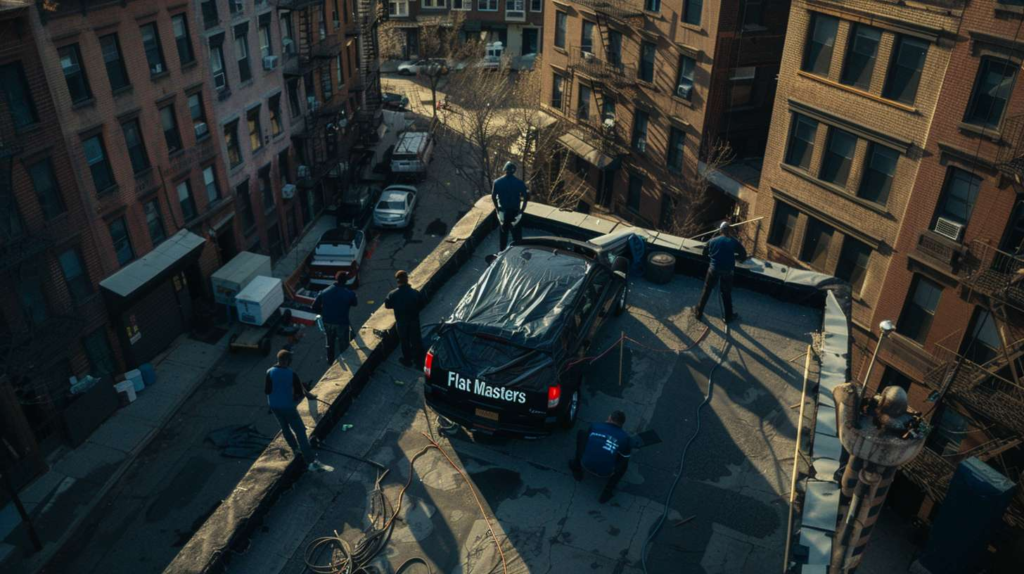
Here's the part people never enjoy hearing: coating over a roof with underlying problems doesn't fix anything - it seals the problems in. I remember being on a two-story brick building off Roosevelt Avenue at 6:40 in the morning, coffee still too hot to drink, and the owner was begging me to "just roll on white coating" before his new tenant moved in. The roof looked tired, yes, but when I cut one blister open, warm water actually ran out like soup. That was the morning I had to tell him a seal coating would not save him from trapped moisture - it would just make the problem more expensive and quieter for a few months. That's the cautionary version of this story. There are a lot of buildings in western Queens with similar histories.
1. After rain, does water still sit more than 48 hours?
2. Are there wet insulation signs, soft spots, active blisters, or moisture below the membrane?
3. Are seams, flashings, and penetrations mostly sound?
4. Is the existing surface compatible with the selected coating system?
- Sealing over trapped moisture - the membrane keeps degrading from underneath while the surface looks fresh.
- Coating over grease contamination near exhausts - adhesion fails quickly and the coating peels in sheets, often within one season.
- Ignoring ponding at drains - a coating cannot compensate for standing water that weakens the membrane over time.
- Assuming "white = fixed" - a bright surface is not the same as a waterproofed one; color does not equal performance.
A coating can quiet a problem before it solves it.
Drainage, Surface Prep, and Moisture Decide the Grade
What I Check Before I Trust a Coating
At the drain bowl, I start there first - it tells me more in thirty seconds than most of the roof combined. Clogged bowls, low spots where debris collects, and parapet staining from water backing up are all flags I've learned to read on western Queens mixed-use roofs over storefronts, where the drainage was often an afterthought when the building went up. Marta Jablonska, with 22 years in flat roofing and a specialty in diagnosing failed coating jobs on older mixed-use buildings, will tell you that the drain bowl shows the building's water habits - and water habits don't lie. If the bowl is ringed with sediment and the surrounding membrane is soft and discolored, the roof hasn't been draining right for seasons, not weeks.
Think of the roof like a lab tray - whatever is trapped in there will show itself. Moisture testing, probing for soft areas, cutting a blister to see what's inside - those aren't extras, they're the actual inspection. A seam that looks sealed from six feet away can be lifting at the edge when you get down and run a finger along it. Fan discharge from kitchens and salons leaves a greasy film that spreads further than you'd expect, and old mastic patches applied over the years create uneven bonding surfaces that new coatings struggle to grip. That sounds like a lot of variables, but here's what the roof is actually telling us: it's showing you exactly where prep will fail if you rush it.
One August afternoon, ninety-plus degrees, I got called to a nail salon in Jackson Heights because the ceiling stain had come back three weeks after another contractor did a flat roof coat and seal. The product itself was not the whole problem - the roof had ponding around a clogged drain bowl, and they had coated right over greasy residue from an exhaust fan. I still remember the owner standing under a beach umbrella on the roof asking why the "fresh white layer" already looked tired. Coating over bad prep is like grading homework written on a wet napkin. The product had no chance from the moment they skipped the cleaning and drain work.
Why Prep Failures Show Up Fast
| Roof Condition Seen | What It Usually Means | What Must Happen First | Coating Candidate Now? |
|---|---|---|---|
| Ponding at drain bowl | Blocked drain or low-slope area with inadequate pitch; membrane under stress | Clear drain, assess slope, correct standing water before any product is applied | Not yet |
| Greasy residue near exhaust fan | Grease film contamination; coating adhesion will fail in this zone | Degrease thoroughly; verify no residue remains before coating | Not yet |
| Open laps or seam lifting | Active entry point for water; structural coating failure if left unaddressed | Repair all open seams and flashings; let cure fully before coating over | Not yet |
| Blister with moisture inside | Trapped moisture in insulation or between membrane layers | Investigate moisture source, dry substrate to spec, and address root cause | Do not coat |
| Chalky, weathered surface | UV-degraded membrane surface; bonding may be weak if not cleaned properly | Pressure wash, prime if needed, verify surface passes adhesion test | Possibly, after prep |
| Isolated patched areas | Prior repairs with mixed materials; compatibility unknown without inspection | Identify patch materials; confirm they're compatible with coating system | Conditional |
- ✅ Clear drains and scuppers - confirm water can move off the roof freely before anything is applied
- ✅ Remove grease and rooftop film - especially near HVAC units and exhaust fans where contamination is easy to miss
- ✅ Repair seams and flashings - no coating can bridge an active separation or open lap; fix those first
- ✅ Let substrate dry to manufacturer spec - moisture content must meet the product's requirements, not your schedule
- ✅ Match coating to existing membrane - confirm the product is formulated for the specific surface below it, not just the surface type in general
Queens Roofs Fail in Patterns, Not in Surprises
If I'm standing on your roof, the first question I ask is simple: where does the water sit after lunch? On mixed-use Queens buildings over storefronts - the kind you see stacked along Jamaica Avenue or Northern Boulevard - flat roofs have usually been "fixed" three or four times by three or four different contractors, each one working over the last person's solution. Penetrations get patched with whatever was on the truck. Parapets get caulked, then re-caulked, then forgotten. Old flashings get coated over rather than replaced. By the time I get up there, I'm reading layers of decisions, and the water sitting in the low spots is telling me exactly which decisions were wrong.
Would you rather pay for a coating, or pay later to uncover what the coating hid?
| Myth | Fact |
|---|---|
| "Any old roof can be coated." | Age alone doesn't qualify a roof. Moisture content, drainage condition, and membrane integrity determine candidacy - not how many years the roof has been up. |
| "White coating means waterproofing is solved." | White is a color. Waterproofing is a system. A bright new surface can look perfect while water works through open seams underneath it. |
| "A thicker coat beats better prep." | Doubling the mils on a contaminated or wet surface just means more material fails faster. Prep is the performance - the product is secondary. |
| "If it stopped leaking for a month, the job worked." | A dry ceiling in August doesn't mean the roof is fixed - it might mean the summer was drier than usual. Wait for heavy rain or the first freeze-thaw cycle before declaring victory. |
| "Coating is always the cheap answer." | Coating is cheaper than replacement when the roof is a real candidate. Applied to the wrong roof, it's the most expensive option - because you still pay for replacement, plus the cost of the coating that didn't work. |
A dry, stable roof with sound seams, functioning drainage, minor surface wear, and a known membrane type compatible with the selected coating system.
Trapped moisture in the insulation - once you coat over it, you've locked the decay cycle in place and made future diagnosis significantly more difficult.
Grease contamination from rooftop exhaust fans - it migrates further from the source than contractors expect and quietly kills coating adhesion across a wide area.
Flat roofs on mixed-use buildings over commercial tenants - multiple HVAC units, exhaust fans, and years of layered patch repairs create complex surfaces that need careful evaluation before any coating is selected.
Choosing the Product Means Matching the Roof, Not the Sales Pitch
When the Right Product Really Can Buy Time
Blunt truth: a coating is not forgiveness. Selecting a product is like testing a hypothesis - you observe the surface condition, you identify the membrane type, you account for sun exposure on a south-facing Queens rooftop versus a shaded one, and you trace how water moves across that specific deck. All of those variables matter before you open a single bucket. And honestly, I'd rather tell someone "not yet" than sell a coating that's set up to fail by conditions we could have fixed first. That's not a sales position - it's just the only recommendation I can stand behind.
One October evening in Ridgewood, I learned again exactly what "right product, right prep" actually looks like in practice. A retired bus driver met me on a windy evening with a flashlight and a handwritten folder of every repair on his building since 1998 - he'd kept records the way I used to keep lesson plans. He wanted seal coating services for flat roofs because his nephew had told him coatings are cheaper than roofing, which is true in the same way soup is cheaper than dental work - depends what's actually wrong. We did a full walkthrough, found the membrane seams were mostly sound, the drains were clear, and the surface was clean and compatible with an elastomeric system. That roof was a genuine candidate. We coated it properly, and I think about that job often because the right product and solid prep bought him real service life, not just a prettier surface for one summer. Before that first bucket was opened, though, we confirmed the proposal covered seam repairs, drain inspection, the cleaning method, required drying time, and product compatibility - worth asking about every single one of those before you sign anything.
If you want an honest evaluation before committing to flat roof seal coating in Queens, call Flat Masters for an inspection that separates roofs worth coating from roofs that need repair first - because knowing the difference before you spend is the only answer that actually protects your building.
- Marta Jablonska, Flat Masters · Queens, NY