
The Details Are What Separate a Good Flat Roof From One That Fails in a Few Years
Roughly 90% of premature flat roof failures don't start in the middle of the membrane field - they start where one material, edge, wall, or drain hands off to another. This article traces those early failure points back to the specific flat roof construction details that usually get rushed, skipped, or guessed at on install day.
Most Flat Roof Leaks Begin at the Handoffs, Not the Open Field
I'll say this plain: the field membrane gets too much credit - and too much blame. A flat roof is like a signal system: the tiny connection is what shuts the whole line down. You can have a hundred feet of clean, smooth membrane and still end up with a ceiling stain by Thursday, because one drain transition was loose, one parapet corner was rushed, one edge termination never got the attention it needed. The big open field is visible, it's easy to photograph, and it's easy to sell material upgrades against. But the boring little handoffs are where the diagnostic work actually starts.
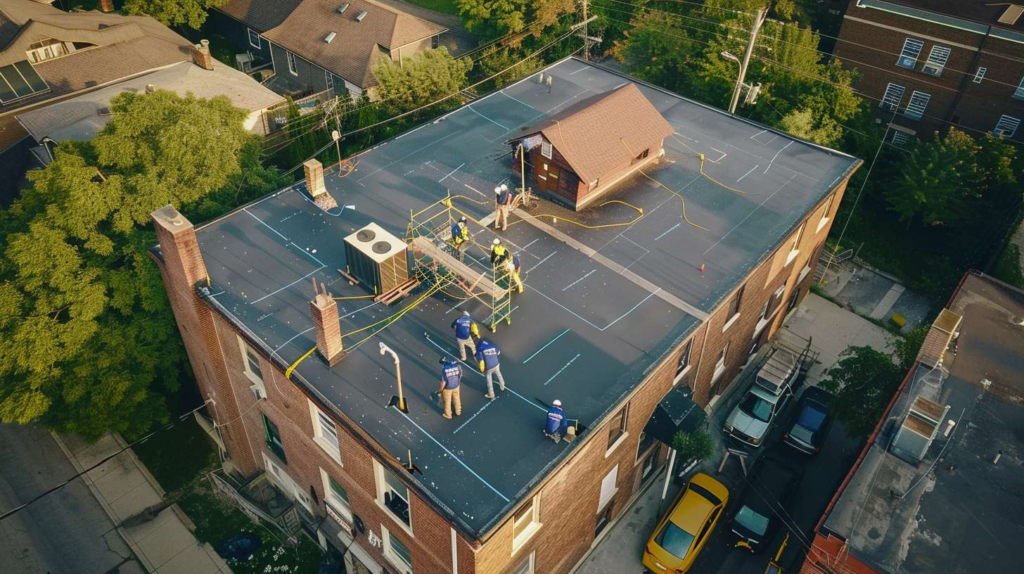
What I mean by "handoffs" is specific: drain bowls where the membrane meets the clamping ring, parapet inside and outside corners where base flashing changes direction, termination bars where the system ends at a wall, penetrations for pipes and HVAC curbs, and edge conditions where the roof meets the building's perimeter. I'm Carlos Rivera - I've been doing flat roofing in Queens, NY for 17 years, and my specialty has always been edge metal, drain placement, and perimeter detailing, which is exactly why those are the first places I look, not the last. Experience changes what gets inspected first, and any roofer who walks straight to the ponding area without checking the transitions around it is already one step behind the problem.
Drainage Layout Tells You Whether the Roof Was Thought Through
If I asked you where water hesitates on your roof, would you know? Because the answer is usually baked into the construction, not the weather. One August afternoon in Astoria - heat bouncing off the black membrane hard enough to blur the horizon line over the BQE - I watched a crew install insulation so unevenly that water had nowhere honest to go. Nice materials, decent pace, terrible thinking. Three years later, the owner called saying the drains were "clogged," but when I got there the drains were clean. The problem was that the insulation had no consistent slope, so water pooled fifteen feet from the nearest drain and stayed there. Queens has a lot of older low-slope building stock - attached two-families, converted commercial space, flat-topped rowhouses that were never designed with generous drainage tolerances. Add a brutal July sun that accelerates membrane degradation, and freeze-thaw stress that punishes every weak joint from November through March, and you've got a building type where drainage layout isn't optional - it's the whole game.
How water hesitation turns into failure
Eight inches from the drain is where I start judging a roof. That small radius tells me more than thirty feet of smooth membrane ever could, because right there you can see whether the sump was built, whether the insulation actually slopes toward the opening, whether the clamping ring is secure, whether the membrane lays flat or fishmouths around the bowl edge, and whether the area uphill from the drain was tapered or just laid flat and hoped for the best. That's the insider read - a drain surrounded by standing water after a normal rain isn't a clogged drain problem, it's a slope problem that was built in on day one. Don't skip that eight-inch radius. It's where the whole drainage story gets told.
| What You See | Likely Detail Problem | Why It Matters in Queens | Risk Level |
|---|---|---|---|
| Ponding around but not in the drain | No sump depression; insulation not tapered toward drain opening | Queens freeze-thaw cycles expand water trapped in that ring into the membrane seam below it each winter | High |
| Water line mark running along wall base | Low point is at the perimeter rather than at a drain; drainage layout pushes water to the wall instead of away from it | Older Queens buildings with party walls absorb this water into structural masonry - staining inside is often already happening before anyone checks the roof | High |
| Circular cracking pattern around drain | Drain clamping ring was under- or over-tightened; membrane was not properly reinforced at the bowl before clamping | Heat expansion in summer and cold contraction in winter widen these cracks progressively - what starts as a hairline is a gap by year two | Medium-High |
| Stain pattern far from visible low spot | Water is traveling under insulation or along the deck before exiting; slope directs flow away from drains rather than toward them | Very common on older flat-roof additions and rear extensions in the Jackson Heights and Elmhurst corridor where insulation was added in layers over time without a unified slope plan | High |
| Repeated winter icing near outlet or scupper | Outlet is not insulated or is partially blocked; water freezes in the throat before it exits and backs up under the membrane edge | Queens rooftops with low parapet walls and exposed scupper outlets face this every February - ice dams at scuppers force water back under termination flashing fast | High |
⚠️ Don't Misread Ponding Water
The deepest puddle on a flat roof is not necessarily where water is getting in. Water typically enters through a nearby transition, seam, or flashing termination - and it enters there precisely because drainage design keeps that area wet for extended periods. The puddle is a symptom of the drainage problem. The entry point is almost always a detail failure - a loose termination bar, a fishmouthed seam, a drain flange that never fully sealed - that sits right next to the standing water, not underneath it. Chasing the puddle without tracing the detail is how you end up patching the wrong spot twice.
Perimeter Work Is Where Good Materials Get Betrayed
I was on a two-family in Ridgewood at 6:15 a.m., still holding coffee that had gone cold, and the homeowner kept pointing at the center of the roof - there was obvious ponding, obvious wear, obvious places to blame. But the leak wasn't there. It was sneaking in where the base flashing died into a sloppy parapet corner, eight inches of detail work that somebody rushed through on install day. The membrane in the field still had life left in it. That job stuck with me because it made the point clearly: a crew that spent good money on material and then guessed at the corners gave this homeowner years of headaches that had nothing to do with membrane quality. Standard flat roof construction details at walls and edges are where rushed crews expose the whole system - and here at Flat Masters, perimeter work is where we spend the most time on every job, because that's where the exposure is.
✅ Edge and Parapet Checkpoints Every Roofer Should Verify
- ✅ Corner reinforcement: Inside and outside corners have pre-formed boots or additional fabric reinforcement layer - not just straight membrane folded into place
- ✅ Termination height: Base flashing runs at least 8 inches up the wall from the roof surface - lower than that puts the termination in the splash zone
- ✅ Edge metal securement pattern: Fasteners at manufacturer-specified intervals (usually 8-12") with no skipped spots, especially at corners and seam overlaps
- ✅ Continuous backing/substrate support: Nailer or blocking behind the edge fascia is solid, level, and fully supports the metal - no deflection when pressed
- ✅ Tie-in at scuppers: Membrane wraps cleanly into the scupper throat with no exposed raw edges - transition is sealed and continuous, not just lapped and hoped for
- ✅ Signs of movement or separation: No visible lifting, waving, or gap between edge metal and membrane - any daylight between them means the system is already telling you something
One Pulled Edge Can Explain an Entire Failure Story
One Sunday in Middle Village, I peeled back a metal edge and already knew the story. Small commercial building, owner in a dress shirt trying to rush us through because tenants were walking in Monday morning. I pulled back the edge metal and found fasteners spaced like somebody was guessing from memory - some eight inches, some twenty, a couple that had pulled clean out. The membrane behind it had started to lift. He told me it looked fine from the street, and I told him a lot of failures do. That's the thing about detail flat roof construction decisions - appearance covers the damage for months, sometimes years, until one storm with a real wind component pulls back the curtain. The visual surface of a flat roof is almost never where the problem lives.
A roof can look clean and still be one storm away from telling the truth.
What "looked fine from the street" usually hides
Here's what's worth asking any contractor before you approve a flat roof scope - and these aren't trick questions, they're basic ones. How are the edges fastened, and at what intervals? Is a drain sump being built, or is the drain just being dropped in at deck level? How are inside and outside corners being reinforced - with pre-formed pieces, fabric reinforcement, or just a fold and a prayer? How high is the base flashing terminating at the walls, and what's holding it there? If a contractor can't answer those questions specifically, that's not a communication problem. That's a detailing problem that hasn't happened yet.
How a Detail-Focused Roofer Diagnoses a Flat Roof Problem
- Step 1 - Note the visible symptom. Where is the stain? When did it appear? Did it follow wind-driven rain or just steady rain? Does the timing tell you anything about direction versus volume?
- Step 2 - Trace the water path backward. Water rarely enters where it appears indoors. Work from the stain upward and outward, considering the slope of the roof deck and the path water would take under insulation.
- Step 3 - Inspect transition details before touching the field membrane. Check drain surrounds, parapet corners, wall terminations, penetrations, and edge conditions first. The field gets looked at last, not first.
- Step 4 - Check attachment and slope. Is the membrane pulling away from transitions? Is there actual slope to drain, or just the appearance of it? Is insulation taper consistent or did it settle unevenly over time?
- Step 5 - Determine whether the problem is isolated or systemic. One bad penetration flashing is a repair. Poor drainage layout and rushed perimeter work throughout is a replacement conversation - and that distinction has to be made honestly, not optimistically.
Before You Call About a Flat Roof Leak - Check These 7 Things First
- 1. Where the stain appeared indoors - ceiling center, near a wall, near a light fixture, or above a specific room. The location narrows the search zone on the roof significantly.
- 2. Whether the leak followed wind-driven rain - if it only leaks in wind from a specific direction, the entry point is almost certainly a perimeter or wall detail on that side.
- 3. Whether ponding remains 48 hours after rain - standing water two days later means the drainage layout isn't functioning, not just that it rained hard.
- 4. A photo of the drain area - standing water around the drain, cracking at the drain ring, or visible debris tells part of the story before anyone walks the roof.
- 5. A photo of the edge or parapet - look for lifting metal, gaps between the edge and membrane, or any visible separation at the top of the wall flashing.
- 6. Roof age, if known - a 4-year-old roof with a leak is almost always a detail failure. A 15-year-old roof may be a detail failure or general system fatigue - the age changes the diagnosis approach.
- 7. Whether previous patches were done at corners or penetrations - prior patches at those locations are a red flag that the same detail has been failing repeatedly, which is a systemic problem, not a one-time fix.
Questions to Ask Before You Approve Any Flat Roof Scope
Here's the blunt truth - if a proposal spends three paragraphs on membrane brand and two sentences on everything else, the wrong part of the roof is getting the attention. Membrane brand matters, but it's not what decides whether your roof lasts twelve years or four. Personally, I'd trust a less flashy proposal that specifically addresses drain placement and sump construction, corner reinforcement method, perimeter termination height, and edge metal fastening pattern over a slick pitch that leads with manufacturer warranties and barely mentions how the edges get finished. The detail language in a proposal tells you what the crew actually thinks about when they're on the roof. Vague on details usually means rushed on details.
Frequently Asked Questions: Flat Roof Construction Details in Queens
What are standard flat roof construction details on a replacement?
Standard flat roof construction details on a replacement should include tapered insulation for slope-to-drain, drain sump depressions at each drain location, reinforced inside and outside corners at all parapet transitions, properly terminated base flashing at minimum 8 inches up the wall, secured edge metal at consistent fastening intervals, and individually flashed penetrations. Any proposal that doesn't specifically address each of those is leaving something to chance.
Can a good membrane fail early because of bad detailing?
Absolutely - and it happens more often than most building owners realize. A quality membrane installed over an improperly tapered deck, with rushed corner work and loose edge metal, will fail at those transition points within a few years regardless of what the membrane warranty says. The warranty covers the material. It doesn't cover the installation decisions around it.
How do I know if my drains were set correctly?
The simplest field check: after a normal rain, go up and look at the area within a foot of each drain. If water is sitting in a ring around the drain opening rather than pooling inside and draining through, the sump wasn't built correctly and the insulation wasn't tapered toward the bowl. You can also check whether the drain feels flush with or slightly below the surrounding membrane - it should be the low point, not a flat spot.
Are parapet walls a common leak source on Queens buildings?
Very common - especially on the older attached housing and converted commercial buildings spread across neighborhoods like Woodside, Sunnyside, and Corona. Parapet walls move with temperature changes, and base flashing that wasn't properly terminated or reinforced at the corners will separate from that movement over time. On buildings with masonry parapets, cracked mortar joints above the flashing line compound the problem by letting water in above the waterproofing system entirely.
Should edge metal be replaced during a new flat roof install?
In almost every case, yes. Old edge metal that's been through multiple seasons has fastener holes that are worn, metal that's lost its original shape, and seams that no longer lock tight. Installing new membrane and terminating it against old, compromised edge metal is a shortcut that saves maybe an hour of labor and costs years of performance. New edge metal, properly fastened and locked at every joint, is not optional on a quality re-roof - it's part of the system.
What a Flat Roof Proposal Should Address in Writing - Before Work Starts
Drainage Plan
Specifies drain locations, sump construction, and tapered insulation slope - because "drains are present" and "drains will actually drain" are two different things.
Perimeter Termination Method
Describes how base flashing ends at each wall - height, counterflashing or termination bar type, and sealant spec. If it just says "flash walls," that's not a specification.
Corner Reinforcement Approach
States whether pre-formed corners, peel-and-stick reinforcement, or fabric embedding will be used - because cut-and-patch corners are the most common callback trigger in flat roofing.
Fastening / Attachment Pattern
Documents fastener type, spacing, and substrate - especially for edge metal and insulation attachment. Wind uplift failures almost always trace back to fastening that wasn't specified and wasn't checked.