
Mixing a Flat Roof With a Pitched One Looks Stunning - If the Junction Is Right
Why Mixed Roof Systems Work Better Than People Expect
Tired of getting quoted blindly? Here's something most roofing conversations skip entirely: a flat roof paired with a pitched one is often more attractive and more durable than forcing your home into one style or the other - as long as the junction is designed before a single shingle or membrane roll touches the deck. I'll be direct about that preference, because I've seen too many Queens homeowners accept an all-flat solution just because it felt "simpler," when their architecture was practically asking for a mixed approach. The difference between a stunning result and a chronic leak is never which style you choose. It's whether someone thought through the transition first.
At the junction line, that's where the whole story is. One foggy Tuesday at 6:40 in the morning in Middle Village, I was standing on a rear extension where a new pitched section emptied straight into an old flat membrane, and I told the homeowner - still in slippers, holding coffee - "Your roof isn't leaking because it's old. It's leaking because these two roofs are arguing." By 7:15, the fog had turned to mist, and I could already see the water hesitating at that junction, slowing down, losing direction, pooling right where the geometry changed. That's the thing about flat roof and sloping roof combinations: the risk lives where water stalls, not where it runs hard. Runoff doesn't fail at the steep part. It fails where it changes its mind.
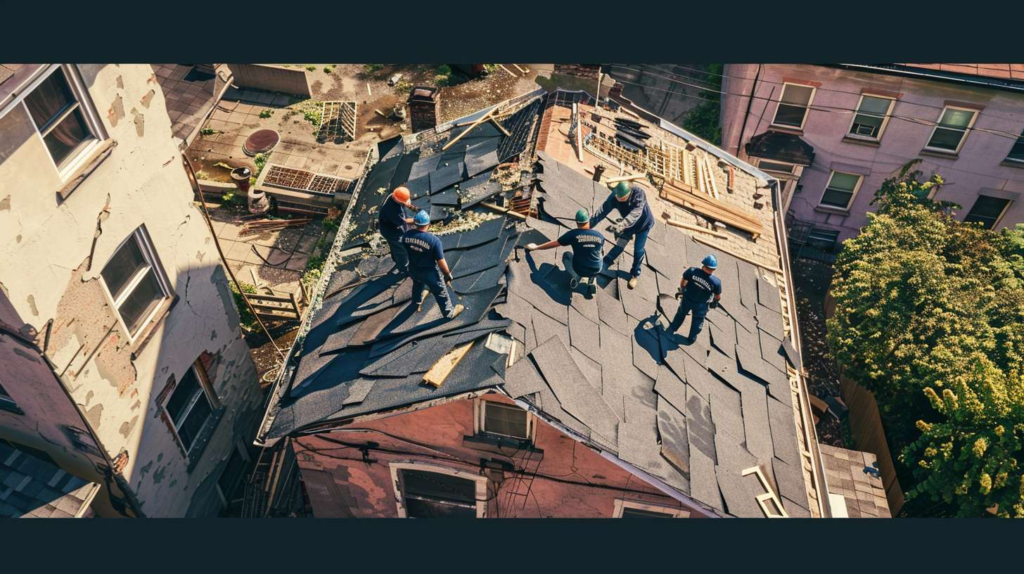
Quick Facts - Mixed Roof Systems
Best Use Case
Rear extensions, dormers, bump-outs, and additions where flat and sloped planes meet naturally
Most Common Failure Point
Junction flashing and drainage transfer - where the sloped plane hands off water to the flat field
Queens Factor
Wind-driven rain plus heavy leaf buildup at transitions - especially on tree-lined blocks in Ridgewood, Astoria, and Middle Village
Main Design Goal
Keep water moving without hesitation from the sloped section through the flat field to its final exit point
Where the Transition Usually Goes Wrong in Queens Homes
Drainage That Looks Fine From the Yard but Fails on the Roof
I'll say this plainly: the assumption that a clean roofline from the alley means a well-drained roof is one of the most expensive mistakes Queens homeowners make. That sounds reasonable - if it looks good, it must be working. But here's what water does instead: it follows geometry, not aesthetics. In Queens, where attached homes, rear kitchen extensions, and narrow side setbacks are the norm rather than the exception, the sloped section of a mixed roof often has nowhere obvious to discharge except directly onto the flat field below. Blocks in Ridgewood near Onderdonk Avenue, leaf-heavy stretches in Astoria, and tight rear yards in Middle Village all create the same problem - runoff from the pitched section arrives at the flat membrane with force, and if no one designed a path for it to leave, it just parks there.
Metal, Membrane, and Shingles Meeting in the Wrong Sequence
One morning in Ridgewood, I watched water do something rude. A landlord had been telling me for twenty minutes that his problem was just a backed-up gutter. I climbed up during a light drizzle and watched the runoff overshoot the gutter entirely, not because the gutter was clogged, but because the transition metal had been bent so awkwardly that water launched off it like a ramp and landed two feet past its intended path. I pulled out my chalk and drew the actual flow line right on the roof surface. He went quiet. That small geometry error - maybe a two-inch bend angle off - had redirected every rain event away from the drainage point. It wasn't the gutter. It never was.
If water has to decide where to go, the roof is already losing.
| Junction Mistake | What Water Does | Visible Symptom | Likely Result |
|---|---|---|---|
| Pitched runoff empties onto flat membrane with no path out | Pools at the base of the slope, then spreads laterally | Visible water stain circle on flat field after rain | Membrane deterioration, seam stress, eventual leak into ceiling |
| Low wall flashing below recommended height | Backs up and climbs behind the flashing during heavy rain | Interior wall dampness, bubbling paint near roofline | Water infiltration behind the wall assembly, hidden rot |
| No cricket or saddle behind slope tie-in | Collects and stalls in the dead corner behind the intersection | Persistent debris and standing water in the shadow zone | Accelerated flashing failure, deck rot underneath |
| Gutter placed below actual discharge line | Overshoots the gutter entirely and hits fascia or siding | Staining on siding directly below the transition edge | Siding damage, foundation splashback, gutter that "works" but captures nothing |
| Transition metal bent inward toward the roof | Rides the metal edge and redirects toward the wall instead of away | Moisture behind parapet or interior wall near the junction | Wall framing water damage, repeated misdiagnosis as a "window leak" |
| Debris-catching inside corner with no drain | Slows to almost zero, leaves and grit collect and hold moisture | Black staining and soft membrane around inside corner | Membrane puncture or seam failure accelerated by debris weight and freeze-thaw cycles |
⚠ Warning - Don't Approve a Design Based on Renderings Alone
Pretty rooflines can still send water directly into seams, insulation cavities, parapet corners, and wall intersections. A rendering shows how a slope and flat roof combination looks. It does not show where the water goes.
If the estimate does not specify drainage direction and flashing sequence, you're being asked to guess. That's not a proposal - that's a sketch with a price tag on it.
How a Proper Flat-to-Pitch Junction Is Laid Out Before Installation Day
If you were standing next to me on the ladder, I'd ask you this: where does the water leave the sloped plane, where exactly does it land on the flat section, and does it have a continuous, uninterrupted path from that landing point to its final exit? Those aren't three questions. They're one question asked three ways, because if any one of them doesn't have a clear answer, the design isn't ready. The sloped plane is the delivery system. The flat field is the receiving zone. And the drain, scupper, or gutter is the exit. Every piece of the sequence has to be confirmed before the first layer of underlayment goes down, because once the roofing is on, the geometry is locked - and correcting a bad drainage path after installation costs three times what it would have cost to plan it right the first time.
Marisol Vega - that's me, and I've been doing flat roofing in Queens, NY for 19 years with a specialty in exactly these awkward flat roof and sloping roof junctions - uses runoff tracing as a standard part of every estimate visit, not just the complex ones. Here's the insider move worth doing before you sign anything: ask your roofer to physically trace the water path on the estimate folder, on a sketch, or directly on the roof surface with chalk. If they can't show you where the water leaves the slope, where it lands, and how it exits the flat section without stalling, the design isn't finished. I carry chalk in my tool bag specifically for this. It takes four minutes, and it immediately separates the crews who've thought about it from the ones who haven't.
Design Sequence for a Durable Flat Roof and Sloping Roof Junction
Map the discharge path from the sloped section
Verify the exact point where the pitched plane ends and where its runoff volume and velocity reach the flat field - trace it physically, not just on paper.
Calculate where runoff lands on the flat section
Confirm the landing zone is not a dead corner, a membrane seam, or a low point with no exit - if it is, the design needs to change before installation begins.
Build slope or cricket support so water cannot stall
Verify that tapered insulation, a saddle, or a cricket redirects any water that would otherwise collect behind the tie-in and sit there through the winter.
Set flashing and membrane heights before outer finishes
Confirm that wall flashing termination height meets minimum clearance above the flat field, and that the membrane tie-in sequence is layered from the bottom up - not the other direction.
Confirm gutter, scupper, or downspout capture after the transition
Verify that the final exit point is aligned with the actual flow line - not just installed where it's convenient - and that it can handle combined volume from both roof sections.
Should Your Mixed Roof Design Be Revised Before Work Starts?
START → Does the estimate show where sloped runoff lands?
NO → Revise the design before signing. No path shown means no path planned.
YES → Continue below.
Is there a defined drain, gutter, scupper, or tapered path on the flat section?
NO → Revise the drainage plan. A flat field with no exit is a holding tank.
YES → Continue below.
Are flashing heights and tie-in materials specified in writing?
NO → Request a detail drawing before any deposit changes hands.
YES → Proceed with installation review.
✔ Proceed with installation review - your junction is designed, not assumed.
What Homeowners Should Ask Before Signing a Proposal for a Slope and Flat Roof
Questions That Reveal Whether the Contractor Has Really Thought Through the Junction
Here's the part people try to decorate instead of solve: the trim color, the shingle profile, the cedar-look fascia. None of that fixes a confused runoff path. I got called to an Astoria job where a crew had built a genuinely gorgeous cedar-look slope over a kitchen bump-out - the kind of roofline that neighbors actually compliment. But they'd tied it into the existing flat membrane with almost no thought for what happened at the seam. The client kept telling me it looked beautiful from the alley. I didn't disagree. But when we opened the tie-in, the insulation underneath smelled like a wet basement in July. Water had been collecting at that junction through two rainy seasons, and the outer finish had hidden every sign of it. Beautiful rooflines and watertight junctions are not the same achievement.
A roof transition is like a bad handoff in a relay race - fast, visible, and embarrassing when it fails. The questions worth asking before you hire anyone for flat roof and sloping roof combinations aren't about materials or warranties. They're about sequencing and geometry. Can the crew tell you, without hesitating, where the water goes after it leaves the pitched section? Can they describe what happens at the inside corner specifically? If the answers are vague, the design is vague - and you'll be the one dealing with the consequences after the first hard rain.
Before You Call - What to Verify for Mixed Roof Systems
-
☐
Ask specifically where runoff from the sloped section lands on the flat field - get a pointed answer, not a general one -
☐
Ask how the flat section will move that water to an exit point - drain, scupper, gutter, or tapered path -
☐
Request the flashing termination height in writing - it should be specified, not assumed -
☐
Ask whether tapered insulation or a cricket is needed behind the slope tie-in to prevent water from collecting in the dead zone -
☐
Ask what happens at inside corners - this is where debris and standing water accumulate first, and the answer reveals how much detail work they've actually planned -
☐
Ask whether gutters are aligned with the real flow line from the mixed system - not just installed at a standard height from the eave -
☐
Ask for photos of similar flat roof and sloping roof combinations they've completed in Queens - completed work tells you more than any proposal language
Common Questions About Mixed Roof Systems in Queens
---
Ready to stop guessing and get a real look at your junction? Call Flat Masters and ask for a roofline review focused specifically on your drainage path, transition detail, and flashing sequence - before any shingles or membrane get ordered. That's where the difference between a roof that lasts and one that doesn't gets made.