
Sealing Where Your Flat Roof Meets the Wall Prevents the Most Common Leaks
We want you to know the real answer. Most flat roof leaks that keep coming back - the ones that get patched in spring and return by October - are not failures in the middle of the membrane. They're flat roof wall junction sealing failures, and until that transition is treated as a complete assembly rather than a caulk target, the leak cycle doesn't stop. This article explains exactly what proper sealing looks like for Queens buildings, what the warning signs are, and which questions to ask before anyone touches your roof.
The Leak Path Usually Starts at the Wall, Not the Middle of the Roof
We want you to know the real answer - and that means resetting the most common assumption first. When a ceiling stain shows up in the middle of a room, owners naturally assume the membrane above that spot gave out. That's the wrong hypothesis. In a flat roof failure, water almost always enters at a weak transition point - a wall edge, a parapet base, a masonry interface - and then travels horizontally or along joists before it finally drops somewhere visible. The stain is evidence, but it's the last piece of evidence, not the first. Treating it like a source and patching directly above it is the diagnostic equivalent of testing the wrong variable.
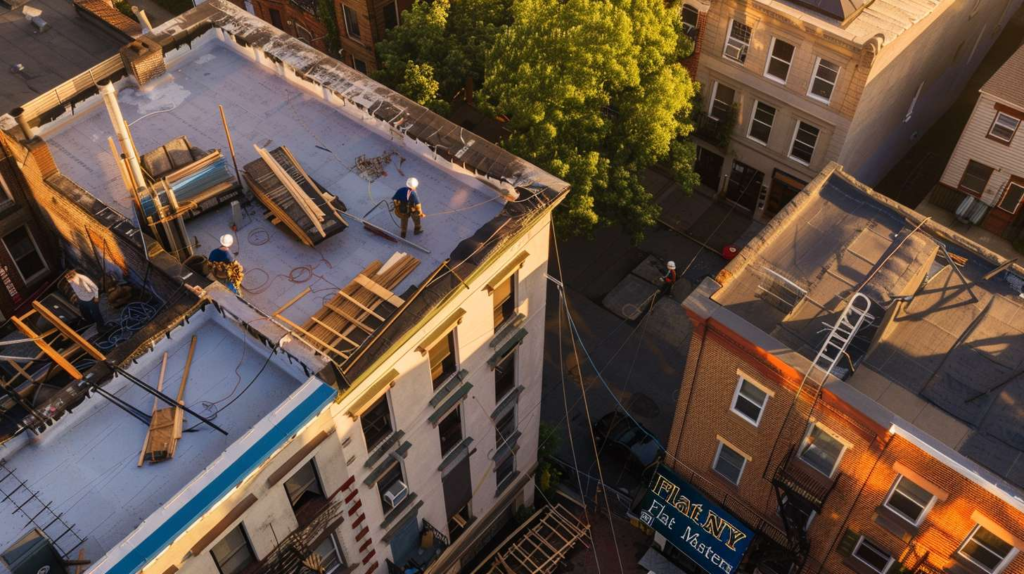
At the base of a parapet, I already know where I'm looking first. I remember being on a two-family in Ridgewood at 6:40 in the morning, still holding coffee, after an overnight rain. The owner kept pointing at the middle of the ceiling stain - confidently, like he'd already solved it. But I went straight to the rear parapet, because the membrane at the wall had been smeared with roof cement instead of being properly turned up and secured. Water had traveled almost nine feet before it showed inside. That matters because it explains why so many patches applied to the wrong location seem to hold for a few weeks and then fail - the actual entry point was never touched.
| Myth | Real Answer |
|---|---|
| The ceiling stain marks where the leak entered the roof. | Water travels. On flat roofs, it commonly enters at a parapet or wall base and moves several feet before appearing on a ceiling. The stain shows where it stopped, not where it started. |
| A recent roof coating protects the wall line too. | Coatings applied over the field membrane don't automatically seal the base flashing, counterflashing, or masonry interface at the wall. A shiny roof can sit right above an open water path at the parapet. |
| Caulk closes the gap between the roof and the wall well enough. | Caulk is not a substitute for a proper flashing assembly. Without a mechanically secured termination and counterflashing, caulk fails under UV exposure and seasonal building movement - usually within one to two freeze-thaw cycles. |
| Flat roof leaks come from drains or ponding water. | Drains and ponding are real failure points, but the roof-to-wall junction is the most frequently overlooked entry point - especially on older Queens buildings with exposed parapets and deteriorating masonry. |
| If it only leaks in wind, the roof membrane must be loose. | Wind-only leaks are a signature of counterflashing or base flashing failure at the wall junction. Wind drives rain uphill, directly into gaps at the masonry line that still water would never reach. |
Flat Roof Wall-Junction Realities in Queens
Most Common Failure Point
The roof-to-wall transition, not the open field membrane
Water Travel
Can move several feet before becoming visible indoors
Worst Trigger
Wind-driven rain hitting exposed parapets on mixed-use and multifamily buildings
Bad Patch Sign
Roof cement or hardware-store caulk smeared at the masonry line
How a Proper Roof-to-Wall Seal Is Actually Built
What Has to Be Continuous from Roof Surface to Wall Line
Here's the blunt part nobody likes hearing. Sealing flat roofs against walls is not a product - it's an assembly. Every durable repair involves the membrane turn-up (where the flat roofing material runs up the vertical face of the wall), a secure mechanical termination holding that edge in place, base flashing covering the transition, counterflashing or a reglet embedded into the masonry above it, a compatible sealant at the masonry interface, and a wall substrate solid enough to hold all of it. Miss one component and you're just buying time. This is what Rosa Mendez - with 22 years in flat roofing and a specialty in recurring wall-line leak diagnosis across Queens - keeps telling property owners who come back with the same leak year after year: there's no single product that replaces doing the full assembly correctly.
Now follow the evidence on how to seal a flat roof against a wall conceptually. The sequence starts at the field membrane and works upward: the membrane turns up the wall face a minimum height, base flashing bridges the angle between the horizontal roof plane and the vertical wall, a termination bar or adhered edge locks that flashing down, counterflashing laps over it from above, and sealant closes the top edge against the masonry. The exact materials - modified bitumen, TPO, EPDM - and the method all depend on the existing system, the parapet height, and the masonry condition. That's why the process isn't a DIY promise. It's a diagnostic and installation sequence that has to match what's already on the building.
| Component | What It Does | What Happens When It Fails |
|---|---|---|
| Roof Membrane Field | Provides the waterproof deck surface and connects to the base flashing at the wall | Open seams or punctures in the field allow direct water penetration before it even reaches the wall |
| Base Flashing Turn-Up | Runs membrane material vertically up the wall face to bridge the roof-to-wall angle | Without it, the horizontal-to-vertical angle becomes an unprotected entry point - the most common failure location |
| Termination Bar or Adhered Securement | Mechanically locks the top edge of base flashing to the wall so it can't lift or separate | Flashing edge lifts under wind or thermal movement, creating a gap directly behind the membrane face |
| Counterflashing / Reglet / Cap Flashing | Laps over the base flashing from above to redirect water away from the termination edge | Without counterflashing, water runs directly behind the base flashing every time it rains - especially in wind-driven conditions |
| Sealant at Masonry Interface | Closes the top gap between counterflashing and masonry to stop capillary water intrusion | Open masonry gaps allow water to migrate behind the entire flashing assembly - often appearing far from the original entry point |
| Wall Substrate Condition | Must be solid, dry, and clean to hold fasteners and maintain adhesion for all flashing layers above | Spalling masonry, saturated substrate, or crumbling mortar causes flashing to pull out - no matter how good the materials above it are |
Correct Sequence for Sealing a Flat Roof Against a Wall
These are professional process steps. They describe what a proper repair involves - not a DIY checklist.
Trace the actual water travel - not just the stain location - and assess masonry integrity, existing flashing, and substrate condition before any work begins.
Roof cement, hardware-store caulk, and temporary coatings must come off. Sealing over failed material adds layers without correcting the failure beneath.
The wall face and roof deck area at the junction must be dry, free of loose material, and compatible with the adhesives or fasteners being used. Repoint or stabilize deteriorated masonry here.
The membrane runs up the wall to the correct height and is sealed or torched to create a continuous, watertight transition from horizontal to vertical - no gaps at the angle.
Termination bar is mechanically fastened to lock the flashing edge. Counterflashing laps over the base flashing from above, set into a reglet or embedded in the masonry to shed water outward.
Compatible sealant closes the top gap at the masonry line. After the assembly is complete, simulate stress conditions - water test the wall-junction area - before calling the job done.
Wind-Driven Rain Is the Test That Exposes Fake Fixes
If you told me, "It only leaks during wind-driven rain," I'd head for the wall before I touched the drain. One windy November afternoon in Astoria, I was checking a building where a handyman had sealed the wall joint with exterior caulk from the hardware store - the kind you'd use around a bathroom window. The tenant on the top floor told me exactly that: the rain came sideways and the ceiling dripped. That sentence basically solved it before I even got on the roof. The counterflashing had a gap at the masonry line, and the wall junction was acting like an open door every time wind pushed water uphill against the parapet face. Buildings in Astoria, Woodside, and along the older mixed-use stretches of Queens Boulevard deal with this constantly - exposed parapets on two- and three-story buildings with aging brick, party walls that have been repointed unevenly, and rooflines that catch northeast winds with nothing breaking the exposure. Caulk doesn't hold that. An assembly does.
⚠ Why Surface Caulk and Roof Cement Create Repeat Leak Cycles
- Traps water behind the seal: A caulk bead applied over an already-wet substrate seals moisture in, accelerating substrate decay and membrane separation from the wall face.
- Hides loose termination: Smearing over a lifted flashing edge makes it invisible to the next contractor, who may re-seal instead of fixing the mechanical failure underneath.
- Fails under UV and seasonal movement: Elastomeric caulk not rated for roof exposure becomes brittle within one to two seasons. Freeze-thaw cycles in a Queens winter crack it open at the masonry line every time.
- Diverts water deeper before it surfaces: A partial seal redirects water to travel farther along joists or wall cavities before appearing inside - making the next diagnosis harder and the damage broader.
Before Anyone Starts Sealing, Verify These Failure Clues
What a Property Manager Can Check Safely from Ground Level or Roof Access Point
A trowel and a tube of caulk have fooled more owners than bad weather ever has. The clearest signs that a wall junction has been patched instead of repaired are visible without getting on the roof at all: a dark, irregular smear of mastic or roof cement at the base of the parapet wall, a split or peeling sealant bead running along the masonry line, flashing that's visibly lifted at one edge, or staining on the masonry face below the parapet from water running over the same path repeatedly. Pay attention to when the leak happens - and which wall it's near. If the water appears after northeast storms and the stain is below a north- or east-facing parapet, that's not a coincidence. That's a pattern pointing directly at a wind-exposed wall junction.
Last winter, standing on a cold Queens rooftop, I saw the same mistake again. A super in Forest Hills swore the roof was solid because it had been coated the month before - clean, white, uniform. I peeled back one section at the base of the wall and found trapped moisture, a termination bar that had pulled loose from the masonry, and a coating that had been brushed straight over old chalking and dirt without any prep. The job looked pristine from six feet away. It had failed completely where the flat roof met the wall. And here's the insider tip worth remembering: if a repair looks uniformly shiny but the wall line feels soft underfoot, shows bubbling at the base, or the flashing edge moves when you press it, assume the coating was used to hide the problem rather than fix it. That's not a sealed roof - that's a deferred diagnosis.
Evidence to Gather Before Calling About a Wall-Junction Leak
- ✔When does the leak occur? Note whether it happens during any rain, only heavy rain, or only wind-driven rain from a specific direction.
- ✔Which wall orientation faces the storm? Note which cardinal direction (north, east) the affected wall faces relative to typical storm direction.
- ✔Where exactly is the ceiling stain? Measure or photograph its position relative to the nearest exterior wall - the farther it is, the more the water traveled.
- ✔Any recent coating or patch history? Note what was applied, when, and whether the same area was patched more than once.
- ✔Photos of the parapet and base flashing line. Capture any visible cracking, smearing, lifted edges, open reglets, or staining on masonry below the parapet cap.
- ✔Any loose or visible metal flashing? Note whether counterflashing or cap flashing is visibly separated from the wall face or the base flashing below it.
- ✔Does the leak happen only during wind-driven rain? This pattern strongly suggests a wall-junction issue, not a field membrane failure or drain problem.
Is This a Roof Field Issue or a Roof-to-Wall Junction Issue?
Start here: Does the leak worsen during wind-driven rain, or does it seem tied to one specific wall line?
YES →
Inspect the roof-to-wall junction first. Focus on base flashing, termination condition, counterflashing position, and masonry interface - before evaluating the field membrane.
NO →
Does the leak appear near a drain or in a low area where water ponds after rain? If yes, evaluate drainage, drain flashing, and membrane condition around the bowl area.
Recurring leaks after repeated patching? Regardless of where the stain appears, this pattern points back to wall flashing and termination failure almost every time. A patch that holds briefly then fails is not confirming the patch location was wrong - it's confirming the assembly was never completed.
Questions Owners in Queens Should Ask Before Approving the Repair
Think of water like a student looking for the easiest way to break a rule - it's not malicious, it's just relentless. It tests every gap, every soft edge, every place where two materials meet imperfectly, and it will always find the one variable the repair missed. That's why I personally don't trust any repair proposal that says "seal wall joint" without naming how the base flashing, termination bar, and counterflashing will be handled. Vague scope is a red flag. If someone can't explain the water path before they price the job, they haven't diagnosed it yet - and you shouldn't be paying for their on-site discovery process. A written scope should name materials, method, and every component in the assembly. That's not being difficult. That's controlling the variables so the experiment doesn't fail again.
If the scope does not explain the water path, it is not a repair plan.
Pre-Approval Questions for Any Flat Roof Wall Junction Sealing Proposal
What Credibility Actually Looks Like for This Type of Repair
- →Direct experience with recurring wall-line leaks. Not general roofing experience - specifically the pattern of leaks that come back at the same junction after being patched.
- →They explain the water path before they quote you. Diagnosis precedes pricing. Any contractor who can't trace the likely entry point before they're on your roof is guessing - not diagnosing.
- →Photos of actual parapet and base flashing repairs they've done. Not stock images, not coating jobs. Visible evidence of completed assemblies: membrane turn-up, termination, and counterflashing in place.
- →Written scope that names the assembly, not just the product. The proposal should specify membrane termination method, flashing materials, wall prep, and masonry condition requirements - not just "seal and coat."
If a leak at the same wall line has come back more than once, the assembly at that junction hasn't been completed - it's only been covered. At Flat Masters, we inspect the full roof-to-wall transition before recommending anything, because that's the only way to stop the cycle rather than extend it. Don't let another patch go over an unresolved water path. Call Flat Masters and let's follow the evidence to the real source.