
Your Flat Roof Might Just Need Resealing - Here's How to Know and What's Involved
Before you sign, know this: many leaking flat roofs in Queens don't need a full tear-off - they need a correct diagnosis and properly executed flat roof resealing services, not a panic-driven replacement contract. This article will help you figure out whether resealing existing flat roofs is the smart repair your building actually needs, or whether it's just a way to delay a bigger conversation.
Why a Leak Does Not Automatically Mean Full Replacement
Before you sign anything, take a breath. A ceiling stain spreading overnight, a bucket in the hallway, a wet corner of drywall - none of that automatically tells you the whole roof has failed. What it tells you is that water found a path. The real question is where that path starts, and whether the membrane around it is still fundamentally sound. Condition, not panic, should drive the decision.
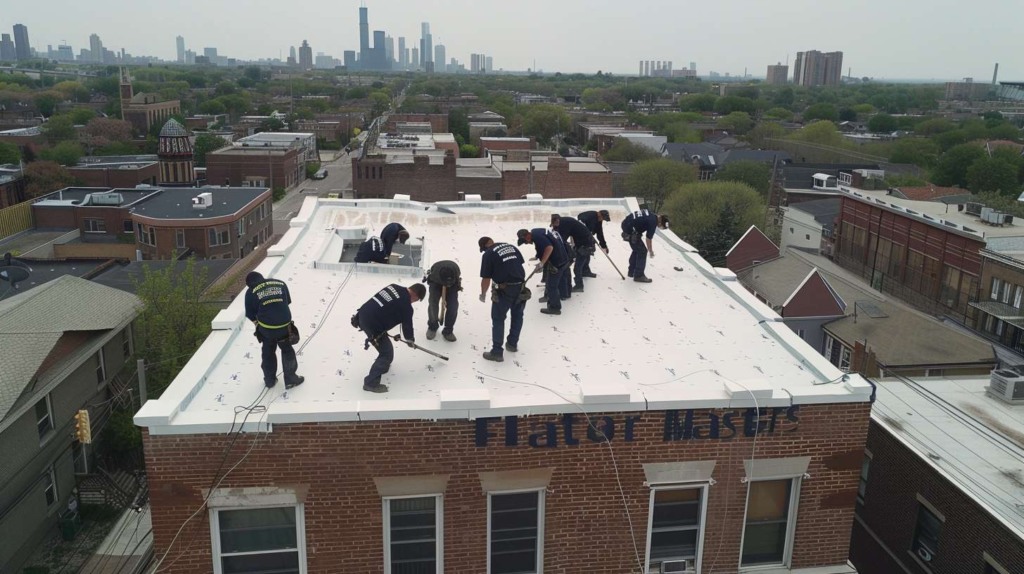
My honest opinion - and I've held it for a long time - is that approving full replacement before anyone has graded the actual failure points is one of the most common budget mistakes I see building owners make in this borough. Think of it like a report card: your seams might be a B, your flashing a C-minus, your coating adhesion incomplete, and your ponding areas headed for summer school. That's not a failing student - that's a student who needs targeted intervention, not to repeat the whole grade. Approving a $25,000 tear-off before that report card exists is a mistake you can't undo.
| Myth | Real Answer |
|---|---|
| "Any leak means replace the whole roof." | Not even close. A single failed seam or open flashing joint can cause a dramatic ceiling stain while the rest of the roof is perfectly serviceable. Diagnosis determines scope - not the leak itself. |
| "More roof cement always helps." | It doesn't. Smearing mastic over a wet or dirty surface traps moisture and creates a bigger problem than the one you started with. Roof cement is a detail product, not a field coating. |
| "If it looks shiny, it's watertight." | Shiny means it was coated at some point. It does not mean the coating is adhered, crack-free, or still bridging the seams underneath. Surface appearance and waterproofing performance are two different things. |
| "All ponding means immediate replacement." | Ponding that clears within 48 hours is a drainage issue, not automatic membrane failure. The real question is whether the standing water is degrading the membrane - that requires inspection, not assumptions. |
| "A new coating fixes trapped moisture." | It seals it in, which is worse. Moisture trapped beneath a fresh coating continues to degrade the membrane, creates blistering, and eventually forces the coating off from underneath. Wet roofs need drying out, not covering up. |
Where a Roof Usually Tells the Truth First
Drain bowls, seams, curbs, and edges
At the drain first - because roofs usually confess there before anywhere else. The interior ceiling stain is not the leak location; it's where water ended up after traveling through the assembly. Tracing starts at drains, transitions, seams, and low spots. In Queens specifically, you're also factoring in leaf debris from street trees clogging drain strainers, wind-driven rain coming off Jamaica Bay that hammers edges at angles, freeze-thaw movement in January that widens open laps, and the steady foot traffic to rooftop bulkheads that's just part of life in a six-family or mixed-use building. All of those forces concentrate stress at the same spots: drains, curbs, and edges.
I'll say this plainly: shiny does not mean sealed. Coatings can look completely fresh from Northern Boulevard while hiding hairline cracking, adhesion loss, or open laps underneath. Rita Mazzone - that's me, 27 years in flat roofing with a specialty in figuring out whether an aging Queens roof needs replacement or smart resealing - will tell you that the most expensive assumptions in this business come from trusting what you can see from five feet away. You need to get down on one knee with a flashlight, probe the seams, and check whether the coating lifts at the edges before you can grade the membrane honestly.
If you were standing next to me on this roof, the first question I'd ask is: where is the water actually entering? Not where the stain is - where the water gets in. That answer comes from checking whether the leak follows a rain event with wind, whether it happens only when drains back up, and whether there's any history of patching near penetrations. That evidence, assembled before anyone picks up a caulk gun, is what tells you whether resealing a flat roof is the right call or whether you're about to buy yourself a temporary fix on a fundamentally compromised system.
| Roof Area | ✔ Pass | ⚠ Needs More Testing | ✖ Fail |
|---|---|---|---|
| Drain Condition | Clear bowl, tight clamping ring, no pooling at rim | Slow drainage, slight membrane separation at collar | Clamping ring loose or missing, saturated area around drain |
| Seam Integrity | Seams flat, bonded, no edge lifting or gap | Minor edge separation at one or two laps, no open gap | Open laps, fish-mouths, or seams that lift with finger pressure |
| Flashing Condition | Terminations sealed, metal tight, no gap at wall or curb | Sealant cracking at termination but still adhered | Flashing pulled away from wall, open gap, or corroded through |
| Coating Adhesion | Coating bonded across field, no lifting at edges or seams | Isolated blistering or surface cracking, adhesion questionable in spots | Coating peels by hand, widespread blistering, or delamination |
| Signs of Trapped Moisture | No soft spots underfoot, no blistering, core cut comes back dry | Soft feel in localized area, moisture scan inconclusive | Spongy underfoot, visible blistering, wet insulation on core cut |
Verdict before we go further: if the roof is wet underneath, no coating on top earns a passing grade.
What Proper Resealing Actually Involves
Prep before product
Here's the part building owners hate hearing - old coating on top of bad prep is not a repair. I remember a windy March afternoon in Ridgewood, standing on a six-family building with a landlord who kept saying, "Just put more tar on it." The previous handyman had smeared mastic over wet, dirty membrane, and by the time I got there it had trapped moisture like a lid on a pot. The coating looked like it had been applied - and it had. But it had zero adhesion, zero sealing value, and it had made the moisture condition underneath significantly worse. Resealing a flat roof only works when the surface is dry, sound, and properly prepped. Without that, you're just embalming the problem, and you'll be back on the roof - or paying someone else to be - within a season.
Sealing details before coating the field
Think of a flat roof like a lab surface: contamination ruins the result. The actual sequence for how to reseal flat roof sections correctly goes like this - dry surface first, then remove all failed patching and loose material, reinforce open seams or failing transitions with compatible fabric or flashing tape, address all detail work around penetrations and edge metal, then and only then apply the field coating. Cure time at the end isn't optional; it's the step that tells you whether the system will hold. And here's the insider truth that changes the whole picture: penetrations, edge metal, and drain transitions almost always leak before the open field membrane does. If you coat the field first and ignore the details, the water finds a way in through exactly the spots you skipped, and the whole job looks like it failed - even if the field coating itself is fine.
Smearing mastic over a wet membrane doesn't seal anything - it seals the moisture in, where it continues degrading the system from underneath. That's a worse situation than the one you started with.
Using incompatible products - say, a solvent-based coating on top of a modified bitumen that can't take it, or a water-based system applied before the surface is fully dry - destroys adhesion before the coating finishes curing.
Coating over blisters traps the moisture pocket that caused the blister, which then continues to expand and eventually punches through the new layer. You've added cost without adding protection.
The bottom line: these shortcuts don't just fail quietly. They trap water, worsen adhesion across the field, and create a layered mess that makes future repair - or eventual replacement - significantly more expensive and complicated.
When Resealing Makes Financial Sense in Queens
I remember one sticky August morning in Astoria, about 7:15, when a bakery owner walked me up to the roof before his first trays came out of the oven. He was braced for a replacement number. What I found instead were three failed lap seams around a patched vent curb and a dried-out coating near the drain bowl - the kind of detail failures that happen on aging roofs before the field membrane gives up. We resealed those problem areas properly, and he spent thousands less than he'd been expecting. That's a story I've repeated in variations across Queens for years: mixed-use storefront buildings along Junction Boulevard, six-families in Jackson Heights, co-ops in Forest Hills - the building stock here often features aging flat roofs where the details fail a full cycle before the whole system does. Knowing that changes how you evaluate a leaking roof. The question isn't always "replace or not." It's often "which parts have actually failed, and can they be addressed without disturbing what's still working?"
Questions Worth Asking Before You Approve the Work
One March in Ridgewood, I peeled back a so-called repair with two fingers. The mastic underneath was still soft and dark - it had never properly cured because it had been applied over a wet surface in cool weather. From arm's length it looked like a professional patch. Up close, it was just a flap. That's the thing about bad prep: it can look acceptable for a few weeks, sometimes even a season, and then the first hard freeze or wind-driven rain event peels it back and you're right where you started - except now you have two problems instead of one. The right contractor will show you what they pulled off before they show you what they put down.
Roofs that look fine from the street can still have serious issues hiding in plain sight. A Bayside co-op I was called to - after a day of on-and-off rain, buckets lined up in the top-floor hallway - had membrane that looked clean from ten feet away. But kneeling down with a flashlight told a completely different story: hairline cracking through the entire traffic path to the bulkhead, and edge metal sealant that had shrunk back enough to let water in at every corner. The owner had been told it "looked fine" twice before. Looks are not a diagnostic tool. If the answers to the questions below aren't clear, don't approve any coating work until they are - and feel free to call Flat Masters for a straight-talk roof evaluation before you commit to anything.
-
1
Leak location history: Where exactly has water appeared inside, and does it happen consistently in the same spot or move around? -
2
Roof age if known: Approximate age helps set expectations for membrane condition and remaining service life - ask the building manager or pull old records if available. -
3
Prior repair attempts: Note whether any previous patching was done, by whom, and how long the fix held before the leak returned. -
4
Where ponding occurs: Identify any spots where water sits for more than 48 hours after a rain event - those locations are almost always part of the diagnostic picture. -
5
Wind-driven rain trigger: Does the leak only appear during heavy wind-driven rain? If so, edge metal and flashing terminations are likely suspects, not the open field membrane. -
6
Photos of seams, drains, and edges: If anyone has taken photos of the roof surface - even casual phone shots - bring them. They often show conditions that change quickly and are easy to miss on inspection day.
Getting this decision right doesn't require expensive guesswork - it requires an honest look at what the roof is actually doing and what it still has left to give. If you're not sure whether your building needs targeted resealing or a more involved conversation, reach out to Flat Masters in Queens and ask for a straight diagnostic evaluation before anyone touches the roof.