
Built-Up Flat Roofing Has Been Around for Over a Century - Here's Why It Still Works
What it looks like and what it actually is are often different. Built-up flat roof systems have survived a century of competition from newer materials not because contractors are slow to change, but because layering is still one of the most logical ways to move water off a flat roof - and this article is going to show you exactly why appearance and actual assembly condition are two completely separate conversations.
Why a Century-Old Layered System Still Outperforms a Lot of Newer-Looking Roofs
What it looks like and what it actually is are often different. A gravel surface that looks tired and faded might be sitting on top of a perfectly sound assembly - and a smooth, recently coated roof can be hiding wet insulation and delaminated felts underneath. Built-up roofing doesn't work because it's traditional. It works because stacking redundant layers of felt and bitumen gives water multiple chances to stop before it reaches the deck. That's not nostalgia - that's physics. And honestly, on the kind of flat, low-slope roofs you find all over Queens on prewar mixed-use buildings, redundancy isn't optional.
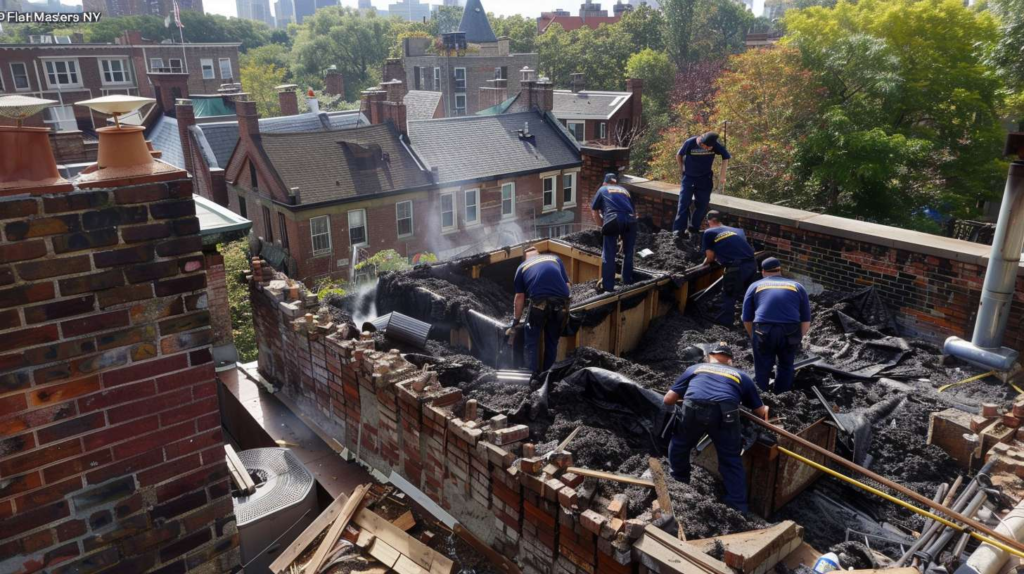
Three layers in, and this is usually where people start guessing. A proper flat roof build up goes in a specific order: roof deck at the bottom, then insulation board, then reinforcing felt plies bonded with bitumen, then a cap sheet or final ply, and finally a surfacing layer - usually flood-coated gravel or a reflective coating - with flashings at every edge and penetration. I have no patience for the myth that age alone decides whether a flat built up roof deserves replacement. Thicker doesn't automatically mean stronger. Sequence and material compatibility matter far more than sheer bulk. Two plies done right beat five plies installed in the wrong order with incompatible products.
| Myth | Reality on Queens Flat Roofs |
|---|---|
| Old BUR means obsolete. | Age of the system matters far less than condition of the assembly. A 30-year-old BUR with dry insulation and sound flashings can outperform a 10-year-old botched overlay. |
| More layers always mean a stronger roof. | Incompatible materials stacked on top of each other trap moisture and create delamination. Sequence and compatibility decide performance - not thickness. |
| If gravel is still there, the roof is fine. | Gravel stays put long after the bitumen and felts beneath it have degraded. Its presence tells you almost nothing about what's happening two layers down. |
| A leak spot tells you exactly where water entered. | Water travels horizontally through insulation before dropping into the interior. The stain on your ceiling and the entry point on the roof are rarely in the same ZIP code of the building's footprint. |
| Every aging BUR roof needs a full tear-off. | Plenty of older built up flat roof systems have dry, intact lower assemblies that support a targeted repair or a proper overlay. The decision belongs to diagnostic data, not the calendar. |
Where Queens Roofs Reveal the Difference Between Surface Wear and System Failure
On Queens Boulevard, I can point to two roofs proving opposite lessons. One looked clean - smooth, recently coated, no obvious ponding. The insulation was soaked. The other had surface alligatoring bad enough to make a new owner nervous, but the felts underneath were still bonded and dry, and a targeted flashing repair was all it needed. This kind of misread happens constantly on the prewar mixed-use buildings you'll find between Woodside and Rego Park, buildings that carry thirty years of patch history and drainage problems in their parapet walls. That's exactly what Rina Mendez - with 19 years in flat roofing and a specialty in diagnosing old built up flat roof systems on Queens prewar buildings - has seen play out in both directions more times than she can count. Surface condition is one data point. Assembly condition is the whole story.
Here's the blunt version: I remember being on a three-story building off Roosevelt Avenue at 6:40 in the morning, coffee still too hot to drink, when a landlord told me his built up flat roof was "suddenly failing." It wasn't sudden at all. The top gravel had thinned down to bare bitumen in patches, the flashings had been patched with three different materials over ten years - one rubber, one fibered aluminum, one mystery product applied badly - and the morning dew made every weakness show itself at once. That was the day I explained to him that old BUR roofs don't collapse in one dramatic moment. They give you a long, patient warning in layers, and the problem is that each individual symptom looks manageable until you realize they've all been accumulating together.
If you were standing next to me at the parapet, I'd ask you one question first: where is the problem actually living? Is it in the surface membrane - cracking, thinning, alligatoring? Is it in a seam or flashing edge that's been letting water track sideways? Is it trapped moisture below the membrane that's been slowly destroying your insulation? Or is it a drain transition that was never properly waterproofed? That one question changes everything about what the right move is. Don't let a dramatic-looking surface push you toward a full replacement before you know which layer is actually the problem.
| What the Roof Looks Like | What May Actually Be Happening | Immediate Next Step |
|---|---|---|
| Thinning or missing gravel | UV exposure reaching the bitumen layer directly; accelerated oxidation of the cap sheet | Check membrane integrity below; determine if coating or gravel reapplication is still viable |
| Alligatoring surface pattern | Oxidized bitumen that has lost flexibility; may be surface-only or may indicate deeper felt delamination | Core sample to confirm whether felts below are still bonded before deciding on repair scope |
| Isolated blister on membrane | Trapped moisture or air between plies expanding under heat; may be localized or part of a larger delamination pattern | Do not puncture or coat over it; probe surrounding area and scan for moisture extent |
| Repeated wall flashing patches | Original flashing termination has failed; patchwork using incompatible materials has created layered failure points at the parapet | Strip back all patch layers to identify the original flashing substrate; rebuild from a clean base |
| Soft or spongy feel near drain | Saturated insulation beneath the membrane; water has been pooling and wicking outward from the drain collar | Moisture scan or test cut to determine how far saturation extends; replacement of affected insulation area likely required |
| Interior stain with no obvious surface split | Water entered at a seam, flashing edge, or penetration and traveled laterally through insulation before appearing inside | Do not assume the stain location is the entry point; work backward from all nearby transitions and low points |
Signs That Look Dramatic but Are Not Always Fatal
Heavy alligatoring, widespread gravel loss, and surface cracking can make a roof look like it's one rainstorm from collapse. Sometimes that's true. But plenty of roofs in this condition still have intact lower plies and dry insulation - meaning targeted repair or a proper overlay is still on the table. The surface got old. That's not the same as the system failing.
Signs That Look Minor but Usually Mean Trouble
A small soft spot near a drain, a thin line of efflorescence creeping down an interior wall, a flashing that's been re-caulked three times in four years - these are the ones I take seriously before the dramatic stuff. They're telling you water has already found a path and has been using it long enough to establish a routine.
⚠ DIY Misreads That Lead Owners to Replace the Wrong Thing
- Assuming the wet-looking spot is where water entered. Water travels. The entry point is almost never directly above the interior stain - it's usually at a flashing edge or seam several feet away.
- Coating over active moisture. Applying a reflective coating or sealant over a membrane that's already trapping water locks the problem in and accelerates damage to the insulation and deck below.
- Stacking incompatible patch materials. Rubber caulk over aluminum flashing over fibered cement over old bitumen doesn't compound into a solution - it compounds into a future failure point with six layers to untangle.
- Ignoring parapet and drain transitions. The field membrane gets all the attention, but the most chronic leak sources on Queens flat roofs are at parapet base flashings, scupper edges, and drain collars that were never properly waterproofed in the first place.
Misdiagnosis is how a roof can look "fixed" while the ceiling is still at risk.
When Repair Makes Sense, When Overlay Fails, and When Replacement Is the Right Call
Back in my teaching days, this is the part I'd draw in blue marker. Three columns on the board: Repair, Overlay, Replace. First problem people run into - they assume the roof's surface tells them which column they're in. It doesn't. First thing to establish: is the wear surface-only, or has moisture made it below the membrane? Next misconception is a big one - an overlay solves wet insulation. It does not. Coating or layering over saturated material locks in the moisture, accelerates deck deterioration, and means you're doing the real job again in three years. Last thing people miss: replacement isn't automatically the right answer just because the roof looks rough or because it's old. The decision belongs to what the assembly is actually doing. I was called to a co-op near Forest Hills on a windy Sunday in February - cold enough that my notes nearly flew off the parapet - where a board member was ready to tear off the entire old built up flat roof because a newer single-ply overlay had been installed badly over it. We opened a test cut and found the lower assembly was surprisingly sound. Dry felts, intact bitumen, stable insulation. The problem wasn't the old BUR system. The problem was the sloppy update on top of it. We spent half an hour in frozen gravel explaining built up flat roof details to six people in puffer coats, and by the end, even the most skeptical board member agreed: replace the bad overlay, keep the good base.
A tidy surface is not a diagnosis - and letting it make the decision for you is one of the most expensive mistakes you can make on a flat roof.
Option 1: Repair
Best Fit
Localized membrane damage, isolated flashing failure, or a single problem area with a dry, intact surrounding assembly.
Common Mistake
Using targeted repairs on a saturated assembly - they'll hold temporarily and fail faster than the original problem.
Option 2: Overlay
Best Fit
When the existing assembly is confirmed dry and stable, and the building code allows an additional layer over the substrate.
Common Mistake
Burying bad flashing details and wet spots under a new membrane - the problems don't disappear, they just get harder to find and more expensive to fix.
Option 3: Full Replacement
Best Fit
Widespread moisture in the insulation or deck, multiple overlapping failure points, or incompatible past recover layers that can't be properly tied into a new system.
Common Mistake
Treating full replacement as automatically necessary just because the roof is old. Age is not a condition report - the assembly's actual state is.
How to Replace a Built Up Flat Roof Without Repeating the Same Hidden Mistakes
Sequence Matters More Than Bulk
A roof is a lasagna only up to a point, and then the comparison falls apart. One August afternoon right before a thunderstorm rolled through Queens, I got called to a bakery on a block near Jamaica Avenue where the owner had been watching videos and decided to learn how to replace a built up flat roof with his cousin's help. By the time I got there, the kitchen smelled like wet insulation and yeast - they'd stacked the materials in the wrong order and trapped moisture under a fresh cap sheet that was already starting to blister. The owner kept saying, "But it looked thicker." That's the trap, and I've seen it end careers and eat budgets. A proper flat roof build up for a replacement follows a strict sequence: tear-off down to a suitable substrate, thorough deck inspection with repairs before anything goes on top, insulation installed with correct slope and layout, felt plies applied with compatible bitumen in the right order, then flashings and edge details rebuilt from scratch - not patched over - and finally the correct surfacing for the exposure conditions. Skip a step or reverse two of them and you're trapping moisture into a system that was supposed to drain it out.
Here's the insider part that most owners don't hear until something's already gone wrong: on older Queens buildings, whether a replacement actually holds long-term depends less on the field membrane and more on what happens at the parapets, scuppers, drains, and rooftop penetrations. Those transitions are where water finds its way in on day one, and they're where a crew cutting corners will cut them first. A perfect field membrane with sloppy drain flashing is still a leaking roof. Appearance versus function - it applies to the new work just as much as the old.
✔ Before You Call for a BUR Replacement Quote: What Queens Property Owners Should Verify First
- Leak history by area: Know which interior spaces have had staining or active drips - and when they started.
- Age of last overlay, if any: Find out whether a recover layer was added and what material was used. This changes the tear-off plan and cost significantly.
- Whether interior staining is currently active: Old staining may mean a repaired problem. Active staining means water is moving right now.
- Parapet condition: Check whether brick is spalling, coping is loose, or the base flashing has been patched repeatedly. Parapet failures are some of the most common overlooked sources on prewar Queens buildings.
- Drain and scupper performance: Note whether any areas pond after rain and how long it takes to clear. Slow drainage usually means a slope problem that needs to be corrected in the replacement - not just new membrane.
- Whether previous patches used mixed materials: Rubber over aluminum over fibered coating layers require extra assessment time and sometimes a more extensive tear-off than a clean original assembly would need.
▾ How long can a built up flat roof last in Queens?
▾ Can part of a built up roof be repaired instead of replaced?
▾ Does more roofing material always mean a better flat roof build up?
▾ What built up flat roof details fail first on older buildings?
A built up flat roof that looks questionable from the surface might be perfectly sound underneath - or it might be quietly failing in ways that won't show up until the damage is significant. If you've got a Queens property with a BUR roof and you're not sure which situation you're in, reach out to Flat Masters for a straight-talk diagnostic - not a sales pitch, just a real look at what the assembly is actually doing.