
Getting Flat Roof Drainage Right on a House Is More Important Than It Looks
Drainage works only when the roof gives water a believable route to the outlet
Truthfully, most residential flat roof drainage failures have nothing to do with the drain being missing. The drain is usually right there. The problem is that it's sitting in the wrong relationship to the roof's actual slope, the water's real travel path, and - almost always - whatever overflow backup was supposed to catch the moment things back up. That's the part nobody talks about until the ceiling stains come back.
Before we talk residential flat roof drains, where is the water trying to leave now? Because the outlet, the path leading toward it, and any overflow release have to function as one connected system - what I call the house's exit plan for water. That's a phrase I picked up from years of explaining this in Queens kitchens, and it comes straight from my plumbing background. I'm Pam Ricci, with 24 years solving residential flat roof drain problems on Queens homes where the roof itself is often less guilty than the layout sending water nowhere useful. Collection, movement, outlet, backup - pull one piece out and the whole exit plan breaks down.
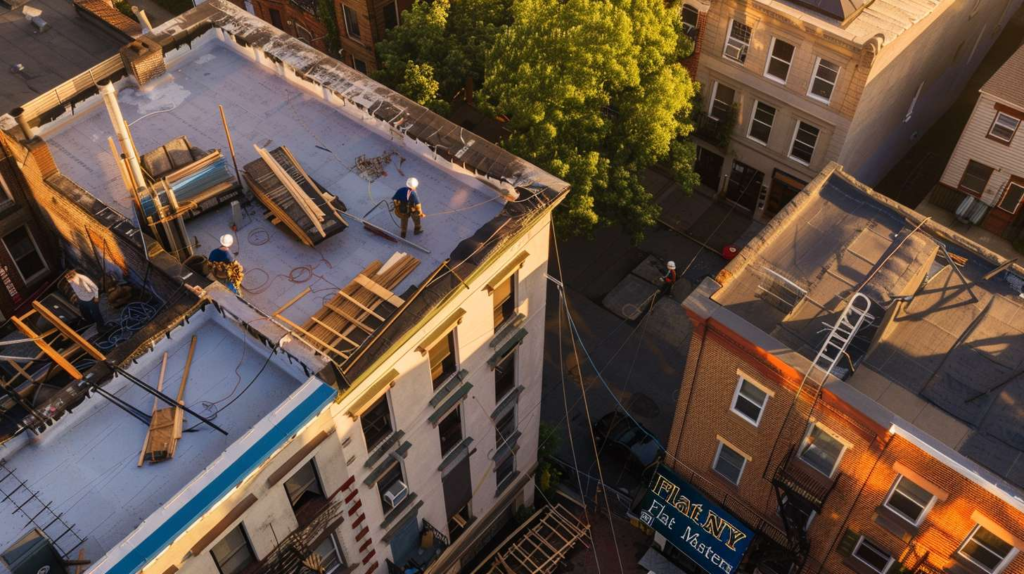
What residential flat roof drains need to work properly
The roof surface must funnel water toward the drain, not away from it. A well-made drain sitting in the high spot of the roof will never collect enough water to matter - the roof geometry decides what gets collected.
Water has to have a clear, unobstructed route between where it lands and where it exits. Low ridges, debris dams, or a membrane that has settled unevenly can cut that route off completely, even with a perfect outlet waiting at the end.
The drain bowl, scupper, or edge outlet has to be physically clear, correctly sized, and properly integrated into the membrane. A drain that's half-blocked by a leaf mat or a scupper that's been painted over restricts flow just as badly as no drain at all.
If the primary outlet struggles during heavy rain, where does the water go? Without a secondary scupper, overflow drain, or engineered release point, the answer is: straight into the building. Overflow planning isn't extra - it's the part that protects the house when everything else gets tested at once.
Water stalls because the roof line and the outlet are not talking to each other
A drain can sit there perfectly available and still be bypassed
I still remember that bottle of water refusing to cooperate. It was a muggy August morning in Glendale - the kind where the tar is already soft by 8 a.m. - and the homeowner was convinced the membrane had failed because a ceiling stain kept coming back after two patch jobs. I got on the roof, looked around for maybe five minutes, and the picture was clear. The drain sat there almost decorative, clean and open, while the real low area held water several feet away. I grabbed a water bottle from my bag, poured it across the surface, and we both watched it pool in completely the wrong direction. The homeowner's face changed right then. Not the drain. Never was the drain.
On a house roof, the drain is only as smart as the water path feeding it. That's something Queens rear extensions teach you fast - those small flat sections added over kitchens and back rooms along streets like Jamaica Avenue and the rows off Myrtle have shallow low spots that develop their own gravity logic, and it almost never agrees with where the scupper or edge outlet was placed. The roof fall goes one way, the outlet faces another, and water finds a seam before it finds the exit. It's collection, movement, outlet, backup - and when one of those four breaks down on a rear extension with six inches of total drop across the whole surface, you're not fixing the drain. You're fixing the exit plan.
| What you notice | What it usually means | What should be checked next |
|---|---|---|
| Ponding several feet from the drain | The real low spot and the drain location don't match - the roof falls the wrong way. | Slope across the full surface; the drain may need to move or tapered insulation may be needed. |
| Water line staining near a scupper | Water reached the scupper but couldn't exit fast enough - suggests partial blockage or undersized opening. | Scupper size relative to roof area, and whether debris is damming the throat of the opening. |
| Sloshing sound inside after rain | Water is pooling above the ceiling assembly - the exit plan failed and water found a resting place it was never supposed to reach. | Drain bowl integration into roof fall, and whether the outlet is seated below the membrane's lowest point. |
| Debris collecting just before the outlet | The path to the outlet works, but debris is creating a dam right at the threshold - a maintenance failure about to become a drainage failure. | Cleaning schedule, drain cover design, and whether a debris screen is the right fix or a bigger scupper opening is. |
| Ceiling stain returns after patching | The membrane was patched but the water path was never corrected - water keeps finding the same spot because it has no other place to go. | Where water sits between rains, not just where the patch is - the stain follows the path, not just the leak point. |
| Edge runoff where an outlet was supposed to help | The outlet exists but water bypasses it entirely - the collection path and the outlet relationship were never aligned. | Whether the roof slopes toward or away from the outlet, and whether edge overflow is intentional or accidental. |
Openings at the edge and drain bowls in the field only work when the roof surface agrees with them
A roof drain works like a house plumbing fixture - if the pitch and path are wrong, the exit can be perfectly good and still fail the job. A scupper punched through a parapet wall is useless if the roof surface slopes away from it. A drain bowl set in the membrane accomplishes nothing if the field of the roof was installed flat or - worse - with a subtle crown that moves water toward the edges instead of the center. The opening is just the last three inches of a system that starts the moment rain hits the surface.
Here's the blunt truth: an opening is not the same thing as a drainage plan. I had a sweet older couple in Astoria call me during a slow November drizzle - one of those gray Queens afternoons where everything drips - because they were sure their gutters were the complete drainage story on a small rear flat roof section. They weren't. When I got up there, I found a partially blocked scupper, bad debris habits that had built up a mat right at the throat of the opening, and genuinely no understanding of how residential flat roof drain systems need a clear, maintained path - not just a hole at the edge. The husband said, honestly, "I thought a hole was enough." I appreciated that sentence. And I hated that it almost cost them a ceiling.
My opinion? Homeowners get sold waterproofing when the bigger issue is drainage logic. A Ridgewood row house drives that point home for me - it was a windy spring evening, the new rear roof was less than two years old, and the owner still heard water sloshing in the structure after storms. The drain bowl was technically present, but it was poorly integrated into the roof's fall. Nobody had drawn the arrows. Nobody had shown that homeowner where his house spits. And here's my insider tip, the one I hand out more than any estimate: ask your contractor to draw the exit plan - where the roof spills water in a normal rain, and where it would go if the main outlet got blocked. That second scenario, the blocked-drain sketch, tells you instantly whether the contractor understands overflow planning or is just selling you a product. If they can't draw it, they haven't designed it.
⚠ What happens when residential flat roof drains are treated like accessories
- Assuming a scupper or drain bowl solves drainage by default - an opening placed without slope design is a decoration, not a system. Water doesn't navigate toward hope; it follows gravity, and gravity doesn't care what you installed.
- Skipping overflow planning entirely - a single outlet under a heavy Queens downpour can be overwhelmed in minutes. Without a secondary release, the water backs up and the ceiling becomes the overflow point.
- Patching the membrane repeatedly without fixing the water path - if the exit plan is broken, the membrane will keep failing at the same low spots no matter how good the patch material is. You're treating the symptom while the cause sits there getting rained on.
The right drain fix usually looks boring on paper because it is really a path correction
Good drainage is not dramatic once it starts working
On a house roof, the drain is only as smart as the water path feeding it. And that's not a warning this time - that's the reassurance. Because what it means is that most residential drainage improvements aren't big, dramatic replacements. They're corrections: re-establishing the slope, repositioning where the outlet sits in relation to the real low point, adding an overflow scupper the original contractor skipped, or cleaning and clearing the path so the exit plan the roof already has can actually do its job. When Flat Masters maps a residential flat roof drain system, we draw the arrows - where the house spits in a normal rain and where it would spit if the main outlet got blocked. That's not fancy. That's just how drainage is supposed to work, and once it does, you stop thinking about your roof between storms. That's the whole goal.
| Myth | Fact |
|---|---|
| "If the drain exists, the roof should drain." | A drain only works when the roof surface slopes toward it. A perfectly clear outlet in the wrong location does nothing for water that never reaches it. |
| "Gutters are the whole drainage story." | Gutters handle water that reaches the edge. Anything that pools in the field of a flat roof never makes it to a gutter - those are two different systems serving two different parts of the exit plan. |
| "More waterproofing solves standing water." | Waterproofing manages water that gets in - it doesn't move water off the roof. Standing water that never drains will eventually defeat any membrane because no coating is designed to sit underwater indefinitely. |
| "A little sloshing after storms is normal." | Sloshing means water reached somewhere it wasn't supposed to - usually above a ceiling assembly. Normal is dry and quiet. Sloshing is a drainage failure that already happened. |
| "Overflow planning is overkill on a house." | A single outlet blocked by debris during a heavy rain can turn a small flat roof into a temporary pond in under 20 minutes. Overflow planning isn't extra - it's the backup that keeps a clogged drain from becoming a structural event. |
Why does my flat roof still hold water if the drain is open?
Because the drain being open only means it can receive water - it doesn't mean the roof is sending water toward it. If the surface slope runs away from the outlet, or if a low spot has developed between the drain and the field of the roof, water pools there and never travels far enough to reach the drain at all. The opening is fine. The path is broken.
What do residential flat roof drains actually need to work properly?
Four things: a collection area where the roof slope funnels water toward the drain, a clear movement path between the surface and the outlet, an outlet that's clean, correctly sized, and properly integrated into the membrane, and an overflow plan for when the primary outlet gets tested hard. Pull any one of those out and the system fails - even if the drain itself looks perfect.
How important is overflow planning on a house roof?
More important than most homeowners realize until the first serious storm. A single drain or scupper can be overwhelmed quickly in heavy rain, and if there's no secondary release - an overflow scupper, a secondary drain set slightly higher - water has nowhere engineered to go. It finds its own way, and that way is usually through the roof assembly and into the ceiling.
Can a bad water path make patch repairs seem useless?
Absolutely - and it happens more than it should. If water consistently pools in one area because the exit plan is broken, that area of membrane is under sustained stress no patch can fix permanently. The patch holds but the water returns to the same spot, the same pressure, and the same seam or blister it found before. You're not fixing the leak; you're just giving it a new surface to work through.
What should a roofer explain before changing a drain layout?
They should be able to tell you where the roof currently sends water, where it will send water after the change, and what happens if the new outlet gets blocked. If they can draw that for you - even on the back of a card - you're talking to someone who understands the exit plan. If they can only describe the drain product they want to install, keep asking questions.
Get the exit plan mapped - not just patched.
If your flat roof keeps pooling, staining, or sloshing after storms, call Flat Masters in Queens. We'll map exactly where your roof spits - in a normal rain and in a blocked-drain scenario - so you're fixing the drainage design, not just putting another layer over a water path that still leads nowhere good.