
Need a Temporary Fix for a Leaking Flat Roof? Here's What Works Until the Pro Arrives
Before Any Patch, Check Whether a Temporary Repair Can Even Hold
Spending less now can cost twice later. A temporary fix for a leaking flat roof only has a fighting chance when three things line up: the patch area is dry enough to prep, clean enough to bond, and you've traced the likely entry point well enough that you're not sealing the wrong spot entirely.
Eight inches away from the drip, that's usually where I start looking. Ceiling stains are symptoms, not confessions - the water traveled to that spot, it didn't start there. Think of it the way I used to explain gravity to seventh graders in Jackson Heights: follow the path, don't chase the puddle. The stain is where class ended; the leak is where the note got passed.
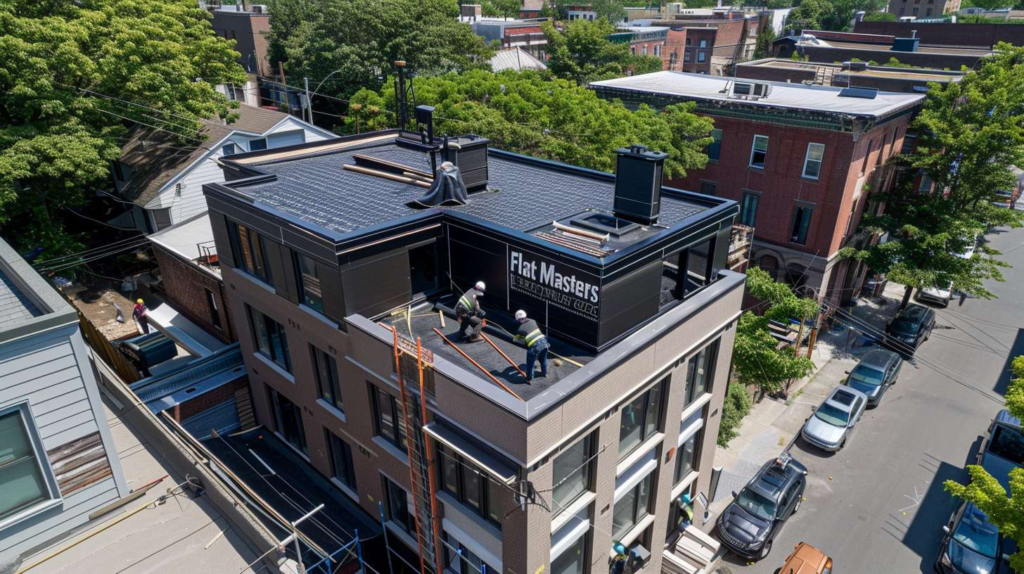
Blunt truth: wet surfaces make liars out of emergency patches. A short-term seal is only realistic when there's no active sheet flow across the membrane, you can towel-dry the patch zone, loose debris can be swept away, and the area is accessible without stepping onto soft or unsafe decking. If even one of those conditions is missing, you don't have a patching job yet - you have a containment job.
Quick Facts: What Makes a Temporary Flat Roof Leak Fix Realistic
Best Use
Buy 24-72 hours until a professional repair can happen - nothing more.
Works On
Small splits, open seams, isolated flashing gaps on accessible dry membrane.
Usually Fails On
Saturated insulation, widespread blistering, and roofs with pooled standing water.
Immediate Goal
Slow water movement and reduce interior damage - not restore full waterproofing.
Should You Attempt a Temporary Fix for a Leaking Flat Roof Right Now?
Can you safely access the roof?
❌ NO
Do not go up. Contain interior water with buckets and towels, and call a pro immediately.
✅ YES
Is the area dry enough to wipe and prep?
❌ NO
Use interior containment only. Wait for safer conditions before going on the roof.
✅ YES
Can you identify a likely entry point near a seam, flashing, drain, or puncture?
❌ NO
Mark the stain location inside, take photos outside, and avoid random patching - you'll seal the wrong spot.
✅ YES
Apply a limited temporary seal using the right material for the defect type - and schedule professional repair right away.
What Actually Works for a Short-Term Flat Roof Leak Stop
Here's the part nobody likes hearing. The best temporary repair for a leaking flat roof depends entirely on the type of defect in front of you, not on how stressed you are at 11 p.m. on a Tuesday. Matching the method to the problem is the only part that actually matters - which is why Darlene Velez, with 27 years in flat roofing and a reputation in Queens for tracing leak entry points on low-slope roofs, treats every emergency patch like a control measure first, not a solution. Honestly, she'd rather see a small, honest temporary seal or simple containment than a big messy patch that hides the real problem from the next crew that has to find it.
A flat roof leak behaves a lot like a kid passing notes in class - it almost never starts where you finally catch it. Water enters at a seam, travels under the membrane to the lowest gravity point, then drips through a ceiling that might be four feet from the actual breach. Seams, flashing bases, and drain collars are almost always the real starting point. The drip in the middle of your ceiling is just where the note arrived.
If you cannot prep the surface, you do not have a patching job - you have a waiting job.
| Leak Situation | Temporary Fix That Can Work | What to Use | How Long It May Buy | What Not to Do |
|---|---|---|---|---|
| Small puncture (nail, screw, debris) | Clean, dry patch using peel-and-stick roof repair tape pressed firmly over the hole | Roof-compatible butyl or polyester repair tape | 24-48 hours if surface is genuinely dry | Don't use duct tape - it lifts with moisture and traps water underneath |
| Short seam split (open edge) | Press seam edges back, clean with a rag, apply roofing cement only to a dry surface, then tape over | Roofing cement + repair tape overlap | Up to 48-72 hours if no rain follows | Don't glob cement on a wet or dirty seam - it won't bond and will slide |
| Lifted flashing edge (parapet, wall, or curb) | Re-press the flashing, clean debris from the gap, apply a bead of roofing cement under the edge if the surface is dry | Roofing cement or butyl-based flashing tape | 24-48 hours - flashing moves with temperature swings | Don't seal the face of the flashing only - water will get behind it anyway |
| Leak near drain bowl or collar | Clear any debris from the drain first. If collar is separated, apply repair tape around the perimeter of the collar on a dry surface | Peel-and-stick repair tape; ensure drain flow isn't blocked | Variable - drains shift with ponding weight | Don't seal over a clogged drain - you'll create ponding that spreads the leak |
| Active water under a blister or bubble | Do not cut or puncture the blister. Place a weighted tarp over the area as containment only - this is not a patchable situation short-term | Heavy-duty tarp with weight (sandbags or water containers at edges) | Until professional arrives - interior containment is the real fix here | Don't slice a blister open - it releases trapped water and accelerates damage |
Emergency Patch Materials: Good Choices vs. Bad Choices
✅ Roof-compatible repair tape - Butyl or polyester-backed tape rated for roofing applications bonds well to dry membrane surfaces and stays flexible.
❌ Duct tape - It has no UV resistance, lifts within hours in moisture, and traps water right where you least want it.
✅ Roofing cement (on dry, prepped surfaces only) - Applied in a thin, even layer over a properly cleaned spot, it can bridge a small gap temporarily. Context matters enormously here.
❌ Random caulk or silicone - Most caulks don't bond to roofing membrane, peel fast, and prevent proper adhesion when the real repair happens later.
✅ Weighted tarp as containment - When patching isn't possible due to wet or unsafe conditions, a heavy-duty tarp weighted at the edges redirects water and reduces damage until a pro arrives.
❌ Coating over standing water - No coating adheres to a wet surface. You'll seal moisture in, accelerate membrane rot, and make the real repair harder.
Queens Conditions That Change the Plan Fast
If you called me to Queens and pointed at a ceiling stain, what would I ask first? Not "where's the drip" - I'd ask which direction the wind was coming from during the storm, how old the roof is, whether the drain ran clear last fall, and whether the leak showed up after a short hard rain or a slow all-day soaker. Those four answers tell me more than the stain does. In Queens row buildings - especially the two- and three-family brick homes in Ridgewood, the mixed-use storefronts along Jamaica Avenue, and the older walk-up apartments in Rego Park - leaf-clogged drains back water up against parapet walls, and wind-driven rain in Astoria and Jackson Heights comes in nearly horizontal along that parapet cap. In Rego Park, I've seen water travel twelve feet under a membrane before dripping through a ceiling. Twelve feet. So no, I don't start where you're pointing.
That sounds right, but here's what actually happens when people assume the roof is ready to patch just because the rain stopped. In colder months, cheap patch materials - especially the thin peel-and-sticks you grab at a hardware store - stiffen to the point where they can't conform to surface texture, and they'll pop at the edges with the next freeze-thaw cycle. Summer is the flip side: soft mastic sitting on a dirty, granule-covered surface in August heat will slide right off the pitch before it ever cures. Temperature matters, surface prep matters, and the time of year in Queens changes both of those calculations faster than people expect.
| Myth | Real Answer |
|---|---|
| "The stain on my ceiling marks the leak source." | Water travels horizontally under the membrane before dripping through. The stain is often several feet from where the water actually entered the roof system. |
| "Any tar I put up there is better than nothing." | Tar applied to a wet, dirty, or misidentified spot seals nothing - it just adds a layer that the next roofer has to remove before doing the real repair. |
| "It's dry this morning, so the roof is ready to patch." | The surface may look dry while insulation below the membrane is still saturated. Trapped moisture compromises adhesion from underneath, and the patch fails under the next rain. |
| "One patch solves all ponding-related leaks." | Ponding creates multiple stress points across a membrane over time. One spot patch won't stop water that's sitting and migrating across a larger area. |
| "The dripping stopped, so the problem is fixed." | Interior dripping stops when the water has fully saturated the insulation and can't move farther - not because the roof sealed itself. The damage is often worse after the dripping stops. |
Roof Layout Factors That Misdirect Homeowners
▶ Parapet Walls and Wind-Driven Rain
▶ Old Patched Seams on Multi-Family Roofs
▶ Drain Backups After Leaf Drop
▶ Rooftop Penetrations on Mixed-Use Buildings
Contain the Damage Indoors While You Wait for the Roofer
What to Move First
I was standing on a roof in Ridgewood one rainy Halloween when this became very clear. It was cold, the surface was slick, and a landlord's handyman had already gone up with a can of roof cement and come back down with nothing stuck. The material had stiffened and peeled before it even set. The real protection that night didn't come from anything on the roof - it came from what they did inside. Moving electronics away from the drip zone, getting containers under the active leak, sliding cardboard and plastic under furniture, and staying out of the room where the ceiling felt soft - that's what kept a bad situation from becoming a ruined situation. Relieving a bulging ceiling is sometimes necessary, but only if the bulge is small and you can do it with one small hole and a container ready below. If the ceiling is sagging across a wide area, stay out of the room entirely.
What to Photograph for the Repair Crew
That sounds right, but here's what actually happens when people just keep adding buckets without documenting anything: the roofer shows up the next morning, the rain has stopped, the roof looks fine from the hatch, and now you're both guessing. A good set of photos speeds diagnosis faster than most people realize. Photograph the ceiling stain shape, note the exact time the drip started relative to when the rain began, and snap wide and close photos of the suspect roof area - the nearest seam, the closest drain, any visible flashing. Text the roofer one wide shot and one close shot of the suspect roof zone, plus the time of the last active drip - that one habit alone cuts diagnostic time significantly. The stain shape tells an experienced roofer a lot about direction of travel, and timing relative to the storm tells them whether it's a drain backup or a membrane breach.
Indoor Leak Containment Until Professional Flat Roof Service Arrives
Catch drips and protect flooring
Place buckets, pots, or containers directly under active drips. Lay towels or plastic sheeting around the area to protect floors and prevent water from spreading to baseboards or subfloor.
Move valuables and unplug nearby electronics
Clear electronics, documents, and furniture from the drip zone immediately. Water and electricity is the most dangerous combination in an indoor leak situation - unplug anything within several feet of the active drip.
Reduce spread with towels and plastic sheeting
Lay plastic sheeting over furniture and across a wider radius than you think is necessary. Water spreads further than the drip point, especially once it reaches a wood floor seam or carpet.
Check for ceiling bulge danger
A small, isolated ceiling bulge can be carefully relieved with one small puncture and a container below. A wide or heavily sagging ceiling section means stay out of that room - the drywall can fail suddenly under the weight of trapped water.
Document leak timing and locations
Note when the drip started, how hard it rained before it began, and where exactly on the ceiling the water appears. Photograph the stain shape from directly below. This information is genuinely useful to the roofer diagnosing the source.
Share roof access details with the roofer
Let the roofer know the hatch location, whether a ladder is needed, if roof access goes through a tenant's unit, and whether any temporary material was already applied. All of that changes how they prep and plan the visit.
⚠ Situations Where a Temporary Roof Fix Should Be Skipped Entirely
- Icy or frost-covered roof surface - Do not go up. No patch is worth a fall.
- Active lightning or high-wind conditions - Wait. The temporary fix can wait; your safety cannot.
- Soft or spongy decking underfoot - If the roof feels like it's giving way, step back immediately. The structure may be compromised.
- Sagging ceiling across a large area - Stay out of the room; stay off the roof. Call a pro and if necessary, contact emergency services.
- Electrical exposure or water near a service panel - This is an emergency call to your utility provider first, roofer second. Don't treat it as a simple leak.
Know When the Quick Fix Has Done Its Job and It's Time to Call
Here's the part nobody likes hearing. A leaking flat roof quick fix is successful only if it slows immediate water entry long enough for a proper diagnosis and repair to happen - not if it "looks sealed" the next morning when the sun is out. I remember one August Sunday at 6:15 a.m. in Rego Park, when a bakery owner called because water was dripping right over the proofing rack. Someone had already applied what looked like half a roll of duct tape and a prayer. When I pulled back the loose edge of that old patch, I found trapped water traveling under the membrane - the bad patch had sealed the water in, not out. The entry point was somewhere else entirely. That's the risk with a hasty patch: you seal a surface and leave the water nowhere to go except deeper into your building.
That sounds right, but here's what actually happens after a temporary seal that's reached its limit. The signs are clear if you watch for them: the drip comes back after the next rain, the insulation feels soft when you press on the membrane surface, the ceiling stain spreads outward, or the patch edges start lifting. During a windy March afternoon in Astoria, I was on a three-family building where the top-floor tenant swore the leak was new. It wasn't. The leak had been migrating for weeks under the membrane, and the first visible ceiling stain appeared only after a gusty rain pushed water through a split at the base of a vent flashing. The stain was new; the damage behind it was not. A temporary flat roof leak fix that's doing its job buys you time - but it doesn't buy you the right to stop watching.
Urgent Call-Now vs. Can-Wait Situations for a Flat Roof Leak
Temporary Flat Roof Leak Fix - Frequently Asked Questions
▶ Can I use roof cement in the rain?
▶ Does a tarp help on a flat roof?
▶ How long can a temporary fix last?
▶ Why is the leak not directly above the stain?
▶ Should I patch around the drain if I'm not sure that's the source?
Before You Call a Queens Flat Roofer - Have This Ready
Building address and borough - Include the cross street or closest intersection so the roofer can check satellite imagery before arriving.
When the leak started - Note the date, approximate time, and whether it followed a heavy rain, a light rain, or a wind event without much rain.
Whether power is affected - Tell the roofer upfront if the leak is anywhere near electrical fixtures, panels, or outlets. It changes how they approach the visit.
Roof access method - Interior hatch, exterior ladder, or through a tenant unit? Letting the roofer know in advance saves time and prevents miscommunication on arrival.
Photos of ceiling stain and roof area - One wide shot of the ceiling, one close shot of the stain, one wide shot of the roof surface near the suspected entry zone, and one close shot of the nearest seam, drain, or flashing.
Whether any temporary material was already applied - If you've put tape, cement, or a tarp on the roof, the roofer needs to know what and where. It affects both diagnosis and prep for the real repair.
If the leak is active or your temporary repair is already failing, don't wait for the damage to compound. Call Flat Masters for a proper Queens flat roof diagnosis - before a manageable emergency turns into saturated insulation, damaged ceilings, and a repair bill that dwarfs what a timely call would have cost. - Darlene Velez, Flat Masters