
Howard Beach Roofing - Waterfront Queens Homes Need Roofs That Can Handle It
This is fixable. Most things are at this stage. But in Howard Beach, waterfront flat roofs rarely get into trouble because of one big storm-they get into trouble because salt air, standing water, and edge fatigue stack up quietly over months and years, until the roof that looked fine last fall starts announcing itself through a ceiling stain in February.
Waterfront wear starts small and bills big
On a Howard Beach roof, the corners usually tell on the whole system. The parapet edges, the flashing transitions, the low spots near drains-that's where salt air does its patient work. What you're really dealing with here isn't just weather, it's weather patterns with invoices: every ponding event, every freeze-thaw cycle near the bay, every salt-laden gust off Jamaica Bay bends the membrane a little more at the edges, and each one adds quietly to what the eventual repair bill will say.
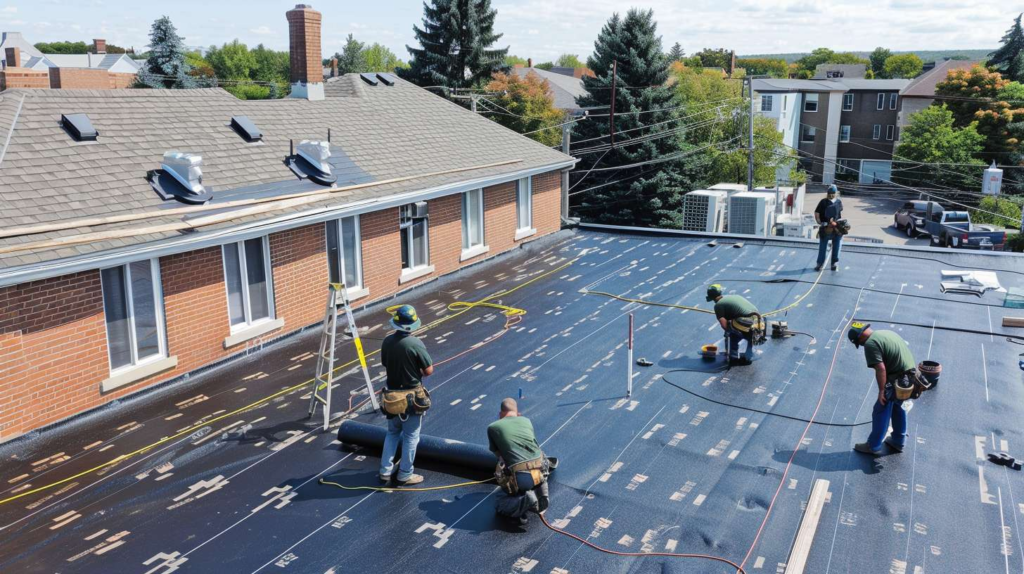
Here's the blunt version nobody likes hearing: the most expensive roofing decision in Howard Beach is usually the fear-based one made before anyone actually traces the leak. If your membrane, flashing, or drain path is failing at the edges and you wait, you're not just dealing with a surface problem-you're feeding moisture into the insulation layer, and from there it gets into the decking and framing. I'm Marta Sadowski, and with 19 years in flat roofing and a specialty in waterfront low-slope failures in Howard Beach, I can tell you that a $400 repair ignored for one wet season regularly becomes a $4,000 problem. Flat roof services done early are almost always the cheaper version of the same story.
Howard Beach Flat Roof Reality Check
Most Common Leak Origin
Corners, curbs, and drains - not the open field of the membrane
Most Misleading Symptom
Interior stain appears far from the actual water entry point
Most Cost-Saving Action
Inspect immediately after any standing water event, not just after storms
Most Vulnerable Homes
Low-slope roofs near bay exposure with parapet edges and aging flashings
Typical Flat Roof Service Scenarios in Howard Beach
| Scenario | Typical Size / Condition | Estimated Price Range | Main Cost Drivers |
|---|---|---|---|
| Leaking flat roof repair - seam or flashing | Small area, isolated failure | $350 - $900 | Access difficulty, flashing type, material compatibility |
| Drain-area repair with localized membrane work | 10-30 sq ft around drain | $500 - $1,400 | Drain condition, insulation saturation, membrane system type |
| Residential flat roof maintenance visit | Standard home, stable membrane | $250 - $600 | Roof size, drain clearing, coating touch-up needs |
| Garage flat roof replacement | 200-400 sq ft, tear-off required | $1,800 - $4,500 | Layer count, decking condition, insulation replacement |
| Residential flat roof replacement - small home | 800-1,500 sq ft, full system | $6,500 - $14,000 | Membrane system, wet insulation volume, parapet work |
| Commercial flat roof repair - curb/skylight area | Penetration zone, targeted scope | $700 - $2,200 | Skylight curb condition, drain path obstruction, membrane flashing detail |
Note: Flat roof repair cost per square rises fast when wet insulation or multiple layers are found beneath the surface.
Repair, replacement, or just maintenance?
How to tell which lane your roof is in
Last winter, I stood on a garage roof with sleet ticking off my hood and saw this exact problem. The homeowner-a woman near Jamaica Bay with a two-family on a block where every neighbor had an opinion-had already called two contractors who quoted her a full garage flat roof replacement on the spot. I cut a small test section near the worst-looking area and found the insulation dry in most of the field. A targeted repair and a maintenance plan saved her somewhere between two and four thousand dollars, depending on which scare quote she'd accepted. The Cross Bay Boulevard corridor and the streets backing up to the bay have a particular wind pattern and moisture exposure that makes surface wear look more dramatic than the underlying system sometimes is. Don't let geography or neighborly fear write a check your roof doesn't actually need.
If you were standing next to me at the roof hatch, I'd ask you one thing first: where does the water sit after the rain? That single question tells me more than most full walkthroughs. Here's the practical breakdown: an isolated failure with dry insulation in the surrounding field means you're in repair territory. Recurring ponding combined with repeated leaks in the same zone means we need to look deeper-corrective drainage work or broader membrane attention. Saturated insulation, widespread membrane breakdown, or a repeated patch history across multiple areas? That's a replacement conversation, and trying to avoid it usually costs more in the end. Before you request any flat roof estimate, take your phone out the morning after a rain and photograph every spot where water still sits 24 to 48 hours later. That map is worth more than a dozen descriptions over the phone.
So which bill are you feeding right now-the small one or the future one?
Do You Need Flat Roof Repair, Maintenance, or Replacement?
→ Likely targeted repair. Dry field, isolated failure.
→ Inspection for hidden saturation. Corrective repair scope.
→ Start a replacement conversation. The field is failing.
→ Flat roof maintenance plan. Protect what's working.
Targeted Repair vs. Full Flat Roof Replacement
When Targeted Repair Makes Sense
- Single identifiable failure point (flashing, seam, drain edge)
- Insulation is dry in the surrounding field
- Roof membrane has limited age-related wear beyond the problem zone
- No history of repeated leaks across multiple areas
- Budget-conscious owner with a structurally sound deck
- Repair paired with a flat roof maintenance schedule extends lifespan
When Replacement Is the Smarter Spend
- Multiple leak zones appearing in different areas of the roof
- Wet or compressed insulation found in the field on core test
- Aging membrane with widespread cracking, blistering, or shrinkage
- A long history of patches that keep failing seasonally
- Measurable energy loss or interior humidity tied to roof system
- Structural decking showing rot, deflection, or soft spots
How Marta Explains the Bill in Three Layers
What you see, what water is doing, what the bill is trying to become
1. Surface Symptoms - What You Can See
Bubbles or blistering in the membrane. A split at a seam or lap edge. Interior ceiling stain that appeared after rain. Lifted flashing at a parapet corner. These are signals, not the whole story. The surface is where the roof tells you something is wrong - but it rarely tells you how far it's already gone.
2. Hidden Moisture Behavior - What Water Is Actually Doing
Water doesn't fall straight down indoors. It travels sideways through insulation, pools in low spots you can't see, and moves toward the path of least resistance - which might be a light fixture twelve feet from where the roof actually failed. Freeze-thaw cycles near Jamaica Bay expand trapped moisture and crack the membrane from inside. Saturation spreads before any ceiling stain appears.
3. Cost Escalation - What the Bill Is Trying to Become
A flat roof maintenance visit: $250-$600. A targeted leaking flat roof repair caught early: $400-$900. The same repair after one wet winter of waiting: $1,800-$3,500 once wet insulation is factored in. A residential flat roof replacement after two seasons of ignored saturation: $7,000-$14,000, plus possible interior drywall and mold remediation. Every stage costs more than the one before it. That's the whole three-layer story.
Drainage and details decide whether a leak spreads
Three feet from the drain is where bad decisions start showing up. Clogged drain paths, patch material slapped down on a still-wet membrane, ignored curb flashing at HVAC units or parapet corners - these are the details that turn a contained problem into a traveling one. Water doesn't respect the border of your repair. If the path to the drain is blocked or the patch sits over a wet substrate, the moisture just keeps moving sideways until it finds a ceiling to announce itself through.
⚠ Why You Shouldn't Patch Blindly Around Ponding Water
Smearing roof cement over a bubbled or ponded area doesn't fix a flat roof - it seals moisture in. Covering wet insulation accelerates the saturation and gives you a temporary visual fix that makes the eventual job larger and more expensive.
Skylight curb leaks and drain-area failures are never surface-only problems. Treating them that way traps water in the system and turns what could have been a $600 repair into a discussion about full flat roof replacement cost.
Don't patch the symptom. Trace the cause first.
Urgent Now vs. Can Wait a Few Days
🚨 Call Now - Urgent
- Active interior drip during or after rain
- Membrane bubbling or ballooning near a drain
- Skylight curb actively leaking into living space
- Membrane edge lifted or peeling after wind event
- Water still standing near entry points 48+ hours after rain
✓ Can Wait a Few Days
- No active leak, just scheduling routine maintenance
- Minor granule loss on a coated or modified surface
- Drain cleaning and debris clearing as part of flat roof maintenance
- Getting a flat roof estimate on a dry, stable roof
- Planning ahead for residential flat roof replacement before failure
Skylights, storefront roofs, and the leaks people misread
Why stains rarely point to the real entry spot
A flat roof near the water behaves a lot like a shoreline map - you ignore the edges at your own expense. I was off Cross Bay Boulevard at 6:40 in the morning after a windy overnight storm, crouching by a parapet with coffee in one hand, and the homeowner kept pointing at a bedroom ceiling stain like it had materialized from nothing. The actual failure point was a salt-stiffened corner seam about fifteen feet away - the flashing had separated just enough to let water travel laterally through the insulation before it found the ceiling. That was the morning I said it out loud for the first time: "Water is a liar indoors." I've been telling customers that ever since, because it resets the whole conversation about where to look.
Commercial and mixed-use roofs in this neighborhood tend to fail at penetrations well before anything goes wrong in the open field. Mechanical curbs, skylight frames, vent stacks - those are where the membrane gets worked hardest. I once met a deli owner at 8:15 at night after he closed because he had an active drip over his back storage and was convinced he needed a whole new roof. We went up with flashlights and found a failed skylight curb with a clogged drain path pushing water sideways under the membrane. That's it. A surgical commercial flat roof repair - no tear-off, no replacement panic. It stuck with me because it's the cleanest example I have of what proper leak tracing saves. The flat roof skylight cost in that case was only the curb flashing and drain clearing, not a new system.
If you're dealing with a suspected flat roof leak - residential or commercial - ask for leak tracing before you approve anything. Ask for moisture probe readings or a test cut near the failure zone. Ask for photos of the actual entry point, not just the symptom. A new flat roof installation is sometimes absolutely the right call, but it should be reached by evidence, not by guesswork or a neighbor's story. Know what you're approving before you sign.
Common Flat Roof Assumptions in Howard Beach - Myth vs. Fact
| Myth | Fact |
|---|---|
| "A ceiling stain shows the roof entry point." | Water travels laterally through insulation before it drips indoors. The entry point can be feet - or a full room - away from the stain. |
| "If a flat roof leaks once, replacement is the only answer." | A single isolated leak with dry insulation around it is almost always a repair situation. Replacement is warranted by extent of damage, not by the fact of a leak. |
| "Ponding is normal if it dries eventually." | Ponding accelerates membrane degradation, adds structural load, and signals drainage failure. "It dried" isn't a passing grade near a waterfront environment. |
| "Garage roofs are too small for maintenance to matter." | Garage flat roof replacement cost runs $1,800-$4,500. A $300 annual maintenance visit that extends the system by three to five years is not optional - it's arithmetic. |
| "Skylight leaks always mean the skylight itself is bad." | More often, the skylight curb flashing has failed or the drain path adjacent to the penetration is blocked. The skylight glass is usually fine. Diagnosis first, replacement conversation second. |
Howard Beach Flat Roof Service Questions
How much does flat roof repair cost in Howard Beach?
Most targeted leaking flat roof repairs in Howard Beach run $350-$1,400 depending on scope. Simple seam or flashing repairs land at the lower end. Drain-area work with membrane involvement pushes higher. Flat roof repair cost rises significantly if wet insulation is found underneath - that's when a repair starts looking more like a partial replacement.
What affects flat roof installation cost on a residential home?
Flat roof installation cost depends on square footage, membrane system chosen (TPO, EPDM, modified bitumen), number of layers being removed, insulation condition, parapet height, and number of penetrations like vents, skylights, or HVAC curbs. In Howard Beach, salt-air exposure also affects material selection - some membranes hold up better to waterfront conditions than others.
How is flat roof repair cost per square calculated?
Flat roof repair cost per square (100 sq ft) typically runs $150-$400 for surface-level work. That number climbs when insulation needs replacement, when multiple layers have to come off, or when structural decking is compromised. Waterfront homes near the bay often see higher per-square costs because access, material performance specs, and moisture complexity are all elevated.
When is garage flat roof replacement worth it?
Garage flat roof replacement makes sense when the membrane has failed across most of its surface, when test cuts show saturated insulation throughout, or when the roof has been patched multiple times without lasting results. If a test cut shows the insulation is mostly dry and the failure is isolated, a targeted repair is almost always the right call first - don't spend $2,000-$4,500 on a full garage flat roof replacement cost when $700 handles it cleanly.
Can a leaking flat roof repair hold through winter near the water?
Yes - if the repair is done correctly, addresses the actual entry point (not just the symptom), and the surrounding membrane and insulation are dry. Repairs made over wet substrates or without proper flashing integration won't survive a Howard Beach winter. The bay environment means freeze-thaw cycles are harder on marginal work. A proper repair with a flat roof maintenance visit in spring is a legitimate long-term strategy on a roof that's otherwise in good shape.
Don't let a repair job become a replacement bill.
If your Howard Beach roof is holding water, showing interior stains, or aging at the edges - call Flat Masters for a flat roof estimate now, before what's fixable today turns into what's expensive tomorrow.