
Rubber Flat Roof Leaking? Here's What You Need to Do and What Not to Touch

Rubber Flat Roof Leaking? Here’s What You Need to Do and What Not to Touch

Rubber Flat Roof Leaking? Here's What You Need to Do and What Not to Touch

In this climate, the smartest first move on a leaking rubber flat roof is to locate the leak path and identify the membrane type before you touch any sealant, coating, or loose edge - because the way you respond in the first hour can either set up a clean repair or contaminate the whole diagnostic picture. This guide covers what to check first, what not to interfere with, and why Queens leak patterns have a way of sending homeowners to the wrong spot on the roof every single time.

Map the leak before you touch the membrane

At the drain first - that's where I look before I believe anybody's ceiling stain theory. I remember being on a two-family in Ridgewood at 6:40 in the morning, still holding my coffee, while the owner pointed to a bedroom ceiling stain and swore the leak had to be directly above it. It had rained all night, the rubber roof was slick, and the actual failure was a tiny split near a drain sump almost fourteen feet away. Water on a flat rubber roof doesn't travel in a straight line down to your ceiling - it finds the low point, follows the membrane's slope, sneaks under a lap, and shows up inside three rooms east of where the problem actually started. Think of it like a subway map: there's an entry point where water gets under the membrane, a transfer point where it moves through the insulation or decking, and a final stop where it finally drips through your ceiling and gets your attention.
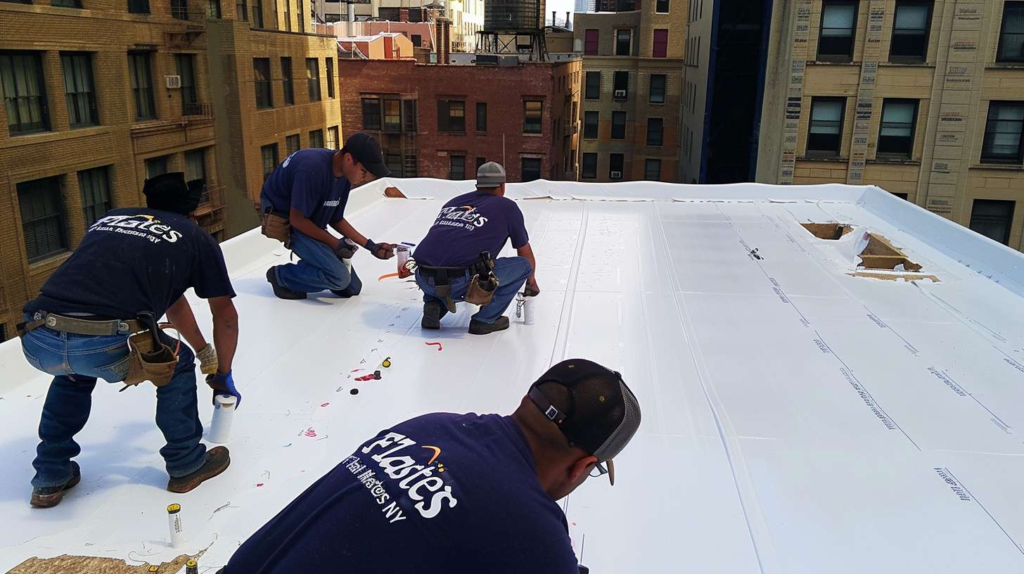
Damaged rubber roof with visible cracks and standing water, highlighting common leak issues requiring professional repair.

That's what people think, anyway - that the stain marks the breach. It doesn't. I'm Alicia Moreno, and in 19 years specializing in flat roofing across Queens, the calls I get most often are from people whose rubber roof leak keeps "coming back" after two or three patch jobs - not because the patches failed at the center, but because nobody traced the actual leak path before reaching for a caulk gun. Identifying whether you're dealing with EPDM, TPO, or a modified bitumen system changes everything: which products are compatible, which seam types need which adhesives, and whether a prior repair is helping or hiding the problem.

🔍 First Response: What to Do When Your Flat Rubber Roof Is Leaking

1
Do you know the membrane type?

YES → Proceed to Step 2
NO → Stop. Photograph all seams, drains, and any prior patches before touching anything. Membrane ID comes first.

2
Is water actively entering indoors right now?

YES → Contain drips indoors, move valuables away from electricals, and call for emergency service immediately.
NO → Proceed to Step 3

3
Has anyone already applied coating or caulk to the roof?

YES → Do not disturb the patched area. Document the product name if you know it and photograph the repair perimeter.
NO → Visually inspect drains, seams, penetrations, and edge terminations - eyes only, hands off.

How Leak Signs Connect to Likely Roof Entry Points on Rubber Systems
What You Notice Inside Likely Roof Entry Point Why Water Travels What Not to Touch Yet
Ceiling stain near center of room Seam separation or lap failure several feet away Water follows slope under membrane before dropping through decking Don't pull up any seam edges to investigate
Dripping near a light fixture or recessed can Penetration flashing failure (pipe boot, conduit, HVAC curb) Water channels down the penetration inside the insulation layer Don't press or reseat the flashing collar
Damp wall near an exterior parapet Termination bar or edge flashing failure at roof perimeter Wind-driven rain forces water behind the termination, runs down wall cavity Don't caulk the exterior parapet face without identifying the edge condition first
Pooling or stain in corner of top-floor room Drain sump split or clogged drain causing standing water that finds any seam Ponded water has time and pressure to exploit any small gap in the membrane Don't clear the drain by jamming tools into the sump bowl

Hands off these common DIY 'fixes'

Here's the blunt version: if you don't know whether it's EPDM and what was used on it before, stop opening buckets. One August afternoon in Astoria, heat bouncing off every surface, I got called in after a handyman had used what looked like half a bucket of silver roof coating over an EPDM patch. The customer genuinely believed more goop meant more protection - and honestly, I've heard that logic more times than I can count. Underneath, the seam was still open, the adhesive was completely incompatible, and the trapped moisture had made the whole repair feel like stepping on warm pudding when I walked across it. That job is one of the clearest examples I know of how random bucket chemistry turns a small rubber roof leak into an expensive one. More goop is not more protection. It's just more of the wrong thing.

A rubber roof is not fragile, but it is unforgiving when people get experimental. Queens rooftops deal with a specific combination of stressors - summer heat that softens old adhesive, freeze-thaw cycles through January and February that stress every seam and termination, and rooftop foot traffic on small multifamily buildings where people drag equipment, stack things, and generally treat the membrane like a parking lot. That context matters when you're deciding whether to wait or make a call. A coating product that might hold up on a single-family in a quiet suburb can trap moisture and fail catastrophically on a busy two-family roof off Jamaica Avenue.

Why mystery sealant makes diagnosis harder

The specific problem with applying an unknown product before a professional arrives is that it can destroy the diagnostic baseline entirely. Coating over an open seam hides the gap. The wrong adhesive contaminates the bonding surface so that correct EPDM splice adhesive won't adhere properly later. Trapped moisture under a sealed area creates blistering that looks like a new problem, even though it's a consequence of the "fix." And when a roofer arrives and lifts the edge of that repair area, the substrate is now compromised - what was a targeted two-foot splice repair can become a six-foot replacement because the surrounding material is no longer clean. That's the chain reaction, and it starts the moment someone opens the wrong bucket.

⚠️ Products and Actions That Can Make a Rubber Roof Leak Worse
  • Smearing unknown sealant on EPDM seams - incompatible chemistry breaks down the membrane bonding over time
  • Brushing aluminum or silver coating over an active leak area - traps moisture and hides the breach from professional diagnosis
  • Pulling up a loose edge "just to check underneath" - once an EPDM lap is disturbed, it needs proper adhesive reactivation to reseal
  • Pressing bubbles or blisters flat by hand - punctures or further delamination is a real risk, and the moisture underneath needs to be addressed, not pushed around
  • Walking repeatedly around a wet drain sump - foot pressure on a split or stressed drain area can worsen the tear and shift standing water toward open seams

✅ Safe Right Now
  • Move valuables and furniture away from the drip zone
  • Set up buckets or towels to catch interior water
  • Photograph the roof - drains, seams, visible patches, perimeter
  • Mark ceiling moisture boundaries with tape to track spread
  • Clear obvious leaf debris from the drain opening by hand - only if the roof is safely accessible and dry
❌ Do Not Touch
  • Adding any random caulk, roof cement, or sealant
  • Cutting or poking blisters in the membrane
  • Lifting or peeling back flashing or termination bars
  • Rolling coating product over seams or patches
  • Scrubbing or scraping old patch material - it destroys the repair record

📦 Open This Before You Buy a Bucket

Step 1: You apply a sealant or coating to what looks like the leak source. The product may not be compatible with EPDM rubber - many off-the-shelf sealants are petroleum-based and actively degrade EPDM over time.

Step 2: The incompatible product seals the surface but not the actual seam gap underneath. Water continues entering through the same breach, but now it's hidden under a layer of coating.

Step 3: Moisture trapped under the coating has nowhere to go. It sits between the membrane and the insulation, promoting mold, softening the adhesive on adjacent seams, and causing blistering across a wider area.

Step 4: A professional arrives and can no longer read the original leak path. The breach location, the membrane condition, and the prior product history are now obscured - meaning more area has to be opened to find the true source.

Step 5: What was a $400 splice repair is now a $1,200+ section replacement because the surrounding substrate is compromised and the contaminated area can't be selectively patched. That's the chain reaction one bucket started.

Notice the three stops where rubber roofs usually fail

Last February in Elmhurst, I watched a leak travel like it had missed its train stop - and that's actually the most useful way I know to explain how rubber roof leaks work. Think of the membrane like a Queens subway line: the entry point is where water first gets under the rubber, usually at a seam, drain, or penetration. The transfer point is where it moves laterally - through the insulation layer, along a nailer board, or under a previous patch - before it finds a gap to drop through. The final stop is that stain on your ceiling, which can be several "stations" away from where the line actually broke. Skipping straight to the final stop and patching the ceiling above it is exactly as useful as fixing the train three stops past where the breakdown happened. You've got to go back to the origin.

The Three Most Common Leak Stops on a Queens Flat Rubber Roof
✅ Likely Source Zone #1: Drain Sump Splits

The rubber membrane around the drain collar is flexed constantly by foot traffic, thermal movement, and standing water pressure. Cracks and splits here are the single most common entry point on Queens flat roofs - and they're rarely directly above the interior stain.

✅ Likely Source Zone #2: Seam Separation

EPDM lap seams rely on contact cement and seam tape that degrades with age and temperature cycling. A seam that's opened even a quarter-inch is enough for wind-driven rain or ponded water to exploit. These often fail at lap transitions, not the center of a sheet.

✅ Likely Source Zone #3: Penetration Flashing Failure

Pipe boots, HVAC curbs, vent stacks, and conduit penetrations all require flexible flashing that bonds to EPDM. Age, UV exposure, and freeze-thaw cycles crack the lap seals around these penetrations - and water channels straight down the pipe inside your roof assembly.

❌ Misleading Clue #1: Stain Location

Interior water stains show you the final stop, not the entry point. Water travels horizontally through insulation and decking before dropping. Treating the stain as the source address leads to wrong-spot repairs every time.

❌ Misleading Clue #2: The Last Wet Spot Touched by Hand

People instinctively press on soft or damp spots and assume that's the breach. Soft membrane areas may just be saturated insulation below - the actual entry point can be feet away in any direction.

❌ Misleading Clue #3: The Shiniest Old Patch

A visible, obvious old patch looks like the obvious suspect - but if it was applied correctly, it may have held. The real failure is often at the edge of that patch, where the old adhesive met new thermal stress. Shiny doesn't mean solid.

Check these roof zones in the right order

What do I ask a customer before I even grab my probe? "Did anyone already smear something on it?" - because prior smears change the entire inspection strategy from the first step. Queens rooftops aren't uniform; a two-family in Woodhaven has a different drainage path than a mixed-use building with a rear addition off Hillside Avenue, and rooftop equipment - HVAC condensers, satellite dishes, water tanks - redirects sheet flow in ways that shift the entry point completely away from where you'd expect it. Tight lot lines mean water that might drain off a larger suburban roof is held on the surface longer here, finding every weakness in every seam. That matters for how you read the inspection.

A rubber roof is not fragile, but it is unforgiving when people get experimental. A few winters back, during a windy Saturday in Bayside, I was checking a leak over a small law office where the owner had put a flowerpot stand on rubber walkway pads and then dragged it around all season. The leak didn't show up until after a cold rain, and the membrane had a wear spot right where the edge of one pad had shifted and rubbed. I ended up showing him the damage with a piece of chalk and saying, "This roof didn't fail dramatically. It got annoyed slowly." Slow abrasion from shifted pads, misplaced furniture, or HVAC service foot traffic creates wear zones that look unremarkable until freeze-thaw finishes the job.

Drain area

Seams and terminations

That's what people think, anyway - that the worst-looking patch is the one to blame. Here's the insider reality: old repairs almost always fail at the edge of the previous patch, not the center. The center of a patch typically bonded well enough to hold. But the perimeter - where the patch material meets the original membrane, where the lap transitions under stress, where a stressed corner gets pried up by freeze-thaw - that's the weak point. Don't skip the border inspection on any patch you can see. Run a thumb along the edge (don't lift it), look for any gap or whitish separation line, and photograph it before you call anyone. Those patch borders are where a good roofer will start.

Visual Inspection Order for a Leaking Flat Rubber Roof
1
Interior Stain and Active Drip Mapping

Mark the boundaries of every wet ceiling or wall area with tape, note the room location, and record whether dripping is active or dried. Do not cut drywall or attempt to locate the entry point from inside - you'll need the undisturbed interior evidence when the roofer arrives.

2
Drain Sump and Drainage Path Check

Look at the rubber membrane around each drain collar for splits, lifting, or standing water - and check whether ponding is present anywhere on the roof surface. Do not jam tools into the drain sump bowl or force debris through; remove only loose leaf material by hand if the roof is safely dry and accessible.

3
Seams and Previous Patch Edges

Walk the visible lap seams and look for any whitish separation lines, lifted edges, or gaps at transitions between sheets - pay particular attention to the perimeter of any old patches, since that's where failure most often restarts. Do not lift, peel, or press down on any seam edge, even one that looks loose.

4
Penetrations, Curbs, and Pipe Boots

Visually inspect the flashing lap where the rubber membrane meets each pipe boot, HVAC curb, vent stack, or conduit - look for cracking, separation, or shrinkage pulling the flashing away from the surface. Do not reseat or press down on any flashing collar; disturbing it can break whatever partial seal remains.

5
Perimeter Edge and Termination Bars

Check the entire roof perimeter for termination bars that are pulling away from the wall, missing fasteners, or gaps where the membrane edge is exposed to wind-driven rain. Do not caulk the exterior parapet face or attempt to press the termination bar back - without proper fastening and sealant protocol, that intervention traps water behind the edge.

📋 Before You Call for Rubber Roof Leak Repair - Verify These 7 Things

  • When does the leak appear? Hard rain, wind-driven rain, or snow melt - the trigger tells you something about the entry type and location.

  • Is water active right now? Document whether dripping or dampness is currently happening or whether this is post-rain evidence.

  • Has any sealant, coating, or caulk been applied? If yes, note the product name if you have it, or describe the color and texture - this affects every repair decision.

  • What's the roof access situation? Interior hatch, exterior fire escape, or ladder access - this affects emergency response time and what equipment we bring.

  • Photos of drains, seams, and any patches. Take them before it rains again - wet evidence disappears fast, and dry evidence is easier to read.

  • Which room is affected inside? Floor, room name, and relationship to the roofline above - this helps locate the transfer path before the inspection starts.

  • Has anyone moved planters, walkway pads, or furniture on the roof recently? Abrasion leaks are slow and show up later - shifted objects are often the cause and nobody connects them.

Ask better questions when you bring in a roofer

Think of the membrane like a subway line: one bad connection downtown, and the problem pops up three stops later - which means the roofer you call needs to be tracing the line, not just coating the stop. The difference between a real diagnosis and a sales pitch is pretty easy to spot. A contractor who's actually reading the leak will tell you the membrane type before they quote anything, explain how the water likely traveled from source to symptom, and be specific about whether the repair is an isolated splice or part of a broader seam problem. If the first thing out of their mouth is a coating recommendation without any discussion of where the water entered, that's a red flag. Ask them how they plan to check whether a prior patch's edges are still holding. Ask what products they use and why those products are compatible with your membrane. Good answers to those questions are short and specific - not vague reassurances. If you're in Queens and you want the leak traced correctly before another bad patch buries it, call Flat Masters. That's exactly the kind of call we're set up to handle.

Questions to Ask About Flat Rubber Roof Leak Repair
Q: Can you tell if this is EPDM or another membrane before repairing it?
Yes - and any experienced flat roofing contractor should be able to identify the membrane type on sight or with a quick surface test before touching anything. If the contractor can't tell you the membrane type before they start, they're not ready to repair it. Material identification changes which adhesives, splice tapes, and coatings are safe to use.

Q: Will you repair the actual breach or just coat the area?
These are two completely different scopes of work. A coating is a surface treatment. A repair addresses the specific breach - whether it's a seam separation, a split at the drain sump, or a flashing failure around a penetration. You want a contractor who commits to finding and closing the breach, not one who defaults to coating the whole surface and hoping for the best.

Q: How do you check whether the leak traveled from another section?
A good answer involves probing, moisture mapping, and following the slope of the roof from the interior stain back to potential entry zones - not just walking to the spot directly above your ceiling. If the contractor isn't asking about your roof layout, drainage paths, and whether there's been prior water intrusion in adjacent areas, they're probably not tracing the full leak path.

Q: If there's an old patch, do you test the edges of that repair?
The edges of prior patches are among the most common failure points on a rubber roof - the center of an old patch usually holds, but the perimeter lap transitions are where thermal stress and adhesive degradation restart the leak. Any contractor worth calling will inspect the patch border closely, not just look at the shiny center and move on.

Q: What should I avoid touching until you arrive?
The right answer: don't apply any sealant, caulk, or coating; don't lift any seam edges or flashing; don't cut or press any blisters; and don't scrub away old patch material. A contractor who gives you this guidance before they arrive is thinking about your repair, not just their invoice.

Emergency Now - or Can It Wait a Day?
🚨 Call Right Away
  • Active indoor dripping near electrical fixtures, panels, or outlets
  • Water entering during a storm that's currently in progress
  • Sagging or bubbling ceiling - structural risk
  • Drain area split with visible standing water ponding over it
  • Repeated leak in the same spot after a recent patch job
📅 Can Usually Schedule Soon
  • Old dried stain with no active moisture - needs diagnosis, not emergency
  • Minor dampness after yesterday's rain but interior is now dry
  • Suspected abrasion or wear zone with no interior leak yet
  • One isolated seam concern spotted early during routine check
  • Blistering visible on surface but no interior water evidence

Faq’s

Flat Roofing FAQs: Everything Queens, NY Homeowners Need to Know

How much does flat rubber roof leak repair typically cost?
Simple patches run $200-400, while major seam repairs cost $800-1,500+. The key is addressing problems early – a $300 repair now can prevent a $3,000 replacement later. We provide detailed estimates explaining exactly what work is needed and why.
While YouTube makes it look easy, rubber roofing requires specific materials and techniques. Using wrong sealants can actually make leaks worse. Professional repairs use manufacturer-approved products and proper surface prep that DIYers typically don’t have access to.
Water traveling along the deck can make small problems seem bigger – or hide major issues. If you see interior water damage, ponding on the roof, or bubbling membrane, call professionals immediately. Early diagnosis prevents minor leaks from becoming major repairs.
Delaying repairs typically makes problems exponentially worse. Water damage spreads to structural elements, insulation, and interior spaces. A small puncture can become a major membrane failure requiring partial roof replacement instead of simple patching.
Simple patches take 2-4 hours in good weather, while major seam repairs need a full day. Weather matters – we can’t do quality work below 45°F or when rain is expected within 24 hours. Emergency temporary fixes can be done immediately.

Ask Question

Or

SIPS Flat Roof Panels - Installed and Repaired by NYC Experts

6 min read

What's the Average Flat Roof Truss Cost for Your Project?

5 min read

Building a Flat-Top Roof on a New Structure? Here's What the Process Looks Like

15 min read

Converting Your Flat Roof? Here's What the Project Will Actually Cost You

15 min read

Which Flat Roofing Material Is Right for Your Job? Here's the Complete Guide

16 min read

Expert Weathering Slate Flat Roof Repair and Installation Services

6 min read

Commercial Flat Roof Replacement Cost - Get Your Free Estimate

6 min read

Calculating Flat Roof Slope Sounds Technical - Here's How It Actually Works

13 min read

Which Flat Roof is Best? Your 2026 Guide to Top Options

7 min read

Are Flat Roofs Really More Expensive to Own? Here's the Honest Breakdown

13 min read

Getting a Flat Roofing Quote? Here's What Should Be on It and What Shouldn't

14 min read

Flat Roof Skylights Are Great Until Summer - Here's What Fixes the Heat Problem

14 min read

Installing a Window in a Flat Roof Changes the Space Below More Than You'd Expect

19 min read

How Much Does It Cost to Replace a Flat Roof? Real Figures You Can Work With

12 min read

All the Flat Roofing Materials Compared - What Each One Actually Delivers

12 min read

Expert Guide: How to Remove Snow from Flat Roof Safely

7 min read

Brand New Flat Roof - and It's Already Holding Water? Here's Why That Happens

13 min read

Building a Flat Roof for an Extension? Here's What the Build Really Involves

16 min read

Flat Roof Installation Cost - Your Questions Answered Honestly

8 min read

Professional Flat Roof Windows Installation & Repair Services

6 min read

What's the Average Asphalt Flat Roof Cost for Your Home?

8 min read

Liquid Roofing Sounds Too Simple - But It's One of the Best Options Out There

13 min read

How to Remove Flat Roof Felt: Professional Step-by-Step Guide

5 min read

Installing a Deck on a Flat Roof Takes More Planning Than Just Laying Boards

16 min read

Professional Spongy Flat Roof Issues Repair & Solutions

6 min read
Flat Roof Repair near Addisleigh Park, Queens Flat Roof Repair near Arverne, Queens Flat Roof Repair near Astoria, Queens Flat Roof Repair near Auburndale, Queens Flat Roof Repair near Bay Terrace, Queens Flat Roof Repair near Bayside, Queens Flat Roof Repair near Bayswater, Queens Flat Roof Repair near Beechhurst, Queens Flat Roof Repair near Belle Harbor, Queens Flat Roof Repair near Bellerose, Queens Flat Roof Repair near Breezy Point, Queens Flat Roof Repair near Briarwood, Queens Flat Roof Repair near Broad Channel, Queens Flat Roof Repair near Broadway-Flushing, Queens Flat Roof Repair near Cambria Heights, Queens Flat Roof Repair near Chinatown, Queens Flat Roof Repair near College Point, Queens Flat Roof Repair near Corona, Queens Flat Roof Repair near Douglaston, Queens Flat Roof Repair near East Elmhurst, Queens Flat Roof Repair near Edgemere, Queens Flat Roof Repair near Elmhurst, Queens Flat Roof Repair near Far Rockaway, Queens Flat Roof Repair near Floral Park, Queens Flat Roof Repair near Flushing, Queens Flat Roof Repair near Forest Hills, Queens Flat Roof Repair near Fresh Meadows, Queens Flat Roof Repair near Fresh Pond, Queens Flat Roof Repair near Glen Oaks, Queens Flat Roof Repair near Glendale, Queens Flat Roof Repair near Hammels, Queens Flat Roof Repair near Hillside, Queens Flat Roof Repair near Hollis, Queens Flat Roof Repair near Holliswood, Queens Flat Roof Repair near Howard Beach, Queens Flat Roof Repair near Jackson Heights, Queens Flat Roof Repair near Jamaica Estates, Queens Flat Roof Repair near Jamaica Hills, Queens Flat Roof Repair near Jamaica, Queens Flat Roof Repair near Kew Gardens Hills, Queens Flat Roof Repair near Kew Gardens, Queens Flat Roof Repair near Koreatown, Queens Flat Roof Repair near Laurelton, Queens Flat Roof Repair near Locust Manor, Queens Flat Roof Repair near Long Island City, Queens Flat Roof Repair near Maspeth, Queens Flat Roof Repair near Meadowmere, Queens Flat Roof Repair near Middle Village, Queens Flat Roof Repair near Neponsit, Queens Flat Roof Repair near Ozone Park, Queens Flat Roof Repair near Pomonok, Queens Flat Roof Repair near Queens Village, Queens Flat Roof Repair near Queensboro Hill, Queens Flat Roof Repair near Rego Park, Queens Flat Roof Repair near Richmond Hill, Queens Flat Roof Repair near Ridgewood, Queens Flat Roof Repair near Rockaway Beach, Queens Flat Roof Repair near Rockaway Park, Queens Flat Roof Repair near Rockaway, Queens Flat Roof Repair near Rosedale, Queens Flat Roof Repair near Roxbury, Queens Flat Roof Repair near Seaside, Queens Flat Roof Repair near South Jamaica, Queens Flat Roof Repair near South Ozone Park, Queens Flat Roof Repair near Springfield Gardens, Queens Flat Roof Repair near St. Albans, Queens Flat Roof Repair near Sunnyside Gardens, Queens Flat Roof Repair near Sunnyside, Queens Flat Roof Repair near The Hole, Queens Flat Roof Repair near Whitestone, Queens Flat Roof Repair near Willets Point, Queens Flat Roof Repair near Woodhaven, Queens Flat Roof Repair near Woodside, Queens Flat Roof Repair near Wyckoff Heights, Queens
blue circle

Get a FREE Roofing Quote Today!

Schedule Free Inspection