
Building a Flat-Top Roof on a New Structure? Here's What the Process Looks Like
You're not overreacting here. A flat-top roof is never truly flat - it only looks that way from the street - and if the slope and drainage plan are wrong from the first framing decision, every choice that follows in flat top roof construction becomes damage control rather than proper building. Water doesn't negotiate.
Slope Sets the Entire Build in Motion
You're not overreacting here. A flat roof that's actually level is a roof that's already failing. Water doesn't wait around to see if the membrane is premium-grade or beautifully installed. In the first ten minutes after rainfall, water finds the lowest point on that deck and stays there - and if that lowest point wasn't designed to be a drain, you've got a ponding problem, a load problem, and a membrane lifespan problem stacking up before the crew has even left the site. Water is the only inspector who never misses an appointment, and it will expose every weak detail without a word of warning.
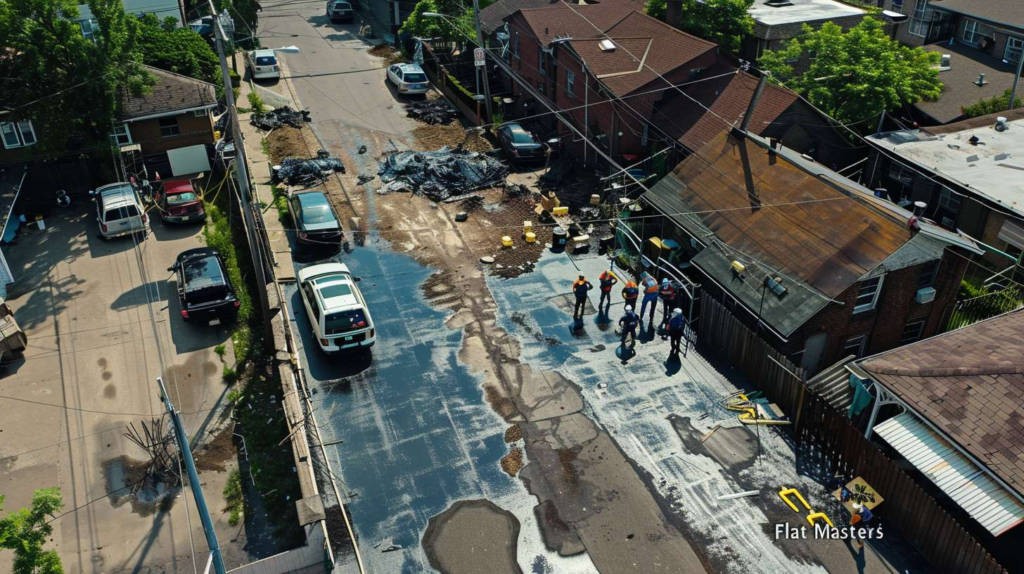
At 1/4 inch per foot, the roof starts telling the truth. That's the baseline pitch required for new flat top roof construction - not steep enough to feel like a slope, but enough that water has a direction instead of a destination it chooses itself. On a new build, deck layout and drain placement get settled before any membrane conversation happens. Material finishes, color, and specification sheets don't fix a low point that was never supposed to exist. Now, follow the water with me, and you'll see exactly why the sequence below isn't optional.
The Early Planning Sequence - Flat Top Roof Construction
Confirm Structural Deck Dimensions and Load Assumptions
Water weight is 5.2 lbs per square foot per inch of depth - knowing the deck's load capacity before anything else keeps ponding from becoming a structural event.
Map High Points and Low Points
Before insulation or framing slope is introduced, you need to know where water naturally wants to travel on the bare deck so you're guiding it rather than guessing.
Set Drain and Scupper Locations
Drains go where water is already trying to go - placing them at true low points means they actually collect instead of sitting in the field doing nothing useful.
Calculate Tapered Insulation or Framing Slope
Whether slope comes from framing or tapered insulation board, the calculation has to match the drain elevation - otherwise you're adding material that fights the water instead of moving it.
Verify Parapet and Flashing Heights Before Membrane Selection
Parapet height determines how much room the base flashing has - if the wall is too short, no membrane choice in the world will give the termination enough surface to hold against driven rain.
| Checkpoint | What Good Looks Like | What Goes Wrong If Missed | What Water Does Next |
|---|---|---|---|
| Deck slope confirmed at 1/4″ per foot minimum | Laser level reads consistent fall toward drain at every field point | Low spots get covered by insulation and membrane before anyone notices them | Ponds form under the membrane and accelerate delamination |
| Drain elevation set below finished insulation surface | Drain bowl sits recessed - membrane terminates into it cleanly without bridging | Drain ends up flush or proud, creating a dam ring the installer has to work around | Water pools at the drain collar instead of entering it |
| Parapet height allows minimum 8″ base flashing | Wall height measured from finished membrane surface - 8″ minimum confirmed before framing is locked | Flashing gets compressed or terminated too low to seat a proper counter-flash | Wind-driven rain tracks behind the membrane at the wall junction |
| Scupper path clear of structural or mechanical interference | Scupper sleeve location confirmed in the framing stage - not retrofitted after walls are built | Sleeve gets relocated by a trade conflict and ends up in a field position instead of a low point | Emergency overflow path is blocked; roof loads up in a heavy storm |
Deck, Drain, and Edge Details Come Before the Pretty Choices
Where the water exits
Before you ask about membrane type, where is the water supposed to go? That's the question I ask every new construction client before we open a single spec sheet, and it's the question that Marta Zielińska - 22 years in flat roofing, with a specific track record of catching slope and drainage errors on new builds before they become costly surprises - settles before material selection ever begins. Queens is unforgiving on this. Tight lot lines in neighborhoods like Jackson Heights and Woodside mean adjoining walls frequently block what would otherwise be a natural scupper location. Parapet-heavy designs on two-story additions hem in the drainage field. And new builds tucked against existing structures often have one viable drain quadrant, which makes it critical to identify that quadrant at the framing stage rather than after insulation is ordered.
I once watched a beautiful new deck hold rain like a cafeteria tray. It was a Long Island City project, a Monday morning after overnight rain, and I was on site by 6:40 with coffee going cold in my hand while the framing crew pointed proudly at how "flat" they'd gotten everything. There were five puddles sitting across that deck like little exam answers marked wrong in blue ink. Not one of them was anywhere near the intended drain location. The deck looked perfect at eye level. At water level, it was a different story entirely - small dips in the sheathing, slightly crowned blocking, one field joist that had settled a quarter inch more than the rest. All of it invisible until rain showed up and made its own map. That was the conversation that reset the project sequence: deck correction, then drain positioning, then insulation layout - in that order.
Here's the blunt version I give people in Queens: a membrane cannot rescue a layout mistake. It can cover one up for a season, maybe two, but it cannot redirect water that has nowhere to go. Parapet height has to be confirmed before roofing subcontractors are even scheduled, because cant strip transitions at the base of a wall require a specific amount of vertical membrane surface to work. Flashing clearance is not a finish detail - it's a structural commitment made at the framing stage. If the parapet ends up 4 inches shorter than it needs to be, you don't solve that with a better adhesive. You solve it with a saw and more lumber, which nobody budgets for in week seven.
⚠️ Quiet Layout Mistakes That Get Expensive After Close-In
- Misplaced drains - set in the field instead of confirmed low points, they collect debris instead of water once the membrane covers the surrounding slope
- Parapets framed too short - less than the required clearance for base flashing height means the membrane can't terminate with enough vertical surface to seal properly
- Blocked scupper paths - when a structural element or mechanical run crosses the intended scupper sleeve location and nobody catches it until the wall is closed, overflow capacity is lost
- Assuming the structural deck is already sloped - new decks are framed level unless slope is explicitly designed in; that assumption has turned more than a few "finished" roofs into emergency corrections
What the perimeter has to allow
Layers Only Work When Each One Helps the Water Leave
The expensive mistakes are usually the quiet ones. Once layout is approved and drain locations are confirmed, the build-up sequence on a new flat roof goes in one direction: vapor control layer if interior humidity conditions call for it, then insulation, then cover board, then membrane, then flashing at walls and penetrations. On a sleet-day walk-through in Ridgewood, I was reviewing a new addition with a young couple while their framing was still exposed. The husband kept asking me about finished roof color. I kept tapping the drain location with my boot, because it had been placed almost where the high point of the slope should have been - not the low point. We fixed it before a single piece of insulation went down, and I still think about what that one quiet correction would have cost if it had been discovered a year later, after the membrane was adhered and the cover board was screwed. Insist on a laser-level verification or a visible water-path check before the membrane is fastened or adhered. That's not extra work - it's the only chance to confirm that every layer beneath the membrane is actually sending water somewhere useful.
Think of it like setting up a science experiment you can't redo cheaply. Every layer in that assembly either preserves the slope or interferes with it. Tapered insulation thickness transitions have to be coordinated with drain sump depths - if the taper reaches the drain at the wrong elevation, you've built a ring dam. Penetration boots need to be set at the right height before the cover board is cut around them, not shimmed up afterward. Edge metal has to be coordinated before membrane adhesion begins, because pulling back adhered membrane to correct a metal height discrepancy is not a repair anyone budgets for. The layers don't fix each other. They amplify whatever is underneath them.
Tapered Insulation in Flat Top Roof Construction - Used Correctly vs. Misapplied
| ✅ Pros | ⚠️ Cons |
|---|---|
| Creates code-compliant slope on a structurally level deck without modifying framing | Costs significantly more than flat board - and that premium disappears if the drain placement is wrong |
| Supports drainage direction when designed in coordination with confirmed drain locations | Sequencing is complex - thickness transitions at walls, drains, and curbs must all be calculated together, not field-improvised |
| Gives retrofit projects a way to improve slope without rebuilding the structural deck | Adds R-value unevenly across the field - thicker sections perform better than thin edges, which can affect energy code compliance if not calculated correctly |
| Reduces ponding duration when the layout is right, extending membrane life meaningfully | Gets used to hide bad drain planning - which just buries the problem under expensive insulation rather than fixing it |
Pre-Membrane Installation Checks
- ✅ Low points confirmed - laser level or water test verifies actual drainage direction matches the plan
- ✅ Drain bowls recessed correctly - bowl elevation sits below finished cover board surface so membrane can terminate cleanly into the clamping ring
- ✅ Tapered plan matches field conditions - thickness transitions in the insulation layout correspond to actual deck dimensions, not the original drawing assumptions
- ✅ Cover board transitions flush - no raised edges at seams or at changes in insulation thickness that would telegraph through the membrane surface
- ✅ Penetrations boxed and elevated - all pipes, conduit, and mechanical curbs properly flashed and raised to minimum heights before membrane work begins
- ✅ Edge metal coordination reviewed - drip edge, gravel stop, or coping base heights confirmed against finished membrane elevation before the first roll is cut
Verification on the Jobsite Is What Separates a Roof System From a Roof Guess
The inspection pass before close-in
Now, follow the water with me - one last time, before the membrane goes down and the roof becomes inaccessible to honest correction. The last meaningful chance to catch a failure isn't during the warranty call two years from now. It's the verification pass, and it happens when the assembly is fully laid out but not yet adhered or mechanically fastened. I had a contractor in Astoria call me near sunset after his crew had loaded half the material onto the roof. The parapets looked "a little off," he said. They weren't a little off. One wall would have left the base flashing with less than three inches of vertical surface - squeezed so tight it would have failed before the first hard summer storm hit Queens. I spent two hours on that roof with a laser level, a red marker, and a very embarrassed site supervisor walking through every wall transition before a single fastener was set. That correction cost an afternoon. Ignoring it would have cost a full re-flash and potential wall damage within 18 months. I'm Marta Zielińska, and in 22 years of flat roofing I have never once regretted stopping to verify - but I've watched other crews regret not doing it. Rushing to close in a new flat roof before the final verification pass is, plainly, a foolish shortcut. The roof doesn't care about the schedule. Water certainly doesn't.
A flat roof does not care who was in a hurry.
Common Misconceptions About How to Build a Flat Top Roof
| Myth | Fact |
|---|---|
| "Flat means level" | A truly level flat roof is a roof with nowhere for water to go. Code requires a minimum 1/4 inch per foot slope, and that slope has to be designed in - it doesn't appear on its own. |
| "The membrane fixes ponding" | Membranes resist water - they don't move it. Ponding shortens membrane life, stresses seams, and eventually finds any weakness in the assembly. The layout fixes ponding. The membrane just holds the line. |
| "Any drain location can work" | A drain placed in the wrong field position sits at a high point relative to where water actually travels. It collects debris and does almost nothing during rain. Location is a drainage decision, not a convenience decision. |
| "Parapet height is finish carpentry's problem" | Parapet height determines whether the base flashing has enough vertical surface to work. That's a roofing requirement locked in at the framing stage - not a trim detail adjusted after the walls are closed. |
| "If it looks clean, it's built right" | A flat roof can look immaculate at eye level and still have a drain in the wrong location, a parapet 3 inches too short, and a low spot covered by cover board. Water doesn't care how clean the installation looks - it cares where the low point is. |
Owner Questions - Flat Top Roof Construction in Queens
If you want flat top roof construction handled with slope mapped before materials are ordered, drainage confirmed before insulation goes down, and a verification pass completed before anything is adhered - call Flat Masters. That's the sequence that builds a roof system, not a roof guess.
