
Flat Tar Roof Leaking? We Repair It Fast - Free Estimate

Flat Tar Roof Leaking? We Repair It Fast – Free Estimate

Flat Tar Roof Leaking? We Repair It Fast - Free Estimate

Usually, the ceiling stain is the last stop on the route - not the first. On a flat tar roof in Queens, water enters somewhere along a failed seam or compromised flashing, travels sideways through wet insulation, and finally drops through your ceiling three rooms away from where the real problem lives. At Flat Masters, we trace that path, fix the actual source, and give you a free estimate before a single tool comes out.

Where Flat Tar Leaks Actually Begin

Think of a flat tar roof leak like a subway line: there's the entry stop, the travel line, and the final stop where everyone finally notices the problem. The drip hitting your bucket? That's Times Square. The real failure might be somewhere on the Queens Boulevard stretch - a split seam near the parapet, a failed pitch pocket, a tarred-over conduit flashing that gave up quietly during the last heavy rain. And the roof is, as always, lying to your ceiling again.
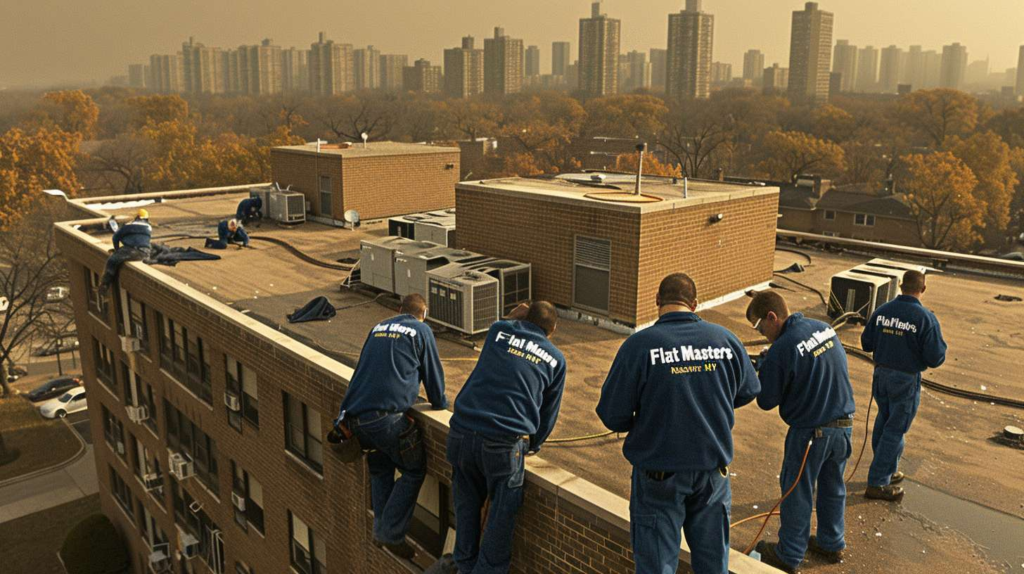
Contractor inspecting a flat tar roof for leaks, with repair tools and materials nearby on a commercial building.

The visible stain doesn't tell the whole story - it tells the end of it. I'm Marcus, and I've spent 17 years in flat roofing, specifically tracking down stubborn flat tar roof leak repair problems in Queens buildings that other crews have patched in the wrong spot twice already. The real diagnostic starting points on Queens flat tar roofs are parapet edges, base flashing where walls meet the membrane, seam transitions over older patches, drains that have backed up through winter, and conduit or HVAC penetrations where tar has cracked away from the sleeve. That's where the investigation starts, not at the stain.

Queens Flat Tar Roof Leak Service - Quick Facts
Response Window
Same day when scheduling allows

Estimate
Free - phone or onsite

Service Area
Astoria, Ridgewood, Sunnyside, Jackson Heights, Maspeth, Elmhurst & surrounding Queens neighborhoods

Typical Leak Sources
Seams, base flashing, blisters, ponding at parapet edges

Should This Leak Be Treated as Urgent?
Water active right now?
YES →
Near electrical fixture or ceiling bubbling?
YES →
Call immediately for emergency tar roof leak repair

NO →
Contain water inside and schedule same-day inspection

NO →
Stain growing after rain?
YES →
Schedule inspection within 24-48 hours

NO →
Monitor and schedule a non-emergency roof check

Signals That Point to the Real Failure

What People Think Is the Problem

Three feet from the parapet is where I start looking, not in the middle where the stain makes everybody nervous. I remember being on a tar roof in Sunnyside at 6:10 in the morning, fog still hanging low over the rooftops, and the landlord kept insisting the leak had to be above the kitchen stain. I pulled up one split seam near the parapet about twelve feet away and found wet insulation that had been channeling water sideways all night. That's a flat tar roof specific leak repair situation where the roof looks completely intact until you press with your boot and feel the sponge underneath. Queens buildings - especially the older mixed-use stock you see packed along the side streets in Astoria, Ridgewood, and Jackson Heights - carry decades of patched penetrations, parapet-heavy rooflines, and tar surfaces worn flat by foot traffic and weather cycles. The failure is rarely where the ceiling says it is.

What the Roof Is Really Doing

What people think is that the center stain marks the leak. What the roof is really doing is feeding water laterally - under felt layers, along base flashing angles, through the path of least resistance until gravity finally wins somewhere in your living room. Water moving sideways through saturated insulation can travel six, eight, even twelve feet before it drops. That's not a mystery; that's just physics on a low-slope roof.

There are specific field signs that point toward targeted tar roof specific leak repair rather than guesswork. Soft spots underfoot are a giveaway - if the membrane sinks when you walk on it, the insulation beneath is already compromised. Alligatoring across open field areas, lifted seam edges, blister formations telegraphing through silver coating, cracked pitch pockets around penetrations, and the same interior drip coming back after every wind-driven rainstorm - those are the real signals worth reading carefully.

Common Flat Tar Roof Leak Assumptions - Myth vs. Reality
Myth Real Answer
The stain on the ceiling is directly below the hole in the roof Water travels laterally through insulation and felt layers on flat tar roofs. The entry point can be feet - or rooms - away from where it finally drips.
More roof cement always helps seal a leak Roof cement applied over a wet surface doesn't bond - it covers. It traps moisture underneath, accelerates deterioration, and makes the eventual proper repair more invasive.
Silver reflective coating fixes an active leak Silver coating is a reflective maintenance product. It bridges nothing, seals no open seam, and will split along existing cracks within one freeze-thaw cycle on a Queens rooftop.
If it stopped dripping, it sealed itself Insulation absorbs and holds water between storms. The drip stopping means the storage capacity filled - not that the entry point closed. The next rain will confirm this.
A small blister in the membrane can be ignored Blisters hold trapped moisture and expand under summer heat. Once the membrane over a blister cracks, you have a direct entry point - and a soft, wet substrate already underneath it.

Visible Clues That Call for a Targeted Tar Roof Repair
  • Split seam near the parapet wall - usually the first failure point on aging tar roofs
  • Failed base flashing at a wall or curb - where vertical meets horizontal is where tar loses the fight first
  • Soft insulation under the membrane - spongy underfoot means water has been living there a while
  • Blister telegraphing through coating - the surface looks bumpy or raised; trapped moisture is pushing out
  • Cracked or open pitch pocket - around HVAC units, conduits, or pipe stacks that have been tarred over and re-tarred
  • Recurring leak after a temporary patch - the same drip after two or three repairs means the real failure zone was never opened

How We Open, Dry, and Rebuild the Leaking Area

What a Proper Tar Roof Specific Leak Repair Includes

Here's the blunt part: tar doesn't forgive lazy prep - and I say that having stood on a Jackson Heights rooftop one August afternoon at 3:30 p.m. where a handyman had smeared silver coating over everything like he was frosting a sheet cake. The roof was hot enough by that point to soften the old patchwork underneath, and every trapped blister was starting to telegraph through the surface in slow motion. I had to explain, pretty calmly but with some effort, that how to repair a flat tar roof leak is not "cover the evidence until sunset." Covering evidence isn't repair. It's just a more expensive problem scheduled for later.

Real repair means isolating the failure zone, removing compromised patch material, cutting out wet or unstable sections when the insulation is already saturated, drying the substrate properly before anything goes back on top, rebuilding the plies with compatible tar roofing materials, reinforcing all flashing details at walls and penetrations, sealing every transition point, and verifying the drainage path before packing up. The insider detail that separates a durable patch from another callback: the repair material has to land on dry, stable membrane well beyond the visible crack or split - not just directly over the stain mark. If your overlap doesn't extend onto sound material, you've drawn a frame around the problem without solving it.

Professional Sequence: Flat Tar Roof Leak Repair
1
Trace the Interior Stain and Map the Travel Path
Mark where water appeared inside, then work backward on the roof surface to find the likely entry corridor - not just the area directly overhead.
2
Probe Seams, Flashing, and Penetrations - Mark the Failure Zone
Test seams manually and with probing tools. Check parapet base flashing, drain collars, and all tarred-over conduit entries. Identify the actual failure point before any material is opened.
3
Remove Failed Patch Material or Cut Out the Wet Section
Old roof cement, delaminated felts, and saturated insulation come out. There's no shortcut here - you can't repair over soft or wet substrate and expect it to hold through a Queens winter.
4
Dry and Prep the Substrate
Surface moisture is allowed to off-gas or is mechanically removed. New material does not go down until the substrate is confirmed dry and clean. This step is where most DIY and quick-patch approaches fail.
5
Rebuild with Compatible Tar Roofing Materials and Reinforced Detail Work
New plies are installed in sequence with proper tar roofing materials. Flashing angles, wall transitions, and penetration collars are rebuilt and sealed - not just coated over. Patch overlap extends well beyond the failure zone onto confirmed sound membrane.
6
Water-Test or Verify the Drainage Path Before Cleanup
The repair area is checked for correct drainage flow and surface integrity before tools leave the roof. If conditions allow, a controlled water test confirms the entry point is closed.

⚠ Why Smearing Roof Cement Over a Leak Can Make the Repair Bigger
  • Traps moisture under the patch - sealed-in water has nowhere to go except deeper into insulation and deck, expanding the damaged zone before anyone realizes it.
  • Hides the actual split seam or open flashing - the failure looks cosmetically covered, making it harder to locate during the real repair and requiring more material removal.
  • Summer heat softens soft patches - on a Queens tar roof in August, a cement patch applied over an existing blister can re-open, buckle, or create new trapped air pockets under the membrane.
  • Makes tear-out harder and more expensive - every layer of cement applied over a failed area is another layer that has to come off cleanly before new material can bond. Stacked temporary repairs compound the final cost.

Repair Scope and Timing in Queens

Last winter in Elmhurst, I peeled back a patch that looked decent from the ladder - smooth surface, no obvious cracking, neatly cut edges - and the insulation underneath had the consistency of wet bread. The original problem was a flashing failure at a low parapet corner, probably small when it started, but the water had been sitting under that neat-looking patch through two or three storms before anyone called. Time and price on a flat tar roof leak repair depend entirely on what's underneath: a simple seam split near a parapet might take a few hours and minimal material; a base flashing failure at a wall transition takes longer because the detail work has to be done right; a saturated section that needs cutting open, drying, and rebuilding is a different scope altogether. Inspection is what determines which category you're actually in.

If the patch looks neat but the insulation underneath feels like a soaked sponge, the roof is not repaired.

Typical Flat Tar Roof Leak Scenarios - Queens
Leak Scenario Typical Repair Approach Usual Visit Length Complexity
Minor seam split near parapet Open seam, clean and dry substrate, rebuild with reinforced tar plies and seal transition 2-4 hours Low
Base flashing failure at wall Remove failed flashing, prep wall and membrane contact area, install new base flashing with proper overlap and seal 3-5 hours Medium
Blister and soft patch zone Cut and remove blistered membrane, inspect insulation condition, rebuild plies and surface - scope depends on how far moisture has spread 4-6 hours Medium
Drain-area leak with debris backup Clear drain, inspect collar and surrounding membrane, repair or replace drain flashing detail and ponding-edge membrane as needed 2-5 hours Low-Medium
Saturated section requiring cut-out and rebuild Full section removal down to dry deck or insulation, allow drying, install new insulation if needed, rebuild full ply sequence with all perimeter detail work Full day or multi-day High

Inspection determines final scope and pricing on every job. These are general reference ranges, not guarantees.

🚨 Call Now - Urgent Situations
  • Active interior drip during or after rain
  • Leak near an electrical fixture or panel
  • Ceiling bubble that's visibly growing
  • Water entering the building after every rain event - no dry periods
🕐 Can Wait Briefly
  • Old stain that hasn't changed size after recent rain
  • Minor moisture mark after one isolated storm - now dry
  • Suspected problem caught during a routine roof check before any storm activity

Questions Homeowners Usually Ask After the Bucket Comes Out

During a cold November rain in Maspeth, a retired piano teacher stood in her hallway with a mixing bowl under a drip and apologized to me for the mess - as if she'd caused it. I traced that whole leak to a tiny failure at the base flashing behind a tarred-over conduit stub, nowhere near the main field of the roof. She thought about it for a second and said, "So the roof leaked in cursive," and honestly that's not a bad description of how water actually moves on a flat tar build. It curves through insulation, redirects along flashing angles, slides down conduit sleeves, and finds the path of least resistance to your ceiling. That's why diagnosis isn't an add-on here - it's the core of the repair. When Flat Masters shows up, figuring out where the leak actually entered is the first job, not a separate consultation.

Common Questions - Flat Tar Roof Leak Repair in Queens
Can a flat tar roof leak be repaired without replacing the whole roof?
Yes - the majority of flat tar roof leaks are repairable at the failure zone without a full replacement. A full tear-off becomes the conversation only when the insulation is saturated across a large area, the deck itself is rotting, or the membrane has reached the end of its serviceable life. Inspection tells you which category you're in before you spend anything.

How long does a tar roof leak repair usually take?
A straightforward seam repair or flashing fix typically takes a few hours. A larger zone that needs to be opened, dried, and rebuilt can run a full day or require a follow-up visit if drying conditions aren't ideal. We don't rush dry time - that's how temporary patches become permanent problems.

Will you need to remove old patches?
Often, yes. Old patches - especially cement-over-cement stacks - hide what's actually happening at the membrane level. If they're soft, delaminated, or sitting over wet insulation, they come off. Leaving compromised material under a new patch is what turns a $300 repair into a $1,500 cut-out job two seasons later.

Is a leak around a parapet wall usually a roof problem or a masonry problem?
It's frequently both - or one masking as the other. Failed base flashing is a roofing failure. A cracked parapet cap or open brick joint is masonry. Water coming through a deteriorated parapet on a Queens building can enter at the cap, travel down the interior face, and exit through the base flashing area on the roof surface. We diagnose both sides before recommending a scope.

Can you repair leaks during cold or wet weather conditions?
Some temporary stabilization can happen in any conditions - stopping active water entry is sometimes a same-day necessity regardless of weather. Full repairs with proper bonded layers need surface temperatures and conditions that allow adhesion and curing. We'll tell you honestly what can be done now versus what needs to wait for a dry window. We'd rather give you that straight than collect a payment on a repair that won't hold.

Why Call Flat Masters for Queens Tar Roof Leaks
🔍

Leak Tracing, Not Guessing
We trace the travel path from ceiling to entry point before opening anything. The fix targets the real failure, not just the stain.
🏗️

17 Years in Flat Roofing
Experienced specifically in flat tar systems - the material behavior, the failure patterns, and the repair details that hold up through Queens winters.
💬

Free Estimates - Phone or Onsite
No charge to look and explain what's happening. You'll know the scope and what it takes to fix it before any commitment.
📍

Local Queens Familiarity
We know the older flat-roof building stock in this borough - the parapet styles, the patch histories, the drainage quirks. That familiarity speeds up every diagnosis.

If your flat tar roof is leaking in Queens - whether it's been dripping since last Tuesday or you just noticed a stain that wasn't there before - Flat Masters can trace the real source, walk you through exactly what the repair involves, and get you a free estimate by phone or onsite. Call us and let's find where that leak actually starts.

Faq’s

Flat Roofing FAQs: Everything Queens, NY Homeowners Need to Know

How much does flat tar roof leak repair actually cost?
Most flat tar roof leak repairs in Queens cost $300-$1,200 depending on the damage size. Small leaks under 10 sq ft run $300-$600, while larger repairs cost more. Emergency calls add 25-50% to these prices. Hidden damage like rotted decking can increase costs significantly.
DIY repairs usually make problems worse and more expensive later. Cold roof cement doesn’t bond properly and just pushes water elsewhere. Professional repairs use hot asphalt at 375-400 degrees for proper bonding. Most DIY attempts hide real issues and increase eventual repair costs.
Simple leak repairs typically take 4-8 hours depending on size and weather conditions. We stock materials locally so there’s no waiting for deliveries. However, if we find rotted decking or extensive damage during inspection, repairs may extend to 1-2 days for proper restoration.
Small $500 leaks often become $2,000+ repairs when ignored. Water spreads under the membrane, rotting decking and insulation. Last month, a “small leak” in Astoria became $1,800 due to 6 months of water damage. Early repair prevents expensive structural damage.
Call professionals when you see water spots on ceilings, gravel washing into gutters, soft roof spots when walking, or standing water after 48 hours. Don’t wait for multiple drips or wall stains. Early professional assessment prevents small problems from becoming major expenses.

Ask Question

Or

Building a Single Garage With a Flat Roof? Here's What Makes It Right

16 min read

The Details Are What Separate a Good Flat Roof From One That Fails in a Few Years

18 min read

Your Flat Roof Doesn't Have to Just Sit There - Here's What You Can Do With It

17 min read

What Does Continuous Ply Flat Roofing Actually Cost? The Numbers Explained

13 min read

Flat Roof Installation for NYC Properties - Built to Last

7 min read

What Does Flat Roof Damage Actually Look Like? Here's How to Spot the Signs

14 min read

Rubber Flat Roof Covering - Installed and Repaired by NYC Experts

6 min read

Your Complete Guide to How to Remove Old Flat Roof Safely

7 min read

Professional Flat Roof Crack Repair Services Near You

6 min read

Which Flat Roof is Best? Your 2026 Guide to Top Options

7 min read

Fix Your Flat Roof Leaking Around Vent Pipe Fast & Affordably

5 min read

Finding a Flat Roof Leak Is Harder Than It Looks - Here's the Proper Method

13 min read

Tarping a Flat Roof Wrong Makes the Damage Worse - Here's the Safe Method

13 min read

How to Level a Flat Roof: 5 Essential Steps for Success

7 min read

Professional Roll Roofing on Flat Roof Installation & Repair

7 min read

How Much Does a Fiberglass Flat Roof Cost? Here Are the Real Numbers

15 min read

That Flat Roof Over the Extension Could Become a Deck - Here's How to Get There

14 min read

Leak at the Edge of Your Flat Roof? Here's What's Happening and How to Fix It

14 min read

Getting Flat Roof Drainage Right on a House Is More Important Than It Looks

15 min read

Flat Roof Leak Repair in NYC - We Find It, We Fix It, We Guarantee It

8 min read

Let's Be Honest About Flat Roofs - Here Are the Downsides Nobody Talks About

14 min read

How Much Does Your Flat Roof Replacement Cost Calculator Save?

6 min read

Velux Flat Roof Windows Let in Serious Light - Here's Everything You Need to Know

16 min read

Garage Flat Roof Construction Isn't Complex - But There Are Details That Matter

16 min read

Professional Flat Roof Scupper Drains Installation & Repair

6 min read
Flat Roof Repair near Addisleigh Park, Queens Flat Roof Repair near Arverne, Queens Flat Roof Repair near Astoria, Queens Flat Roof Repair near Auburndale, Queens Flat Roof Repair near Bay Terrace, Queens Flat Roof Repair near Bayside, Queens Flat Roof Repair near Bayswater, Queens Flat Roof Repair near Beechhurst, Queens Flat Roof Repair near Belle Harbor, Queens Flat Roof Repair near Bellerose, Queens Flat Roof Repair near Breezy Point, Queens Flat Roof Repair near Briarwood, Queens Flat Roof Repair near Broad Channel, Queens Flat Roof Repair near Broadway-Flushing, Queens Flat Roof Repair near Cambria Heights, Queens Flat Roof Repair near Chinatown, Queens Flat Roof Repair near College Point, Queens Flat Roof Repair near Corona, Queens Flat Roof Repair near Douglaston, Queens Flat Roof Repair near East Elmhurst, Queens Flat Roof Repair near Edgemere, Queens Flat Roof Repair near Elmhurst, Queens Flat Roof Repair near Far Rockaway, Queens Flat Roof Repair near Floral Park, Queens Flat Roof Repair near Flushing, Queens Flat Roof Repair near Forest Hills, Queens Flat Roof Repair near Fresh Meadows, Queens Flat Roof Repair near Fresh Pond, Queens Flat Roof Repair near Glen Oaks, Queens Flat Roof Repair near Glendale, Queens Flat Roof Repair near Hammels, Queens Flat Roof Repair near Hillside, Queens Flat Roof Repair near Hollis, Queens Flat Roof Repair near Holliswood, Queens Flat Roof Repair near Howard Beach, Queens Flat Roof Repair near Jackson Heights, Queens Flat Roof Repair near Jamaica Estates, Queens Flat Roof Repair near Jamaica Hills, Queens Flat Roof Repair near Jamaica, Queens Flat Roof Repair near Kew Gardens Hills, Queens Flat Roof Repair near Kew Gardens, Queens Flat Roof Repair near Koreatown, Queens Flat Roof Repair near Laurelton, Queens Flat Roof Repair near Locust Manor, Queens Flat Roof Repair near Long Island City, Queens Flat Roof Repair near Maspeth, Queens Flat Roof Repair near Meadowmere, Queens Flat Roof Repair near Middle Village, Queens Flat Roof Repair near Neponsit, Queens Flat Roof Repair near Ozone Park, Queens Flat Roof Repair near Pomonok, Queens Flat Roof Repair near Queens Village, Queens Flat Roof Repair near Queensboro Hill, Queens Flat Roof Repair near Rego Park, Queens Flat Roof Repair near Richmond Hill, Queens Flat Roof Repair near Ridgewood, Queens Flat Roof Repair near Rockaway Beach, Queens Flat Roof Repair near Rockaway Park, Queens Flat Roof Repair near Rockaway, Queens Flat Roof Repair near Rosedale, Queens Flat Roof Repair near Roxbury, Queens Flat Roof Repair near Seaside, Queens Flat Roof Repair near South Jamaica, Queens Flat Roof Repair near South Ozone Park, Queens Flat Roof Repair near Springfield Gardens, Queens Flat Roof Repair near St. Albans, Queens Flat Roof Repair near Sunnyside Gardens, Queens Flat Roof Repair near Sunnyside, Queens Flat Roof Repair near The Hole, Queens Flat Roof Repair near Whitestone, Queens Flat Roof Repair near Willets Point, Queens Flat Roof Repair near Woodhaven, Queens Flat Roof Repair near Woodside, Queens Flat Roof Repair near Wyckoff Heights, Queens
blue circle

Get a FREE Roofing Quote Today!

Schedule Free Inspection