
Your Flat Roof Doesn't Have to Just Sit There - Here's What You Can Do With It
Stop waiting for it to seal itself. A flat roof can absolutely become useful, attractive space - a garden corner, a shade setup, a seasonal hangout - but how well any of it works has almost nothing to do with your mood board. Success depends on how your decorations, shelters, and furniture touch the roof, how they distribute weight, and whether your drainage stays clear once everything's in place.
Usable rooftops start at the membrane, not at the mood board
Before you add anything up there, what's touching the membrane? That's the question that determines whether your rooftop upgrade is a smart investment or a slow leak waiting to reveal itself two summers from now. Every support foot, furniture leg, planter stand, turf backing, shelter base, and string-light anchor becomes a roofing decision the moment it makes contact with the surface - I'm Elio Ramos, and with 14 years helping Queens homeowners turn bare flat roofs into usable spaces without wrecking the roof system underneath, I can tell you the design always starts at that contact point, not at the Pinterest save.
✏️ What belongs in your first rooftop planning sketch
- ✔Traffic path - where people will actually walk, because foot traffic concentrated in one line creates wear patterns the membrane wasn't designed for
- ✔Drain location - mark it before anything else goes down, because covered drains are how small puddles become big interior problems
- ✔Furniture and support contact points - every leg, foot, and base that touches the membrane needs to be identified before you buy a single piece
- ✔Weight concentration areas - distributed load is manageable; concentrated load from small feet or heavy planters in one spot is a structural conversation
- ✔Wind exposure - Queens rooftops above the second floor catch real crosswind, especially on corner lots and exposed row houses near Jamaica Avenue
- ✔Power and lighting path - how cords route to the roof, where they pass through or over the parapet, and whether any connection point becomes a water entry risk
- ✔Pads and separation layers - whether anything needs a rubber or composite pad between itself and the membrane to prevent abrasion and grit damage
4 Practical Truths About Decorating a Flat Roof
TRUTH 1
Style is the easy part. Picking furniture, choosing turf, hanging lights - all of that is fast. Getting the membrane-contact decisions right is where the real work lives.
TRUTH 2
Membrane contact is the real issue. What sits on the surface, how it's padded, and whether it traps grit or moisture underneath determines how long your roof - and your setup - lasts.
TRUTH 3
Wind matters more than people expect. Items that feel solid at ground level become unpredictable when they're elevated and catching full crosswind, especially in unsheltered urban rooftop conditions.
⚠️ WARNING
Drainage must remain visible and open at all times. Covering a drain with turf, decking, or a furniture arrangement is how a manageable rainstorm becomes an emergency interior repair.
Furniture, turf, and planters go wrong underneath long before they look bad on top
Pretty layouts can still grind grit straight into the roof
I still remember that planter stand leaving a grit ring underneath. It was a warm May evening in Ridgewood - the couple had strung café lights across the whole space, rolled out artificial turf, and set down a gorgeous little bench area that looked straight out of a magazine. Then I lifted one planter stand and found trapped grit grinding into the membrane at every shift. The husband said, "But it looks perfect up here," and I had to tell him that perfect-looking and roof-safe are genuinely not the same thing. That visit became my standing example for flat roof decoration done with real taste but not enough separation from the surface underneath it.
The first question is never color or furniture. On Queens row-house rooftops and compact extension roofs - where every square foot gets reused hard and layouts are tight by default - the evaluation has to start with separation from the membrane, movement control, cleaning access, and drain visibility. A narrow rooftop hangout in Woodside or Jackson Heights doesn't have room for mistakes to hide. Grit, shifting weight, and blocked access points show up faster when the footprint is small and the setup is dense.
| Item | What can go wrong underneath | Safer contact-point rule |
|---|---|---|
| Planter stands | Narrow feet concentrate weight and trap grit; stand shifts with temperature expansion and slowly abrades the membrane | Set on rubber or composite pads at least 4x the foot surface area; leave clearance around base for inspection |
| Outdoor rugs / artificial turf | Backing traps moisture and debris; prevents the membrane from being inspected; can block drainage path if laid across slope | Use modular tiles or roll-up turf so the membrane stays inspectable; never lay across or near drain openings |
| Bench feet | Hard rubber or metal feet with small contact area punch into softened membrane on hot summer days when EPDM or TPO becomes pliable | Fit wide rubber bumpers or purpose-built rooftop furniture feet; recheck contact points after first heat season |
| String-light supports | Pole bases create point loads; wind leverage on the pole multiplies force at the base and can shift the support repeatedly across the membrane | Use ballasted bases with wide rubber footpads; make sure the ballast weight is calculated for actual wind conditions, not just what feels stable by hand |
| Storage boxes | Flat bottom traps standing water between box and membrane after rain; creates a wet zone that never fully dries out and promotes membrane degradation | Place on slatted risers or rooftop pavers so air and water can pass freely underneath; leave clearance on all sides |
| Decorative screens | Act as wind sails; if base isn't weighted or anchored properly the screen walks across the membrane surface, dragging and scratching as it goes | Ballast base heavily relative to screen size; check that movement in wind doesn't drag base contact across the membrane surface |
⚠️ Decor choices that quietly damage flat roofs
- Dragging furniture across the membrane - even once - can scratch or tear the surface layer, especially on EPDM and modified bitumen systems
- Rough-bottom planters placed directly on the membrane without any separation layer trap grit and grind it in every time the planter shifts even slightly
- Covering drains with turf, decking, or furniture is one of the most common causes of preventable flat roof water damage in Queens residential buildings
- Trapping grit under any object that moves - whether from foot traffic, thermal expansion, or wind - turns a surface abrasion problem into a membrane breach over one to two seasons
Shelters and pergola ideas only stay charming if the load path and anchoring plan are real
A decorated roof is like a stage set in the wind - if the base isn't thought through, the pretty part becomes the problem. A flat roof garden shelter idea shifts from a design conversation to a structural and waterproofing conversation the moment posts, feet, ballast, or anchors get introduced. Every support that touches the roof becomes a contact point with load implications. Every anchor that penetrates the membrane becomes a potential leak point. And every shaded canopy or decorative screen that catches wind becomes a lever working against whatever's holding it in place underneath.
Here's the blunt truth: a flat roof is usable space, not consequence-free space. I had a homeowner in Astoria ask me about a flat roof garden shelter after seeing a sleek pergola online - it was a windy September afternoon, and before we even talked style I asked how he planned to secure it. He pointed at the membrane and said, "Can't we just bolt through and seal it?" That's exactly the kind of sentence that keeps roofers awake at night. We ended up having a real conversation about load distribution, ballast options, support pads, drainage clearance, and how to secure decorations on flat roof systems without turning every anchor point into a future leak argument. The pergola he ended up with was great. But it took about 45 minutes of non-style discussion to get there.
My honest opinion? Rooftop ideas usually fail at the feet, not the top. The canopy can be beautiful, the lighting can be perfect, the whole thing can look like a rooftop bar in Long Island City - and if the support feet aren't padded, the load isn't spread, and the drain is three inches from a pergola post that nobody can reach anymore, you've built a problem with good lighting. Here's the insider move worth doing before any installer touches your roof: ask them to show you exactly how each support makes contact with the membrane, what's spreading the load at each point, and whether every drain stays reachable and serviceable once the shelter is installed. If they can't walk you through all three of those, that's your answer before the first piece goes up.
🌿 Can this flat roof decoration or shelter idea move forward safely?
Wind is the design partner nobody invites until the decorations start sliding
Seasonal decor fails fast when it is weighted casually instead of planned deliberately
The first question is never color or furniture. It's whether your rooftop setup has a wind plan - and I learned a long time ago that most don't, until the wind makes its opinion known. I got a December call in Sunnyside after a family's holiday setup partly skidded across the roof in a gusty storm. Nothing dramatic - just enough to scare them and tangle a few extension cords near a parapet drain. They had lightweight decor, a handful of weighted pieces that felt solid by hand, and no real thought about how the whole arrangement would behave in a sustained gust at 30 feet up. I was up there at sunrise with one mitten still on, explaining that flat rooftops are part outdoor room, yes - but they're also fully exposed weather platforms, and wind gets the final vote every single time. If you treat a rooftop like an interior room with sky instead of a ceiling, the sky will correct you, and it will do it on its own schedule.
If the roof stays inspectable and drainable, the design has a chance to last
The best rooftop setups I've seen in my years working across Queens - from Astoria to South Jamaica - all share one thing: you can still lift a section, clear a drain, and eyeball the membrane without dismantling the whole layout. That's not a limitation; that's what keeps the design standing five seasons later. If the pretty layer ever hides the functional layer so completely that nobody can check what's underneath, the design isn't done - it's just waiting to become a repair call. Keep it inspectable, keep it drainable, and the rooftop space you build will actually last.
📋 What to measure or photograph before asking about rooftop decoration, shelter, or seasonal setup
- Roof dimensions - length and width of the usable area, including any setback from mechanical equipment or HVAC units
- Drain locations - photograph each drain and note how many inches of clearance exist around the collar
- Parapet height - how tall is the wall around the perimeter, and does it provide any meaningful wind protection or none at all
- Current membrane condition - note any visible bubbles, cracks, seam separations, or ponding water areas before you add anything on top of them
- Any soft spots or past repairs - walk the roof and note anywhere that feels soft or spongy underfoot; photograph patched areas
- Likely furniture and shelter footprint - rough sketch of where you think items will sit and how large their base areas are
- Wind exposure clues - note surrounding building heights, open directions, and any existing damage from wind on the current roof or parapet
- Access route for materials - how does furniture, shelter framing, or ballast actually get up to the roof, and is that path something that can damage the membrane edge or parapet?
Questions Homeowners Ask About Decorating a Flat Roof Safely
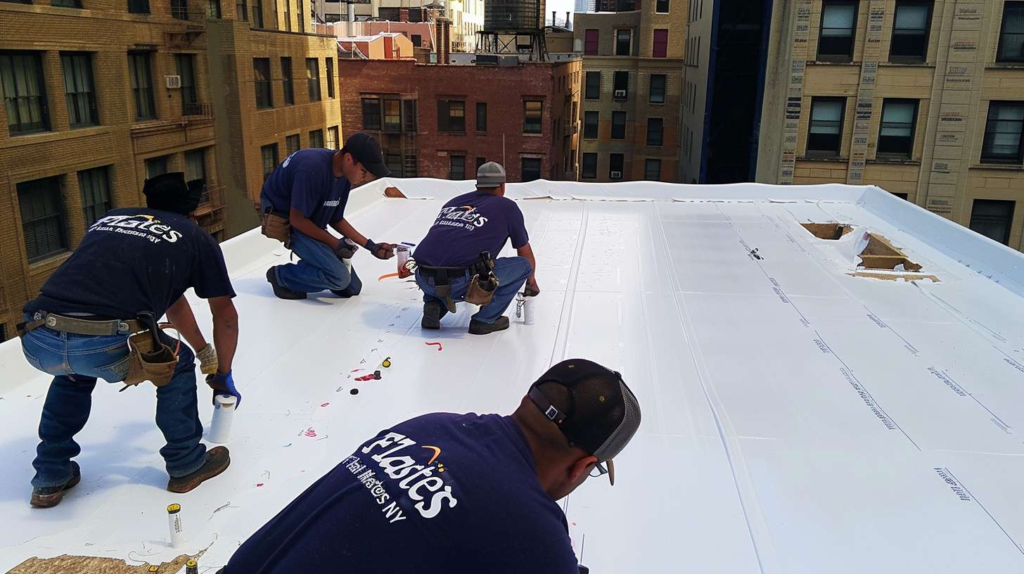
If you're ready to actually use that flat roof - for a garden corner, a shade setup, a seasonal hangout, or a proper shelter - Flat Masters can help you plan it in a way that doesn't make the membrane the sacrifice. Give us a call and let's talk through what your roof can actually handle before anything goes up there.
- Elio Ramos, Flat Masters, Queens, NY
