
What Does a Flat Roof Replacement Cost Per Square Foot? Real Figures Right Here
A few hundred today versus a full rebuild next spring. That is the actual choice sitting behind every flat roof replacement conversation in Queens, and the difference usually comes down to whether the first number you heard was real or just a door-opener. In Queens right now, flat roof replacement cost per square foot runs roughly $9 to $16 and up, depending on membrane type, tear-off depth, insulation condition, and how complicated the roof layout actually is - and the lowest number you'll find advertised almost never includes the items that do the most damage to your budget.
Queens Numbers First: What You May Actually Pay Per Square Foot
In Queens right now, the honest number usually starts at around $9 per square foot for a straightforward full replacement on a clean, single-layer roof with a simple EPDM or TPO system - and it moves toward $14, $15, $16 and beyond once you add tear-off of multiple layers, wet insulation, drain corrections, parapet flashing, and any edge or coping detail that hasn't been touched since the building went up. The contractors quoting $6 or $7 per foot are almost always pricing a recover, not a true replacement, or they're leaving the hard lines out of the number entirely.
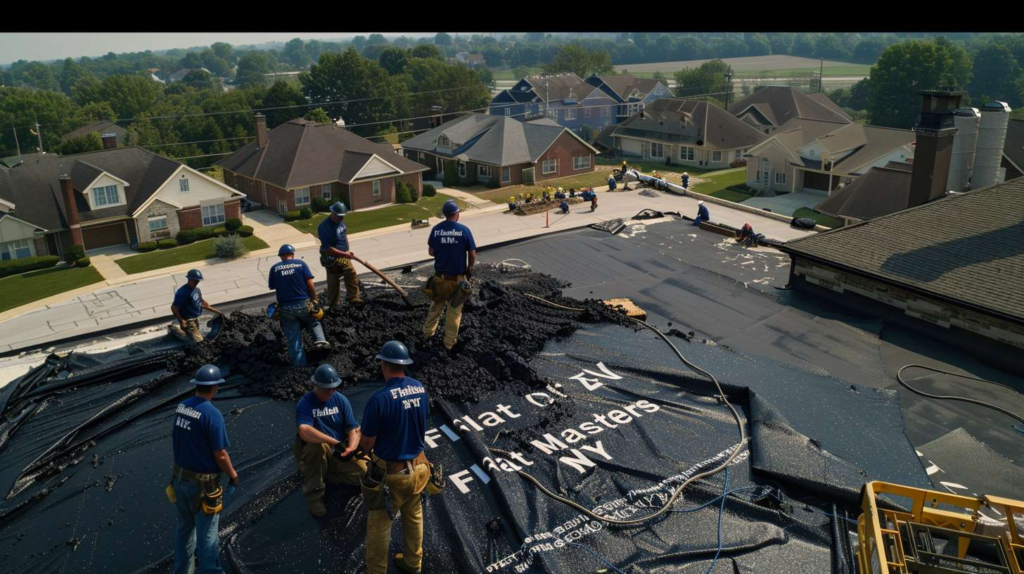
Let me be plain for a second: a square-foot price is just the shell of an estimate. It's a starting point, not an answer. If you were handed a math problem and told the answer without seeing any of the steps, you'd have no idea whether the work was right. Same thing here. Until a quote shows tear-off and disposal, wet insulation removal, drain resets, flashing transitions, edge metal, curb detailing, and debris hauling as separate visible lines - the number on the page is not reliable. That's not an opinion. That's just how the arithmetic works.
Queens Flat Roof Replacement - Quick Facts
Typical Full Replacement Range
$9 - $16+ per square foot in Queens, depending on membrane, layers, and site conditions.
What Low Numbers Usually Skip
Tear-off labor and disposal fees are routinely excluded from low per-foot advertised prices.
Small Roofs Cost More Per Foot
Roofs under 1,000 sq ft often carry a higher per-foot rate; setup, access, and fixed labor don't scale down proportionally.
Biggest Cost Movers
Drainage corrections and insulation replacement consistently move a project from the low band to the middle or upper range.
Where the Estimate Starts Sliding Up
Tear-Off and Disposal
At 7 in the morning on a wet roof, this is what I look at first. I remember one damp Tuesday in March, around 7:10 a.m. in Astoria, standing on a six-family building with a property manager who kept asking me for a "simple square-foot price." The roof looked uncomplicated from the street - flat, nothing unusual. Then I walked the perimeter and found patched seams around three old skylight curbs, a drain that had clearly been re-flashed at least twice, and a soft sag toward the rear that told me the insulation near that drain was holding water. By the time we got back downstairs, he understood why one building gets quoted $9 a foot and another gets quoted $16. That gap isn't padding - it's condition. I'm Marta Zielińska, and after 19 years in flat roofing, I'd say reading drain layout and penetration count before writing a number is the single most reliable way to keep an estimate honest.
Now, if we add the real condition of the insulation to that same roof, the number moves again. Wet polyiso or wet fiberboard doesn't just add material cost - it adds labor hours, disposal weight, and sometimes a tapered replacement system if the existing slope is inadequate. Ponding water is its own separate conversation. A roof that holds water after rain for more than 48 hours is already accumulating dead-load stress and accelerating membrane degradation; correcting that means drain resets, sometimes additional drains, and occasionally a tapered insulation system to redirect flow. Each of those items is a line that separates the $10-per-foot roof from the $14-per-foot roof.
Tear-off, disposal, edge wood repair, and flashing transitions are the three items most likely to disappear from a low bid. In older Queens mixed-use buildings - the kind you find running along Northern Boulevard or lining the side streets off Jamaica Avenue - roofs often have two or three existing layers, parapet walls that haven't been re-coped in decades, and edge conditions that were never flashed correctly to begin with. Stripping all of that, hauling the debris off a tight urban lot, and resetting edge details properly is real labor with real cost. When a bid doesn't show it, the work isn't being skipped - it's being surprised at you later.
| Cost Driver | Why It Changes Price | Typical Direction of Cost | Commonly Omitted in Low Quote? |
|---|---|---|---|
| Tear-Off Layers | Each additional existing layer adds labor hours, disposal weight, and equipment time | ↑ Increases | Yes - frequently |
| Wet Insulation Replacement | Saturated board adds material, disposal, and sometimes full tapered insulation system | ↑↑ Significant increase | Yes - very often |
| Drain Reset / Additional Drains | Raising or relocating drains to correct ponding requires plumbing coordination and reframing | ↑ Increases | Sometimes |
| Parapet Wall Flashing | Deteriorated base flashing at parapets is a primary water entry point; full replacement is labor-intensive | ↑ Increases | Yes - frequently |
| Curb / Skylight Detailing | Each HVAC curb or skylight requires custom flashing; older curbs often need rebuilding | ↑ Per unit increase | Sometimes |
| Edge Metal / Coping Replacement | Rotted edge wood beneath metal must be replaced before new metal goes down; often hidden until tear-off | ↑ Increases | Yes - frequently |
| Difficult Access (Dense Queens Blocks) | Narrow driveways, interior-only hatches, or permit-required street staging add crew time and cost | ↑ Increases | Often |
| Deck / Structural Repairs | Damaged or delaminated roof deck discovered during tear-off; cannot be priced accurately before opening the roof | ↑↑ Can be major | Yes - almost always |
| What Low Bids Often Leave Vague | Phrases like "deck repair as needed," "insulation replaced if required," or "minor flashing included" without defined unit allowances are placeholders for costs the contractor has not committed to - until they send a change order. | ||
⚠ Watch Out: The Suspiciously Low Per-Foot Quote
If a quote uses phrases like "as needed," "minor repairs included," or "price subject to deck condition" without specifying allowance amounts, those lines aren't covering the work - they're creating legal wiggle room for change orders after demolition starts. This isn't about distrusting every contractor. It's about knowing what a complete scope looks like so you can ask the right follow-up questions before anyone picks up a pry bar.
Your Roof Is Not a Spreadsheet Until These Questions Get Answered
If you were sitting across from me at your kitchen table, I'd ask: How many roof penetrations - pipes, HVAC curbs, skylights, vents? How many existing layers are up there? Any visible sagging, or interior leaks near walls rather than drains? Does the estimate you're holding include insulation replacement, or does it say "as needed"? Does the contractor need special staging to reach your roof from the street, or does access run through a narrow side passage? And critically - is this quote covering a full replacement across the whole deck, or just a section? I think about a retired piano teacher in Forest Hills I met during an heat wave August - ninety degrees before lunch, three estimates on her kitchen table like exam papers. She had one quote that looked like a bargain, about $2 per foot lower than the others. When I looked at the scope, tear-off wasn't included, and insulation repair was listed as "allowance TBD." Those two missing lines accounted for nearly $4,000 in work that was absolutely going to happen on that roof. I circled the gaps in blue pen, and she laughed because I was apparently still grading homework.
Comparing two bids without matching their scope lines is, and I'll say this plainly, a meaningless exercise. You're not comparing prices - you're comparing two different projects. And honestly, Queens makes this harder than most places. The building stock shifts dramatically between neighborhoods: a newer two-family in Rego Park has almost nothing in common structurally with a 1940s mixed-use on Hillside Avenue in Jamaica, or a six-family off 31st Street in Astoria. Roof conditions, parapet construction, deck material, drainage infrastructure - they all vary block to block. A per-square-foot figure that makes sense in one building genuinely does not transfer to the next one without a fresh set of eyes on the actual roof.
Do you want the cheaper number, or do you want the complete one?
Before You Call for a Flat Roof Replacement Price - Confirm These 8 Things
- Approximate roof size - measure or pull it from your property records; even a ballpark helps frame the initial conversation.
- Leak locations - note whether leaks appear near drains, near walls, or in the field of the roof; each pattern points to a different problem.
- Age of current roof - if you know when the last membrane was installed, say so; age determines how many layers may have accumulated.
- Known prior coatings or overlays - aluminum coatings or rubber overlays on top of existing roofs change tear-off scope and cost.
- Number of drains or scuppers - count visible drains on the roof and note if any are blocked, slow-draining, or have been recently patched around.
- Photos of penetrations - snap pictures of all HVAC curbs, pipes, skylights, and vents; flashing condition around each one affects the estimate.
- Tenant or commercial occupancy below - if tenants are living or working directly below the roof deck, access scheduling and interior protection add scope.
- Roof access type - note whether access is through a rooftop hatch, interior stairwell, exterior fire escape, or street-facing ladder; tight urban lots sometimes require permitted street staging.
The Arithmetic Nobody Likes, But Everybody Pays For
Replacement vs Repair Confusion
Here is the arithmetic nobody likes, but everybody pays for. Break the bill into clean blocks: membrane system (material and installation labor), tear-off and disposal (per layer, per ton, per haul), insulation (replacement board, tapered system if needed, cover board), flashing and penetrations (base flashing, pipe boots, curb wraps), drainage corrections (drain body replacement, clamping ring, resetting height), edge details (metal, wood substrate, coping cap), and a contingency allowance for what the deck looks like once the old roof is off. Each of those is a number. Each number has a reason. If a contractor can show you every one of those blocks and explain how they arrived at it, the estimate is probably real. If the whole job is just one number per square foot, you're looking at a draft, not a quote.
Change that one variable, and the number moves. After a night storm in October, I was on a small mixed-use building off Roosevelt Avenue just after 6 a.m. The owner was furious - convinced he needed a full replacement immediately. And I understood why. The interior damage was significant. But when I walked the roof, I could see that the membrane itself was still largely intact. The real problem was soaked edge wood running the full perimeter, a coping cap that had been unsealed for years, and water that was wicking down the parapet wall rather than coming through the field of the roof. That changes everything about how much does it cost to replace a flat roof per square foot, because you're not replacing the roof - you're replacing the edge system and repairing what it damaged. Doing a full tear-and-replace on top of that would have cost tens of thousands more than the actual problem required. The insider tip I'd pass on from that job: always ask for a base replacement price, and then ask for separate line items - add-alternates - for wet insulation, deck repair, and edge metal or coping replacement. When those items are priced as additions, not buried in a blended per-foot rate, no one can shift the budget after demolition starts.
One Simple Test Before You Sign Anything
A flat roof estimate behaves a lot like a school exam - miss one line, and the final score changes fast. Before signing, ask the contractor to walk you through each pricing step in plain language: what does the tear-off cost, what does the membrane cost, what does insulation replacement cost per square foot if it's needed, what is the per-unit price for each drain. If they can answer those questions without hesitation, the estimate is real. If they can't, it isn't ready. At Flat Masters, that's exactly how we work - every line visible before anything is agreed to. If you're ready for a flat roof replacement estimate in Queens where every cost step is shown clearly, call Flat Masters and we'll put the full picture in front of you before you make any decisions.