Replacing a Flat Roof? Here's Which Material to Actually Choose for Your Build

Replacing a Flat Roof? Here’s Which Material to Actually Choose for Your Build

Replacing a Flat Roof? Here's Which Material to Actually Choose for Your Build

Use case beats reputation when you are choosing replacement materials

You came to the right spot. There is no single best flat roof replacement material for every build - only the best match for your specific roof layout, exposure, traffic levels, heat load, and how honestly you'll keep up with maintenance. Anyone who tells you differently is selling you a brochure, not a roof.

Before we talk flat roof replacement materials, what kind of life is this roof actually going to live? That question is where every real conversation should start - and it's the same lens I've used since I started in this trade. I'm Samir Adeyemi, and I've spent 8 years helping Queens homeowners choose flat roof replacement materials by fit, tolerance, and real-world behavior instead of brochure status. My old career was buying camera gear for a shop in Astoria, where I steered people away from "best overall" lists and toward the body or lens that matched how they actually shoot. Same philosophy applies here: the conditions, the user habits, and what the system needs to survive matter more than any product's reputation alone.
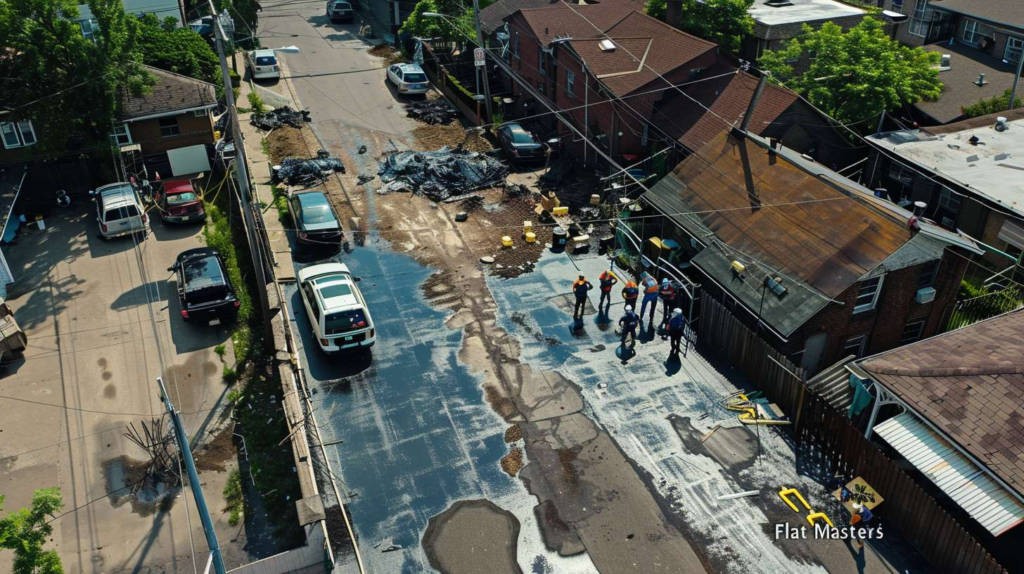
Person inspecting a flat roof surface, assessing materials for potential replacement costs.

DECISION TREE: Which Flat Roof Replacement Material Category Fits This Build Best?

START HERE

Will the roof have many penetrations, odd angles, or awkward details?
YES → Look for detail-friendly systems - materials with strong weld-ability around pipes, curbs, and transitions. Ease of flashing is non-negotiable here.
NO → Continue to next filter.

Will there be service traffic, window washing access, or rooftop use?
YES → Prioritize traffic-tolerant systems with puncture resistance and reinforced membranes that hold up to foot traffic and equipment staging.
NO → Continue to next filter.

Is heat load or top-floor comfort a real concern?
YES → Favor thermal-performance systems with high reflectivity or strong insulation compatibility that reduce heat transfer into occupied space below.
NO → Continue to next filter.

How disciplined will maintenance actually be - honestly?
LOW → Choose a forgiving system - one with redundancy built in, wider maintenance windows, and fewer failure points when inspection cycles slip.
HIGH → More precise systems become viable. Reward comes with consistent upkeep.

✓ RESULT: Best fit for your build - not best in theory.

4 PRACTICAL FILTERS THAT SHOULD CHOOSE YOUR MATERIAL

📐 Roof Geometry

Complicated parapet transitions, curbs, skylights, and tight angles will rule certain materials out before anything else enters the conversation.

🚶 Use & Traffic

A roof that gets walked for HVAC service or future solar access needs puncture tolerance. A purely drainage-only roof can live with a lighter system.

☀️ Heat & Exposure

South-facing Queens rooftops in summer aren't the same environment as a shaded rear addition. Reflectivity, insulation compatibility, and heat tolerance all shift accordingly.

🔧 Owner Follow-Through

Be honest here. A system that requires annual inspection and prompt sealing of any breach is only as good as the person who'll actually pick up the phone to schedule it.

Premium on paper is meaningless if the roof and the owner are a bad match for it

Reputation does not cancel awkward details or lazy maintenance

On my tailgate, materials behave very differently once we stop reading the brochure. I remember a cool May evening in Forest Hills when a homeowner asked me about the best material for flat roof replacement and then immediately admitted he was choosing mostly by what sounded "premium." Honest, at least. His roof had weird little penetrations, limited access, and a future solar plan that changed the conversation more than he realized - because that solar plan meant future seam disruption, added dead loads, and someone walking that surface during installation. I lined up material samples on his patio table the way I used to line up camera lenses: same price range, very different tolerance profiles. The fanciest-sounding option wasn't the smartest fit once his actual roof got a vote.

Here's the blunt truth: a respected material can still be the wrong pick. One bright March morning in Jackson Heights, I visited a replacement job where the homeowner had already been quoted three different answers about flat roof replacement what materials are best - and one contractor had told her there was only one "serious" option worth considering. But the access was awkward, the drain setup was unusual, and not gonna lie, her track record on maintenance was limited. In Queens, rear additions, rooftop skylights, odd drain placements, and tight alley access are genuinely common - the kind of details that make installation quality and material behavior inseparable from each other. A material that demands precise detailing on a roof that's tough to work and tough to revisit isn't a serious option. It's a liability dressed up in brand recognition.

Comparison Point Chosen for Reputation Chosen for Fit
What it prioritizes Brand prestige, neighbor validation, or contractor default preference Roof geometry, access, use case, and the owner's real maintenance capacity
Awkward penetrations May require costly custom detailing or leave weak points at transitions Detail-friendly material is selected specifically because the roof demands it
Maintenance demands May require tight inspection intervals that don't match the owner's habits Maintenance requirements are matched to the owner's realistic follow-through
Tolerance for imperfect upkeep Punishes neglect quickly; small oversights compound into expensive failures Forgiveness is built into the selection - the system suits the owner, not just the roof
Future rooftop changes Solar, HVAC, or skylights can disrupt seams in ways nobody planned for at install Future access and additions are factored into material selection before the first roll goes down
Long-term satisfaction Often leads to regret once real-world performance diverges from brochure language Owners are happier because the system does exactly what was described - for their roof

⚠️ WARNING: When a "Serious Option" Is Serious Overkill

If your contractor leads with their favorite product before they've walked your roof, asked about access, drain configuration, or your future plans - slow down. A material that demands perfect detailing on a hard-to-access Queens residential roof, or requires disciplined annual maintenance from an owner who won't realistically deliver it, is not a serious recommendation. It's a sales pitch wearing a technical name. Brand prestige, neighbor talk, and product mystique are not substitutes for an honest assessment of what this particular roof - and this particular owner - can actually support.

The roof, the building, and the owner all get a vote in the final material choice

I still remember the guy who said he needed a roof that forgave him. That was in Ridgewood, and it cut straight to the point faster than any spec sheet I could have pulled out. The roof was over a busy family kitchen, the top-floor heat was already a daily complaint, and looking at the existing system, it was clear that inspections had been irregular for years. He wasn't apologizing - he was being honest about capacity, and that honesty is exactly what a good material recommendation requires. The heat tolerance question and the maintenance question weren't separate conversations. They were the same conversation.

Choosing a roof material is a lot like choosing camera gear - the right system depends on the conditions, the user, and what kind of mistakes it can survive. A high-performance membrane isn't a bad product any more than a professional mirrorless body is a bad camera. But if the person using it isn't going to clean the sensor, won't shoot in the right lighting conditions, and needs something that can take a knock - then it's the wrong tool, full stop. The roof materials that perform best long-term are the ones chosen against a real picture of what the roof asks and what the owner will actually deliver. Not what sounds best in a conversation at a hardware store on Hillside Avenue.

My take? "Best" is usually shorthand for "best for one very specific situation." A drizzly Astoria evening sticks with me: a garage roof and a rear addition, two sections with completely different heat loads, drainage behaviors, and traffic expectations, and the customer wanted one clean material answer for both. And we did get to one answer - but only after we sat with each section honestly and asked what it would demand. I use this as my insider tip every time someone asks how to evaluate a contractor's recommendation: ask them what roof behavior or owner habit would make them rule this material out before they tell you which one they like. If they can't answer that, they're not giving you a fit recommendation - they're giving you their default pitch. Flat Masters builds every recommendation the other way around.

Real-World Filters That Decide the Best Flat Roof Replacement Material

Filter Why It Matters What Kind of Material Traits It Favors
Penetration complexity Every pipe, curb, and transition point is a potential leak origin if the material can't seal cleanly around it Pliable, weldable, or seamlessly applied systems with strong flashing compatibility at odd angles
Drain behavior Slow drainage, ponding, or unusual drain placement stresses membrane adhesion and seam integrity over time Materials with strong ponding water resistance and proven seam performance under sustained moisture load
Rooftop traffic HVAC servicing, solar panel access, or any rooftop use adds puncture and abrasion risk that many systems aren't designed for Reinforced membranes, higher mil thickness, or built-up systems with inherent redundancy under foot traffic
Heat & solar exposure A dark, unshaded Queens rooftop can reach temperatures that accelerate material degradation and bake heat into top-floor living space High-reflectivity membranes or systems with strong insulation board compatibility to cut heat transfer
Maintenance discipline Some systems are unforgiving when annual inspections slip; a missed early repair can become a full replacement trigger Forgiving systems with wider maintenance windows, visual failure warning, and simpler spot-repair access
Future add-ons or equipment Solar panels, new HVAC units, skylights, or rooftop gardens all mean future roof penetrations and membrane disruption Patchable, re-weldable, or modular systems that allow future additions without voiding the original installation

✅ 7 Questions to Ask Before Accepting a Material Recommendation

  • How does this material handle awkward details? Pipes, curbs, corners, and transitions should have a direct answer, not a vague one.
  • What traffic will it tolerate? Confirm whether foot traffic, staging equipment, or service access was factored into the recommendation.
  • What happens if maintenance slips? Ask specifically how the system behaves when an inspection cycle gets skipped or a minor repair gets delayed.
  • How does it behave under heat? For top-floor comfort and material longevity both, heat tolerance and reflectivity belong in the conversation from the start.
  • What future additions could affect it? Solar, skylights, HVAC replacements - anything that means returning to the roof surface should already be accounted for.
  • What would make you reject this material for this roof? This is the most important question. A contractor who can answer it is thinking about fit. One who can't is pushing a default.
  • What owner habit makes this a bad fit? If they haven't asked about your maintenance habits, they haven't finished their assessment.

A good replacement choice should still feel right after the sales language is gone

If the fit is honest, the explanation gets simpler

On my tailgate, materials behave very differently once we stop reading the brochure. And here's what that actually means as a closing principle: when the right material is chosen against the real filters - use, detailing complexity, maintenance honesty, and what the roof is going to go through in the next decade - the explanation doesn't require a long sales conversation. It gets shorter. The recommendation makes sense on its own because it matches the roof, not a manufacturer's talking points. That's the standard every flat roof replacement recommendation should be held to, and it's the standard Flat Masters brings to every Queens property we work on.

Myth vs. Fact: What Owners Believe About the Best Material for Flat Roof Replacement

✗ Myth ✓ Fact
"There is one best material for every roof." The best material for flat roof replacement is always the one that fits the specific roof's geometry, use, and exposure - not a universal ranking.
"The premium option is always the safest choice." A high-end material on a poorly accessed roof with inconsistent maintenance can fail faster than a well-matched, simpler system.
"One material should work the same across every roof area." Different roof sections - like a garage vs. a heated addition - can have completely different exposure, traffic, and detailing demands that change what works best.
"Maintenance habits don't affect material selection." A system that requires strict annual upkeep is a poor match for an owner who won't realistically deliver it - forgiveness is a legitimate selection criterion.
"A good recommendation should sound universal." A recommendation that sounds the same for every roof is a red flag, not a sign of expertise. The right answer gets more specific, not more general.

Flat Roof Replacement Materials: Common Questions Answered

What is the best material for flat roof replacement?

There isn't one. The best material is the one that fits your roof's layout, penetration count, traffic load, heat exposure, and your realistic maintenance behavior. Any contractor who leads with a universal answer hasn't evaluated your roof yet.

How do I compare flat roof replacement materials without getting lost?

Run each option through real-world filters: how it handles your specific details, what it tolerates under foot traffic, how it performs in heat, and what happens if an inspection cycle slips. Specs on paper matter less than behavior on your actual roof.

Does heat, traffic, or solar planning change the choice?

Significantly. Planned solar panels mean future seam disruption and added load - some materials handle re-penetration much better than others. Heavy summer heat loads favor reflective or well-insulated systems. Regular rooftop traffic demands puncture-resistant membranes. Each of these shifts the answer.

Can one material work for two very different roof areas?

Sometimes, but only after each section is evaluated honestly. A garage roof and a rear extension over a heated kitchen are different environments. One material choice can work for both - but it should be the result of a real conversation about what each area will ask from it, not a shortcut to simplicity.

What should a contractor ask me before recommending a system?

They should ask about your roof's penetration count, access conditions, drain configuration, any future plans for solar or HVAC, top-floor heat issues, and honestly - your maintenance habits. If they skip those questions and jump straight to a material name, push back. Fit-first recommendations take a few more minutes. They're worth it.

Do you want the most recognized material on the market, or the one your roof can actually live with for the next 20 years? Those aren't always the same answer - and knowing the difference is where a good replacement starts. Call Flat Masters for a fit-first flat roof replacement recommendation built around your Queens property, not a product catalog.

Faq’s

Flat Roofing FAQs: Everything Queens, NY Homeowners Need to Know

How much should I budget for flat roof replacement materials?
For a typical 1,200 sq ft flat roof, expect $4,200-$21,600 in materials. EPDM rubber is the budget option at $3.50-$7.50/sq ft, while premium PVC runs $8-$18/sq ft. Your total depends on membrane choice, insulation needs, and roof complexity.
While possible, flat roofing requires specialized tools, safety equipment, and expertise. Improper installation voids warranties and can lead to costly leaks. Professional installation ensures proper sealing, drainage, and manufacturer warranty coverage.
60 mil EPDM offers great value for most buildings – reliable, repairable, and 20-25 year lifespan. For energy savings, white TPO costs more upfront but reduces cooling bills by 25%. Match the material to your specific building needs and budget.
Delaying replacement risks water damage to your building’s structure, insulation, and interior. Emergency repairs cost 3-4 times more than planned replacement. Failing membranes can also void insurance coverage for water damage claims.
Quality EPDM lasts 20-25 years, modified bitumen 15-20 years, and premium TPO/PVC can exceed 25 years. Lifespan depends on installation quality, maintenance, and material grade. Cheap materials often fail in 8-10 years, making them costlier long-term.

Ask Question

Or

What's Holding Your Flat Roof Up? Here's the Structural Support It Depends On

17 min read

Residential Flat Roof Maintenance in NYC - Stay Ahead of Problems

7 min read

Asphalt Flat Roof Leaking? We Find It and Fix It Fast

6 min read

Converting a Flat Roof to a Pitched One Is a Big Job - Here's What It Takes

13 min read

Lights on a Flat Roof Can Transform the Space - Here's How to Install Without Leaks

19 min read

Connecting a Flat Roof to a Cavity Wall - Here's the Detail That Makes or Breaks It

13 min read

A Single Storey Flat Roof Extension Is Often the Most Cost-Effective Way to Add Space

13 min read

Professional Flat Roof Deck Waterproofing Services Near You

5 min read

How Much Does It Cost to Felt a Flat Roof? The Numbers That Actually Matter

13 min read

Flat Roof Fascia Detail - Installed and Repaired by NYC Specialists

7 min read

Flat Roof Skylight Windows - Installed and Repaired by NYC Pros

7 min read

How to Felt a Garage Flat Roof: Professional Installation Guide

6 min read

Everything You Need to Know About Flat Roof Costs - Before You Call Anyone

17 min read

Can You Actually Tarp a Flat Roof? Honest Answer: It Depends on a Few Things

16 min read

Professional Flat Roof Scupper Downspouts Installation & Repair

5 min read

Puddles Sitting on Your Flat Roof After Rain? That's a Problem You Can Fix

17 min read

The Best Way to Fix a Leaking Flat Roof - from NYC's Top Experts

7 min read

Flat Roof Not Draining Properly? The Slope May Need Correcting - Here's How

14 min read

Insulation Is What Makes a Flat Roof Energy Efficient - Here's How to Get It Right

17 min read

Triple Glazed Flat Roof Windows Keep Heat In and Noise Out - Here's What's Available

15 min read

How to Make a Flat Roof House Look Better: 5 Design Solutions

7 min read

Building a Flat Roof for an Extension? Here's What the Build Really Involves

16 min read

There's More Than One Way to Cover a Flat Roof - Here Are All Your Options

17 min read

Can You Have Flat Roof in Snow? Expert Solutions & Safety Tips

7 min read

Snow Is Heavy - And Your Flat Roof Needs to Be Designed to Handle the Weight

14 min read
Flat Roof Replacement near Addisleigh Park, Queens Flat Roof Replacement near Arverne, Queens Flat Roof Replacement near Astoria, Queens Flat Roof Replacement near Auburndale, Queens Flat Roof Replacement near Bay Terrace, Queens Flat Roof Replacement near Bayside, Queens Flat Roof Replacement near Bayswater, Queens Flat Roof Replacement near Beechhurst, Queens Flat Roof Replacement near Belle Harbor, Queens Flat Roof Replacement near Bellerose, Queens Flat Roof Replacement near Breezy Point, Queens Flat Roof Replacement near Briarwood, Queens Flat Roof Replacement near Broad Channel, Queens Flat Roof Replacement near Broadway-Flushing, Queens Flat Roof Replacement near Cambria Heights, Queens Flat Roof Replacement near Chinatown, Queens Flat Roof Replacement near College Point, Queens Flat Roof Replacement near Corona, Queens Flat Roof Replacement near Douglaston, Queens Flat Roof Replacement near East Elmhurst, Queens Flat Roof Replacement near Edgemere, Queens Flat Roof Replacement near Elmhurst, Queens Flat Roof Replacement near Far Rockaway, Queens Flat Roof Replacement near Floral Park, Queens Flat Roof Replacement near Flushing, Queens Flat Roof Replacement near Forest Hills, Queens Flat Roof Replacement near Fresh Meadows, Queens Flat Roof Replacement near Fresh Pond, Queens Flat Roof Replacement near Glen Oaks, Queens Flat Roof Replacement near Glendale, Queens Flat Roof Replacement near Hammels, Queens Flat Roof Replacement near Hillside, Queens Flat Roof Replacement near Hollis, Queens Flat Roof Replacement near Holliswood, Queens Flat Roof Replacement near Howard Beach, Queens Flat Roof Replacement near Jackson Heights, Queens Flat Roof Replacement near Jamaica Estates, Queens Flat Roof Replacement near Jamaica Hills, Queens Flat Roof Replacement near Jamaica, Queens Flat Roof Replacement near Kew Gardens Hills, Queens Flat Roof Replacement near Kew Gardens, Queens Flat Roof Replacement near Koreatown, Queens Flat Roof Replacement near Laurelton, Queens Flat Roof Replacement near Locust Manor, Queens Flat Roof Replacement near Long Island City, Queens Flat Roof Replacement near Maspeth, Queens Flat Roof Replacement near Meadowmere, Queens Flat Roof Replacement near Middle Village, Queens Flat Roof Replacement near Neponsit, Queens Flat Roof Replacement near Ozone Park, Queens Flat Roof Replacement near Pomonok, Queens Flat Roof Replacement near Queens Village, Queens Flat Roof Replacement near Queensboro Hill, Queens Flat Roof Replacement near Rego Park, Queens Flat Roof Replacement near Richmond Hill, Queens Flat Roof Replacement near Ridgewood, Queens Flat Roof Replacement near Rockaway Beach, Queens Flat Roof Replacement near Rockaway Park, Queens Flat Roof Replacement near Rockaway, Queens Flat Roof Replacement near Rosedale, Queens Flat Roof Replacement near Roxbury, Queens Flat Roof Replacement near Seaside, Queens Flat Roof Replacement near South Jamaica, Queens Flat Roof Replacement near South Ozone Park, Queens Flat Roof Replacement near Springfield Gardens, Queens Flat Roof Replacement near St. Albans, Queens Flat Roof Replacement near Sunnyside Gardens, Queens Flat Roof Replacement near Sunnyside, Queens Flat Roof Replacement near The Hole, Queens Flat Roof Replacement near Whitestone, Queens Flat Roof Replacement near Willets Point, Queens Flat Roof Replacement near Woodhaven, Queens Flat Roof Replacement near Woodside, Queens Flat Roof Replacement near Wyckoff Heights, Queens
blue circle

Get a FREE Roofing Quote Today!

Schedule Free Inspection