
Lights on a Flat Flat Roof Can Transform the Space - Here's How to Install Without Leaks
I hate seeing this happen. A property owner strings up beautiful café lights across a flat roof, the setup looks stunning for about three weeks, and then the ceiling below starts showing water stains that nobody can explain - until I get up there and find cords draped through ponding zones, anchors punched straight through the membrane, and nowhere for the water to go except down. On a flat roof, the first job is reading how water moves. Punctures, unstable anchors, and trapped moisture will wreck a building long before the lights ever burn out.
Water Paths Decide the Lighting Plan
I hate seeing this happen - and I see it often enough that it's the first thing I say when someone calls asking about flat roof lighting installation. On a flat roof, where you put the lights is secondary to drainage pattern, membrane protection, and anchor stability. That order of priorities is not flexible. Attractive placement sounds reasonable, but roofs do not care what sounds reasonable, and they will find every shortcut the moment the weather shifts.
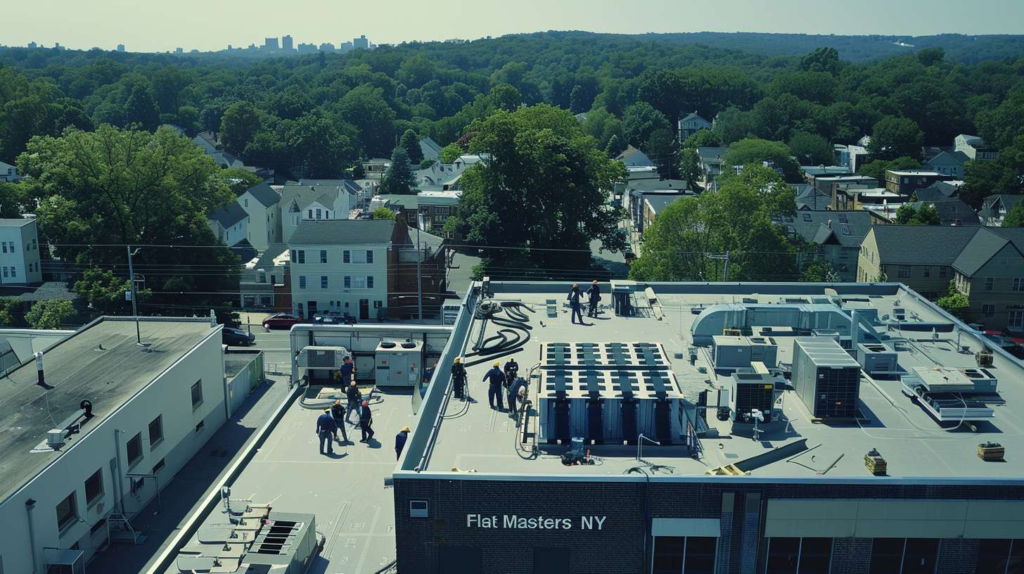
On a Queens roof at dawn, the puddles will point out every mistake before I do. Every ponding area, every scupper, every seam line and parapet edge is already telling you where not to set a base or leave a cord. That sounds obvious until you're standing on an Astoria rowhouse roof trying to figure out why the owner placed a weighted stand directly over the only internal drain. Roofs don't organize themselves around aesthetics - water always votes, and it votes with leaks.
⚠️ Three Ways Flat Roof Lighting Installation Causes Leaks
- Drilling through the field membrane for posts or mount hardware - every hole is a future leak point, especially on occupied buildings where the staining shows up two floors down.
- Tying lights or guide wires to vents, pipes, or HVAC equipment - these penetrations already have flashing details that weren't designed to carry load or shed cord water.
- Laying extension cords through ponding zones - standing water wicks under cord jackets, creates abrasion points, and gives moisture a direct travel path toward any nearby seam.
Water tells on shortcuts.
| Roof Area | Usually Acceptable for Lighting? | Primary Risk | Safer Approach |
|---|---|---|---|
| Open field away from drains and seams | Yes - with proper bases | Wind displacement of unsecured stands | Weighted stands with protective rubber pads; no membrane contact without pads |
| Near or over internal drains | No | Bases or cords block drainage; ponding escalates fast on small Queens rooftops | Keep a clear 24-inch minimum radius around every drain opening |
| Along parapet walls | Conditionally | Fastening into parapet cap or coping without proper flashing voids waterproofing | Use non-penetrating parapet clamps rated for the wall thickness; confirm with a roofer first |
| Over membrane seams or patches | No | Weight and abrasion accelerate existing seam weakness; common on older mixed-use roofs in Jackson Heights | Map all seams before placement; route lights away from any repaired or raised membrane areas |
Skip the Membrane Holes and Build Stable Support Instead
Weighted Bases Beat Improvised Anchors
Let me be blunt: if your first idea involves drilling the membrane, stop right there. Unsupported penetrations don't fail dramatically - they fail quietly, and you won't see the evidence until it's already inside the building. Moisture migrates horizontally through insulation layers for weeks before it shows as a ceiling stain, and by then the damage costs three times what the lights were worth. I'm Rosa Velásquez, and I've been doing flat roofing in Queens, NY for 19 years with a specialty in roof penetrations, lighting details, and leak tracing on occupied buildings - and as I've seen repeatedly, the jobs that end in callbacks almost always involve someone who thought a drill was faster than thinking through the anchor strategy.
I remember one café owner who thought zip ties counted as engineering. This was in Astoria, early morning, and I was there because the lights he'd rigged for a rooftop happy hour had shifted overnight. He'd zip-tied string light spans to a vent stack and laid the rest across two loose pavers that weren't seated against anything. It had rained, and every low spot on that roof was showing me exactly what went wrong - cords sitting in standing water, one paver had already walked two inches downhill, and the vent stack flashing had stress marks at the base where the wire tension kept pulling. He said, "But it looked great on Instagram." I pulled the whole setup and replaced it with weighted steel stands on rubber isolation pads, cord runs clipped above the water line, and zero contact with any penetration. That's the field-tested version. The zip tie version is just a delayed repair bill wearing a party hat.
Wire management is its own plan - not an afterthought. Cords routed across the field membrane need to stay elevated above drainage paths, secured with UV-rated clips attached to the base stands rather than stapled, screwed, or looped around anything that penetrates the roof. Keep slack managed with service loops that sit above standing water zones, and never run a wire tight across the roof surface where foot traffic or thermal movement can create abrasion. Honestly, improvised anchors aren't clever - they're delayed repair bills, and the roof will always collect on that debt before the owner does.
What a Reliable Light Installation Actually Includes
- ✅ Protective rubber or EPDM pads under every weighted base - direct contact between concrete ballast and membrane causes abrasion damage over time
- ✅ Spacing that avoids all active drainage paths - bases and cord runs clear of drains, scuppers, and low-point zones by at least two feet
- ✅ UV-rated outdoor wiring throughout - standard indoor extension cords degrade quickly under Queens summer sun and are not rated for rooftop exposure
- ✅ Secured slack management at every base - loose cord between stands creates trip hazards and allows wind to create repeated tension loads on anchor points
- ✅ Service loops positioned above standing water zones - any low cord point that can collect water will eventually wick moisture toward connections
- ✅ Membrane condition checked before setup begins - existing soft spots, blisters, or open seams change where bases can safely sit and whether installation should even proceed
Map the Roof Like a System Before Any Fixture Goes Up
Before I touch a light, I ask the customer one question: where do you think the rain goes? Most people point vaguely toward one side of the roof and say "over there," which means they haven't actually mapped it. The correct order of operations starts with identifying slope, then drains, scuppers, and gutters, then seam lines, then the roof access path and electrical source, and finally the maintenance walk route - all before deciding where the lights will look good. Think of it like a lunch tray in a school cafeteria: once water starts moving, it carries everything toward the low side, and if your cords, bases, and wire runs aren't already out of that path, the roof will sort them out for you. The visual plan comes last. It always does.
Pre-Install Roof Mapping Sequence for Flat Roof Lighting
-
1
Spot low areas after rain - Walk the roof after a rain event or check for dried watermarks. Every ponding zone is a no-go for bases, cords, or anchor points.
-
2
Locate all drains and scuppers - Mark them physically with chalk or tape. These define your exclusion zones before anything else on the roof gets decided.
-
3
Mark no-place zones around seams and penetrations - Field seams, repair patches, pipe boots, and HVAC curbs all need clearance. Any cord or base near these areas adds stress to an already sensitive detail.
-
4
Choose your support type - Based on membrane age, warranty status, and parapet condition, decide between weighted stands, edge-mounted non-penetrating hardware, or a combined approach.
-
5
Plan the cable route back to power - Cord path should run along the high side of the roof slope, never across drainage paths. Confirm your electrical source, outlet location, and whether a GFCI circuit is in place.
-
6
Test for trip hazards and maintenance access - Walk the planned layout at night if possible. Every base, cord span, and service loop should allow a person to inspect the roof without stepping over wires or into dark low spots.
If a storm hit tonight, would you trust every anchor point you planned?
Should This Roof Use Non-Penetrating Lighting Support?
Queens Conditions Make Small Mistakes More Expensive
Wind, Freeze-Thaw, and Occupied Spaces Change the Risk
Here's the part people don't enjoy hearing - a flat roof is not a patio with a black floor. It's a waterproofing system under tension, thermal stress, and foot traffic, and Queens buildings add layers of complication that rooftops in calmer climates don't have. Rowhouses in Astoria and Long Island City sit exposed to prevailing winds off the water, and an unsecured 15-pound weighted stand can walk two feet overnight in a November gust. Mixed-use buildings in Jackson Heights carry retail or restaurant space below - one displaced base that blocks a drain means ponding, and ponding in a freeze-thaw cycle means cracked membrane, seeping water, and a ruined ceiling in a space someone is paying rent for. Ridgewood's older attached housing stock carries its own challenge: many of those roofs have layers of repair work going back decades, which means the surface that looks solid might have compromised flashing beneath that no one has touched in fifteen years. Parapet conditions vary wildly across all of these neighborhoods, and what's structurally sound on one building does not transfer to the next one on the block.
Water is the honest witness here - it doesn't read the sales brochure, and it will find every hole once the weather shifts. I know this firsthand from a February call in Ridgewood, where a co-op board had hired a handyman to mount light posts for a roof deck. By the time I got there, he'd drilled straight through a membrane that was less than four years old. I had six nervous board members, one genuinely angry super, and three fresh leak points I marked in blue tape, one by one, kneeling on that cold roof with my gloves off so I could feel the flex in the membrane around each hole. "These aren't lighting holes," I told them. "These are future ceiling stains." The repair bill for that job was more than three times what the original installation cost, and not a single board member thought it was a reasonable trade for string lights.
| What People Assume | What the Roof Actually Does |
|---|---|
| "It's only a few screws - won't cause any real damage." | Each screw through a field membrane is an unflashed penetration. Water migrates horizontally through insulation for weeks before showing as a stain. By then, the damage is already done. |
| "Zip ties are fine for lightweight string lights - no real load." | Zip ties on vent pipes, HVAC curbs, or pipes transfer tension directly to flashed penetrations not designed for lateral load. One good wind event and the flashing fails, not the zip tie. |
| "If it doesn't leak right away, the installation is fine." | Flat roof leaks routinely take weeks to show. The membrane may bridge the hole initially, but thermal cycling, freeze-thaw stress, and foot traffic widen it. Absence of immediate dripping is not confirmation of a watertight seal. |
| "The roof membrane is basically a deck surface - it can handle furniture and fixtures." | The membrane is a waterproofing skin, not a structural floor. It was designed to shed water, not resist point loads from posts or edge pressure from unsupported hardware without protective distribution pads. |
| "Any handyman can mount lights safely on a flat roof." | Light installation on a flat roof requires understanding drainage patterns, membrane type, penetration details, and wind load - none of which are part of a standard handyman job description. The Ridgewood co-op board found this out the hard way. |
Local Conditions That Alter the Lighting Detail
Finish With Inspection, Testing, and a Leak-Safe Maintenance Routine
Think of the roof like a lunch tray in a school cafeteria: once water starts moving, it carries everything toward the low side, and the job isn't done when the lights turn on - it's done when the first real storm confirms nothing moved. After installation, the final checks cover stability under wind load, cord lift above wet zones, clear drain paths with no new obstruction, no abrasion points where a wire crosses a base edge or parapet lip, and nighttime visibility without new trip hazards along the maintenance path. I finished a job on a private roof in Long Island City about an hour before a summer thunderstorm came through sideways - homeowner had two kids, birthday dinner that night, lights absolutely had to work and nothing could leak. We used weighted bases on isolation pads, isolated every wire run off the membrane surface, and kept every fastener out of the field. At 9:40 that night, mid-storm, the homeowner sent me a photo of the lights glowing and one text: "No drips." That's the benchmark. A flat roof lighting installation is successful when nobody notices the roof at all.
Here's the insider tip that separates a finished job from a proven job: after the first hard rain, get back up there in daylight and re-check every base, cable run, and drainage point before you call it complete. That's when water reveals the things a dry walkthrough doesn't - tension points where a cord pulled tighter than expected, a pad that shifted a half-inch toward a drain, an abrasion mark where a service loop rubbed against a base edge overnight. Worth doing before winter, too. Freeze-thaw cycles in Queens will stress anything that's even slightly out of position, and what was snug in September can be a problem by December. Plan a follow-up after major storm events through the season, and a full inspection at seasonal takedown or annual service.
Before You Schedule Flat Roof Light Installation - Verify These First
-
☐
Roof membrane age, if known - A membrane under 5 years old almost certainly has an active warranty. A membrane over 15 years old may have underlying issues that change the support options available. -
☐
Whether there is an active manufacturer's warranty - If yes, confirm which accessories and installation methods are approved before anything gets placed on the roof. -
☐
Where power will come from - Confirm outlet location, whether a GFCI circuit is in place, and the planned route for the main supply cord from power source to roof field. -
☐
Whether the roof has had leaks before - Prior leaks mean prior vulnerability. The installer needs to know about them to avoid placing weight or cords in areas with known history. -
☐
Who has regular roof access - If multiple tenants, supers, or maintenance staff access the roof, the installation plan needs to account for foot traffic patterns and not create hazards in those paths. -
☐
Whether lights are seasonal or intended to be permanent - This changes the support system, wire management approach, and whether the installation plan needs to accommodate safe winter storage of components.
Questions Building Owners and Property Managers Ask Most
Can you hang string lights on a flat roof without drilling?
Yes - and on most Queens rooftops, that's exactly what you should do. Weighted stand systems with isolation pads can support span lengths suitable for residential and small commercial rooftops without a single membrane penetration. The key is sizing the ballast weight to the wind exposure and keeping cord runs elevated above drainage paths.
What if the roof already ponds water?
Ponding is a sign the drainage system needs attention before any installation happens. Placing bases, cords, or any hardware in or near a ponding zone increases drainage obstruction and membrane stress. Address the drainage issue first - that's a conversation for a flat roofing contractor, not a lighting installer. Don't skip this step.
Can lights be attached to parapets or railings instead of the membrane?
Sometimes, conditionally. Non-penetrating parapet clamps designed for the specific wall thickness and construction type can work well for edge-run fixtures. What you don't want to do is screw or bolt directly into a parapet cap or coping without a roofing contractor confirming that the existing flashing detail can accommodate it. Parapet flashing failures are some of the most common leak sources on Queens flat roofs.
How often should the setup be inspected?
Immediately after installation, after the first heavy rain, before winter sets in, after any high-wind event, and at seasonal takedown or annual service. That schedule isn't excessive - it's the minimum needed to catch shifts, abrasion points, and drainage blockages before they become leak events. Five checkpoints a year protects a membrane that cost thousands to install.
Inspection Schedule After Flat Roof Light Installation
Immediately After Installation
Walk the full layout in daylight and again after dark. Check every base for level and pad contact, verify all service loops are elevated, and confirm drain clearances with a physical measure.
After the First Heavy Rain
This is when water reveals everything. Re-check base positions for any drift, look for new abrasion marks, verify cords didn't wick moisture at connection points, and confirm drains are still unobstructed. Re-check in full daylight - not right after the storm.
Start of Winter
If lights are seasonal, take them down before the first hard freeze. If permanent, check that no cord run sits in a position where ice formation can create tension or abrasion. Freeze-thaw cycles in Queens will shift anything that wasn't fully secure going into cold weather.
After High-Wind Events
Any storm with sustained winds above 35 mph warrants a next-day walkthrough. Check that no base shifted toward a drain, no cord span pulled a clip loose, and no stand tipped against a parapet edge. Upper-story Queens rooftops are particularly exposed.
Seasonal Takedown or Annual Service
Full inspection of membrane condition under every base pad, replacement of any worn isolation pads, UV-rating check on all cord jackets, and review of the drainage field to confirm nothing has shifted the original layout. If the membrane has aged another year, reassess whether support placement still reflects current roof conditions.
If you want flat roof lighting installation in Queens without gambling on leaks, let Flat Masters inspect the roof's drainage path, support options, and wire routing before anything gets mounted - because a well-lit rooftop and a dry ceiling aren't competing goals if the work is planned correctly from the start.