
A Leak-Proof Flat Roof Isn't a Dream - It Just Takes the Right System
Hidden. That's where most flat roof leaks actually live-not in the obvious crack or the dramatic hole people expect, but tucked inside a chain of small failures across an underperforming system: a seam that was never fully adhered, a drain that slows just enough, flashing that was never tied in properly from the start. A genuinely leak proof flat roof is achievable in Queens, but only when the diagnosis follows water travel, seam behavior, drainage, and transitions together as one coordinated system-not as a list of isolated spots to patch.
Why Flat Roof Leaks Keep Returning After "Repairs"
Most people assume there's one bad spot letting water in. Find it, seal it, done. But that's not the part that decides whether it stays dry. Water on a flat roof doesn't announce itself at the source-it travels. It moves along the membrane, finds a low point, ducks under a lap, migrates through wet insulation, and eventually shows up on your ceiling six feet from where it entered. The stain in the corner isn't the culprit. It's the last stop on a longer trip.
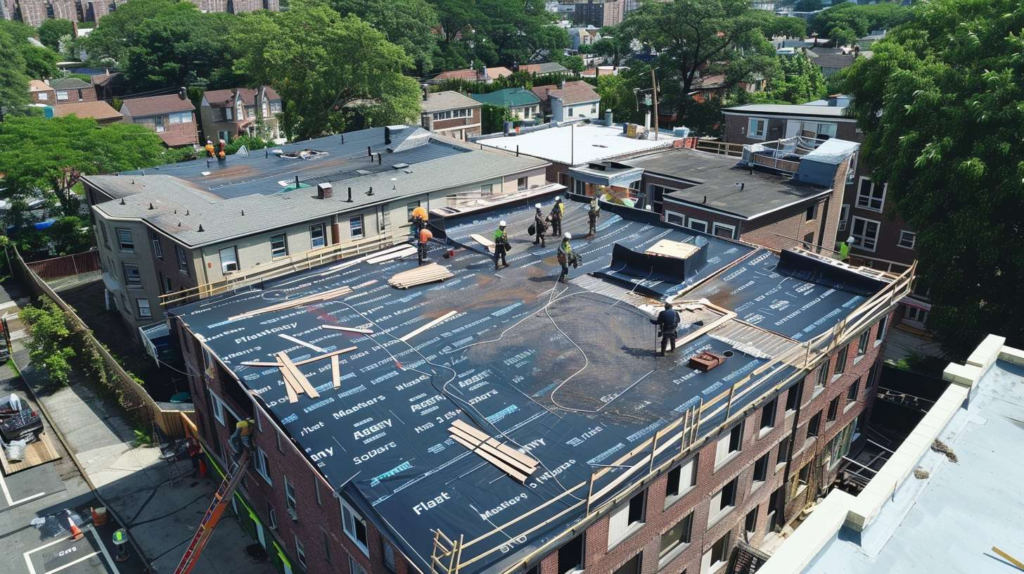
And here's where repeated patching becomes a real problem. Leaks are bad choreography-water follows cues, finds openings, and exposes every single piece of a roof system that's out of position. When you slap mastic over one seam without diagnosing the whole sequence, you're not fixing the choreography. You're just reassigning the cues. Honestly, I don't consider repeated patching a serious plan when the roof system was never properly diagnosed. You end up with a roof that has three different crews' fingerprints on it and still leaks every August.
| Myth | What's Actually Happening |
|---|---|
| The stain marks the source. | Water travels horizontally through insulation and under membranes before it ever drips through a ceiling. The stain is the destination, not the origin. |
| More roof cement means better protection. | Heavy mastic application traps moisture underneath, bridges over soft spots, and makes future diagnosis nearly impossible-especially in multi-family Queens buildings with layered repair histories. |
| A coating always fixes an old roof. | A coating applied over wet insulation or failing seams seals the moisture in. The blistering and delamination that follows is worse than what was there before. Coatings extend healthy roofs-they don't revive failed ones. |
| If it only leaks during heavy rain, the membrane is fine. | Wind-driven rain often enters at flashing transitions and poorly tied-in seams that only fail under pressure. Light rain may not generate enough force to expose the entry point-heavy rain does. |
| Flat roofs are supposed to pond a little. | Standing water that remains 48 hours after rain is a drainage failure. It accelerates membrane degradation, adds structural load, and forces water to probe every seam and penetration it touches during the next storm. |
⚠ Warning: Repeated Patching Can Hide a Failing Assembly
Layering mastic over seams, flashing, and wet insulation without opening the roof system doesn't solve the problem-it buries it. Each patch can create new detours for water, making the next diagnostic inspection significantly harder. In multi-family buildings and mixed-use properties throughout Queens, this kind of patchwork history is exactly what turns a manageable repair into a full system replacement conversation. If a crew is proposing their third patch on the same corner, it's time to open the assembly and look at what's underneath.
What a Real Leak-Proofing System Includes
Genuine leak-proofing services aren't about any single material-they're about system alignment. That means evaluating deck condition before anything else, confirming insulation is dry enough to bond to, verifying membrane compatibility with what's already there, checking seam adhesion across the entire field, reviewing every flashing transition including curbs, walls, and penetrations, and confirming that drains and scuppers are actually moving water off the roof. As Marina Velez, who has spent 17 years in flat roofing with a specialty in tracing recurring leak paths across Queens buildings, puts it-the roof doesn't fail in one place, it fails where the system stopped talking to itself.
One February afternoon in Astoria, I got called by a bakery owner who said the leak only showed up when the wind came from one direction. That kind of sentence makes my ears perk up. I found a poorly tied-in membrane seam running behind a sign frame mounted on the parapet. Every gust was pushing water uphill just enough to slip under the lap-tiny entry point, big mess inside, and three previous crews had never looked behind that frame because the stain was on the opposite wall. Wind direction was the cue the roof was responding to. The seam was out of position in the choreography, and every northeast gust was the cue it was waiting for.
Here's the insider tip that doesn't get said often enough: before you discuss any coating or patch material, ask where water exits this roof during a hard storm. Not where it entered. Where it exits-meaning, are the drains clear, are the scuppers unobstructed, is there a path off the roof that doesn't require water to linger? If the contractor can't answer that, the proposal coming your way is going to be about materials, not about the system. And materials without a functioning system is just a more expensive version of the same problem.
| Roof Component | Common Failure | Leak-Proofing Requirement |
|---|---|---|
| Membrane Field | Punctures, blisters, UV degradation, foot traffic tears | Full field inspection; compatible patch or replacement layer fully adhered to dry substrate |
| Seams & Laps | Delaminated edges, insufficient overlap, wind-driven entry | Seam probe or pull test across full roof; re-weld or re-adhere with verified bond width |
| Base Flashing | Separation at wall tie-in, shrinkage pulling away from vertical surface | Minimum 8-inch vertical height; mechanically fastened and fully adhered with proper termination bar |
| Curb Flashing | Open corners, unbonded laps at HVAC and skylight curbs | Fully wrapped corners, capped or counter-flashed, sealed at all terminations |
| Penetrations | Cracked pitch pockets, deteriorated collars around pipes and conduit | Pipe boots or pre-formed pitch pockets with compatible sealant; no open mastic-only solutions |
| Drains & Scuppers | Debris clogging, improper clamping ring seal, low-point misalignment | Clear drain bowl, confirmed clamp ring integrity, drain set below field membrane level |
| Insulation & Substrate | Wet polyiso or fiberboard, soft deck sections, delaminated layers | Moisture scan or probe before any new membrane; wet sections removed and replaced, not covered |
| Edge Metal & Coping | Open joints, lifted sections, water entry behind parapet cap | Lapped and sealed joints, fully anchored coping with counterflashing integrated into membrane edge |
How Queens Weather and Building Layout Change the Diagnosis
At 7 a.m. on a Queens roof, the puddles tell on everybody. The older mixed-use blocks in Jackson Heights, the co-op rooftops in Sunnyside, the six-family buildings in Ridgewood-they've all got their own awkward histories: penetrations added decade by decade, bulkheads patched from three different directions, drain layouts that made sense in 1962 and make none today. A flat roof is like stage lighting-one angle off and the whole illusion falls apart. Local knowledge isn't a nice-to-have when you're diagnosing a recurring leak on a Queens building. It's the difference between finding the entry point in one visit and spending three crews worth of billable hours missing it entirely.
Wind & Parapets
Wind-driven rain around parapets and sign frames creates pressurized entry at seam laps and flashing edges that standard rainfall never reaches.
Freeze-Thaw Stress
Queens winters run through repeated freeze-thaw cycles that work open seams and flashing bonds that were borderline to begin with-spring reveals what fall sealed over.
Interior Drain Clogging
Leaf and debris buildup in interior drain bowls is one of the most common and preventable leak accelerators on low-slope Queens buildings-ponding follows within hours of a clog.
Overlay History
Many older low-slope buildings in Queens carry two or three generations of roofing material. That buried history hides wet layers, failed seams, and compressed insulation that no coating reaches.
Does Your Roof Need Targeted Repair, Invasive Diagnosis, or Full Replacement?
YES ↓
Open-system diagnosis required. Patching without inspecting substrate, seams, and drainage is not a repair plan at this point.
NO ↓ Continue
Is the insulation or decking wet or soft underfoot in that area?
YES ↓
Section removal and replacement scope. Wet insulation can't be repaired over-it has to come out before any new membrane goes down.
NO ↓ Continue
Are seams, flashing, and drainage otherwise intact across the whole roof?
YES ↓
Targeted repair with post-repair verification. Isolated damage on a sound system is the narrow case where a single repair holds.
NO ↓
System-level restoration or replacement plan. Multiple compromised components mean targeted repairs will keep trading places with each other.
When a Patch Makes Sense-and When It's Just Delayed Honesty
Signs a Repair Is Still a Real Repair
Blunt truth: a patch is not a waterproofing strategy. There is a narrow window where a repair is legitimate-and it requires all of the following to be true at once: the damage is isolated to a specific, identifiable cause (a puncture, a pulled pipe boot, a single lifted lap), the insulation beneath it is dry and dimensionally stable, the membrane field on either side is in sound condition, drainage is functioning without ponding near the repair zone, and the patch material is compatible with the existing system. When those conditions are all present, a repair holds. Take one of them away and you're buying time, not solving the problem.
Signs You Are Paying for Postponement
I once met a co-op board president in Sunnyside on a drizzling Saturday site visit, and he proudly told me they had "saved money" by coating over an aging roof two years earlier. I looked at the blisters spreading across the field, felt the soft insulation give underfoot near the center drain, and saw two interior drain bowls so clogged you couldn't find the strainer. I knew we weren't discussing savings. We were discussing delayed honesty-and a fairly expensive one at that. When I peeled back one section and showed him the trapped moisture mat underneath, he laughed and said, "Okay, so the roof has been acting." It had been acting for two years. The coating had just given it better costuming.
When to Call - Urgent vs. Can Be Scheduled
Questions to Ask Before You Hire Leak-Proofing Services in Queens
I was on a six-unit building in Ridgewood at 6:40 in the morning after an overnight summer storm-the kind of night that soaks everything and leaves the sidewalks steaming by sunrise. The owner kept pointing at the bedroom ceiling stain like it owed him an explanation. I remember kneeling by the curb flashing near the bulkhead, still wet from the rain, and telling him, "The leak introduced itself in the bedroom, but it started its day over here." The last crew had patched three different spots with mastic, and all they did was give the water new detours. A competent contractor should be able to walk you to the entry point and show you, on the actual roof, the path that water followed to reach your ceiling-not just hand you a quote that references the stain.
What you're listening for in a contractor's explanation is a cause, a path, a scope, and a plan to verify the work afterward. They should be able to tell you what failed in the system (cause), how water traveled from entry to interior (path), what materials need to come out versus what can stay (scope), and how you'll both know the repair worked before it rains again (verification). If the answer to any of those four is "we'll coat it and see," that's not a leak-proofing strategy. That's a performance.
Can your roofer show you the route the water took, not just the spot where it performed?
Before You Call for Leak-Proofing Services - Gather This First
- When does the leak appear? During rain only, after sustained rain, or any time-including dry spells that follow wet periods
- Does wind direction seem to matter? If leaks correlate with storms from a specific direction, note that-it narrows flashing and seam suspects fast
- Photos of stain progression over time, including timestamps if you have them-shows whether it's growing or stable
- Roof age and prior coatings if you know them-building management records or prior repair invoices are helpful
- Last repair location on the roof-where did the previous crew work, and did it hold through any storms since?
- Whether interior drains overflowed or were slow to clear after the storm that caused the most recent leak
Common Questions About Getting a Leak Proof Flat Roof in Queens
What Credibility Should Look Like from a Flat Roofing Company
- Licensed and insured for commercial and residential flat roofing work in New York State
- Documented inspection photos provided before the proposal-entry points, seam conditions, flashing transitions, and substrate findings
- Clear scope that separates repair from replacement-not a single line item that covers both as a vague possibility
- Demonstrated experience with Queens low-slope buildings-multi-family, mixed-use, co-op, and older pre-war construction
- Post-repair verification plan-a defined method to confirm the repair held, whether that's a water test, follow-up inspection, or documented review after the next rain event
A leak proof flat roof is built by fixing the choreography, not hiding the performance-and that starts with a diagnosis that follows the water, not the stain. If you're in Queens and you're tired of repairs that don't hold, call Flat Masters for a real system inspection and find out what's actually driving the problem.