
Patching a Flat Roof Leak Can Work - If You're Doing More Than Covering It Up
Newer builds here have a different issue. But on the older mixed-repair stock that covers most of Queens - the rowhouses, the two-families, the converted commercial buildings along Northern Boulevard - patching a flat roof leak only works when three things line up: the surface is completely dry, it's been cleaned down to sound material, and you've correctly traced where the water actually entered the roof system. On a Queens roof at 7 in the morning, the first thing I look for is leftover moisture, not the hole people want me to point at. A patch is either a real repair or a cosmetic result that only looks convincing from the hallway - and the difference lives entirely in the prep work that happens before the patch goes down.
Why a clean dry surface matters more than the patch itself
Moisture, rooftop grime, ponding residue, old coating dust, and embedded grit all destroy adhesion before a patch ever gets the chance to bond. The membrane surface on a Queens flat roof is almost never as clean as it looks from standing height - and as Rosa Mendez, with 19 years in flat roofing and a specialty in tracing sideways-traveling leaks on Queens flat roofs, keeps telling customers: "The patch is only as good as the surface under it, and that surface has been through a lot." Every layer of accumulated contamination is a failed test condition. A patch that skips prep isn't conservative repair - it's wishful thinking with a two-week expiration date.
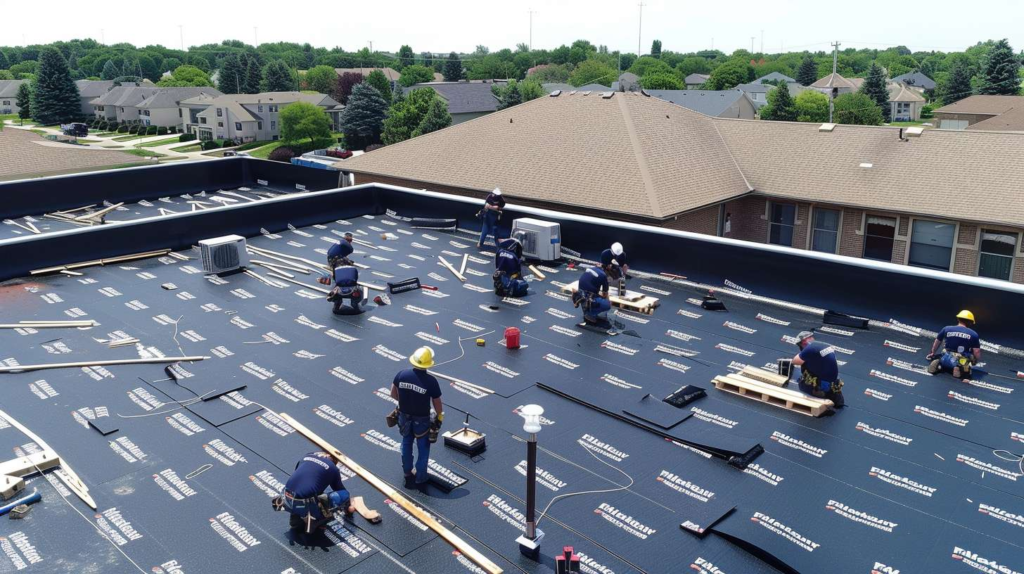
What Determines Whether a Flat Roof Leak Patch Has a Chance of Holding
Fact 01
Surface must be completely dry - even residual moisture under a patch will break adhesion and allow water to migrate laterally.
Fact 02
Membrane must be cleaned to sound material - dust, chalk, old coating, and grit all prevent proper bonding regardless of patch type.
Fact 03
The leak source may be feet away from the interior stain - water travels under membranes before finding a path down, making ceiling stains unreliable guides.
Fact 04
Patch material must match the roof system type - applying EPDM adhesive over modified bitumen, or mastic over TPO, creates incompatible chemistry from day one.
Common Assumptions About Patching Flat Roof Leaks
| Myth | Real Answer |
|---|---|
| If the stain is here, the hole is here. | Water migrates laterally under flat roof membranes before dripping down. The stain tells you water entered the building - not where it entered the roof. |
| Roofing cement fixes any flat roof leak. | Roofing cement is a temporary material at best. It cracks with temperature cycling, is incompatible with TPO and EPDM, and fails rapidly when applied to anything less than a perfectly clean, dry surface. |
| A neat-looking patch is a good patch. | Appearance has nothing to do with adhesion. A patch can look clean and tight on the surface while moisture and contamination are already undermining the bond underneath. |
| You can patch over wet material and let it dry later. | Moisture trapped under a patch doesn't dry - it gets sealed in. It expands with heat, lifts the patch edge, and feeds mold and membrane degradation from below. |
| More sealant means more protection. | Heavy sealant buildup traps water at the patch edge, adds weight, and makes future diagnosis nearly impossible. The right amount of the right material beats a thick coat of the wrong one every time. |
Tracing the leak before choosing patching methods
What homeowners usually point to first
If you called me out today, the first question I'd ask is: did the water come in where you see it, or where the roof actually failed? Water on a flat roof doesn't travel vertically the way people expect - it moves sideways along the path of least resistance, pooling against a parapet base, running toward a drain depression, or sneaking under a vent curb flashing before it ever finds a seam to penetrate. Queens buildings complicate this further because many of them carry roofing layers from three or four different contractors across two or three decades. You'll find modified bitumen under a torch-down layer under a coating over an old BUR section, all of which creates misleading symptoms that point to the wrong spot. I remember a Sunday at 6:40 a.m. in Rego Park, right after one of those sticky August nights when the roof still feels warm under your boots - the owner swore the leak was directly above the ceiling stain. When I peeled back an old patch near the drain, I found trapped moisture and grit underneath it like somebody had sealed a wet countertop. The patch looked neat from five feet away and was completely useless from one inch away.
What actually gets tested on the roof
The actual diagnostic sequence runs field membrane first, then seams, then flashing edges at parapets and walls, then penetrations, then drainage patterns, then any sign of trapped water under previous repairs. Patching methods should be selected after that sequence - not before. Choosing a patch material before you know the roof system type, the moisture condition, and the true entry point is like choosing a lab reagent before you've identified the compound. You might get lucky. More often, you create a new variable that makes the next diagnosis harder.
Should This Flat Roof Leak Be Patched, Opened Up, or Escalated?
NO ↓
YES ↓
NO ↓
Leak Symptom vs. Likely Source on a Queens Flat Roof
| Visible Symptom | Likely Source | First Roof Check |
|---|---|---|
| Ceiling stain near exterior wall, no active drip | Parapet wall flashing or counter-flashing failure | Inspect flashing base and cap detail at the nearest parapet |
| Active drip directly below drain area | Drain collar separation or membrane split around drain ring | Check drain ring adhesion, collar seal, and membrane condition within 12 inches of drain |
| Water near vent pipe or HVAC curb, no ceiling stain yet | Failed pitch pocket or cracked curb flashing | Check pitch pocket fill level and flashing-to-curb bond on all sides |
| Water appearing 4-6 feet from any wall or penetration | Open field membrane seam failure or puncture with lateral migration | Walk field seams with probe; look for bubbling, separation, or water tracking under laps |
| Repeated stain in same spot despite previous patches | Trapped moisture under old repair or unresolved subsurface leak path | Lift edge of previous patch; probe for soft, saturated insulation or substrate |
| Bubbling or blistering membrane, no interior sign yet | Moisture trapped between membrane and insulation layer | Press blister; if water or vapor releases, insulation has absorbed moisture and membrane must be opened |
Methods that hold versus methods that peel back
I'm going to say this plainly: a sloppy patch is just a delayed leak. The repair method has to match the roof system - you don't use EPDM lap adhesive on modified bitumen, and you don't torch a cap sheet patch onto a TPO field membrane. For a proper membrane patch, you're cleaning to bare sound material, cutting a piece with rounded corners from compatible stock, and bonding it with the right adhesive or heat-welding method for that system. Seam reinforcement means re-activating or re-welding the lap and adding reinforcement tape - not smearing sealant over the top and hoping. Flashing repairs at parapets and curbs follow the same logic: clean, dry, mechanically sound, compatible material. Emergency temporary seals exist, but they're honest about what they are - a 48-hour stop-gap while conditions stabilize, not a finished repair. I remember climbing onto a two-family in Elmhurst at twilight, the sky going purple, with a son translating for his dad while I checked a vent curb. Someone had tried to patch flat roof leak trouble by smearing mastic over a split seam without cleaning off the old chalked surface first. I rubbed the membrane with my glove and the patch edge lifted like a sticker on a dusty jar. That was the moment I knew I'd be explaining surface prep for the next half hour - and why it's the step that separates repairs that hold from ones that peel.
Here's the insider detail that gets skipped most often: the cleaning and bonding area has to extend well beyond the visible split or puncture. The edges of a defect are almost always contaminated - oils from previous sealants, chalk from degraded coating, moisture migration from the damaged zone. If your patch boundary lands on contamination, that's your new failure point. You're essentially running a chemistry experiment where the test conditions at the perimeter are already compromised. Extend the prep area, confirm adhesion on the surrounding membrane before you commit, and the patch has a real chance of becoming a permanent repair rather than next year's problem.
✔ Repair With Diagnosis and Prep
- Leak source traced to actual roof entry point
- Substrate confirmed dry before any material is applied
- Patch material selected to match existing membrane system
- Cleaning extends beyond visible defect to sound material
- Patch edges reinforced and pressed to full adhesion
- Drainage pattern checked so water doesn't pool at repair
✘ Cover-Up Patch
- Location guessed based on ceiling stain alone
- Applied over damp or wet membrane surface
- Random sealant grabbed from a bucket - system unknown
- Patch boundary lands on dust, grit, or old coating residue
- Edges pressed flat by hand with no mechanical confirmation
- No check of surrounding membrane condition or drainage
Evaluating Common Patching Methods for Flat Roof Leaks
| Method | Pros | Cons |
|---|---|---|
| Membrane patch with compatible adhesive or heat-weld | Durable long-term repair when properly prepped. Chemically compatible with existing system. Can be considered permanent on a well-diagnosed site. | Requires correct material match and proper prep time. Heat-weld requires equipment and trained hands. Fails immediately if applied to wet or contaminated substrate. |
| Roofing cement smear | Fast and widely available. Useful as a true temporary stop-gap to limit water entry for 24-72 hours while conditions aren't right for a full repair. | Cracks with temperature cycling, incompatible with TPO and EPDM, and becomes the next layer of contamination when real repair is eventually done. Not a finished repair on any system. |
| Tape-only repair (butyl or peel-and-stick) | Quick to apply. Some butyl tapes perform reasonably well on clean, primed EPDM as a short-term bridge repair in low-ponding areas. | Edge adhesion fails on any contamination or moisture. Heat exposure causes lifting. Not appropriate as a standalone repair on seams, flashing transitions, or ponding areas. |
| Reinforced flashing patch | Correct approach for parapet, curb, and wall flashing failures. When prepped properly and tied into the field membrane, flashing repair is one of the most durable patch types available. | Labor-intensive. Requires removing old flashing material fully - layering over failed flashing traps moisture and delays the failure by months, not years. |
Mistakes that turn a minor leak into a wider repair
Here's the blunt truth customers don't love hearing - covering black material with more black material is not a repair plan. I once worked a Forest Hills job where a retired piano teacher called me during a cold November drizzle because water was appearing beside her bookshelf. She kept apologizing for the mess while I traced the leak, and I found three separate patching attempts stacked on one section: roofing cement, aluminum tape, and what looked suspiciously like porch sealant. I told her, "This roof has been given three bandages and zero diagnosis," and she laughed so hard she almost forgot about the buckets in her living room. Every one of those layers had trapped moisture between it and the one beneath, the seam failure underneath was now twice the size it started as, and the area that needed to be opened had grown from about eighteen inches to nearly four feet. Stacked bad repairs hide failure, trap water, and expand the scope of the eventual fix - every time.
⚠ Do Not Patch a Flat Roof Leak Under These Conditions
- Active moisture detected under an existing patch - the area must be opened and dried first
- Leak path has not been identified - patching a guessed location will not stop water entry
- Membrane surface is loose, chalked, or coated with degraded material - no adhesive will bond reliably
- Bubbling or blistering is present around the defect - trapped moisture is already migrating below the surface
- Multiple previous repairs exist in the same area - investigate fully before adding another layer
- Interior leak has returned after repeated patch attempts - escalate to sectional repair or full diagnostic inspection
Six Cover-Up Moves That Usually Fail
- ✗Patching over dust and surface debris - contamination at the bond line means the patch is already failing when it goes down
- ✗Patching over standing or residual moisture - sealed-in water expands, lifts patch edges, and accelerates membrane decay
- ✗Using mismatched sealant - incompatible chemistry breaks down the membrane edge it's supposed to protect
- ✗Patching at the stain instead of the source - treats the symptom, leaves the failure point completely open
- ✗Ignoring edge lift on an existing patch - a lifted edge is an open channel for water; it won't re-seal on its own in a Queens summer
- ✗Layering over an unknown previous repair - you can't diagnose what you can't see, and buried failures grow
Questions to settle before you try to patch a leaky flat roof
Before you open a bucket or cut a patch, can you answer these without guessing?
Knowing how to patch a leaky flat roof starts with four things: what material your roof is made of, where water actually entered the system (not where it showed up inside), whether the surrounding membrane is genuinely dry, and how large the damaged area really is once you pull back any previous repairs. If you can't answer all four clearly, the patch is still a guess - and a guess on a flat roof is just a future callback. This checklist isn't here to slow you down. It's here because the calls that come in after a second or third failed patch attempt are always harder and always more expensive than the original repair would have been. Get the answers first, then make the call.
Before You Attempt or Request a Flat Roof Leak Patch - Verify These 8 Items
- Roof material identified - TPO, EPDM, modified bitumen, BUR, or other; patch material compatibility depends on this
- Interior leak location documented - note the ceiling stain location, size, and whether it's grown or is new
- Suspected roof entry point checked - walked the roof and visually confirmed at least one candidate failure point
- Weather and dryness conditions noted - surface must be dry; document last rain and current conditions
- Photos of roof damage taken - close-up and wide-angle shots of suspected area, any existing patches, and drain/flashing zones
- Age and type of any previous patch known if possible - helps avoid incompatible layering
- Drainage condition observed - check for ponding, blocked drains, or debris near suspected leak area
- Interior active leak status noted - confirm whether leak is currently active, intermittent, or only after heavy rain
Practical Questions About Patching a Flat Roof Leak in Queens
🚨 Urgent - Call Now
- Active dripping during or after rain
- Leak appearing near electrical fixtures or panels
- Repeated failure in the same patched area
- Sagging membrane or visible water trapped under old repair
🕐 Can-Wait Briefly - Schedule Soon
- Old patch edge lifting on a dry day with no interior sign
- Isolated surface crack with no active water inside
- Preventive inspection after a heavy storm or hail event
A patch flat roof leak repair done right is a real solution. Done wrong, it's just buying time until the same spot opens up again - wider, wetter, and more expensive. If you need help figuring out whether your flat roof leak needs a targeted patch or a bigger repair, call Flat Masters - we'll trace it to the source and give you a straight answer.
