
Applying a Flat Roof Coating Wrong Is Almost as Bad as Not Applying One at All
Preparation Failures Start the Bad Reaction
If you're not sure, coating a flat roof without cleaning, drying, and detailing every weak point first doesn't just fail to solve the leak problem - it makes that leak harder to trace and a lot more expensive to fix later. Would you paint over a wet wall in your living room and expect a miracle? Coating over a contaminated or damp flat roof membrane is the same bad chemistry: you're just sealing the problem in and giving it a nice white lid.
Here's the part people try to skip, and it's the part that ruins the job. Surface contamination, trapped moisture underneath, and an unsealed seam are ingredients that react badly when you combine them - and as Marisol Vega, with 19 years in flat roofing and a specialty in diagnosing coating failures on older Queens multifamily roofs, has seen repeatedly, the result isn't a slow fade. It's blistering, peeling, and a repair bill that dwarfs what good prep would have cost. That's the cause; now here's the result: contractors who skip prep don't just deliver a shorter-performing job - they hand you a problem that's now buried under a layer of coating you paid for.
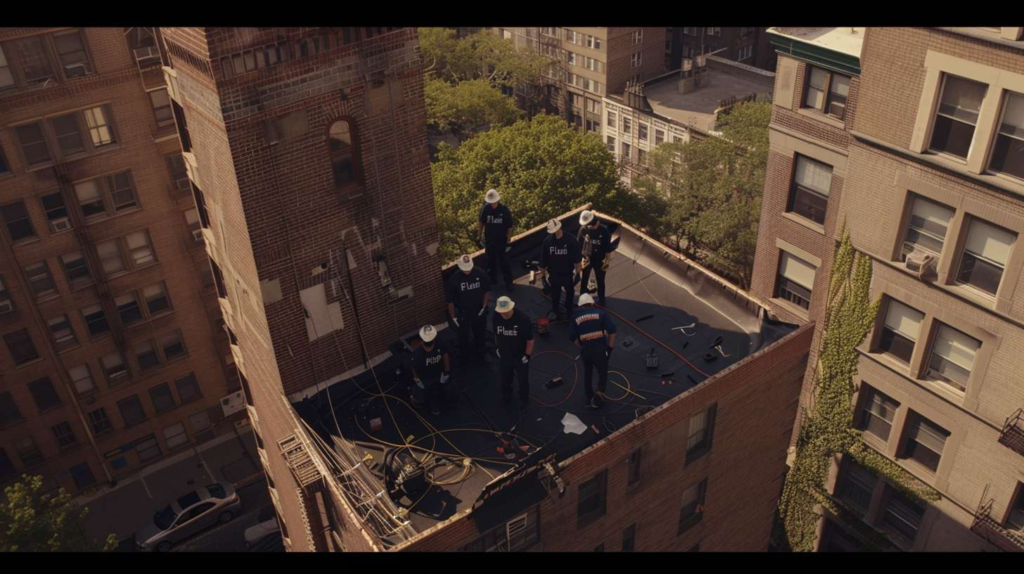
⚠️ Warning: Do Not Coat Over These Conditions
Applying coating over dirt, dampness, open seams, or unidentified wet insulation doesn't protect the roof - it temporarily hides the leak path while trapping moisture underneath, causing damage to spread invisibly. When it surfaces again, the repair area is larger, the insulation may be compromised, and the coating itself has to be removed first.
- Do not coat over morning dew. Even a light moisture film on the membrane breaks adhesion. The coating lifts as the surface heats up, creating soft bubbles over the wet areas.
- Do not coat over greasy exhaust residue. Rooftop HVAC, kitchen exhaust stacks, and vent caps deposit oily contamination that prevents bonding entirely. The coating will peel up in sheets.
- Do not coat over loose patch edges. An old patch that isn't fully bonded will telegraph right through a fresh coating layer. The edge lifts, water gets under, and the "new" coating fails at the same point as the old repair.
Non-Negotiable Pre-Application Checks
- ✅Roof is dry to the touch and below surface moisture threshold. Moisture meters don't lie. If you don't have one, wait longer than you think you need to.
- ✅Drains are clear and functional. Standing water left near drains after the last rain is a signal the roof didn't dry evenly - and some sections are still holding moisture below the surface.
- ✅Seams and transitions are fully inspected. Every lap seam, edge termination, and transition from membrane to flashing must be checked - not assumed.
- ❌Old repairs are not bonded to the membrane. Any patch lifting at its edges, bubbling, or separating at corners must be re-secured or replaced before coating goes down.
- ✅Surface contamination is removed. This includes algae, dirt, exhaust residue, ponding residue rings, and any chalky oxidation from old coating that prevents bonding.
- ✅Forecast supports a full cure window. You need dry weather not just for application day, but for the 24-48 hours that follow. Rain on a partially cured coating rewets and weakens the film.
Moisture, Heat, and Queens Weather Change the Outcome
When the Roof Looks Dry But Is Not
At 6 a.m., a flat roof tells the truth faster than a salesman does. I remember being on a six-unit building in Elmhurst at 7:10 in the morning, coffee still too hot to drink, when the owner proudly told me his handyman had coated the whole flat roof the night before because "the weather app said clear." By 9:30, the trapped dew under that coating had started blistering in little soft bubbles near every old seam patch - exactly the kind of mixed-age patchwork repairs you see all over the attached multifamily rows running off Junction Boulevard. Parapet corners, shaded sections behind rooftop equipment, those low-slope areas near the scuppers - all of them hold moisture longer after a humid night, and none of that shows up in a weather app. Bad timing met trapped moisture; that reaction was predictable.
Why Extreme Surface Heat Thins Your Margin for Error
A five-gallon bucket can hide a lot of bad decisions. One August afternoon in Ridgewood, with the roof surface so hot my infrared thermometer read 154 degrees, I watched a very confident investor insist his crew should keep rolling because "we already opened the buckets." The material was skinning over before it could level properly - forming a dry crust on top while the layer underneath was still fluid and uneven. They were also spreading it thin to make it reach the far parapet, and honestly, those two problems together are worse than either one alone. Bad timing and bad coverage work together like two chemicals you never mix on purpose.
The practical timing logic isn't complicated, but it has to account for real conditions. The substrate has to be genuinely dry - not just dry-looking. The forecast needs to hold for at least two full days, not just the application window. Surface temperature should be in a range where the coating can level and bond before it skins, typically between 50°F and 90°F on the membrane itself. And you need enough daylight left that the coating reaches a weather-resistant state before temperatures drop. Queens summers add another variable: that thick, still humidity after a stretch of rain days slows evaporation from the membrane surface even when the sky is clear. Shoulder seasons bring sharp afternoon winds, especially across open roof decks in Flushing and along the elevated lots near the Long Island Rail Road cuts - and wind pulls moisture out unevenly, which means one section reads dry while another is still holding it.
| Roof Condition | What the Coating Does | Likely Failure Pattern | Proceed / Delay / Prep More |
|---|---|---|---|
| Morning dew on membrane | Bonds to the water film, not the membrane surface | Soft blistering at seam patches within hours of heat exposure | Delay |
| Roof surface above 140°F | Skins over on top before leveling; spreads inconsistently | Thin, uneven film; early cracking at high-traffic points | Delay |
| Overnight temp drop after late coating | Cure stops mid-process; film stays tacky and weak | Poor adhesion; contaminants embed in uncured surface | Delay |
| Humid calm day after rain | Slows evaporation; membrane holds residual moisture longer | Subsurface moisture trapped; blistering develops within days | Prep More |
| Windy cool day with contaminated vent area | Dries unevenly; contamination prevents bonding near vents | Delamination and peeling concentrated around penetrations | Prep More |
Three Local Conditions That Make a Roof Look Ready When It Isn't
Detail Work Decides Whether the Coating Bonds or Peels
I once peeled back a "fresh" coating with two fingers in Astoria. A retired bus driver called me after a winter leak, convinced the coating itself had failed for no reason - and when I got up there just after a windy March rain, the reason was obvious the moment I crouched down near a rooftop vent. They had coated straight over greasy exhaust residue without cleaning it, and the transition cracks where the membrane met the flashing had never been reinforced with fabric. I pressed my knife flat against the surface near the vent, lifted an edge, and the coating came up in ribbons - not torn, just peeled, like a label off a jar. That's what zero adhesion feels like. It wasn't a coating problem. It was an application problem, and every inch of it was preventable. Here's the thing: if a contractor talks about bucket count and finish color but never mentions reinforcement fabric, adhesion testing, or how they plan to treat penetrations, scuppers, and transition cracks - they're skipping the exact steps that prevent callbacks. That's the cause; now here's the result: you pay for a coating that performs for one winter instead of ten years.
Bluntly: a coating is not a forgiveness machine. I've said this to property owners from Bayside to South Ozone Park, and I'll say it here - when you treat flat roof coating application as a cover-up for unresolved defects instead of a protective layer over a properly prepared surface, you're not extending the roof's life. You're buying time while the real problem gets worse underneath. That's the cause; now here's the result: the next repair costs more, takes longer, and involves stripping off the very coating you paid to apply. A coating over a sound, clean, detailed roof is a solid investment. A coating over an ignored problem is just an expensive delay.
Exact Order: How to Apply Roof Coating on a Flat Roof Correctly
Coverage Rate Tells You Whether the Job Was Real or Cosmetic
Thin Application Looks Finished Before It Performs
Many failed coating jobs aren't mystery failures at all - they're under-applied coatings stretched too far to finish the roof. Spread rate and dry film thickness aren't suggestions buried in a spec sheet; they're the difference between a coating that performs for a decade and one that starts cracking in its second year. A neat, bright white surface can still be structurally underbuilt if the material was spread at 200 square feet per gallon when the spec called for 100. The roof looks done. It's not protected. Too much area plus too little material is a reaction with only one result.
Do you know how many square feet each bucket was supposed to cover on your roof?
| Myth | Real Answer |
|---|---|
| "Thicker-looking in one corner means the whole roof is protected." | Coverage has to be consistent across the entire surface. Heavy pooling in corners often means the open field was under-applied as the crew compensated to stretch the material. |
| "One coat is always enough." | Most flat roof coating systems require two coats applied in perpendicular directions to reach the specified dry film thickness. One coat rarely achieves the required mil build. |
| "Any coating covers old repairs equally." | Patched areas have different surface profiles, absorption rates, and adhesion characteristics than the original membrane. Patches need to be primed or detailed separately before the field coat goes down. |
| "Dry to the touch means fully cured." | Surface dry and through-cured are not the same. Most coatings take 24-48 hours to reach full cure and won't achieve rated performance - or rain resistance - until that cure is complete. |
| "If it looks bright white, it's properly applied." | Color is not a measure of film thickness. A coating stretched too thin will still appear white and uniform. The only way to verify mil thickness is to measure it during or immediately after application. |
A coating only performs as well as the prep, detailing, and weather window behind it - and if you want your Queens roof evaluated before anyone opens a single bucket, call Flat Masters and we'll tell you exactly what it needs first.