
A Green Roof on a Flat Roof Does More Than Look Good - Here's What It Involves

A Green Roof on a Flat Roof Does More Than Look Good – Here’s What It Involves

A Green Roof on a Flat Roof Does More Than Look Good - Here's What It Involves

Beneath the plants is the real roof system

Everybody assumes it's the plants that make a green roof complicated - the species selection, the seasonal color, the sedum versus the grasses debate. That's the part people photograph. But the plants are honestly the least difficult piece of the whole system. Start at the membrane, not the mulch. Think of the assembly the way you'd think about a lasagna: every layer depends completely on the one underneath it, and if the third layer down is wrong, it doesn't matter how good the top looks. Green flat roof construction lives or dies in the hidden stack, not in what's visible from the sidewalk.

That stack, working from the bottom up, goes: structural deck, then insulation, then your waterproofing membrane, then a root barrier (sometimes combined with the membrane, sometimes separate), then a protection course, then drainage layer, then filter fabric, then engineered growing media, and finally the vegetation itself. Each of those layers has a specific job. Each of them has a specific way to fail. Skip one or install one out of sequence and the layer above it can't do its job - same as pulling the ricotta out of the lasagna and expecting the whole thing to hold together.
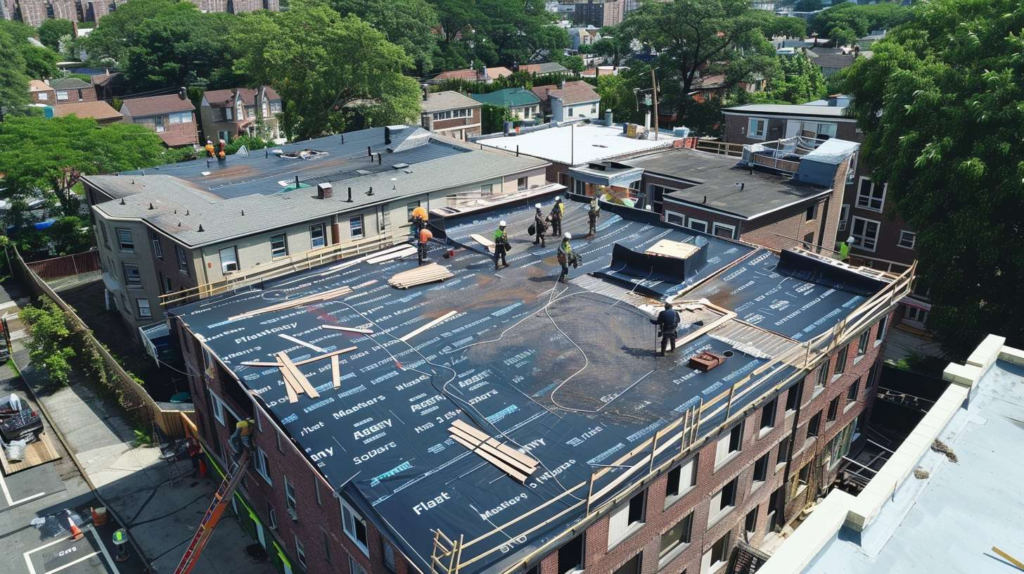
Professional crew installing a flat green roof on a commercial building, showcasing sustainable construction techniques.

Open the roof sandwich: what each layer does

1. Structural Deck

Job: Carries the dead load of every layer above it plus live loads like people, snow, and saturated media.

Common failure point: No structural review conducted before installation - saturated media can weigh 80-150 lbs per sq ft depending on depth, and older Queens decks were not designed for that.

2. Insulation

Job: Controls thermal movement through the roof assembly and helps prevent condensation within the deck.

Common failure point: Wrong insulation type or compression from stored materials causes moisture infiltration that never shows up until you peel the system apart.

3. Waterproofing Membrane

Job: The primary barrier that keeps water out of the building - everything above it depends on this layer being fully intact.

Common failure point: Membrane installed without flood testing or electronic leak detection; small voids get buried and aren't found until the insulation is already saturated.

4. Root Barrier

Job: Prevents plant roots from penetrating and degrading the waterproofing membrane below.

Common failure point: Root barrier omitted entirely when planters or trays are used - roots still migrate laterally and find membrane seams over time.

5. Protection Course

Job: Guards the membrane from mechanical damage during installation of upper layers and from ongoing load stress.

Common failure point: Workers walking on the membrane before the protection course is down - foot traffic creates punctures that won't be visible until water shows up inside.

6. Drainage Layer

Job: Moves excess water quickly off the membrane surface and toward roof drains, preventing ponding against the waterproofing.

Common failure point: Drain mat compressed by materials stored during installation - it looks fine from above, but it's no longer moving water.

7. Filter Fabric

Job: Keeps fine particles in the growing media from migrating down and clogging the drainage layer below.

Common failure point: Filter fabric torn during media installation or lapped incorrectly at seams, allowing media fines to wash through and block drains within one or two seasons.

8. Engineered Growing Media

Job: Provides root anchorage and nutrient base while staying lightweight enough not to overload the structural deck.

Common failure point: Standard garden soil substituted to save money - it compacts, holds too much water when saturated, and adds far more dead load than the structure can handle.

9. Vegetation / Trays

Job: The visible layer - sedum mats, planted trays, or plug plantings - that provides stormwater retention, insulation benefit, and the green aesthetic.

Common failure point: Tray or planted systems treated as the only system - with no thought given to how the layers below will behave when the trays are loaded, wet, and in place for ten years.

Layer Primary Job What Failure Looks Like
Structural Deck Support all load, living and dead Visible deflection, cracking, or collapse under saturated media weight
Insulation Thermal control and condensation prevention Wet insulation discovered during teardown - R-value gone, deck at risk
Waterproofing Membrane Keep water out of the building, full stop Interior leaks with no obvious surface source, often appearing months later
Root Barrier Stop roots from reaching and penetrating membrane Root intrusion into membrane seams - found only during full teardown
Protection Course Shield membrane from physical damage Membrane punctures that don't show water until a heavy rain event
Drainage Layer Move excess water to roof drains efficiently Ponding water sitting against membrane, shortening its lifespan
Filter Fabric Keep media fines from clogging drainage below Clogged roof drains and pooling that looks like a drainage design problem
Engineered Growing Media Lightweight root zone for plant establishment Compaction, overloading, or media washing through to drains

Drainage exposes whether the build was done right

Why Queens weather punishes bad drainage

On a Queens roof, the drain tells the truth. The borough sits in a climate band that throws sudden summer cloudbursts - the kind that drop two inches in forty minutes - followed by freeze-thaw cycling from November through March that works at every seam and penetration. Add wind-driven debris from elevated BQE traffic, neighboring HVAC units, and the street-level tree canopy along places like Metropolitan Avenue, and you've got a drainage system that gets tested hard and often. As Luis Mena, with 17 years in flat roofing and a specialty in green roof assemblies, keeps telling owners, older low-slope roofs across Queens were built for basic drainage, not for the additional retention, weight, and organic debris that a green system introduces on top.

Nice idea, but here's what that means on the actual roof. Drainage board compression, blocked outlets, ponding in corners, and overloaded perimeter edges can all develop under a plant surface that looks completely healthy from a rooftop glance. I was on a six-family in Jackson Heights at 6:40 in the morning, fog still hanging low, when the owner pointed at a beautiful tray system and said, "See? No puddles." Then I pulled up one corner and found the drain mat crushed flat because someone had stored pavers on it during installation. That was the day I started telling people a green roof can look healthy up top while quietly failing underneath. The system had passed a visual inspection for two seasons while water was sitting against the membrane every time it rained.

⚠️
Hidden Drainage Failures Under a Healthy-Looking Green Roof
  • Crushed drain mats: Materials staged on the roof during installation compress the drainage mat permanently - water has nowhere to move, and the membrane stays wet.
  • Clogged roof drains from media migration: Fine particles from growing media bypass a torn or poorly lapped filter fabric and build up inside drain bowls until flow stops entirely.
  • Drain bowls buried under overgrowth: Within two or three growing seasons, dense vegetation can fully obscure drain access points, making inspection and cleaning nearly impossible without disturbing the planting.
  • Ponding that shortens membrane life: Standing water that sits against the membrane at low points - especially in corner zones - accelerates seam failure and can void manufacturer warranties.

Myth Reality
"Plants will use all the rainwater - drainage isn't really a concern." Even well-established sedum holds maybe 50-70% of a moderate rain event. Heavy storms produce runoff that the drainage layer must handle, or it backs up against the membrane.
"A little standing water is normal everywhere on a flat roof." Ponding that lasts more than 48 hours on a green system is a signal - either the slope is wrong, the drain is blocked, or the drainage board has failed. It's not something to watch and wait on.
"Drainage mats can't be damaged once the system is installed." Drainage mats can be crushed during staging, foot traffic from HVAC work, or pavers dropped during future projects. Compression is permanent and usually invisible from above.
"A tray system means there's no waterproofing risk." Trays still sit on a membrane that needs full root protection and drainage below them. Water moves between and under trays - if the membrane underneath isn't properly detailed, you still get leaks.
"If the top looks green and healthy, the layers below are fine." Plant health and membrane integrity are not related. A roof can support thriving sedum while simultaneously holding water against a compromised membrane. The top layer tells you about the plants - nothing else.

Loads, roots, and access need answers before anyone buys plants

I remember one owner in Sunnyside saying they were ready to head to a nursery that same weekend - they had the plant list written out, had priced out containers, and wanted to know how fast things would fill in. We hadn't yet confirmed whether the roof deck could handle saturated media load, whether the overflow scuppers were sized correctly, or whether there was any realistic way to access the drains once the planting was established. Saturated soil, concrete pavers, people walking around, large planters, and a good Queens snowfall all count toward the same load number - and they all happen at once sometimes. Honest answer: Luis would rather disappoint someone during planning than watch them pay for a full tear-off two years later because the conversation about weight happened after installation instead of before it.

Is Your Flat Roof Ready for a Garden-Style Green System?

Do you have a structural review confirming the deck can handle saturated load?

No →
Pause the design. Get engineering input before any further planning - this step cannot be skipped or estimated.
Yes →
Move to the next question.

Are drains, overflow paths, and roof slope confirmed by someone who's been on the roof?

No →
Correct drainage design before any planting decisions. Slope problems don't fix themselves once media is down.
Yes →
Move to system type selection.

Will the system be extensive (low-profile), semi-intensive, or an occupied roof garden?

Match your media depth, edge details, parapet requirements, and maintenance plan to the system type before choosing any plants or finishes.

Then - and only then - choose your plants and finish surfaces.

Extensive Green Roof
  • Low media depth (2-4 inches typical)
  • Lightweight engineered substrate
  • Drought-tolerant ground cover: sedum, fescue, native grasses
  • Minimal foot traffic - maintenance access only
  • Simpler edge and parapet detailing
  • Lower structural demand overall
  • No irrigation required in most cases once established

Occupied Roof Garden
  • Deeper media zones (6-18+ inches for planters)
  • Pavers, furniture, railing, and edge planning required
  • Designed for regular human occupancy
  • Irrigation system typically required
  • Structural engineering review is non-negotiable
  • Higher parapet and fall-protection requirements
  • Drain access must be built into the layout from day one

Ask where the water goes before asking what will grow

If I asked you where the extra water goes, could you answer me in ten seconds? Not the water the plants absorb - the overflow. The water that hits during a storm that drops faster than the media can retain it. Overflow paths, edge restraint, penetration details, and inspection access aren't secondary concerns in flat green roof construction - they're the difference between a system that performs for twenty years and one that gets torn off at year four. Get those answers on paper, confirmed by someone who's actually stood on that roof, before the plant conversation happens.

Pretty planting does not prove a healthy roof.

Build Sequence for Green Flat Roof Construction
1
Structural Review and Use-Case Definition
Confirm the deck can handle saturated media load, live loads, and any planned occupancy before any material is specified or ordered.

2
Slope and Drainage Confirmation
Verify existing slope, drain locations, overflow scupper sizing, and that no low spots will trap water under the system once the assembly is in place.

3
Membrane Installation and Testing
Waterproofing membrane goes down and must pass flood testing or electronic leak detection before any subsequent layer is installed on top of it.

4
Root Barrier and Protection Course Setup
Root barrier is laid continuous and lapped correctly at seams; protection board goes down immediately so no foot traffic touches the membrane going forward.

5
Drainage Board and Filter Fabric Layers
Drainage mat is laid without compression and confirmed flat; filter fabric is lapped a minimum of six inches at seams and turned up at edges to contain media fines.

6
Engineered Media and Vegetation Installation
Growing media is placed to specified depth without overloading any zone, and planting or tray placement is confirmed against the load map before finalizing coverage.

7
Final Drain Access Check and Maintenance Handoff
Every drain access point and inspection zone must be visible, documented, and handed off to the owner or property manager before the job is considered complete.

Here's the blunt part: a lot of the failed "green roofs" I've seen were never green roofs at all. During a windy October teardown near Astoria Park, I opened a roof that had been called green by the previous contractor because they dropped planters on top of a standard membrane and called it done. By 4 p.m. we'd found clogged drains, no root barrier, and insulation holding moisture like a wet sponge. That building owner paid full price twice - once for decoration, once for a real system. Flat green roof construction is a coordinated assembly with a verified sequence. It's not a surface treatment.

Think of it like building a lasagna that has to survive August and January. You wouldn't skip the béchamel and assume the pasta would hold together - and you wouldn't add toppings before confirming the pan can handle the heat. The same logic applies here. Irrigation lines, maintenance walkways, and repair access need to be engineered into the layout before a single plug of sedum goes in, not improvised after two seasons of growth close everything off. And here's the insider detail worth asking any contractor directly: ask them exactly where the drain inspection boxes and access points will remain visible six months after planting fills in. If they don't have a clear answer, that's your answer.

Before You Call: What Queens Property Owners Should Verify
  1. Building use: Residential, commercial, or mixed-use? Occupancy type affects code requirements and structural expectations.
  2. Roof age: How old is the current membrane, and when was it last inspected or replaced?
  3. Known leak history: Any active leaks, past patches, or recurring problem areas should be disclosed upfront - not discovered mid-job.
  4. Drain locations: How many drains, where are they, and are overflow scuppers present and clear?
  5. Parapet height: Parapet dimensions affect edge restraint details, safety requirements, and system termination options.
  6. Intended occupancy: Will this be a maintenance-only vegetated system or a space people will actually use and spend time on?
  7. Irrigation expectation: Do you expect an irrigation system, or is the intent a low-maintenance drought-tolerant planting?
  8. Structural documents: Are original building drawings or a recent engineering assessment available for the deck?

Common questions owners still ask after seeing the layers

One August afternoon in Ridgewood, with the roof surface hot enough to soften the sole of my boot, I met a couple who had tomato plans, string lights, the whole vision - and honestly, I respected it. That's exactly what how to build a flat roof garden looks like in someone's head before the conversation turns practical. The tomatoes are not the problem. The dream is fine. What the roof has to do first - survive roots pushing into membrane seams, handle overwatering from an enthusiastic weekend routine, drain properly after a summer storm - that's the part that decides whether the garden lasts one season or ten. At Flat Masters, the conversations that go best are the ones where the roof assembly gets sorted before the seed catalog comes out.

Green Flat Roof Construction: FAQs for Queens Property Owners
Can any flat roof become a green roof?
Not without a structural review first. Many older flat roofs in Queens - especially on two- to six-family buildings - were designed for basic roofing loads, not saturated growing media. Before anything else happens, the deck needs to be confirmed for the additional dead and live loads the system will introduce.
Does a green roof stop leaks?
No - a green roof does not waterproof a building. The waterproofing membrane underneath the system does that job, and it needs to be in solid condition before any green assembly goes on top of it. Installing a green system over a compromised membrane just buries the problem and makes it harder to find.
What maintenance does a flat roof garden need?
At minimum: seasonal drain clearing, debris removal from drain bowls, inspection of edge restraints and parapet flashings, and a walkthrough of any irrigation components. Extensive systems with sedum are lower-maintenance than occupied gardens, but neither system is maintenance-free - and skipping drain checks is where problems start.
How do drains stay accessible after planting?
They need to be designed that way from the start. Drain inspection risers, clear zones around drain bowls, and removable tray sections around access points all need to be part of the installation plan. If drain access isn't built into the layout before planting, it usually gets buried within two growing seasons.
What is the difference between green roof trays and a full built-in-place assembly?
Tray systems use pre-grown modular units that sit on the roof surface - they're easier to install and remove for maintenance. A built-in-place assembly has each layer installed directly on the roof in sequence, which typically offers better drainage integration and more flexibility for custom designs. Both systems still require a proper membrane, root protection, and drainage design underneath - the trays don't replace those layers.

Faq’s

Flat Roofing FAQs: Everything Queens, NY Homeowners Need to Know

How much does a green flat roof actually cost?
Green flat roof construction ranges from $15-25 per square foot for extensive systems and $25-40 per square foot for intensive systems. While this is more than conventional roofing, NYC offers tax credits up to $100,000 and DEP incentives that significantly offset costs. The energy savings and increased property value make it a smart long-term investment.
Most buildings need structural evaluation first. Green roofs add 15-25 pounds per square foot for extensive systems, up to 150 pounds for intensive ones. Our structural engineer partner reviews your building’s capacity before any work begins. Many Queens buildings from the 1980s and newer can support green roofs with minimal reinforcement.
Typical residential green roof installation takes 2-3 weeks, depending on weather conditions. This includes structural prep, waterproofing, drainage systems, and planting. We coordinate all material deliveries and trades to minimize disruption. Complex projects with HVAC work or structural reinforcement may take longer.
First year requires monthly inspections and irrigation monitoring. After establishment, extensive systems need quarterly maintenance while intensive systems need ongoing garden care. We offer maintenance contracts because proper care is essential – neglected green roofs become expensive problems, but maintained ones outlast conventional roofs.
Installing sooner is better – material costs and labor rates continue rising. Plus, you’ll start enjoying energy savings and property value increases immediately. NYC’s Green Infrastructure Tax Credit and DEP incentives are currently available but could change. Weather delays are always possible, so starting earlier gives more scheduling flexibility.

Ask Question

Or

What Exactly Happens When You Replace a Flat Roof? The Full Process Explained

12 min read

Professional Flat Roof Carport Construction Services Near You

6 min read

Garage Flat Roof Construction Isn't Complex - But There Are Details That Matter

16 min read

Expert Residential Flat Roof Inspection Services Near You

9 min read

What Does a New Flat Roof Cost? Here's Every Number You Need to Know

14 min read

Standing Water on Your Flat Roof After Rain? That's a Problem You Can Fix

13 min read

Flat Roofs Get a Bad Reputation - But Here Are the Things They Actually Do Well

15 min read

How Much Does Your Flat Roof Replacement Cost Calculator Save?

6 min read

Professional Flat Roofing Replacement Services You Can Trust

7 min read

How to Replace a Flat Roof: 5 Essential Steps for Homeowners

6 min read

Flat Roof Repair in NYC - Fast, Reliable, and Done Right

7 min read

Building the Structure of a Flat Roof - What Actually Holds Everything Together

15 min read

Building Up on a Flat Roof - What's Involved in Adding a Second Storey

16 min read

What's the Average Flat Roof Truss Cost for Your Project?

5 min read

Your Complete Guide to How to Remove Old Flat Roof Safely

7 min read

Installing a Window in a Flat Roof Changes the Space Below More Than You'd Expect

19 min read

How to Make a Flat Roof House Look Better: 5 Design Solutions

7 min read

Extension Flat Roof Leaking? Here's Where the Problem Almost Always Starts

14 min read

How to Felt a Garage Flat Roof: Your Complete DIY Guide

6 min read

What's the Average Flat Roof Balcony Cost for Your Home?

7 min read

Flat Roof Skylights Are Great Until Summer - Here's What Fixes the Heat Problem

14 min read

Flat Roof Terrace Construction in NYC - Built for Life

10 min read

A Seal Coating Can Add Years to a Tired Flat Roof - If It's the Right Product

13 min read

The Drainage System Is What Keeps a Flat Roof From Becoming a Pond

17 min read

Flat Roof Cladding That's Seen Better Days? Here's When to Replace It

12 min read
blue circle

Get a FREE Roofing Quote Today!

Schedule Free Inspection