
Standing Water on Your Flat Roof After Rain? That's a Problem You Can Fix
Path beats puddle when you are trying to make a flat roof drain better
Is this the first time it's happened? Because if it isn't, the roof has already been trying to tell you something. Standing water after rain is usually not just about the drain itself - it's about the whole path water has to travel to reach that drain, and somewhere along that path, something is losing.
Before you ask how to improve drainage on a flat roof, where is the water getting stuck? Every puddle has a start point where rain lands and begins moving, a hesitation point where momentum slows, a dead spot where it just sits, an outlet it was supposed to reach, and sometimes a failed backup route it tried after the main path quit. I'm Tanya Brooks, and with 16 years solving ponding-water problems on Queens flat roofs by tracing drainage paths instead of panicking at the puddle, I can tell you that most owners are staring at the dead spot when they need to be looking at the whole play - start point to outlet, backup plan included.
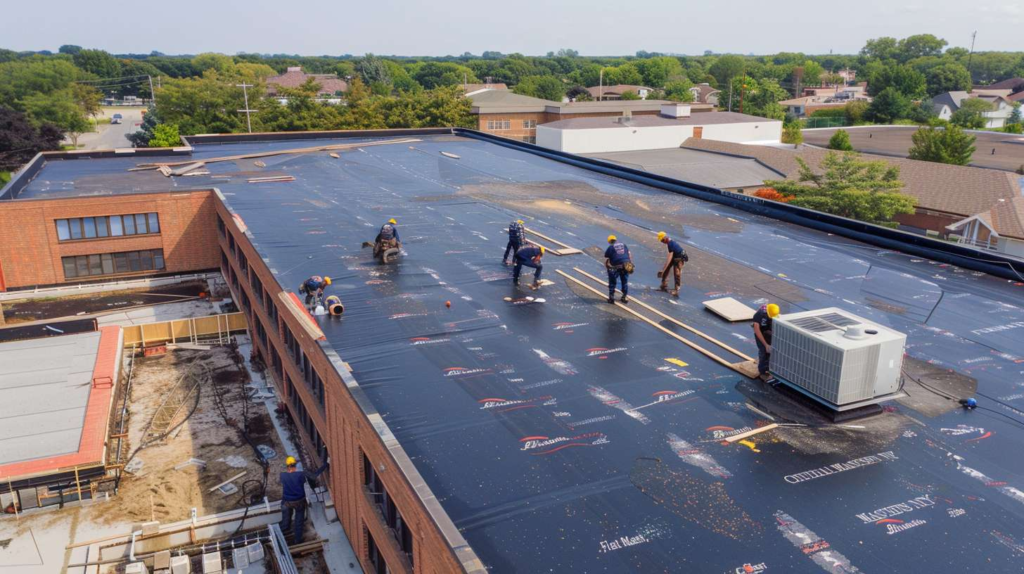
How to Diagnose a Flat Roof Drainage Problem Before Fixing It
-
1
Identify where water first begins to collect after rain - this is your start point on the drainage map. -
2
Trace the intended route from that collection point to the drain outlet, noting any obstacles or transitions along the way. -
3
Locate exactly where flow slows or stalls - this is your dead spot, and it's where the real diagnosis begins. -
4
Confirm whether the drain itself is physically clear by checking for debris, sediment, or blockage at and below the strainer. -
5
Decide whether the problem is obstruction, low surface geometry, or a combination of both - because the fix is different for each.
Dead spots develop long before owners stop trusting the roof
The roof has usually been showing the same play for a while
I still remember that puddle reflecting the satellite dish like a bad joke. One humid July morning in Elmhurst, I walked a rowhouse roof just after a storm and found a broad, shallow pool sitting dead center - calm enough to show a near-perfect reflection of the dish bolted nearby. The owner told me, "It always dries eventually," and I've heard that sentence enough times to know it sounds like reassurance but reads like a warning. When I traced the drain path, I found debris buildup that had been packing tighter with every storm, plus a low area that had quietly survived two previous repairs without anyone actually deciding to fix it. The puddle wasn't mysterious. The roof just hadn't been asked to drain - it had been allowed to sulk.
With one bottle of water, you can learn a lot about a roof. Pour a slow stream at the high end and watch where it hesitates - that hesitation tells you more than staring at the puddle ever will. On Queens rowhouse roofs, especially on rear flats over extensions and garage decks, the combination of satellite dish mounts, air conditioner bases, and seasonal leaf debris creates natural dams that redirect water away from its intended outlet. I've seen shallow ponding on rear garage roofs off Jamaica Avenue that had been repeating for so long the owner thought it was just "how flat roofs work." It's not. It's a path problem - usually fixable without replacing anything structural - and catching it early keeps it from becoming a much longer conversation.
| What You Observe | What It Usually Means | Typical Direction of Fix |
|---|---|---|
| Broad shallow puddle across center | Surface has settled or was never graded toward the outlet | Tapered build-up or slope correction toward drain |
| Circular stain ring after puddle dries | Recurring ponding in the same low spot over multiple seasons | Local surface correction and drain path re-evaluation |
| Debris line forming just before the drain | Flow is reaching the drain zone but getting intercepted by buildup | Drain clearing plus regular maintenance schedule |
| Water consistently favoring one edge | Outlet placement or surface pitch is biased away from center | Edge scupper check or secondary outlet consideration |
| Center ponding on detached garage roof | Surface has crowned inward over time; runoff has no clear outlet | Edge overflow correction or center drain installation |
| Outlet surrounded by poor fall | Drain is present but sits in a flat bowl with no approach slope | Build-up correction around drain to create adequate fall |
⚠ The Danger of "It Dries Eventually"
Accepting delayed drying as proof the roof is fine is one of the most common ways a manageable drainage problem becomes a costly structural one. If the same low spots keep appearing, if there's a debris trail leading to a half-blocked drain, or if a previous repair didn't touch the geometry - the roof has not been fixed. It's been postponed. Each season that pattern repeats is another season of membrane stress, seam fatigue, and shortening roof life. "It dries eventually" is how small drainage problems survive long enough to become expensive ones.
Drain improvement is sometimes cleaning, sometimes slope correction, and sometimes both at once
Here's the blunt truth: a drain can be open and still be losing. I was on a mixed-use building in Ridgewood on a cold November afternoon - wind cutting sideways, property manager frustrated, tenants filing complaints because the puddles were drawing pigeons like a neighborhood attraction. The drains were there. Nobody had capped them. But the roof geometry surrounding each one was working against any meaningful runoff, so water was stalling about six feet short of the outlet every single time. I pulled out a chalk line and a bottle of water and showed him exactly where the flow died. Once he watched it happen in real time, the conversation shifted completely - from "why isn't the drain working" to "how do we fix the path that leads to it."
A flat roof should move water like a well-graded playing field - if the surface fights the outlet, the puddle keeps winning. The menu of real drainage-improvement solutions is wider than most owners expect: drain clearing for the straightforward blockage case, local build-up correction when a specific low area is the culprit, tapered insulation or overlay adjustments when the fall across a larger zone is wrong, edge scupper or overflow redesign when the outlet placement itself is the problem, and broader surface reworking when multiple path failures have compounded over years of repairs. The right answer depends entirely on where in the path the play is breaking down - and that's why diagnosing the path comes before pricing any fix.
My view? Most drainage problems are path problems before they're drain problems. The outlet is just the last player in a play that starts at the high end of the roof and has to travel the full surface to get there. And here's the insider tip worth remembering: ask every roofer you talk to to show you the old water path and the new water path side by side. If they can't diagram the difference - literally sketch it, even on paper - the fix hasn't been thought through. The best drainage corrections are easy to explain, because the person doing them actually understands where the water was going wrong.
What Kind of Drainage Improvement Does This Flat Roof Need?
START HERE
Is the drain blocked or slowed by debris, sediment, or a damaged strainer?
YES →
Cleaning & Maintenance Branch
Clear the drain, flush the line, remove debris buildup. Schedule regular inspections - especially after leaf season and winter.
NO → Continue below
Drain is clear. Water is still ponding. The problem is upstream of the outlet.
Does water stall before reaching the drain - is there a low spot, flat bowl, or surface geometry working against the flow?
YES →
Build-Up / Tapered Correction Branch
Local slope correction, tapered overlay, or build-up around the problem zone to re-establish fall toward the outlet.
NO → Continue below
Water moves but exits wrong. Check edge conditions and outlet placement.
Is edge runoff failing, or is the outlet itself in the wrong position relative to the roof's natural drainage path?
YES →
Edge / Outlet Redesign Branch
Scupper addition, overflow drain installation, or outlet repositioning to match where the surface actually wants to send water.
REPEAT PONDING AFTER PAST REPAIRS →
Broader Drainage Review
Multiple past repairs without path correction means the drainage design itself needs a full re-evaluation - not just another patch.
The broom is a clue, not a drainage strategy
If you are sweeping rainwater, the roof is already telling on itself
With one bottle of water, you can learn a lot about a roof - but a push broom tells you something, too, and it isn't good. I had a garage owner in Middle Village call me around 6:30 a.m. after overnight rain, tired and honest: he was done sweeping water off his flat roof and wanted to know if something could actually be done. I appreciated that. Once I got up there, the issue was a combination of poor edge runoff and a surface that had settled enough at center to trap water in a broad, shallow bowl. Every time he swept, he was manually doing the job the roof was supposed to do on its own. That push broom wasn't maintenance - it was evidence. If you're sweeping water off a roof after every significant rain, the drainage path has failed and the roof is just waiting for you to admit it.
| Myth | Fact |
|---|---|
| "The drain is open, so the roof is draining fine." | An open drain only helps if water can reach it. Poor surface geometry means the drain sits there doing nothing while the puddle wins every time. |
| "A broom is good enough after storms." | Sweeping water is proof the drainage path has failed - it's not a maintenance routine, it's a workaround for a problem that needs a real fix. |
| "If the puddle is shallow, it's harmless." | Depth isn't the measure of damage - duration is. A shallow puddle sitting for 48 hours stresses seams and membrane just as reliably as a deeper one. |
| "One repair should have fixed all the low spots." | Repairs that don't address drainage geometry leave all the other low spots in place. If the path wasn't redrawn, the puddle just found a new dead spot. |
| "Standing water always means full replacement." | Most ponding problems are correctable with targeted drainage fixes - slope correction, build-up, or outlet adjustment - without replacing the entire roof system. |
Flat Roof Drainage: Questions We Hear All the Time
Are you still chasing the same puddle every time it rains - or are you ready to fix the path that keeps letting it win?
Call Flat Masters for a drainage-focused roof evaluation. We'll map the full path, find where it's failing, and tell you exactly what it takes to make your flat roof actually drain.