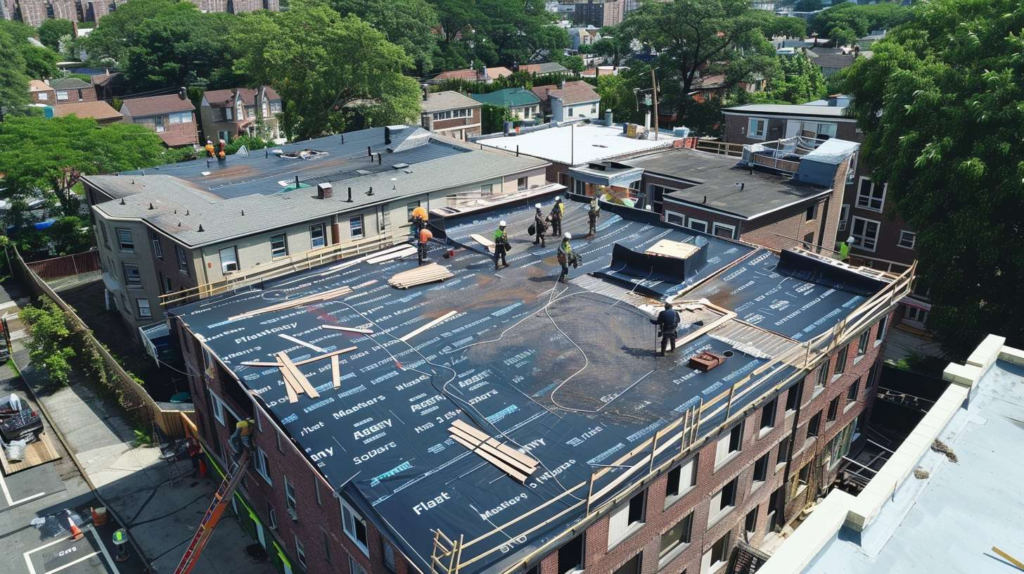
How Much Does a Flat Roof Repair Actually Cost? Real Prices, Not Guesswork
Above what's visible is often where it starts. Flat roof repair cost in Queens runs anywhere from $300-$800 for a very small, confirmed, localized repair to $2,500-$6,000 or more when the real source involves wet insulation, flashing failure, parapet termination damage, or a compromised substrate. That range isn't vague - it's honest. The number shifts the moment hidden conditions get identified, and they almost always do.
Real Repair Pricing Starts With a Range, Not a Fantasy
For a genuinely small repair, here's the range I usually give first. A truly contained membrane repair - one entry point, no moisture migration, no soft or saturated insulation underneath - can stay in the $300-$900 range. But "small" is a word that has to be earned by actually confirming the source, not assumed from the size of a ceiling stain. The moment soft material shows up under the membrane, or a parapet termination is involved, or the edge wood has been quietly rotting for two seasons, that number moves - and it moves fast. I'm Gloria Haines, with 31 years giving flat roof repair estimates in Queens that separate visible drama from the hidden work actually driving the bill, and the most expensive mistake I see isn't the roof damage itself - it's pricing a repair like backstage production math doesn't apply. What the audience sees on stage is never the whole budget.
Flat Roof Repair Cost Scenarios - Queens, NY
Source tracing matters before any scenario below is confirmed. These are real-world ranges, not "starting at" fiction.
| Scenario |
What's Really Being Repaired |
Estimated Range |
What Usually Changes the Number |
| Tiny localized membrane repair |
Single confirmed entry point, dry insulation beneath, no edge involvement |
$300 - $800 |
Finding soft material once the membrane is opened |
| Flashing or parapet detail repair |
Failed termination, open counterflashing, or parapet cap separation |
$600 - $1,800 |
How far the failure runs along the parapet wall |
| Repair involving wet insulation |
Saturated insulation board requiring removal and replacement before membrane work |
$1,200 - $3,500 |
Square footage of wet material and how long it's been wet |
| Edge wood or substrate damage |
Rotted fascia, deteriorated edge blocking, or compromised decking at perimeter |
$1,500 - $4,500 |
How far the decay extends once the edge is opened |
| Detail repair around curb or skylight |
Failed curb flashing, open skylight kerb seam, or deteriorated collar around a roof penetration |
$800 - $2,400 |
Number of penetrations involved and condition of adjacent membrane |
What the First Repair Range Usually Assumes
01 - Very small repairs stay small only when the source has been confirmed, not guessed from the ceiling stain.
02 - Flashing and edge details cost more than people expect because they're labor-intensive and material-specific.
03 - Wet insulation changes scope fast - once you find it, the repair is no longer a membrane story.
04 - Substrate damage pushes any estimate out of "simple repair" territory immediately - no exceptions.
Visible Stains Are Terrible Estimators Because They Bill the Wrong Part of the Roof
The Leak Entrance and the Leak Performance Are Usually Different Locations
I still remember that dinner-plate stain getting cast as the lead actor. It was a rainy Friday at 5:15 p.m. in Woodhaven - the homeowner had been watching that stain spread for two hours and was completely convinced it defined the job. He kept pointing at it like it owed him money. When I got on the roof, the actual opening was near a parapet termination several feet away. The water had traveled laterally under the system before making its dramatic indoor appearance, and the stain itself was just the final performance. I told him, "The leak is not performing where it rehearsed." That repair stayed modest - but only because we priced the real source, not the visible one.
A roof repair estimate is a lot like a theater budget - the thing the audience sees is not where all the work happens. In Queens, parapet terminations on attached row houses and mixed-use buildings are among the most common real entry points, even when the upstairs hall is where the drama unfolds. Water entering at a failed termination along Jamaica Avenue or near a corner parapet on a Woodhaven two-family doesn't announce itself at the source - it travels, finds the path of least resistance through the system, and shows up a foot or six feet away from where any surface scan would point. Pricing from interior evidence alone is how repair estimates end up repriced mid-job.
🎭 What's Visible on Stage
🔧 What's Happening Backstage
| Interior symptom: A water stain or wet spot on the ceiling or wall |
Likely roof source: Parapet termination, counterflashing, or curb seam - often several feet from the stain |
| Travel path: Appears as a single localized drip or stain |
Hidden travel: Water migrates laterally under the membrane before breaking through to the interior |
| Visible damage: Small discoloration, soft drywall, or peeling paint |
Hidden damage risk: Saturated insulation board, corroded fasteners, or softened substrate in the travel zone |
| Visible damage: A small bubble or blister on the membrane surface |
Hidden damage risk: Moisture trapped between layers, delaminating insulation underneath the blister |
| Visible damage: Crack or open seam visible on the roof surface near the stain location |
Hidden damage risk: That crack may be an exit point, not the entry - the real opening is elsewhere |
| What the estimate is based on: The nearest mark or the reported stain location |
What the estimate should be based on: The confirmed entry point after source tracing - not surface appearance |
⚠️ Why Low Repair Quotes Often Price the Wrong Story
An estimate built from a ceiling stain, the nearest visible roof mark, or a generic "patch it" assumption - without tracing the actual water entry point - is pricing the performance, not the problem. Low quotes get low by skipping the source investigation. When the repair opens up and the real condition is sitting right there, the number changes. Except now you're mid-job, the material is exposed, and you don't have much negotiating room.
Don't approve an estimate that can't explain exactly where the water entered the system.
Cheap Quotes Get Cheap by Pretending the Soft Stuff Underneath Does Not Exist
Here's the blunt truth: the cheapest repair quote often prices the smallest possible story. On a muggy August morning in Jackson Heights, a small commercial building owner showed me three estimates for the same leak - all over the map. The lowest one was suspiciously tidy. When I got on that roof and walked to the curb where the HVAC unit sat, I could feel the soft give underfoot before I even pulled a probe out. That low bidder had priced a membrane patch. Just the patch. The insulation around the curb was saturated and had been compressing under foot traffic for who knows how long. I showed the owner the difference between a cheap scene change and a safe set repair. He picked the adjusted middle number - which is exactly the kind of decision I like to see.
My opinion? Average pricing is helpful only until the roof starts confessing. The cost of flat roof repair guides you find online - $400 average, $700 average, whatever the number is this month - are useful for a 30-second gut check and nothing more. The moment hidden moisture turns up, or a curb detail has been failing in two directions at once, or the edge has drainage and rot working together in secret, the average becomes fiction. Averages assume average conditions. Queens roofs, especially on attached brick rowhouses and mixed-use buildings with decades of patch history, are not average conditions.
Before I give you a flat roof repair estimate, what part of this problem has actually been confirmed? That's the question worth asking every contractor you call. Here's the insider move: ask each bidder what condition they're assuming under the membrane - and then ask what finding, once the repair opens up, would legitimately change the number. A contractor who can answer that clearly is pricing the real job. One who says "it shouldn't change" without having opened anything yet is pricing a story they prefer to tell.
What Hidden Conditions Do to Flat Roof Repair Cost
| Hidden Condition |
Why It Matters |
What Part of the Estimate It Changes |
| Soft insulation around a curb |
Saturated insulation board has zero thermal or structural value; patching over it traps moisture and accelerates failure |
Both - material cost (replacement board) and labor (removal, re-setting, re-flashing) |
| Wet edge area |
Perimeter saturation spreads faster than field saturation; drainage slope failure often contributes |
Primarily labor - the repair perimeter expands, and edge detail work is time-intensive |
| Parapet termination failure |
Failed base flashing or open termination bar allows water behind the membrane at the wall - the highest-risk failure point |
Both - material (new flashing, termination bar, sealant) and labor (stripping and re-detailing the wall transition) |
| Hidden substrate damage |
Rotted or delaminated decking can't hold fasteners and won't support a new membrane properly |
Primarily material - decking replacement is a hard cost that cannot be avoided once discovered |
| Old patch history |
Multiple previous patches create incompatible layer buildup, poor adhesion surfaces, and hidden moisture pockets between layers |
Both - labor increases (stripping old patches) and material increases (larger clean repair area required) |
| Access or staging complications |
Tight alley access, no interior roof hatch, steep parapet walls, or high setback from street requires additional setup time |
Primarily labor - staging, equipment, and time on-site all increase when access is non-standard |
What Homeowners Believe vs. What the Estimate Actually Reflects
| Myth |
Fact |
| "Averages tell me enough to judge a quote." |
Averages assume clean, simple conditions. Once hidden moisture or failed details show up, the average is just a number that made you feel prepared. |
| "A smaller stain means a smaller bill." |
Stain size reflects where water landed, not how far it traveled or how much material it saturated getting there. Small stain, large source - happens constantly. |
| "If a quote is lower, the contractor is just more efficient." |
Efficiency is real. But most low quotes are low because they scope a smaller job - one that ignores what's underneath or assumes the best-case condition without confirming it. |
| "Commercial and residential repair math work the same way." |
Commercial roofs deal with more penetrations, curb details, and mechanical equipment. The failure points are different and the labor to address them is priced differently. |
| "A patch and a repair are basically the same thing." |
A patch covers the surface. A repair addresses the source, the travel path, and whatever condition is underneath. One of these keeps water out. The other delays the conversation. |
Recurring Patch Money Is Still Roofing Money, and Eventually It Has to Be Compared to a Real Fix
Past Receipts Often Explain Why a Repair Number Feels High
For a genuinely small repair, here's the range I usually give first - and on a cold February afternoon in Maspeth, I said exactly that. Except the customer who called me had a folder. An actual manila folder with every roofing receipt going back six years, organized by date, which is the kind of thing that makes an estimator's day and breaks her heart at the same time. He wanted to know if the quote he'd gotten was fair. Nice guy, totally prepared, completely right to ask. When we opened one edge area together, the substrate started telling a rougher story than the surface had suggested - rot working in tandem with drainage failure, quietly since probably the third or fourth receipt in that folder. I set my flashlight on a snow shovel to free up both hands, and I explained why the cost to fix flat roof problems climbs when edge wood and standing water have been collaborating for seasons. Then I lined up his running patch spend against what a legitimate edge repair would actually cost. The folder told the real story. The roof had already been expensive - he just hadn't seen it totaled up yet.
Continuing the Patch Cycle vs. Paying for a More Complete Repair
Why People Keep Patching
- Lower immediate cash outlay - a patch invoice is easier to approve than a repair scope
- Minimal disruption to tenants or daily use of the building
- Buys time when budget constraints are genuinely real
- Feels like the problem is being handled, even briefly
Why It Often Costs More in the End
- Repeat patch spend adds up fast - and the underlying failure keeps growing between each invoice
- Hidden deterioration in insulation, substrate, and edge wood continues unaddressed with each patch cycle
- Old patch layers complicate the eventual repair, raising labor and material cost
- The total spend across the folder often exceeds what the real repair would have cost two years earlier
Questions Homeowners Ask About Flat Roof Repair Costs
▶ How much does a flat roof repair cost?
Small confirmed repairs in Queens typically run $300-$900. Repairs involving flashing details, wet insulation, or edge damage run $1,200-$4,500 or more. The range isn't evasion - it's the honest difference between a dry repair and one where hidden conditions show up once the membrane is opened.
▶ What makes a flat roof repair estimate jump from hundreds to thousands?
Wet insulation, parapet termination failure, rotted substrate or edge wood, and old multi-layer patch history are the four main culprits. None of them are visible from the interior. They're found when someone actually gets on the roof and investigates instead of eyeballing from below.
▶ Why are quotes for the same leak so different?
Because they're not quoting the same repair - they're quoting different assumptions about what's underneath. The low quote may be pricing a membrane patch. The higher quote may be pricing what the substrate and insulation actually require. They look like they're solving the same problem. They're not.
▶ How do I know if a low quote is missing hidden work?
Ask the contractor two questions: What condition are you assuming under the membrane? And what finding, once the repair opens up, would legitimately change this number? If they can't answer the first one or say "nothing would change it" to the second - the quote is pricing a story they'd prefer to tell, not the roof you actually have.
▶ When does repeated repair spending stop making sense?
When the running total of patch invoices approaches what a legitimate repair would have cost - or when each patch creates new complications for the next one. Pull out your receipts and add them up. If you're two or three invoices deep on the same roof section, you may already be past the point where patching is saving you money.
If you want a flat roof repair estimate based on the real source and actual hidden conditions - not the cheapest possible version of the story - call Flat Masters. We serve Queens, NY, and we'll tell you exactly what we're looking at and why the number is what it is.