
Flat Roof Ventilation Is the Detail That Prevents Expensive Problems Down the Line
Let's call a temporary measure what it is. Patching a stain and calling it a roof repair - without ever asking why the moisture is there - is how flat roofs in Queens quietly fall apart from the inside out. This article explains how roof ventilation for flat roofs actually works, what a roof flat vent can and can't do on its own, and why your building's specific conditions change every single answer.
Most so-called leaks begin as trapped moisture inside the roof system
Let's call a temporary measure what it is - and a misread diagnosis is exactly that. Many flat-roof "leaks" aren't dramatic water entry from above. They're moisture and airflow problems that build up inside the roof assembly long before anything visibly fails. Think of the roof like a classroom: if heat, moisture, and air have nowhere appropriate to go, the whole room starts acting up - condensation on the walls, that musty smell, the ceiling tiles going soft - and nobody's pointing at a broken window yet. The failure is systemic, not superficial.
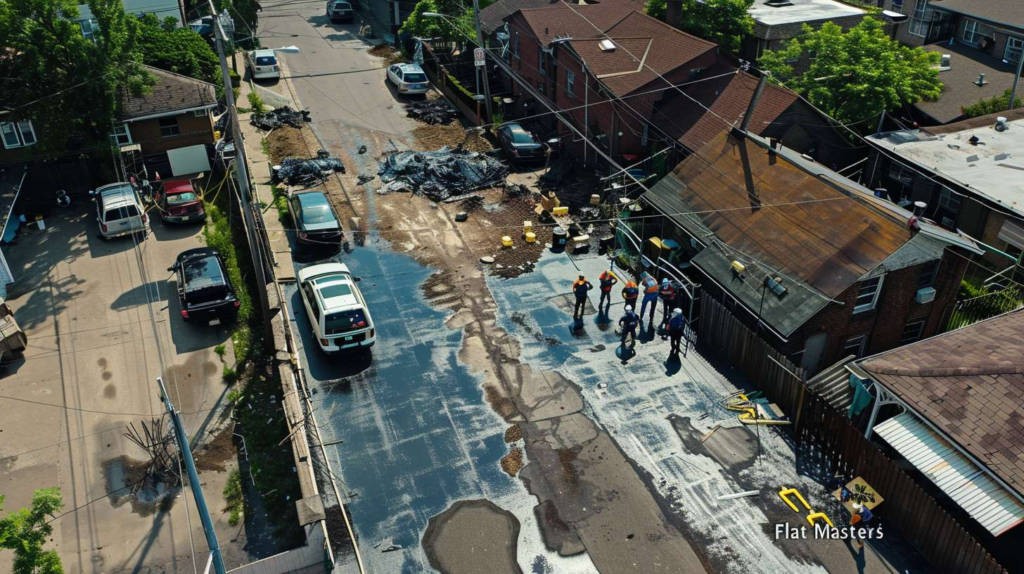
At 7 a.m. on a Queens roof, you learn fast what stayed wet all night. I was on a two-family in Whitestone at 6:40 in the morning after one of those sticky August nights where the air already feels tired before sunrise. The owner swore the roof was failing - the top-floor bedroom ceiling had this slow brown bloom every summer - but when I opened up a section near the drain line, the insulation wasn't soaked from above the way they expected. It was damp and stale underneath. Doreen "Dee" Matalon, with 27 years in flat roofing and a specialty in diagnosing exactly this kind of hidden moisture and ventilation failure, has seen that story repeat across Queens more times than she'd like to count. The membrane on that Whitestone roof was decent. The damage was happening in silence. That's the symptom; now here's the cause: trapped moisture with nowhere to go had been quietly destroying the assembly from within, and the ceiling stain was just the last one to get the memo.
| Myth | What's actually happening |
|---|---|
| "If there's a ceiling stain, rain is getting through the membrane." | Trapped interior moisture vapor can condense inside the assembly and produce staining that looks identical to a surface leak - no storm required. |
| "One roof flat vent solves the airflow problem." | Ventilation on a flat roof is a system - intake, exhaust, air path, vapor barriers. A single vent without that context is decoration, not a fix. |
| "Ventilation only matters on steep-pitched roofs." | Low-slope assemblies trap vapor and heat just as aggressively - often more so, because there's no natural stack effect pulling air through the roof cavity. |
| "If the membrane looks okay from the outside, the roof is healthy." | Insulation can be saturated and degraded while the surface membrane appears intact. The damage is invisible until it isn't. |
| "Ventilation is optional if the repairs are brand new." | New repairs installed over an unresolved moisture problem will fail early - sometimes within one heating season. The assembly doesn't care how recently you patched it. |
Before choosing a vent, identify which kind of moisture problem you actually have
Here's the part people don't enjoy hearing: good observation does not equal correct diagnosis. A property owner who has watched the same corner of ceiling stain every July for three years has data - but they usually have the wrong conclusion. Across Queens, the building stock makes this even harder to read. A mixed-use block in Ridgewood behaves differently than an older multifamily in Astoria or a top-floor condo in Bayside or a storefront below a residential unit in Jackson Heights. Buildings in Whitestone tend to run older assemblies with multiple layered repairs; commercial corridors in Astoria and Jackson Heights often have bakeries, hot kitchens, and laundry operations pushing enormous moisture loads upward all day. The roof above a top-floor apartment sitting over a steam-heated building in Bayside faces a completely different vapor pattern than the same-sized membrane over an unoccupied storage space. Blaming the surface without reading the building first is, not gonna lie, one of the more expensive habits in this industry.
Signs that point to trapped vapor instead of an exterior breach
If you were standing next to me on this roof, I'd ask you one question first: where is the moisture coming from all day - not just where the stain showed up? Because the stain is the last place the moisture went, not the first. That distinction is everything. Vent selection, placement, and assembly design all depend on whether you're managing vapor rising from a heated interior, condensation forming at a thermal bridge, or actual water migrating through a failed seam. Picking a vent before you know which problem you have is like writing a prescription before running the test.
Does this flat roof need ventilation review, leak repair, or both?
Start: Do stains or odors worsen after heat or humidity, even without recent rain?
YES → Possible trapped moisture inside the assembly. Then ask:
Is insulation damp underneath while the membrane above looks serviceable?
YES → Ventilation and moisture-control review needed.
NO → Open targeted areas further and trace the vapor path before closing anything back up.
NO → Ask: Do symptoms appear only after storms or visible ponding?
YES → Exterior leak path likely. Inspect seams, drains, and all penetrations.
Final branch - either path: Has someone already installed a single roof flat vent as a standalone fix?
YES → Reassess the entire venting strategy before any more patching. One vent is not a system.
Field clues that the problem is moisture accumulation inside the roof assembly:
-
🤢
Musty or wet-cardboard odor when the heat runs - vapor is moving through insulation that's already compromised. -
🌡️
Summer staining that repeats without storm timing - seasonal heat cycling is pushing trapped moisture to the surface. -
💧
Damp insulation on the underside while the membrane looks intact above - the water table is working upward, not downward. -
🔥
Uneven warm patches above occupied spaces in cool weather - heat is escaping through degraded insulation, signaling moisture infiltration. -
🫧
Blistering or membrane stress near older repair areas - patched spots trap vapor underneath, accelerating delamination. -
🌫️
Condensation signs around penetrations or parapet transitions - cold-to-warm interfaces are where vapor converts to water first.
Bayside taught me that the wrong vent can be as useless as no vent at all
I once peeled back a seam in Bayside and knew the story in ten seconds. The membrane was telling me one thing - surface wear, minor cracking near the parapet - and the moisture pattern underneath was telling me something completely different: saturated insulation in a band that tracked the interior heat source below, not the weather above. Two contractors had already been on that roof. Both added material. Neither asked why the moisture was there to begin with. And here's where I'll be direct: I'm mildly unimpressed - and that's being generous - by any contractor who recommends or installs a vent before they've opened the assembly and understood what's happening inside it. A vent installed on a misread roof doesn't fix the problem; it just gives everyone something to point at when it doesn't work.
A vent is not a magic button; it is a response to a diagnosis.
| Vent approach | Best used when | What it helps with | Where it falls short | Queens caution |
|---|---|---|---|---|
| Standard static vent | Assembly is well-insulated, vapor barrier is intact, and moisture load is modest | General air relief, reduces minor heat buildup in the cavity | Doesn't create directional airflow; useless if intake path doesn't exist | Older Queens multifamily roofs often lack a clear air path - static vents become expensive caps |
| Pressure-relief vent | Membrane is trapping vapor at seams or showing blistering over partially wet insulation | Releases built-up vapor pressure preventing membrane delamination | Does not dry out wet insulation already in place - that still needs to be addressed | Good short-term tool; in Queens winters, wet insulation left in place freezes and compounds the damage |
| Vented base detail (retrofit) | Recovering or re-roofing over an existing assembly where full tear-off isn't in scope | Creates a designed air gap between old and new layers to allow vapor escape | Requires careful perimeter detailing - gaps at edges defeat the purpose entirely | Common in Ridgewood and Astoria where owners recover rather than replace - edge detail shortcuts are widespread |
| Exhaust-supported vent strategy | Building interior runs hot (bakery, laundry, restaurant, top-floor kitchen) with high daily moisture generation | Coordinates mechanical exhaust with roof-level venting to prevent vapor stacking in the assembly | Needs ongoing building-use awareness - if the interior use changes, the vent strategy may need revisiting | Northern Boulevard and Junction Boulevard commercial corridors in Jackson Heights have multiple such buildings that have never had this evaluated |
| Single random vent (the cautionary example) | Nowhere - this is a guess, not a strategy | Possibly minor pressure relief in ideal conditions; mostly provides psychological comfort | Doesn't address vapor path, insulation condition, or airflow design; can actually trap moisture in adjacent areas | Surprisingly common across Queens after DIY or handyman intervention - and it's usually the first thing found during a real inspection |
The vent only works if the rest of the assembly lets air and vapor move correctly
A flat roof doesn't forgive wishful thinking. One February afternoon in Ridgewood, I got called in after a handyman had installed what he proudly called a roof flat vent dead center on a low-slope roof - like he was putting a hood ornament on a Buick. The tenant upstairs kept saying the apartment smelled like wet cardboard every time the heat kicked on. I was kneeling in 28-degree wind looking at one vent trying to solve an entire building's airflow problem, and thinking: this is what happens when someone treats ventilation like a checkbox instead of a system. Here's the insider move worth knowing: before anyone discusses vent count or product specs, the right questions are where the moisture is generated, how the insulation is layered, where the air barriers break down, and whether penetrations are forcing vapor to collect in pockets. Those answers determine the vent plan. Not the other way around.
What a contractor should inspect before recommending the best roof vents for flat roofs
The correct sequence is teacherly and deliberate: symptom first, then cause, then assembly, then solution. That means mapping when and where staining or odors appear before touching anything. Then inspecting the membrane surface - seams, drains, flashings, penetrations - for actual breach evidence. Then opening targeted test cuts to read the insulation condition and underside moisture. Only after that does the conversation about ventilation strategy make any sense. Skipping steps doesn't save time; it just pushes the cost forward a few months.
Professional review process for roof ventilation on a flat roof:
-
1
Map symptom timing against weather and building use. Note whether staining, odors, or dampness track storms, humidity, or heating cycles - the pattern names the problem.
-
2
Inspect membrane, seams, drains, and all penetrations. Look for breach evidence at every transition - parapet edges, stack flashings, HVAC curbs, and older repair patches.
-
3
Open targeted test areas and read insulation and underside moisture. Visual inspection from above tells half the story. Opening the assembly tells the rest.
-
4
Identify the vapor source and any airflow restrictions. Trace moisture back to where it originates - not just where it ends up - and map where air movement stops in the assembly.
-
5
Specify venting and repair as one coordinated scope. Ventilation and membrane repair aren't separate line items. They're one answer to one problem, written together.
Why a single center-mounted vent is usually a red flag
Think of trapped moisture like kids in a classroom with the windows painted shut. You could crack open one tiny pane in the middle of the room and call it "ventilation" - but if there's no cross-movement, no intake on the other side, no path for the warm stale air to actually exit, that one crack does almost nothing except let you tell the principal you tried. Vent placement matters. Quantity matters. Compatibility with the membrane type, the insulation R-value, and the substrate below matters. A vent that looks substantial sitting on the roof surface may be contributing zero to actual moisture management if the assembly underneath can't support airflow from point A to point B. That's the conversation that should be happening before any product gets ordered.
⚠️ Warning: Installing a vent without opening the roof first
Installing a roof flat vent as an educated guess - without reading the assembly - can leave wet insulation in place, fail to relieve the actual vapor path, and create a false sense of resolution. The roof looks like it got attention. The damage continues. Repeated patching over a hidden moisture problem consistently costs more than doing the investigation right the first time. Don't let a vent be the thing that makes you feel better while the insulation keeps getting worse underneath.
Queens buildings need ventilation answers that match how the space below actually behaves
A flat roof doesn't just cover a building; it reacts to it. I had a bakery owner in Astoria wave me onto the roof at 9:15 at night because he only had time after closing - and the whole roof was still radiating heat from the ovens below. You could feel it through your boots, moving in uneven patches through the assembly. Around an older repair area near the rear parapet, condensation damage was developing in a way that a noon inspection would never have shown as clearly. He apologized for the hour. I told him the late visit was actually more useful. That building runs hot all day, every day, and nobody had ever factored that into the ventilation plan. The roof above it was being treated like it sat over a cold storage unit. That mismatch was the whole problem.
When repeated stains, odors, blisters, or seasonal dampness keep coming back, the next step isn't another hopeful patch. It's a ventilation-aware roof inspection that reads the moisture movement, evaluates the assembly, and builds a vent strategy around how your specific building actually behaves. Flat Masters does exactly that kind of inspection across Queens - call us when you're ready to get the roof assembly read correctly the first time instead of patching from the stain down.
How interior use changes the roof above it:
Flat roof ventilation questions Queens owners ask before approving work: