
Aluminum for a Flat Roof? It's Been Used for Decades for Very Good Reason
I can usually tell within minutes what the previous attempt missed. Aluminum doesn't last because it's magically tough - it lasts because it's light, corrosion-resistant, and forgiving enough to handle the push and pull of a Queens climate, but only when the person installing it respects the way metal actually moves.
Why Aluminum Keeps Passing the Long Test
The panels, seams, and drains on an aluminum flat roof aren't quiet - they confess everything. Stress lines at edge metal tell you the fastener pattern was rushed. Lifted seams near a parapet tell you nobody thought about thermal cycling. Every component is a witness, and if you know what you're listening for, the roof gives up the whole story before you've walked half the perimeter.
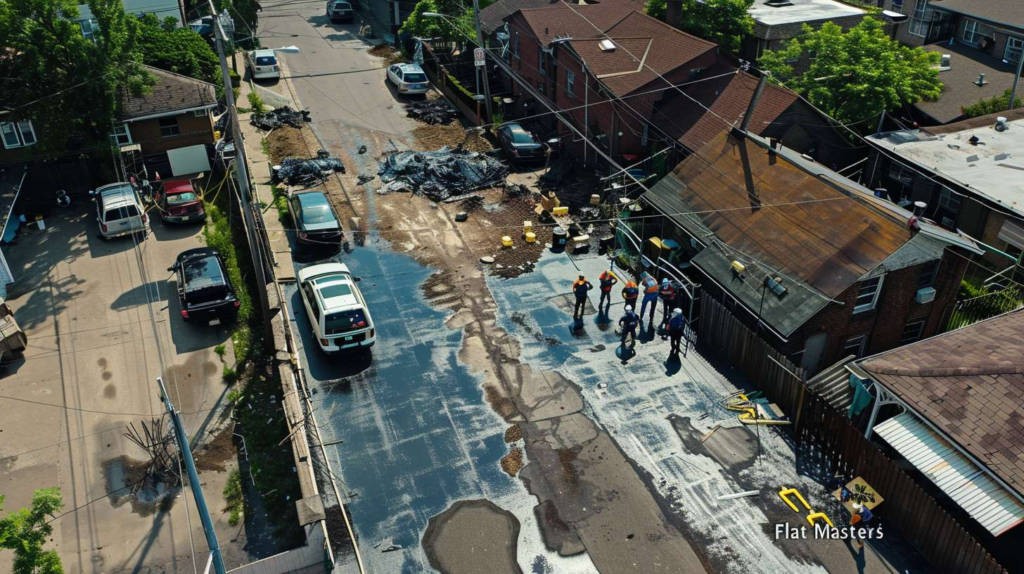
Here's the plain answer: aluminum has earned its place on low-slope roofs precisely because cities like Queens don't let materials off easy. You've got temperature swings that can hit 80°F between a January night and a July afternoon, salt-laden air rolling in off the water, and flat decks that pond if drainage wasn't thought through. Aluminum handles that combination better than most metals - not because it's invincible, but because it oxidizes into its own protective skin and stays lighter than steel under a building that may already be stressed. And honestly, I trust it - when the details are disciplined. The moment someone treats it like a miracle material that doesn't need proper movement allowance or isolation from incompatible metals, I've already seen how that story ends.
| Factor | Aluminum Flat Roof Behavior | Why It Matters on a Queens Flat Roof |
|---|---|---|
| Weight | Roughly one-third the weight of steel at the same thickness | Older Queens mixed-use buildings often have marginal structural capacity; keeping the roof load low matters |
| Corrosion Resistance | Forms a passive oxide layer that slows degradation without paint or coating | Salt air and acid rain from urban pollution attack unprotected metals; aluminum's oxide layer is its own defense |
| Thermal Movement | Expands and contracts significantly with temperature change - roughly 13mm per 30 feet per 100°F swing | Queens rooftops bake in July and freeze in January; without designed-in movement allowance, panels buckle or seams split |
| Repairability | Isolated repairs are possible if the substrate and surrounding panels are still sound | Saves owners from full tear-offs when a single seam or edge detail fails - provided the right repair method is used |
| Common Failure Trigger | Contact with dissimilar metals, over-fastening, or sealant used as a design substitute | Most Queens aluminum roof failures I've seen trace back to a detail shortcut, not the material itself |
| What the Roof Is Usually Confessing | Stress lines = no movement allowance. Corrosion at edges = mixed-metal contact. Lifted seams = over-fastening or deck movement not accounted for. | The material is rarely the villain. Read the seams, drains, and edge metal - they'll tell you exactly where the installer's decisions went sideways. |
Quick Facts - Aluminum Flat Roofing
Best Known For
Lightweight durability and natural corrosion resistance that holds up without constant coating maintenance - when the system is correctly detailed
Main Design Challenge
Thermal movement - aluminum expands and contracts more than most roofing metals, and every seam, clip, and edge detail has to account for that or it will eventually fail
Typical Urban Advantage
Resists the acid rain, salt air, and pollution exposure common on dense commercial rooftops in Queens better than uncoated steel and without the weight penalty
What Shortens Lifespan Fastest
Direct contact with steel or copper, over-fastened panels with no slip, and sealant used to cover up a movement problem instead of solving it at the design level
Where Installations Start Telling on Themselves
Movement at Edges and Fasteners
At 3 p.m. on a Queens roof, metal tells on everybody. I remember a July afternoon in Astoria, around 3:15, sun hammering the parapet caps so hard you couldn't rest a tape measure on them without burning your knuckle. The owner kept insisting the aluminum flat roof was warping for no reason. But the roof had a very clear reason - a cheap fastener pattern spaced way too tight and zero movement allowance at the edge metal. I'm Marisol Vega, and with 19 years in flat roofing and a specialty in diagnosing failing metal flat roofs, I can read stress lines the way a chemist reads a reaction - and these panels were practically shouting. I traced them with a grease pencil right there on the surface, and the owner went quiet in that particular way people do when they realize the roof had been telling the truth the whole time. On dense commercial blocks near the BQE and older mixed-material buildings throughout Queens, that story repeats more often than it should.
Mixed-Metal Contact Near Drains and Trims
I learned this the cold way on a Ridgewood repair - one February morning, freezing drizzle, scraping back sealant on a mixed-material assembly where someone had tied aluminum directly into steel without a separation layer or a second thought. By 8 a.m. my gloves were soaked and I was showing a co-op board president early galvanic corrosion starting exactly where the two metals were forced together. "Aluminum is maintenance-free," the previous contractor had told him. Nice theory; bad detail. Good material still loses when you ignore basic electrochemical behavior - and that's not abstract chemistry, it's what happens every winter on a Queens rooftop when moisture bridges two incompatible metals and the current does its quiet, destructive work.
If you were standing next to me, I'd ask one thing first: where does this roof need to move? That question leads everywhere worth going - edge metal, penetrations, seams, clip spacing, curb transitions, drain flanges. Those are the places where an assembly either has room to breathe or it doesn't. If it doesn't, the roof doesn't fail all at once; it confesses gradually. A lifted seam here. A fastener pulling through there. A stain pattern inside the building that the owner thinks is a plumbing issue until someone finally looks at the drain edge on the roof and sees the real culprit.
Myth vs. Fact - Aluminum Flat Roof Decisions
| Myth | Real Answer |
|---|---|
| "Aluminum never corrodes." | Aluminum resists corrosion on its own, but introduce contact with steel or copper and you'll have galvanic corrosion eating the aluminum at every wet junction - often hidden under sealant until significant damage is done |
| "Movement means the roof is failing." | Movement is normal and expected. The failure happens when movement is trapped - by over-fastening, rigid sealant beads across expansion zones, or edge details with no slip tolerance |
| "More fasteners always means a stronger roof." | On a metal low-slope system, over-fastening is a failure mode. Too many fixed points prevent panels from expanding, which concentrates stress at each fastener hole and eventually tears the substrate or the panel itself |
| "All metal details can touch each other." | They absolutely cannot. Aluminum in contact with steel, copper, or even treated wood accelerates deterioration. Every transition point needs appropriate separation - tape, a non-conductive membrane, or compatible fasteners |
| "Sealant can fix a design mistake." | Sealant is a maintenance material, not a structural solution. Caulking over a movement problem holds for one or two seasons before the stress cycles break the bond - and the next repair becomes harder because the real issue is now buried |
⚠ Hidden Risk: Mixing Aluminum with Incompatible Metals
Direct contact between aluminum and dissimilar metals - steel deck clips, copper drain bodies, galvanized trims - creates galvanic corrosion the moment moisture enters. On a flat roof, moisture is never far away.
The highest-risk zones are drain flanges, edge metal terminations, rooftop unit curbs, and anywhere a previous repair used whatever fastener was nearby. These are also the places most likely to have been sealed over, which means the corrosion has a head start before you can see it.
Don't assume prior sealant means the detail is clean. Lift it. Look at what's underneath before the next repair goes on top.
Questions That Separate a Durable Roof from a Loud One
Before you ask what aluminum costs, can your current roof assembly even let metal move without binding?
Ticking, oil-canning, and visible stress at seams don't automatically mean you need a new roof. They often mean the assembly is fighting itself - panels trying to expand against details that won't let them. That's a diagnostic finding, not a replacement sentence. A good inspection tells you whether the structure is failing or just communicating.
Decision Tree
Should You Repair, Retrofit, or Replace Your Aluminum Flat Roof?
Is there active leaking right now?
YES →
Go to Question 3. Active water entry needs immediate triage - locate the source before any other evaluation.
NO →
Continue to Question 2.
Are seams or edges visibly failing - or is movement noise the only symptom?
SEAMS/EDGES FAILING →
Detail Retrofit. Edge metal, clips, and seam treatment may be the fix - not a full replacement.
NOISE ONLY →
Coating/Maintenance Plan. Verify movement allowance, adjust any binding points, and schedule professional inspection.
Is corrosion isolated to mixed-metal contact points only?
YES →
Targeted Repair. Remove the dissimilar metal contact, treat affected aluminum, and re-detail with proper separation. Panels elsewhere are likely fine.
NO - WIDESPREAD →
Go to Question 4.
Is the substrate - insulation, deck, and structural support - still sound?
YES →
Targeted Repair or Detail Retrofit. Substrate integrity means you're fixing the system, not the building.
NO →
Full Replacement Evaluation. Compromised substrate means new panels won't solve the problem - the full assembly needs assessment.
✓ Before You Call About Your Aluminum Flat Roof - Check These First
-
01
Age of the roof - Do you know when the aluminum was installed and whether it's had any prior repairs? Even a rough decade helps narrow the diagnostic.
-
02
Where leaks appear inside - Note the exact ceiling location. Water travels before it drops, so knowing the interior location helps trace the actual roof entry point.
-
03
When noises happen - Ticking and popping right after sunrise or at sunset points to thermal expansion and is often not a failure. Noise during rain or wind is a different conversation.
-
04
Whether prior patchwork exists - Patched areas, old sealant lines, and replaced sections can hide the original failure point and complicate the current one.
-
05
Whether different metals were used in repairs - If a previous contractor used steel screws, copper flashing, or galvanized trim against the aluminum, that's a corrosion risk worth flagging before the inspection.
-
06
Whether ponding occurs near drains - Standing water that sits for more than 48 hours after rain usually means a drain or slope issue, not just a roofing problem - but it accelerates detail failures fast.
Maintenance Rhythms That Keep the Story Boring
What to Inspect After Summer Heat and Winter Freeze
Blunt truth - a good aluminum flat roof can be ruined by fancy nonsense. Incompatible elastomeric coatings applied over expansion zones, multi-layer patch systems that stiffen panels that need to flex, proprietary sealants that cure rigid in Queens winters and crack by March. The overcomplicated fix often creates more stress than the original problem did. Here's an insider move worth doing on every inspection: tap the rails, edge metal, and drain areas with your knuckle before you start looking. Sound changes - a hollow knock versus a solid thud - reveal looseness and voids that your eyes won't catch until it's worse. I've found separating clips and lifting edge terminations this way that looked completely fine from three feet away.
Think of it like a baking sheet left in the oven: it expands, it shifts, and you'd be foolish to act surprised. I had a small commercial job near Woodside - a restaurant owner on 61st Street called me at dawn because he heard ticking over his prep area every morning before service. He was convinced the deck was failing. What was actually happening was an older aluminum roof expanding right as the morning sun hit after a cold night - normal, expected, harmless thermal movement. I stood there with him, walked him through the distinction between movement and trapped movement, and explained that if the assembly had proper slip allowance at the edges and clips, that sound was the roof doing exactly what it should do. He didn't need a tear-off. He needed someone to explain what the roof was confessing. Flat Masters handles both kinds of calls - the real failures and the ones that just sound like failures.
Maintenance Schedule
Aluminum Flat Roof - Queens Conditions
Open These Before Assuming the Roof Is Failing
Ticking and Popping Sounds
+
Thermal expansion sounds happen when aluminum panels are warming up or cooling down rapidly - typically right after sunrise or just before sunset. That ticking is the panel surface moving against a fixed clip, edge restraint, or adjacent panel with minimal clearance.
It's not pleasant. It's also not automatically a problem. The question is whether the assembly has enough designed-in slip tolerance for that movement to happen without accumulating stress. If the noise is consistent, tied to temperature transitions, and there's no water intrusion - you likely have a movement allowance issue to address, not a failing roof.
When Staining Points to Detail Failure Instead of Panel Failure
+
Interior staining almost never originates directly below the water entry point on a metal roof. Water travels along panels, follows fastener lines, and exits wherever it finds a low point. A stain at the center of a ceiling often traces back to a drain flange edge or a seam near the perimeter - not the spot directly above.
Staining with rust color near roof edges usually points to a steel component - a fastener, clip, or trim - corroding in contact with the aluminum. The aluminum itself may be fine. Don't replace the panel until you've identified whether the stain is coming from the aluminum or from what it's touching.
When Patching Helps Versus When It Traps Movement
+
A targeted patch over a seam that separated or a fastener hole that opened up is a legitimate repair - as long as the patch material is compatible with aluminum and the surrounding assembly still has movement room. You're sealing a breach, not redesigning the system.
Where patching becomes a problem: applying a rigid patch across an expansion zone, or using a thick elastomeric coat that bridges a seam and locks two panels together. Now the panels can't move independently, the stress concentrates at the patch edges, and you've traded one small failure for a larger one on a faster timeline. If the roof needs to flex there, let it flex - fix the seam geometry instead.
An aluminum flat roof that's been designed for movement, isolated from incompatible metals, and properly detailed at every edge, seam, and drain isn't mysterious - it's just disciplined work. If your roof is ticking, staining, or showing stress at seams and edges, let Flat Masters inspect the details before a minor confession turns into an expensive testimony.