
Flat Roofs Come With a Specific Set of Problems - Here's What They Are
True, the flatness isn't really the villain here. Most flat roof problems don't start because a roof lacks pitch - they start because water sits one inch longer than it should and begins quietly testing every weak seam, every aging drain collar, every edge detail that looked fine from the ground. Think of it like a miniature weather system up there: water slows, pools, changes direction, and finds pressure points the way a storm cell behaves around terrain. The roof doesn't fail all at once. It fails at the details, one compromised spot at a time.
At 7 a.m. on a Queens roof, the puddles tell the truth faster than the owner does. A shallow pond near a parapet is "minor" if it drains within a few hours. It "needs attention" if the same low spot fills up every storm. But this is where the real trouble starts: when that water lingers near a seam, a drain collar, or a pipe penetration and finds even a hairline gap to work through.
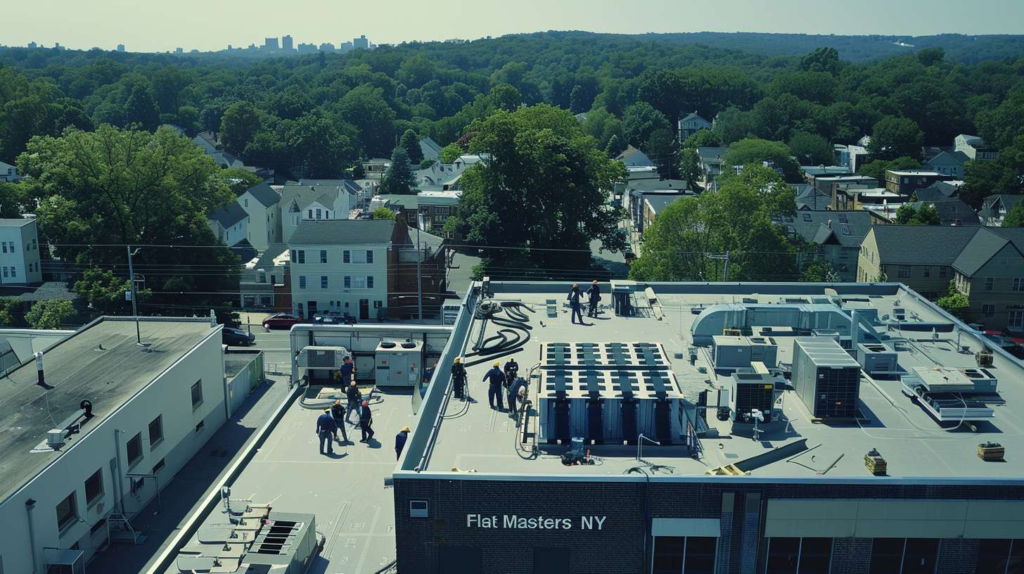
What Usually Goes Wrong First on a Flat Roof
| Problem | What It Looks Like | Typical Cause | What It Turns Into |
|---|---|---|---|
| Ponding Water | Visible standing water 24-48+ hours after rain | Insufficient slope, settled decking, clogged drain | Membrane breakdown, seam failure, structural deck rot |
| Clogged or Slow Drains | Water rises above drain level during rain; debris ring around drain | Leaf buildup, debris, deteriorated drain collar | Chronic ponding, lateral water migration under membrane |
| Open Seams or Blisters | Raised ridges, bubbles, or visible separation in membrane surface | Trapped moisture, thermal cycling, adhesion failure | Water entry into insulation layer, accelerating deck damage |
| Flashing Failure at Edges or Penetrations | Lifted, cracked, or separated metal at walls, pipes, or HVAC curbs | Age, freeze-thaw cycles, improper original installation | Interior leaks, insulation saturation, wall water intrusion |
| Wet Insulation Below Membrane | Soft or spongy walking area; stain pattern on ceiling below | Long-term undetected leak, repeated patching over damp material | Deck rot, mold growth, full roof system replacement |
| Myth | Fact |
|---|---|
| "Flat roofs always leak because they're flat." | A properly installed flat roof with working drainage and intact seams can outperform a neglected pitched roof. The slope isn't the defect - failing details are. |
| "A small bubble is cosmetic." | Blisters mean moisture or gas is already trapped between membrane layers. That bubble will grow with thermal cycling and eventually split open. |
| "If the ceiling stain is near the chimney, the chimney caused it." | Water travels sideways under membranes. The stain location is where water arrived - not necessarily where it entered the roof system. |
| "If it dries out after rain, the roof is fine." | Surface drying doesn't mean the insulation dried. Moisture trapped below the membrane doesn't evaporate - it just waits for the next storm to go deeper. |
Why Water Stays Put Longer Than It Should
Drainage Paths That Fail Quietly
If I asked you where the water is supposed to go, could you point to it? Most owners can't, and that's not a criticism - it's just how roofs work until they don't. On a Queens two-family or mixed-use building, you've often got a drain somewhere in the middle, a scuppers along one parapet, a slight slope that's shifted over decades of settling, and then a collection of HVAC units, conduit runs, and old pitch pockets scattered across the field that create lazy low spots the original installer never planned for. I was on a Ridgewood two-family at 6:40 in the morning after a humid overnight storm, and the owner was completely convinced the leak was coming from the chimney. It wasn't. I peeled back a section near the interior drain and found water that had been traveling sideways under the membrane for what looked like months - all because that drain had been half-blocked by debris and nobody had caught it.
Here's the part people usually don't want to hear. The standing water you can see from the roof hatch is not the whole problem. It's actually the least dangerous version of the problem. What's worse is the water that never visibly pools because it finds a seam gap and moves laterally - under the membrane, into the insulation, toward the deck - without ever giving you a dramatic warning sign until a ceiling tile softens or a wall starts showing a stain three feet from where the real entry point sits.
Should This Drainage Problem Be Monitored, Scheduled, or Treated as Urgent?
Is water still sitting on the roof 48 hours after rain?
YES
Is it near a drain, seam, or penetration?
→ YES: Urgent Inspection - call now.
→ NO: Single low spot or repeating area? Schedule service soon.
NO
Do drains clog or slow during every storm?
→ YES: Maintenance plus inspection needed.
→ NO: Monitor and document after next storm.
When Surface Damage Is Really a Moisture Problem Below
I've seen this movie before, and it always starts with a "small stain." The owner points to a discolored patch on the membrane, maybe a bubble at the edge of an old repair, a soft spot that gives slightly underfoot. These aren't cosmetic - they're symptoms of something deeper. Blisters mean air or moisture is already lifting the membrane from its substrate. Ridges along seams mean differential movement between wet and dry insulation. Soft, spongy areas underfoot mean the deck itself may already be compromised. This is exactly the pattern - something Elena Varga, with 19 years tracing moisture paths on Queens flat roofs, sees all the time - where the visible surface damage is the last thing to appear, not the first. And honestly, my plainest opinion on this: repeatedly patching over damp material is one of the most expensive "cheap fixes" an owner can choose. You're sealing the moisture in, giving it warmth, and creating the exact conditions for it to spread laterally to dry sections that didn't have a problem yet.
⚠ Warning: Patching Over Wet Insulation
Trapping moisture under a new patch doesn't stop the damage - it accelerates it. Moisture spreads laterally through insulation boards, rotting the decking beneath, weakening membrane adhesion across a much wider area, and turning what could have been a targeted repair into a full-section replacement. The later you catch this, the more invasive - and costly - the fix becomes.
| Option | Pros | Cons |
|---|---|---|
| Patch the visible area only | Faster, lower upfront cost; stops surface exposure temporarily | Traps existing moisture; problem recurs and spreads; future repairs become more extensive and more expensive |
| Open, test, and trace moisture before repair | Identifies true extent of damage; allows dry repair; prevents lateral spread; extends repair lifespan significantly | Higher initial cost; takes more time; may reveal a larger repair area than expected |
Where Edges, Flashings, and Old Repairs Start Letting Water In
Wind-Driven Leaks Are Not Random
A flat roof is like a baking sheet with one bent corner - everything runs to the wrong place. The perimeter of a flat roof takes more stress than the field membrane because that's where the system terminates: edge metal, coping caps, counterflashing at parapet walls, pipe boots, all of it held together by material that expands and contracts with every temperature swing. When one piece of that edge system lifts, cracks, or separates, it creates an opening that only activates under the right conditions. I got called to a restaurant on Jamaica Avenue in Jackson Heights during a windy Sunday drizzle - the kind of day most people wouldn't expect a leak - because the owner said the roof only leaked when rain came in sideways. That detail was the whole clue. The issue turned out to be failed edge flashing on the windward side and an old repair seam that was lifting just enough under gusts to let water funnel in. A standard top-down inspection in dry weather never would have caught it.
If a roof only leaks during wind, the entry point is often nowhere near the drip.
Bluntly: flat roofs punish delay. In Astoria, I had a landlord walk me up to his roof telling me it was "fine except for one corner." That one corner had three layers of old patchwork stacked over each other, wet insulation running well beyond what the surface showed, and a flashing split at the parapet where freeze-thaw had been working at it for years. By the time I did a cut test and showed him how far the moisture had traveled, he went quiet. The whole corner section needed to come out. An insider tip worth keeping: start logging whether your leaks happen with rain from a particular wind direction. Wind-driven entry almost always points to edge flashing or a lifted seam rather than a failure in the middle of the roof field - and knowing that before you call a roofer makes the diagnosis faster and the repair more targeted.
Before You Call Flat Masters - Note These 6 Things
- When does the leak happen? During rain, after rain stops, or only during storms with wind?
- Does wind direction seem to matter? Note whether leaks only occur when rain hits from a particular side of the building.
- Where does water pool on the roof? Near the drain, along a parapet wall, beside equipment?
- When was the last repair done? Age and type of last work affects what a roofer needs to investigate first.
- Do drain areas slow or back up during storms? Even partial clogging changes where water ends up.
- Does the interior stain grow after each storm? A stain that expands means active ongoing infiltration, not an old dried event.
Questions Queens Property Owners Ask Before They Book a Roof Inspection
Half the battle with flat roof issues is naming the problem accurately before anyone gets on the roof. Owners who can describe when a leak happens, where water sits, and what the surface looks like get faster diagnoses and more targeted repairs. The details you've read here aren't just background knowledge - they're the vocabulary that helps a roofer skip the guesswork and get straight to the fix.