
How Much Does a Flat Roof Garage Actually Cost? Here's the Full Breakdown
Most homeowners in your situation get this resolved. In Queens, a single-car garage flat roof replacement typically runs $2,800-$5,500, while a double garage flat roof cost lands closer to $4,500-$9,000-but two garages that look nearly identical from the driveway can land thousands apart once tear-off layers, drainage problems, edge conditions, penetrations, and wood rot get factored into the real scope.
Queens Price Ranges Before Anyone Climbs the Ladder
In Queens, the first number I give people is always a range, not a figure-because the same 220-square-foot footprint can price out at $3,100 or $5,800 depending on what's buried underneath it. Basic single-garage modified bitumen replacement, a clean double-garage tear-off with new edge metal, a simple overlay on sound decking, a patch around a cracked flashing-they all look like "flat roof work" from street level, but the scope driving each quote is completely different.
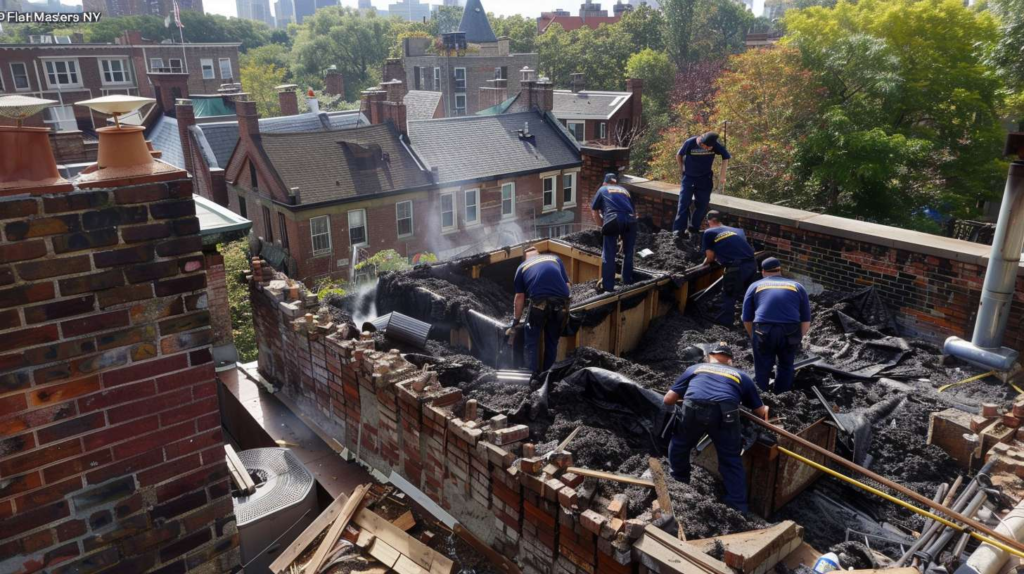
Here's a framing that makes the rest of this easier to follow: think of every flat garage roof job as two separate problems stacked on top of each other. The first is a geometry problem-area sets the baseline, and that part of the math is pretty stable. The second is a damage problem-corners, parapets, flashing, drains, and rot are what change the math, sometimes dramatically. A roof that looks flat and boring from below can be hiding an expensive perimeter once someone actually gets up there.
At-a-Glance: Queens Flat Garage Roof Pricing
Single Garage
$2,800-$5,500
Full replacement, one-car detached, Queens baseline
Double Garage
$4,500-$9,000
Full replacement, two-car, with edge metal and flashing
Repair Window
$350-$1,400
Isolated flashing, seam, or penetration repair
Overlay Window
$2,000-$4,200
New membrane over dry, sound decking; no tear-off
Scenario Pricing: Flat Roof Garage Cost in Queens
| Scenario | Approx. Size | Scope Included | Estimated Queens Price Range |
|---|---|---|---|
| 1. Small detached one-car, basic replacement | 180-220 sq ft | Single-layer tear-off, modified bitumen install, basic edge metal | $2,800-$3,800 |
| 2. One-car garage, multiple buried layers + minor deck repairs | 200-240 sq ft | Multi-layer tear-off, up to 2 sheets decking, new membrane, flashing reset | $4,200-$5,500 |
| 3. Detached double garage, full replacement + new edge metal | 400-480 sq ft | Full tear-off (one layer), modified bitumen system, perimeter edge metal, disposal | $5,500-$7,200 |
| 4. Double garage, drain correction + insulation upgrade | 440-500 sq ft | Full replacement, tapered polyiso insulation, drain relocation, new membrane | $7,500-$9,000 |
| 5. Patch-only around flashing/vent for temporary extension | N/A - isolated area | Surface prep, flashing or vent collar replacement, seam sealing | $350-$900 |
Where the Estimate Starts Growing Teeth
Tear-Off and Hidden Layers
That sounds reasonable until you look closer. Here's the part nobody enjoys hearing: the clean, no-drama number you got over the phone usually assumes a single layer coming off, a dry deck underneath, and simple drip-edge perimeter work. And after nearly 19 years in flat roofing, I-Doreen Vale-usually find the same few hidden cost drivers waiting on every job that started with someone saying "it should be straightforward."
I remember standing on a detached garage roof in Middle Village at 7:10 in the morning, coffee still too hot to drink, while the homeowner kept insisting his neighbor paid half as much for the same job. Then I measured it. Three layers buried under the cap sheet, and a visible sag at the rear edge from years of ponding that nobody had ever corrected. That was one of those mornings where the flat roof garage cost looked unreasonably high on paper-right up until I started peeling it back and realized the cheap number had never accounted for what was actually there. His neighbor's garage probably had one clean layer and a dry deck. That's a different roof.
Drainage, Edges, and Penetrations
Parapet returns, scupper boxes, internal drains, skylight curbs, vent pipe flashings, overhead-door headers-none of these are large in square footage, but every single one of them takes time and material that a basic area calculation won't capture. A detached garage tucked behind a semi-attached home in a Queens alley also adds a labor dimension: when your crew can't park close and has to hand-carry materials through a gate and across a shared yard, that logistical reality shows up somewhere in the quote. It should.
What Changes a Flat Roof Garage Quote in Queens
| Cost Driver | Why It Changes Price | Typical Budget Impact | Main Category Affected |
|---|---|---|---|
| Single-layer tear-off | Standard removal; labor and disposal are predictable | Low - already in baseline | Labor |
| Multiple buried layers | More time, more weight, more disposal runs | +$400-$1,200 | Labor + Disposal |
| Minor decking replacement | 1-3 sheets soft or damaged plywood | +$200-$500 | Material + Labor |
| Major decking replacement | Widespread rot; structural reassessment required | +$800-$2,500+ | Material + Labor |
| Parapet wall flashing | Vertical returns require extra material and careful detailing | +$300-$900 | Labor Intensity |
| Drain reset or relocation | Moving a drain involves cutting, re-sloping, and replumbing | +$400-$1,100 | Labor + Material |
| Skylight curb detail | Requires flashing, step integration, and watertight curb wrap | +$250-$700 per unit | Labor Intensity |
| Vent pipe flashing | Each penetration needs a properly sized collar and seal | +$80-$220 per vent | Material |
| Edge metal replacement | Corroded drip edge or gravel stop must come off before new membrane | +$150-$500 | Material + Baseline |
| Tapered insulation for drainage | Custom-cut polyiso builds positive slope where deck is flat | +$600-$2,000 | Material |
| Difficult backyard/alley access | Hand-carry materials; longer setup and cleanup time | +$200-$700 | Labor |
| Permit and disposal factors | NYC permit fees and dumpster placement in tight Queens blocks | +$150-$600 | Baseline + Logistics |
⚠ Why the Lowest Garage Roof Quote Can Be Misleading
- The quote doesn't specify how many layers will be removed - or who pays if there are more
- Deck repair is listed as "if needed" with no per-sheet rate disclosed upfront
- Edge metal, parapet flashing, and penetration work are described as "included" without being itemized
- The membrane system is never named - no manufacturer, no grade, no warranty path listed
- One lump sum with no breakdown makes it impossible to know what you're actually buying
Repair, Overlay, or Full Replacement? Use the Roof You Have Now
I was on a roof in Astoria when this came up in exactly the way it always does. The customer had asked me for a double garage flat roof cost before I'd even climbed the ladder-which, honestly, is fair. By the time I got up there, I could see why he wanted a fast number: two skylight curbs, one badly patched vent that someone had sealed with what looked like leftover caulk, and flashing cut so rough it might as well have been done with kitchen scissors. I gave him three prices on the spot. Patching, overlay, and full replacement-because when a roof looks like that, one number isn't an honest answer. The range is the answer. It shows you which problem you're actually deciding to pay for.
If I asked you what's under that membrane right now, would you know? Repair makes sense when the failure is genuinely isolated-one cracked flashing, one open seam, a collar that's simply lifted. Overlay works when the substrate is confirmed dry, structurally intact, and code allows it with your current layer count. Full replacement is the only real path when there's trapped moisture, multiple active leaks in different areas, or ponding that's been sitting long enough to soften the deck beneath. And honestly, if there are already two layers up there, don't let anyone talk you into a third-you'll just be putting new material over an old problem.
So the real question is not "What does a flat garage roof cost?" but "Which version of this roof are you paying for?"
Patch vs. Overlay vs. Full Replacement
Patch / Repair
Best Use Case: Single point of failure - isolated flashing, open seam, vent collar
Shortest Realistic Lifespan: 1-5 years on the patched area
Biggest Risk: Missing related failures nearby; recurring leaks
Budget Position: Lowest upfront - $350-$1,400 typical
Overlay
Best Use Case: Dry deck confirmed, one existing layer, no ponding issues
Shortest Realistic Lifespan: 8-12 years if substrate was truly sound
Biggest Risk: Trapping moisture you didn't know was there
Budget Position: Middle ground - $2,000-$4,200 typical
Full Replacement
Best Use Case: Multiple leaks, wet deck, ponding, or 2+ existing layers
Shortest Realistic Lifespan: 15-25 years with a quality system
Biggest Risk: Higher upfront cost - but lowest long-term risk
Budget Position: Highest - $2,800-$9,000+ depending on scope
Decision Tree: Which Option Fits Your Roof Right Now?
Is the decking dry and structurally sound?
✔ YES - Decking is dry and solid
Are leaks isolated to one detail area?
- Yes → Repair / Patch. One collar, one seam, one flashing.
- No, but deck is sound → Overlay may work. Confirm no moisture is trapped with a core test first.
- Already 2+ layers installed → Skip overlay. Go to full replacement; code and weight won't allow another layer.
✘ NO - Soft spots, rot, or ponding damage found
→ Full Replacement Required.
Overlaying or patching a compromised deck only delays the same problem. Tear-off, deck repair, and a new membrane system is the only path that holds.
The Sneaky Math of Shape, Damage, and Queens Access
Why Small Roofs Can Still Be Expensive
Let me be blunt for a second: small does not equal simple, and I genuinely dislike square-foot-only quotes because they make fiddly, complicated little roofs look like a bargain on paper. A 200-square-foot garage with four parapet returns, an odd corner, one interior drain, and a shared driveway so narrow that a ladder can't lay flat isn't a $200-per-square job. It's a puzzle. Queens adds its own layer to this-detached garages tucked behind semi-detached homes off Hillside Avenue, rear-yard structures only reachable through a locked gate, alleys that two people can barely pass each other in. That's not hypothetical; that's Tuesday out here. Every one of those access conditions costs labor time, and labor time costs money.
I once looked at a garage just off Jamaica Avenue in late March, just before sunset, when the wind was cold enough to make the tape measure spring back like it had somewhere better to be. The owner told me the roof was "small, simple, and basically square." And structurally, fine-it wasn't large. But it had parapet returns on three sides, a drain that needed relocating to stop the chronic ponding at the rear, and a soft patch of plywood right near the overhead door header that had been quietly drinking water for probably two seasons. That job changed price three times before I even wrote the scope. Here's the insider tip worth keeping: when you talk to any contractor, ask them specifically how they price perimeter linear footage and how they handle per-sheet deck replacement allowances-not just total square footage. If they can't answer those two questions clearly, the number they gave you isn't real yet.
Common Assumptions About Flat Roof Garage Cost
| Myth | Reality in Queens |
|---|---|
| "Flat means cheap" | Flat means drainage must be engineered, not assumed. Ponding, parapets, and edge detail on a flat surface often cost more per linear foot than a pitched roof edge. |
| "Square footage tells the whole story" | It tells maybe half of it. Perimeter detail, number of corners, penetrations, and access conditions often account for 30-50% of the final price on small Queens garages. |
| "A double garage costs exactly double" | Not necessarily. A double garage with a clean layout and good drainage may cost less than 1.7x a single garage. One with multiple penetrations, parapet returns, and buried layers can push past 2.5x. |
| "If it isn't leaking inside, the deck is fine" | Water travels before it drips. A deck can have trapped moisture and early rot months before you see a stain on the ceiling. By the time it shows indoors, the wood damage is usually already significant. |
| "An overlay always saves money" | Only when the deck is confirmed dry and the layer count allows it. Overlaying onto a wet or compromised deck locks moisture in and guarantees an early failure-usually on your dime again within a few years. |
The Measurements That Actually Matter
Before any contractor gives you a price worth taking seriously, these six things need to be measured or assessed in person:
1. Roof Area (Total Square Footage)
The baseline number. Measured in squares (100 sq ft each) and used to price membrane, insulation, and base sheet quantities. It's the starting point-not the finishing point.
2. Perimeter Length
Every linear foot of edge-drip edge, gravel stop, or parapet cap-has a material and labor cost attached. A garage with a complex perimeter can have more edge footage than a simpler one at double the area.
3. Number of Corners and Parapet Returns
Inside corners and outside returns require extra material cuts, additional membrane overlap, and skilled hand-work. Every return is a time and material add-and they don't show up in a square-footage calculation.
4. Number and Type of Penetrations
Vents, skylight curbs, exhaust collars-each one is a separate flashing detail. A garage with four penetrations takes meaningfully longer than one with zero, even if the footprint is identical.
5. Drainage Layout and Slope
Where does water go when it rains? If it's pooling-or if the drain is in the wrong spot-that's a cost driver that no amount of good membrane work can fix on its own. Slope correction or drain relocation has to be priced separately.
6. Access and Disposal Path
Can material be staged near the truck, or is there a gate, a narrow yard, and a locked driveway between the crew and the roof? In dense Queens blocks, logistical difficulty is a real line item that shouldn't be absorbed silently into "labor."
Questions Worth Asking Before You Sign Anything
A garage roof is a rectangle right up until the corners start charging rent. The estimate you receive should separate two things clearly: what covers the field area, and what accounts for every edge, return, penetration, and condition that punishes a simple number. If those two things aren't broken out-or if the contractor can't explain why their price is what it is-that vagueness will cost you later. Get clarity before you sign, not after the tear-off starts. If you're ready to make a smart decision on your garage roof, Flat Masters is happy to put a real scope together for you.
Before You Call: What to Have Ready for Your Queens Flat Garage Roof Quote
-
1
Approximate garage dimensions - length and width, even a rough estimate helps -
2
Attached or detached - and whether it's accessed through a shared driveway or rear yard -
3
Number of known leak spots - or areas where water has come through before -
4
Whether there's ponding after rain - standing water that sits for 24+ hours after a storm -
5
Number of roof penetrations - vents, skylights, exhaust collars, anything sticking through the membrane -
6
Age of the current roof - or the last time it was worked on, if you know it -
7
Access situation - narrow shared driveway, locked gate, or tight backyard that makes material staging difficult
Last-Minute Cost Questions People Always Ask
What is a normal flat roof garage cost in Queens?
For a standard single-car detached garage with one layer to remove and a clean deck, expect $2,800-$5,500 in the current Queens market. That range widens quickly if there are hidden layers, drainage issues, or significant edge work involved. There's no single "normal" number-scope is what determines price.
What is the usual double garage flat roof cost?
A two-car garage full replacement in Queens typically runs $4,500-$9,000, depending on condition, drainage requirements, and perimeter complexity. Don't assume it's exactly double the single-car price-the relationship between size and cost isn't linear once edge work, penetrations, and access come into the scope.
Is it cheaper to coat or patch instead of replace?
Short-term, yes. Patching runs $350-$1,400 and a coating or overlay can land in the $2,000-$4,200 range. But if the deck has moisture or the failures are spread across multiple areas, those cheaper paths become expensive detours. You'll want to confirm deck condition before deciding-and not just based on what it looks like from below.
Does permit, disposal, or access usually change the price?
Yes, and in Queens specifically, these are not small line items. Permit fees, dumpster placement on tight residential blocks, hand-carry logistics through rear yards-these can add $150-$1,300 to a job depending on conditions. Ask for these to be itemized separately so you know what you're paying for before work starts.
If a quote you've received feels vague, too round, or suspiciously tidy, Flat Masters can break the job down into exactly what covers area and what punishes corners-so you know what you're actually signing. Call us for a clear, itemized flat garage roof estimate in Queens. - Doreen Vale, Flat Masters