
Your Porch Flat Roof Is Leaking - Here's Where the Problem Almost Always Starts
Sharp. On most porch-specific flat roof leaks, the trouble doesn't begin somewhere out in the middle of the roof field - it starts at the edge, the wall tie-in, or a flashing detail that wasn't finished correctly the first time. This article walks through where Queens porch roofs actually open up, how the leak route fools homeowners into chasing the wrong spot, and what kind of repair genuinely matches the problem instead of just covering it up.
Leak Origins Usually Hide at the Perimeter
At the front edge of a Queens porch roof, that's where I look first. A flat porch roof leak isn't a spot - it's a route. Water doesn't just fall through a hole directly above the stain on your ceiling. It enters at one place, usually where the membrane turns a corner, stops at a metal edge, meets the house wall, or terminates at an aluminum drip edge, and then it commutes. It slides along a seam, follows a joist line, hugs the underside of the decking, and eventually shows itself somewhere that has absolutely nothing to do with where it got in.
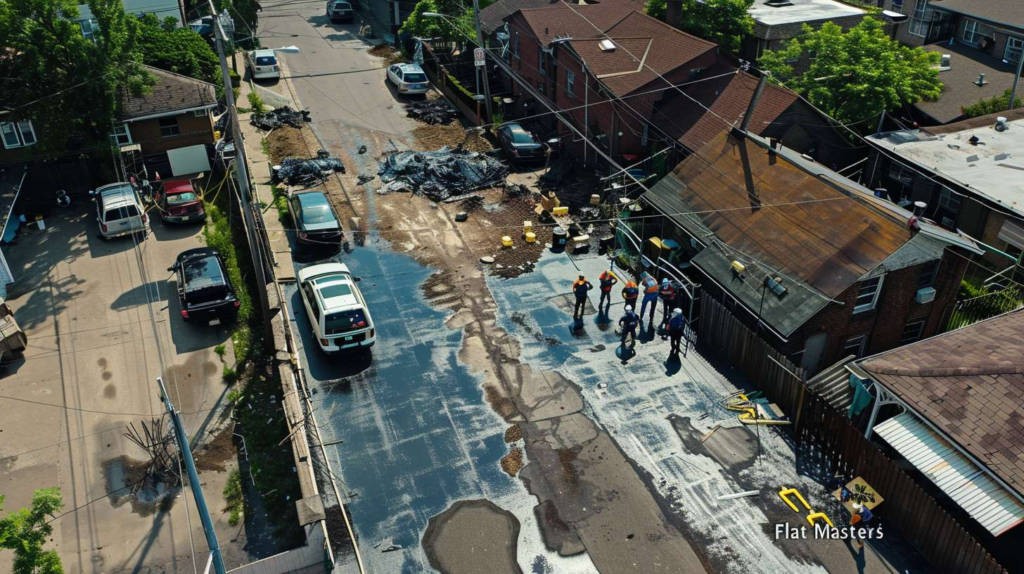
A lot of people see a drip at the center of their porch ceiling and immediately assume the roof membrane split directly above it. That's almost never how porch-specific flat roof leaks work. Water is a commuter - it finds the path of least resistance and travels it, sometimes for several feet, before it finally drops through wherever there's a gap in your ceiling. The stain is the destination, not the origin. Chasing the stain without tracing the route is how you end up with three bad patches and the same drip.
| Myth | Fact |
|---|---|
| "If the stain is in the middle, the hole is directly above it." | Porch leaks travel along seams, joists, decking grain, and wiring paths - the stain is a destination, not a source. |
| "Roof cement anywhere on top will stop it." | Wrong-detail patches trap water and frequently push the active leak farther from where you smeared the mastic. |
| "If it only leaks in heavy rain, the whole membrane is shot." | A tiny open edge seam or a split flashing detail can leak exclusively under wind-driven conditions and nowhere else. |
| "If it drips after the storm, it's probably condensation." | Delayed dripping almost always means water stored under a failed seam or patch that's slowly working its way through. |
| "Small porch roofs are simple roofs." | Short runs, tight edge details, and wall-to-roof transitions make porch roofs deceptively failure-prone - often more so than a full flat roof field. |
Porch Leak Routes I See Again and Again in Queens
Blunt truth: the leak usually starts where two materials meet and somebody got lazy. Attached homes in Queens - especially the row-house-style buildings you'll find from Woodhaven up through Elmhurst - have shallow drainage runs, tight wall tie-ins, and decades of aluminum or vinyl trim retrofits sitting on top of original flashing that was never meant to last this long. And after Eddie Varela spent 17 years on porch roofs and row-house extensions across Queens, these repeat failure points stop being surprising. You see a freeze-thaw cycle hit an old termination bar behind a vinyl J-channel, and it's not a mystery anymore - it's a pattern.
One humid August evening in Ridgewood, around 6:40 p.m., I was standing on a second-floor porch roof while the homeowner down below kept pointing at the rain gutter, absolutely convinced that's where the problem started. I wasn't buying it. I worked the perimeter instead and found a fat ant trail - ants love damp wood - disappearing into a seam right at the wall flashing line, behind a vinyl trim piece. That sloppy tie-in had been "fixed" twice already with roof cement slapped across the surface. The real failure was the wall flashing itself, never properly lapped or tied into the membrane. Nobody had ever pulled that trim piece to look.
Then there was a Sunday morning in Woodside after a hard windstorm - I got the call at 7:15 a.m. and pulled up to find the homeowner standing on his front step in house slippers, holding a pot he'd been emptying all night. The porch roof looked completely fine from ten feet away. Nothing dramatic. But the front edge metal had lifted just enough - maybe a quarter inch at the lip - to let wind-driven rain work straight into the first course of membrane. By morning, that tiny edge detail had soaked the entire porch ceiling. That job sticks with me because it's the clearest proof that "small" and "harmless" are not the same thing on a flat porch roof.
If you only remember one thing, remember this: porch leaks announce themselves in one place and begin in another.
Front Lip Separation
Wall Flashing Hidden Behind Trim
Scupper and Corner Patch Traps
| Leak Starting Point | What You Usually Notice | What's Actually Failing | Urgency |
|---|---|---|---|
| Front edge / drip edge lip | Drip during or just after wind-driven rain, near the outer porch wall | Edge metal lifted, membrane curl at first course, open seam at termination | High |
| Wall flashing / house-side tie-in | Stain or drip where porch ceiling meets house wall, often after every storm | Missing termination bar, failed flashing lap, vinyl trim hiding the gap | High |
| Scupper / corner drain area | Leak during heavy rain or ponding; corner ceiling stain that spreads | Clogged or cracked scupper, failed corner membrane wrap, patch trapping water | Moderate-High |
| Under old patch layers | Delayed drip after rain stops; water shows up in a different spot than previous patches | Water trapped beneath incompatible repair fabric, traveling under layers to a new exit point | Moderate-High |
| Porch light fixture / electrical box | Drip from the ceiling fixture; appears after storm ends, not during | Water stored under seam or patch exits through the electrical box opening - not a roof center failure | Urgent |
| Snowmelt / ice path at corner | Leak only during thaw periods; no drip during rain at all | Ice backing up at blocked scupper or corner seam; melt water finding under-membrane path | Moderate |
▶ Front Edge Drip After Wind-Driven Rain
▶ Leak Shows Where the Porch Meets the House Wall
▶ Drip Around a Light Fixture After the Storm Ends
▶ Leak Worsens After Snow Melt
Before You Smear Anything On, Test the Route
If I'm standing in your driveway, the first thing I'll ask is: where does the drip show up after the rain stops? That timing question tells me more about the leak route than the stain location ever will. A drip that comes during rain points to an exposed opening - wind, pressure, direct entry. A drip that comes after rain stops means water stored itself somewhere, waited, and then traveled. A drip that only happens during snowmelt is almost always a scupper, corner seam, or under-patch path problem. And a drip that only triggers in wind-driven conditions is almost certainly an edge or flashing detail that's open just enough. Get the timing right before you touch the roof surface, and you've already cut the diagnostic work in half.
- Note whether the dripping starts during rain or only after it stops - write it down if you have to.
- Check if the leak is noticeably worse during wind-driven storms vs. straight-down rain.
- Photograph the front edge, wall line, and any previously patched corners from as close as you can safely get.
- Look for lifted edge metal or separated caulk at trim transitions along the front lip and wall side.
- Check whether the scupper or downspout is clogged with debris - this alone can cause ponding and force water under seams.
- Note if the drip appears specifically at a porch light box or ceiling seam rather than open ceiling material.
- Record how many previous patch attempts were made and roughly where - this tells a roofer what they're walking into.
Smearing mastic over the area above the visible drip doesn't fix the route - it hides the real opening. That cement traps water under itself, makes proper seam inspection significantly harder when a roofer finally does show up, and can turn what was a repairable edge detail into a larger tear-out job. Every old patch layer that goes on top of the wrong spot is another layer of confusion that costs time and money to unwind. Don't do it.
Repair Choices Depend on Which Detail Failed
Here's the part homeowners never enjoy hearing: not every flat porch roof leaking situation needs a full replacement, but it's also true that not every patch will hold. The repair has to match the detail that failed, or you're just buying time until the next storm. One cold March morning in Astoria, I got called by a retired MTA conductor whose porch never leaked during actual rain - only when snow started melting. I peeled back a patched corner near the scupper, and underneath were three layers of old repair fabric, all of them incompatible with each other, holding water like a sponge. That water was traveling the full width of the porch and dropping out through the ceiling light box. I told him what I tell everyone: "Water doesn't care where you want the problem to be." We rebuilt the scupper corner from scratch, and that was the end of it.
And honestly, when I see a porch roof that's already been patched two or three times, my opinion doesn't change - it gets stronger. Multiple old patches are usually a sign to stop guessing and open the detail, not keep layering on hope. Every surface dab that didn't fix it is a data point telling you the source was never correctly identified. A peel-back inspection - actually lifting the failed material to see what's underneath - is almost always more useful than another coat of anything on top. The repair that lasts is the one that addresses the actual failed component: the flashing, the edge metal, the seam, the termination bar. Not the stain on the ceiling above your rocking chair.
Know When a Porch Leak Can Wait and When It Cannot
A porch roof leak moves like steam in an old diner vent - never where the customer expects, and never patient once it finds a path. Active dripping through a ceiling light fixture is an electrical hazard, not just a roofing problem - that needs same-week attention, not a scheduled estimate three weeks out. Repeated post-storm dripping, visibly lifted edge metal, or a ceiling that's starting to sag are all signs the situation is actively getting worse with every rain event. If your porch flat roof is leaking in Queens and you want the route traced instead of another guess-patch applied on top of the last three, call Flat Masters - we'll start at the perimeter, not the stain.
▶ Why does my porch roof leak after the rain has already stopped?
▶ Can a small front-edge problem really soak the whole porch ceiling?
▶ Do I need a full replacement or just a detail repair?
▶ What should I tell a roofer so they don't chase the wrong spot?
- Eddie Varela, Flat Masters | Serving Queens, NY