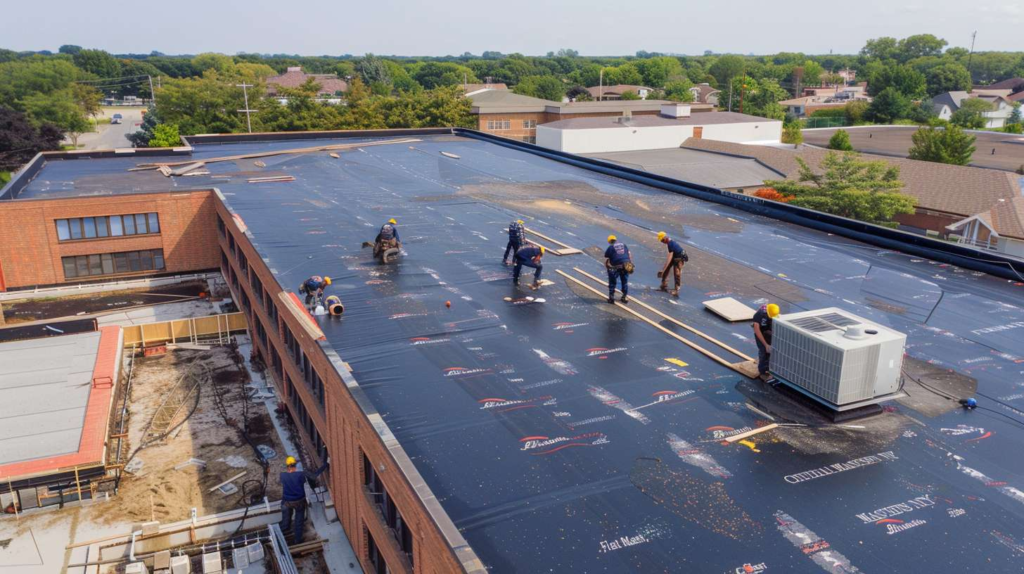
Underlayment Is the Layer Nobody Sees - And It's the One That Matters Most
Beneath the membrane is where flat roofs quietly succeed or fail
Try getting three quotes, and I guarantee all three contractors will spend most of their time talking about the membrane - the visible top layer - while barely mentioning the underlayment assembly that actually controls whether that expensive surface lasts 8 years or 25. Think of a flat roof the way you'd look at a cutaway diagram from an earth-science textbook: the surface tells you very little; it's the hidden layers underneath that reveal where moisture is moving, where pressure is building, and where failure quietly started long before anyone noticed a stain on the ceiling below.
At 6 a.m. on a Queens roof, the first thing I look at isn't the shiny surface. I'm looking at the edges, the seams, the parapet base flashing, and any spot where someone repaired something and moved on. I'm Rosa Mendez, and with 22 years in flat roofing and a specialty in catching substrate and underlayment failures before a single dollar goes toward the top membrane, what I've learned is that the membrane choice is almost never the main decision - the condition and compatibility of everything underneath it is. Most failed flat roofs I've walked in this borough weren't installed with bad membranes. They were installed over bad or mismatched underlayment, and no one caught it in time.
Myth vs. Fact: Flat Roof Underlayment in Queens
| Myth |
Real Answer |
| If the cap sheet looks fine, the layers below are fine. |
Moisture migrates laterally under membranes for months before surfacing visually. A cap sheet can look clean while the underlayment below is saturated, brittle, or delaminating from the deck - a common pattern in older Queens multifamily buildings where small repairs pile up over years. |
| Any underlayment sold for roofing works on a flat roof. |
Slope changes everything. Products rated for steeper assemblies handle drainage differently and often aren't engineered for the ponding tendency and thermal cycling of low-slope or zero-slope decks. Using the wrong spec causes trapped moisture - which is exactly how premature failures start. |
| Leaks always begin at drains. |
Drains are the first place people look, but underlayment seam failures and parapet base transitions account for a large share of interior leaks in flat roofed buildings. Moisture enters at a lap, travels unseen under the membrane, and surfaces at the path of least resistance - which may be a drain, a skylight curb, or a wall 15 feet away. |
| A new membrane fixes an old underlayment problem. |
It doesn't. It covers it. Installing a new membrane over compromised underlayment traps existing moisture, gives the new layer nothing stable to bond or seat against, and accelerates the next failure. The repair looks done from the street - until the ceiling stain comes back in 18 months. |
| Underlayment only matters during initial install, not repairs. |
Repair patches fail faster than full assemblies precisely because the underlayment condition under the repair zone isn't addressed. A new patch over degraded underlayment means the patch edges are sealing against material that's already moving, cracking, or wet. That repair will open again - usually within two freeze-thaw cycles. |
Quick Facts: What Underlayment Controls on a Flat Roof
Main Job
Moisture and separation control - it keeps deck materials isolated from membrane adhesives and acts as the primary moisture management layer between the substrate and the visible surface.
Hidden Risk
Trapped water over a weak substrate. Once moisture gets under the underlayment layer and into an aging deck, it spreads quietly - often for an entire season before any ceiling evidence appears.
Best Time to Verify
Before membrane install - not after. Once the top layer goes down, you've committed. Test cuts and substrate assessment before cover-up are the only reliable way to confirm what you're building on.
Queens Concern
Freeze-thaw cycles and summer ponding expose bad layer choices fast. Queens roofs face hard winters and humid summers that stress underlayment assemblies in ways that gentler climates simply don't.
Queens buildings put extra pressure on the wrong underlayment choice
What installers should match before they roll out anything
Here's the blunt version: flat roof underlayment is not one-size-fits-all, and Queens makes that fact impossible to ignore. I remember one August morning in Ridgewood, maybe 7:15, already sticky hot, standing on a three-family building where the owner kept pointing at blistered cap sheet like that was the whole story. I peeled back one edge and the underlayment underneath was brittle like old pastry. I told him, "This roof didn't fail this summer. It failed years ago, and summer just announced it." That's the thing about older brick multifamily buildings in this borough - you'll find decades of patch history layered under the current surface, parapets that have been re-flashed at least twice, and deck boards that have absorbed more moisture cycles than anyone documented. Summer heat pushes everything apart. Winter freeze-thaw finishes the job. The wrong underlayment spec speeds up that whole timeline considerably.
Why old deck conditions change the answer
If you were standing next to me, I'd ask you one question first: what's underneath this roof right now? Not what's on top - what's below. Substrate type changes the answer on every material decision that follows. A poured concrete deck in an older Woodside six-unit behaves completely differently from a wood plank deck on a converted commercial building near Northern Boulevard. Insulation layers, prior recover systems, mixed moisture history, and incompatible adhesive residue from old repairs - all of it affects whether your next underlayment product bonds correctly, breathes appropriately, and stays stable through temperature swings. Brand marketing won't tell you any of that. A proper pre-install assessment will.
Don't let anyone roll out material until the substrate condition is documented in writing.
Best Underlayment for Flat Roof: By Existing Roof Condition
| Roof Condition |
Recommended Approach |
Why It Fits |
Mistake to Avoid |
| Dry, stable deck - full replacement |
Two-ply SBS base and cap sheet system with mechanically fastened base layer |
Clean substrate allows full adhesion and proper vapor control. Two-ply builds in redundancy for a true low-slope assembly. |
Skipping the base sheet and going single-ply to save cost - the cap sheet alone lacks the separation layer needed over a bare deck. |
| Older roof with mixed repair history |
Full tear-off, substrate inspection, then clean base ply compatible with documented deck material |
Patchwork history means unknown adhesive compatibility and inconsistent lap direction underneath. Starting clean prevents bonding failures. |
Recovering over existing patchwork without testing adhesion of prior layers to the deck - the new system inherits every old failure point. |
| Low-slope section with ponding tendency |
Vapor-open or specifically rated low-slope underlayment; avoid self-adhered products with low perm ratings unless deck is fully verified dry |
Ponding zones need underlayment that can handle standing water stress at seams without delaminating or trapping moisture against the deck. |
Using a high-perm product on a surface that regularly holds water - you'll accelerate moisture wicking into the assembly rather than controlling it. |
| Recover project over existing system |
Only if moisture scan confirms dry existing system; use a separation layer/cover board, not a standard base felt |
A recover without trapped moisture can work if a proper separation course is included - adding bulk felt here creates incompatibility between old and new adhesive chemistries. |
Assuming "it feels dry" is good enough without a moisture scan - trapped moisture under a recover is invisible until the new system blisters. |
| Cold-weather install window |
Mechanically fastened base ply; avoid cold-applied adhesives below their rated temperature range |
Adhesives lose viscosity and bonding strength in cold - mechanical fastening ensures the base layer is actually seated, not just placed and hoped for. |
Using cold-process adhesive in temperatures the product spec prohibits - the bond looks fine on install day and separates by spring. |
| Parapet-heavy roof with many transitions |
Flexible, heat-weldable base ply with a separate flashing-grade underlayment at all vertical transitions |
Parapets flex differently than the flat field - standard base plies can crack at the bend point over time. Flashing-grade material handles the vertical-to-horizontal transition stress. |
Using the same field underlayment at parapet bases - it's a different stress zone and a different material requirement, and this is exactly where Queens roofs fail most often. |
Decision Tree: Underlayment Replacement, Selective Opening, or Full Rebuild?
START: Is the existing substrate dry and structurally sound?
❌ NO - Substrate has damage, rot, or structural issues
Deck repair is required before any underlayment decision. Installing over a compromised deck guarantees early failure regardless of underlayment quality.
→ ENDPOINT: Rebuild assembly from deck up. Do not proceed with underlayment selection until deck is repaired and verified.
✅ YES - Substrate is dry and structurally sound
Next question: Is the current underlayment compatible with the planned membrane system?
❌ NOT compatible
→ ENDPOINT: Replace underlayment. Mismatched systems create adhesion failure and void coverage.
✅ Compatible
Next question: Any evidence of trapped moisture, blistering, or soft spots?
Signs present → Open test areas first. Do not cover until moisture findings are documented.
No signs → Proceed with matched install plan. Document substrate condition before membrane goes down.
Reading failure signs before a new layer hides them again
I once lifted a seam in Elmhurst and knew in five seconds where the money had been wasted. The felt underneath was dark at the laps, lapped the wrong direction for water flow, and had three different colors of mastic from three different patch visits. You don't need a moisture meter to read that story - though I carry one anyway. The field signs are there if you know how to read them: soft, spongy areas when you walk the roof, brittle material that cracks when you bend it instead of flexing, seam repairs that keep opening in the same location, and that faint hollow sound underfoot when moisture has gotten between layers. Every one of those clues points downward, not up.
People love talking about membranes because they can point at them. One February afternoon in Astoria, sleet coming sideways, I got called to look at a flat roof less than two years old that had leaked into a top-floor nursery. The contractor had used a product meant for a steeper assembly - and under that membrane, the moisture had nowhere good to go on a nearly flat section. I still remember the father holding a little plastic bucket under the ceiling seam asking me why the roof sounded wet when we walked on it. It did sound wet. Because it was wet, and it had been wet since probably the first hard rain. The underlayment spec was simply wrong for the slope and the assembly. And here's the insider move that would have caught it before that child's ceiling got stained: ask your contractor for photos of opened test cuts showing the deck surface, the underlayment layer, and the transition detail at any parapet or penetration - before the membrane covers it all up. If they can't show you that, you're buying blind.
⚠️ Red-Flag Proposal Language - Flat Roof Underlayment Installation
If a bid includes any of the following language without clear conditions and documentation, slow down before you sign anything:
- No test cuts mentioned anywhere in the scope - they're planning to guess at substrate condition
- "Install over existing if possible" with no moisture scan or compatibility check specified
- Slope-rated products listed without confirming your roof's actual pitch or drainage design
- The membrane is described in detail but underlayment type, attachment method, and base ply are unspecified
- No mention of parapet base flashing, drain sumps, or penetration detailing as separate work items
Field Signs: Is the Underlayment the Real Problem?
✅
Dry, clean substrate at test openings
Deck surface shows no moisture staining or soft material when opened at representative locations.
❌
Dark moisture staining below the membrane
Brown or black staining visible on the felt or base ply when opened - moisture has been traveling under there for a while.
✅
Consistent lap direction throughout
Underlayment laps run in the correct direction for water shedding - sign of a single, properly planned installation.
❌
Mixed material patchwork visible at openings
Multiple different products, colors, or generations of material layered without any coordination - classic sign of reactive patching over years.
✅
No spongy feel when walking the field
Firm, consistent underfoot feel across the full deck surface - no soft spots suggesting delamination or wet insulation below.
❌
Brittle cracking when underlayment is lifted
Material that fractures instead of flexing when peeled back has lost its elasticity - it's no longer functioning as a control layer.
✅
No repeated repairs near the same seam
A seam that's been patched once might be a maintenance item. A seam that's been patched three times is a system problem.
❌
Hidden soft spots at parapet bases
Parapet transitions concentrate stress and water - soft material here often means the underlayment-to-flashing detail was never done correctly to begin with.
Instead of asking for the cheapest roof, ask for the clearest scope
What a serious underlayment proposal should spell out
A flat roof is a layered lesson, not a single material. I was on a church rectory in Corona just after sunrise one spring, and the maintenance manager swore the problem was clogged drains only. We opened a section near the parapet and found patchwork underlayment from at least three different repair eras, none of it lapped correctly. That roof was like reading three bad chapters written by three different authors, and every leak line in the hallway made perfect sense after that. Each repair era had covered the previous failure without addressing why the previous layer had failed. My opinion on this is firm: the most wasteful decision you can make in flat roofing is paying for a premium top layer while the scope underneath is vague, rushed, or simply dishonest about what it's covering. You don't get credit for a beautiful cap sheet over a chaotic substrate.
That sounds right, but here's where it goes wrong - people get three quotes, compare the membrane brand names, and pick the middle price. None of that helps if the scopes aren't describing the same work. Before agreeing to any flat roof underlayment installation in Queens, verify line by line: does the scope include test cuts and written substrate findings? Does it name the exact underlayment product and attachment method? Does it separate the field work from the parapet, drain, and penetration detailing? Those three things alone will tell you whether you're reading a real proposal or a placeholder. Flat Masters builds every scope around documented conditions - not around what's convenient to skip.
✔ Before You Call: Flat Roof Underlayment Installation Checklist
- Ask whether test cuts are included in the assessment - not offered as a paid add-on after you've already agreed to the job.
- Request written substrate condition notes - verbal "it looks okay" doesn't tell you what you're building on.
- Confirm the exact underlayment type and spec - base ply product name, weight, and attachment method should all be named in the proposal.
- Verify membrane-to-underlayment compatibility - ask the contractor to confirm these are rated for use together, especially on your roof's slope.
- Ask how parapets, drains, and penetrations are detailed - these should be separate line items, not bundled into a general "flashing" note.
- Confirm change-order rules for wet materials - if the contractor opens the roof and finds wet substrate, what happens to scope and price? Get that in writing.
- Ask for photo documentation before cover-up - deck surface, underlayment layer, and all transitions should be photographed and shared with you before the membrane goes down.
📋 Open This Before You Compare Quotes
Removal and Deck Prep
The scope should specify whether this is a full tear-off or a recover, how existing material will be disposed of, and what deck inspection protocol is included. Any damaged decking, fastener pulling, or leveling work should be called out explicitly - not hidden in a "misc prep" line.
Underlayment Material and Fastening/Adhering Method
The exact product name, ply count, and whether it's mechanically fastened, heat-welded, cold-adhered, or self-adhering should all be written out. "Standard base ply" is not a sufficient description. If the installer can't name the product, they haven't committed to anything.
Detail Areas: Parapets, Drains, Penetrations, Edges
These are where most flat roofs actually fail, and they deserve their own scope section. Each transition type should be listed: parapet counter-flashing, drain collar integration, pipe boot details, and edge termination. If a proposal lumps all of this into "flashing included," it's not telling you what's actually planned.
Photo Proof and Moisture Findings Before Membrane Goes Down
Before the membrane covers everything, you should receive photos of the opened deck, the installed underlayment, and each transition area. If moisture was found, the written findings and the agreed resolution should be documented before the job continues. This is your only window to verify the hidden work was done correctly.
Common Questions: Flat Roof Underlayment in Queens
What is flat roof underlayment actually doing?
Flat roof underlayment sits between the structural deck and the visible membrane. Its job is to control moisture movement, provide a stable and compatible surface for the membrane to bond or seat against, and act as a secondary barrier if the top layer is ever compromised. Without the right underlayment, even a properly installed membrane is working without a safety net - and on a flat roof, that matters more than on any sloped surface.
What is the best underlayment for flat roof projects in Queens?
There's no single universal answer - and any contractor who gives you one without looking at your roof first should be questioned. For most Queens flat roofs, a two-ply SBS-modified system with a mechanically fastened base sheet performs well because it handles the borough's freeze-thaw cycles and thermal movement. But the best underlayment for your flat roof depends on your deck condition, existing assembly, slope, and what membrane system is going over it. The condition table above covers the main scenarios.
Can a contractor install a new membrane over failing underlayment?
Physically, yes. As a functional repair, no. A new membrane over failing underlayment traps whatever moisture is already present, gives the membrane nothing stable to bond against, and transfers all the existing failure points directly into the new system. The new roof will look fine for a season or two and then begin failing in the same patterns - seam openings, blistering, interior leaks - because the actual problem was never addressed.
How do I compare bids for Flat Roof Underlayment Installation without getting misled?
Compare scope, not price. Every proposal should name the underlayment product, specify the attachment method, list the detail areas separately, and include what happens if substrate issues are found. If one bid is significantly cheaper, read the scope carefully - the savings usually come from skipping the base ply, skipping test cuts, or grouping all flashing work into a single vague line. The checklist above gives you the specific questions to ask before you sign anything.
If you want a proposal that explains the hidden layers instead of just selling you the visible surface, call Flat Masters for a clear flat roof underlayment installation evaluation in Queens - we'll show you what's underneath before we recommend anything on top.