
Finding a Flat Roofing Contractor Who Actually Knows What They're Doing
You've been burned before - maybe not literally, but you've hired someone who smiled, handed you a clean-looking estimate, and left you with the same leak three months later. Here's the counterintuitive truth: the friendliest estimate and the neatest-looking patch are often the most misleading signals you can get when hiring a flat roofing contractor in Queens. This article is a practical filter - a way to tell, fast, whether the person standing on your roof is actually diagnosing a system or just selling you a cosmetic fix.
Politeness Is Not Proof of Competence
Good roofing decisions work exactly like a classroom experiment. You observe the right variables, collect real data, and follow the evidence - and when someone ignores half the variables, the failure isn't a mystery, it's just a predictable result you could've caught earlier. The friendliest contractor with the tidiest seam work can still be the worst hire you've ever made if they tested the wrong thing. That's not cynicism. That's just how flat roofs work.
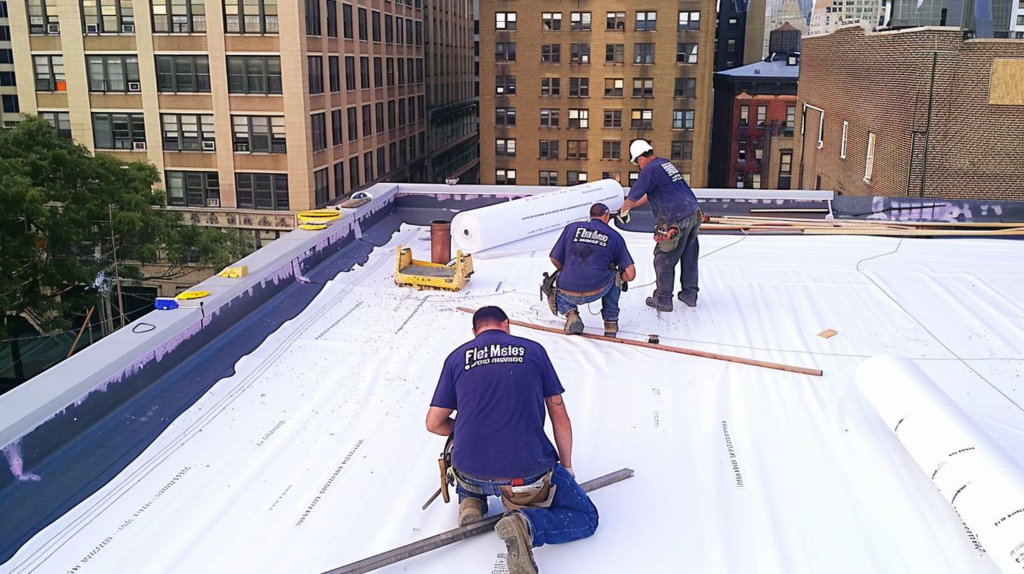
Here's my unpopular opinion: if a flat roofing contractor never says the word "drainage," keep your wallet closed. That smile gets a B for customer service and an F for diagnosis. On a flat roof, drainage isn't a bonus topic - it's the baseline. If an estimator walks your roof, talks about coatings and sealer, and never once asks where water sits or how it exits, they haven't actually inspected anything. They've just looked at it. And honestly, looking at a flat roof without asking drainage questions is like checking a student's handwriting instead of reading their answers.
| Myth | Real Answer |
|---|---|
| If the patch looks clean, the repair was done right. | A clean surface patch says nothing about what's underneath. Wet insulation beneath a sealed membrane holds moisture for months and quietly destroys the substrate while the top looks fine. |
| A lower estimate means they found a simpler solution. | Lower bids almost always mean something was skipped - moisture checks, drain evaluation, edge metal review, or insulation replacement. The number looks smaller because the scope is incomplete. |
| A leak always starts directly above the stain. | On flat roofs, water travels horizontally through insulation and under membranes before it ever shows up on your ceiling. The stain is where it arrived, not where it entered. |
| A fresh coating means the roof was properly fixed. | Coating over a damaged or wet system seals in the problem. Without correcting slope, drainage, or replacing compromised insulation first, a coating is just a timer on the next failure. |
| Any roofer can handle a flat roof. | Flat roofing is a distinct system - membrane transitions, parapet flashing, drain callouts, and ponding behavior require specific knowledge. A crew experienced only on sloped shingle roofs is working with incomplete tools. |
⚠ Red-Flag Phrases in a Flat Roof Estimate
If you hear any of these during an estimate, push back - hard:
- "Just needs some sealer." - Sealer is a finish, not a diagnosis.
- "We don't need to check underneath." - Every flat roof with a suspected leak needs substrate evaluation.
- "Coating will take care of it." - Not if the insulation is already wet or the slope is wrong.
- "Flat roofs are all pretty much the same." - TPO, EPDM, built-up, modified bitumen - each system has distinct repair logic.
If the diagnosis sounds generic, the failure will be specific - and expensive.
Drainage Questions Expose the Real Pros
What a Competent Inspection Sounds Like
What do I ask first when I step onto a Queens roof? "Where does the water sit at 4 p.m. the day after rain?" That question alone tells me more than a full walk-around with a tape measure. Queens roofs are not generic structures - you've got old parapets on pre-war mixed-use buildings in Woodside and Jamaica that have been altered three or four times by three or four different contractors, train-side wind exposure along the elevated 7 line corridor, and block-by-block drainage quirks that only show up after you've worked this borough for a while. I remember standing on a two-story building off Roosevelt Avenue at 6:40 in the morning, with a bakery owner below me yelling that the leak only happened "when the wind comes from the train side." He was right, which is the annoying part. The last flat roofing contractor had sealed the obvious seam but ignored the metal edge where wind-driven rain was sneaking underneath - and I had frosting boxes stacked under drips by 7:15. That edge detail wasn't a bonus item. It was the whole diagnosis.
A contractor who knows Queens flat roofs talks about where water sits, where it exits, where it gets trapped, and what edge conditions are failing - not just where the wet spot is. As Rosa Mendez, with 19 years in flat roofing and a specialty in untangling recurring leak problems on Queens mixed-use buildings, I've seen that the inspection questions a contractor asks reveal more about their competence than any license on the wall. If they walk your roof asking only where it's dripping and never probe the substrate or check your drain callouts, they're collecting the wrong data. And wrong data produces wrong answers - every single time.
| Question to Ask | Strong Answer Sounds Like | Weak Answer Sounds Like | Why It Matters |
|---|---|---|---|
| Where does water sit after rain? | "I'll check slope with a level and map ponding zones before proposing anything." | "Flat roofs always have some water - it's normal." | Ponding accelerates membrane degradation and signals slope or drain failure that a repair alone won't fix. |
| Will you check edge metal and parapet transitions? | "Yes - parapet flashing and edge terminations are where wind-driven rain enters most often, especially on older buildings." | "We'll seal whatever looks loose." | Edge and parapet failures account for a large share of recurring leaks that get mis-diagnosed as membrane failures. |
| How do you verify whether insulation is wet? | "We use probe cuts or a moisture meter and document what we find before scoping the job." | "We can tell from the surface if there's a bigger problem." | Wet insulation left in place traps moisture, breeds mold, and eventually destroys the deck - no surface repair fixes it. |
| Are you matching the existing roof system? | "I'll identify the current membrane type and make sure materials and seaming methods are compatible." | "We use the same material on all flat roofs." | Incompatible materials at transitions fail within months, regardless of workmanship quality on each individual section. |
| How will you document problem areas? | "Photos before and after, mapped moisture readings, and written scope tied to specific areas." | "We'll take care of everything we find up there." | Without documentation, you have no way to verify what was addressed or hold a contractor accountable for warranty claims. |
| What caused this leak, not just where did it show up? | "Based on where the stain is and how water travels on this slope, I suspect the entry point is actually at the parapet corner - let me verify." | "The water is coming in right where you're seeing it." | Treating the appearance point instead of the entry point is the single most common reason flat-roof repairs fail within a season. |
What a Competent Inspection Sounds Like
Under the Surface, Cheap Bids Usually Fail the Test
Last October, I watched a man point proudly at a brand-new silver coating hiding a soaked roof underneath. He was a landlord in Ridgewood - good guy, just working with bad data - and he had three estimates in his hand, each one cheaper than the last, asking why mine included probing wet insulation. So I cut a neat square near a blister, and water came up like someone squeezed a sponge in a sink. That roof had passed a visual test. It had failed the actual experiment. The previous contractor's scope never accounted for moisture in the substrate, which means their number was never a real price - it was just a quote for the part of the work they chose to see. The insider tip here is simple: before you accept any suspiciously low bid, ask the contractor exactly how they'll confirm whether the insulation or substrate is wet. If they can't answer that question specifically, the bid is incomplete and you'll be paying again sooner than you think.
| Why a Cheap Bid Feels Attractive | What It Often Leaves Out |
|---|---|
| Lower upfront cost makes budget approval easier | Wet insulation left in place continues degrading the deck - you're not saving money, you're financing a bigger repair |
| Faster approval and simpler paperwork | Repeated leak calls within 6-12 months are nearly guaranteed when moisture in the substrate is ignored |
| Less disruption during the work | Skipped drain evaluation means ponding water continues to stress the membrane at its weakest points |
| Simple scope feels like a confident diagnosis | Trapped water under a freshly sealed membrane can void manufacturer warranties and accelerate structural damage |
| Feels like a deal when side-by-side with higher numbers | No insulation replacement allowance means the actual cost shows up in the next estimate - which is always higher |
Note: Flat roofs punish incomplete scope faster than sloped roofs. Water has nowhere to shed - it finds every gap you left.
What Low Estimates Often Skip
Probe Cuts or Moisture Checks
Without physically testing the substrate, a bid is priced on appearances - and flat roofs fail below the surface, not above it.
Drain Evaluation
Skipping drain condition means the root cause of ponding and membrane stress stays in place while the surface gets patched over it.
Edge and Flashing Review
Parapet caps, edge metal, and termination bars are the most common hidden entry points - and they don't show up in a scope that only addresses the field membrane.
Insulation Replacement Allowance
When wet insulation is discovered mid-job with no line item budget, work either gets stopped or - worse - done incorrectly to stay within the original number.
When Ponding Water Turns a 'Repair' Into Repeat Failure
Blunt truth: a leak stain on the top-floor ceiling is usually late to the party. By the time water shows up on your drywall or through a light fixture, it's been traveling for a while - through insulation, along the deck, finding the path of least resistance. The ponding near the drain, the blocked scupper, the section of roof that never quite drained right - that's where the chain started. I got called to a small apartment building in Astoria after a Sunday thunderstorm, around 8:30 at night, because water was dripping through a hallway light fixture. The previous roofing contractor for flat roofs had laid new material over old damage without correcting slope, so the roof was holding water exactly where two drains should have been doing their jobs. I still remember the super standing there holding a mop bucket, saying, "They were very nice, though," and me answering, "Nice is not a drainage plan." That building had been re-roofed. The water still had nowhere to go. That's not a materials problem - that's a diagnosis problem.
"Six puddles after one normal rain tells me more than a polished sales pitch ever will." That leak map gets a C-minus if nobody checked the drains. There's a real line between situations that need emergency response tonight and problems that are serious but can be properly scheduled - and knowing the difference protects both your building and your decision-making. When water is near electrical fixtures, actively dripping into occupied units, or you've got a ceiling that's starting to bulge, that's a same-day call. When you're looking at old staining with no current active leak, a surface blister with no interior signs, or you want to get competing bids lined up - that's still urgent, but you're not in emergency territory. The mistake is treating the second category like it can wait until next season.
| 🚨 Call Now | 📅 Can Be Scheduled Soon |
|---|---|
| Water near or dripping through electrical fixtures | Old staining on ceiling with no current active dripping |
| Active dripping into occupied residential or commercial units | Isolated blister or bubble with no interior impact yet |
| Ceiling visibly sagging or bulging from trapped water | Minor surface cracking with no moisture penetration confirmed |
| Drain or scupper actively backing up during a storm | Getting bids together before next season's weather arrives |
| Wind-lifted membrane visible at a roof edge or parapet | Routine maintenance or annual inspection scheduling |
"Can be scheduled soon" does not mean ignore it until the next storm.
If your contractor cannot explain where the water travels, why are you letting them decide where to cut?
Should You Ask for Repair, Investigation, or Replacement Planning?
Screen Your Contractor Before They Ever Touch the Roof
A bad flat roof diagnosis is like grading the wrong student's test - you can be confident and still be completely off. The goal here isn't to hire the nicest person or the fastest talker. It's to find the contractor who can explain cause, evidence, and next steps like they actually ran the experiment - who can tell you where the water entered, what it damaged on the way through, and why the last repair didn't hold. I've been doing flat roofing in Queens since 2006, and the calls we get at Flat Masters most often come from people who trusted a polished presentation over a thorough diagnosis. Don't let that be your story. If you want a flat roof inspection that covers drainage, hidden moisture, edge conditions, and the full assembly - not just the wet spot - call Flat Masters and let's actually look at what's happening up there.
✅ Before You Call a Flat Roofing Contractor in Queens
- 1 Note exactly where the leak appears inside - room, ceiling location, wall, fixture.
- 2 Note when it happens - during heavy rain, wind-driven rain, hours after a storm, or the next day.
- 3 Photograph ponding water on the roof if you can safely access it or see it from a window.
- 4 Find out what roof system you have if known - TPO, EPDM, modified bitumen, built-up.
- 5 Gather past repair invoices - knowing what was done before helps identify what's already been ruled out.
- 6 Note whether drains or scuppers overflowed or backed up during or after the last storm.
- 7 List repeated problem spots - if the same area has been addressed before, say so upfront.
- 8 Be ready to ask how they'll check for hidden moisture - a contractor who can't answer that clearly hasn't thought through the scope.
Common Questions About Hiring a Flat Roof Roofing Contractor