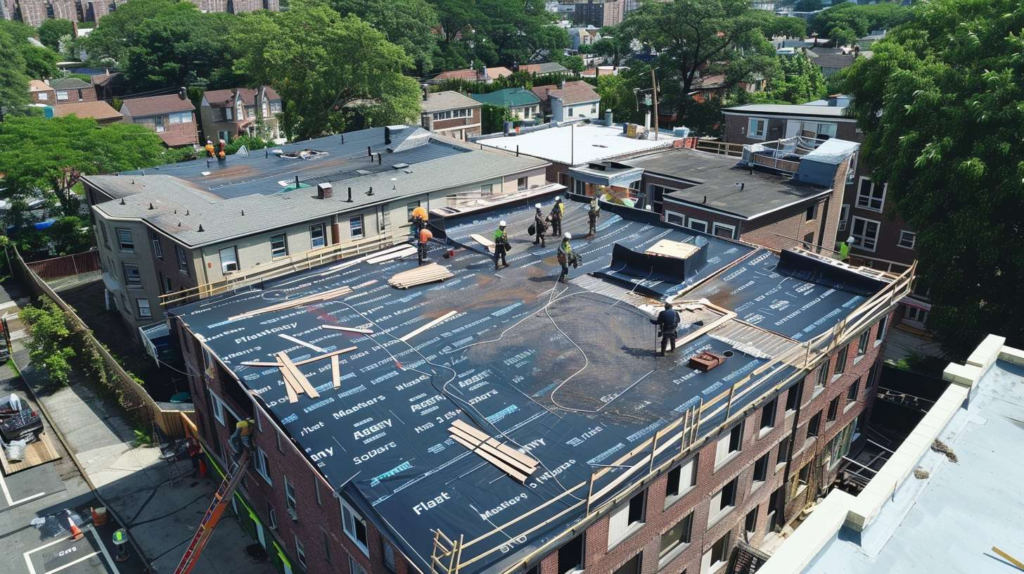
A Low-Profile Skylight on a Flat Roof Looks Clean and Brings in Real Light
Visible doesn't mean obvious. The strongest low-profile skylight on a flat roof often attracts less attention from the street while doing far more work inside the room - shaping how daylight moves, how the space feels, and whether the whole roofline still looks composed.
Street View vs Room Light: Why the Best Skylight Usually Shows Off Less
Visible doesn't mean obvious. The strongest low-profile skylight for a flat roof often attracts less attention from the street while doing more work inside the room - shaping how daylight enters, how a ceiling reads, and whether the roofline still looks like someone thought it through. Think of it less as a feature and more as visual composition: the skylight that disappears into the membrane is usually the one that shapes the room below it best.
I'll say this plainly: bulky skylights age badly on flat roofs. On Queens rowhouses and top-floor additions - the kind you see stacked tight along 37th Avenue or climbing up through Sunnyside - a raised dome or a plastic-looking bubble unit can make an otherwise clean roofline look like an afterthought. The glare comes in wrong, the profile fights the parapet, and ten years later the yellowing plastic tells its own story. A low-profile unit, by contrast, sits quiet. The light it delivers inside feels more like stage lighting - controlled, directional, doing its job without calling attention to itself - while from the street, you'd almost miss it entirely.
Bulky Dome vs. Low-Profile Flat-Roof Skylight
Bulky Dome Skylight
Low-Profile Flat-Roof Skylight
Street Visibility
Clearly visible; dome protrudes above parapet and reads from sidewalk level
Street Visibility
Sits close to roof plane; often undetectable from street on attached Queens homes
Height Above Roofline
Can rise 8-14 inches or more; disrupts flat-roof sightlines significantly
Height Above Roofline
Minimal curb exposure; profile stays tight and flush with the roof plane
Common Aging Appearance
Plastic yellows, hazes, and develops UV cracks within 8-12 years
Common Aging Appearance
Glass-and-aluminum units hold appearance; no yellowing, minimal visual fatigue
Typical Homeowner Reaction
"It looks glued on" - unit feels added, not planned
Typical Homeowner Reaction
"This looks like it belongs here" - light feels planned and the roof reads clean
Fit for Visible Rooflines
Poor - especially on avenue-facing or neighbor-adjacent attached homes in Queens
Fit for Visible Rooflines
Strong - maintains roofline restraint while delivering real light to the room below
| Factor |
Higher-Profile Unit |
Low-Profile Unit |
Why It Matters |
| Street Visibility |
Dome clears the parapet and reads clearly from the sidewalk |
Sits below or flush with parapet on most Queens attached homes |
Rooflines on tight blocks are more visible than owners realize - neighbors and passersby both see it |
| Light Quality Inside |
Direct beam, often harsh in summer; glare bounces off kitchen surfaces |
Diffused entry angle; light reads softer, especially when reflected off adjacent brick |
The goal is livable light, not maximum lumens in your face at 8 a.m. |
| Debris & Water Relationship |
Raised profile catches wind-blown debris; standing water can collect around base |
Lower profile reduces debris catch; still requires clear drainage path on all sides |
On flat roofs in Queens, drainage planning around the unit is non-negotiable regardless of profile |
| Design Fit on Attached Homes |
Clashes with uniform roofline of rowhouses and top-floor additions |
Blends with flat-roof profile; feels like part of the building rather than an addition to it |
Attached housing means your roof is everyone's sightline - restraint is a real design value here |
Curb Height, Drainage Paths, and the Roof Details That Decide Success
What the curb has to accomplish on a flat roof
At 7 a.m. on a Queens roof, the first thing I check is the curb height. I'm Rosa Mendez, and with 19 years of flat roofing experience - and a specialty in solving awkward roof penetrations on older attached homes where nothing is square and every joist seems to have its own opinion - I can tell you that a low visual profile does not mean light waterproofing. The curb has to rise high enough to keep the membrane turn-up clean and the flashing sequence tight. Shave that curb down too far and you've traded visual restraint for a leak path that'll show up in the kitchen ceiling three winters from now.
Now, that sounds small, but it changes everything. I had a rainy Tuesday in Ridgewood where a homeowner called me convinced her new skylight was leaking. I got there with drizzle still hanging in the air, climbed up, and found the skylight was completely fine - the real problem was water backing up from a clogged inside corner three feet away and traveling under old membrane patches until it found the opening. She was embarrassed, but honestly this is why low-profile skylights for flat roofs have to be discussed as part of the whole roof system. Not as a pretty accessory you bolt on and call it done.
A low-profile unit is never just a window; it is a roof penetration with manners.
How a Flat-Roof Skylight Is Evaluated Before Installation
1
Roof Slope Check
Flat roofs need a minimum slope for drainage - usually ¼ inch per foot. Skip this and ponding water builds up directly against the curb base, which is one of the fastest ways to compromise a new skylight installation.
2
Drainage Path Review
Every drain and scupper location relative to the proposed skylight opening gets mapped. If you cut in near a clogged drain or blocked scupper, the skylight becomes a flood magnet the first heavy rain - and it'll get blamed for someone else's problem.
3
Curb Measurement
Curb height has to meet code minimums - typically 8 inches above finished roof surface - while staying low enough to match the profile goal. Get this wrong in either direction and you're either looking at a code issue or a chronic moisture problem.
4
Membrane & Flashing Tie-In Planning
The membrane needs to run up and over the curb in a clean, uninterrupted sequence before the counter-flashing goes on. On older Queens attached homes with multiple patch layers, this is where shortcuts show up as leaks. Skip the planning and you're taping over someone else's bad decisions.
5
Interior Shaft & Light Path Review
The opening above doesn't guarantee usable light below. If the shaft angle, depth, or ceiling finish hasn't been considered, the room can still feel dark even with a new skylight in place. Skipping this review means the homeowner is disappointed and there's no roof reason why.
⚠ Don't Blame the Unit Before You Check the Whole Roof Field
Water can travel from clogged inside corners, deteriorated old patches, or areas of ponding that have nothing to do with the skylight itself - and still show up dripping at the opening inside. It's a very common misdiagnosis.
Don't judge the unit until the full surrounding roof membrane, all patches within a 6-foot radius, and every nearby drain and scupper have been inspected. The skylight is often the messenger, not the cause.
Ask These Before You Approve the Skylight
▸ What's the minimum curb height for my roof membrane type?
Code minimums usually start at 8 inches above the finished roof surface, but your membrane type and the manufacturer's specs may push that higher. A curb that's too low for the membrane system creates a flashing problem before the skylight even sees its first rain.
▸ How does the membrane turn up and how does the flashing sequence work?
The membrane should run up the curb face without interruption, and the counter-flashing laps over the top. On older roofs in Queens with multiple repair layers, getting this sequence clean often means stripping back to bare and starting fresh - not just layering over what's there.
▸ How far is the opening from drains and scuppers?
Placement too close to a drain or scupper means any blockage sends water directly toward the curb. Worth doing a full drainage map of the roof before marking the cut location - this is a five-minute conversation that can prevent a two-year headache.
▸ How do existing roof patches affect the new opening?
Old patches around the proposed opening area are a red flag. If they're hiding deteriorated membrane underneath, cutting in a new skylight can open up failure points that weren't active before. The patch history of the surrounding roof field needs to be part of the conversation, not an afterthought.
Inside the Room, the Light Should Feel Intentional
Choosing for softness, brightness, or privacy
What do you actually want from the light - brightness, softness, or privacy? This question sounds simple but it usually reveals that what homeowners mean by "more light" is something more specific: a gentler morning quality, less August glare off the countertops, or coverage from the taller building next door that looks right into the room. I remember one August job in Jackson Heights, around 6:15 in the morning before the block got loud. The homeowner wanted more daylight in a top-floor kitchen but hated her existing bubble unit because it looked like a plastic salad bowl sitting on the roof. We swapped it for a low-profile skylight on the flat roof, and when the sun came across the neighboring brick wall, the light inside went soft instead of harsh. She said, "This looks like it belongs here" - and that's exactly the point.
Why orientation changes the mood
A good skylight should act like a quiet stage light, not a parade float. Bad roof features are props that compete with the room - they draw your eye upward to a yellowing dome or an awkward raised frame instead of letting the light do the work quietly. The insider detail most spec sheets won't mention: wall color, ceiling depth, shaft finish, and the reflected light bouncing off neighboring brick can change the quality of light in the room as much as the glazing choice itself. A north-facing opening on a room with warm plaster walls and a deep shaft will feel completely different from a south-facing cut into a white-painted kitchen with eight-foot ceilings - even if both skylights share the same product number.
Which Low-Profile Skylight Outcome Fits the Room?
Start Here: Is the main problem darkness or harsh light?
→ Darkness
Choose maximum daylight path. Review shaft finish (lighter = more bounce), ceiling height, and orientation for best solar gain.
Planning focus: Shaft angle + south/east orientation + light-finish interior
→ Harsh Light / Glare
Look at glazing options - low-e coatings, acid-etched glass, or translucent diffusing panels. North-facing placement also reduces direct summer sun.
Planning focus: Glazing spec + placement direction + shaft depth
→ Privacy Concern
Evaluate sightlines from neighboring taller buildings - common in Woodside, Jackson Heights, and Flushing. Diffusing glass or angled placement can resolve this without sacrificing light.
Planning focus: Sightline audit + translucent glazing option
→ Visible Roofline Concern
Prioritize lower exterior profile and clean curb detailing. Match frame finish to roof surface color. Placement behind the parapet line where possible.
Planning focus: Curb detail + profile height + parapet relationship
Room-Level Factors That Change How the Skylight Performs
✔
Ceiling height - taller ceilings diffuse light over more surface area; low ceilings concentrate it and can create harsh spots
✔
Shaft depth - the deeper the shaft between glass and ceiling, the more the light spreads and softens before it enters the room
✔
Room orientation - north-facing openings bring soft consistent light; south-facing can deliver more volume but more direct glare in summer
✔
Nearby brick reflection - adjacent masonry walls bounce warm, filtered light back through the opening, often improving quality more than upgrading the glass itself
✔
Cabinet & gloss surfaces - high-gloss finishes amplify direct light; matte surfaces absorb and diffuse it - the interior palette changes how the skylight "reads" in the room
✔
Privacy from adjacent buildings - taller neighbors in dense Queens blocks mean sightline angles matter; placement and glazing type both need to account for who can see in
Roofline Restraint Matters More on Queens Blocks Than People Expect
One winter job in Astoria taught me this fast. It was maybe 4:40 in the afternoon, that hour in January when the light already turns blue, and I met a retired saxophone player who wanted daylight in his studio without anything on the roof that called for attention. His building sat right on a visible stretch near 31st Street where the roofline reads clearly from the avenue - a bulky dome would've stuck out like a wrong note. After we completed the low-profile skylight flat roof installation with careful curb detailing, he walked across the street, squinted up at the building, and said, "Good. You can't really see it." That's one of the best things a homeowner has ever said to me. In Queens, with attached homes stacked tight, close sidewalks, and neighbors whose windows are sometimes level with your roof edge, the restraint a low-profile unit brings to the roofline is a genuine design contribution - not a compromise.
Here's the blunt part nobody loves hearing. A sleek, low-profile skylight installed on an aging membrane, a poorly formed curb, or a roof that's two or three years from needing full replacement is going to fail - and it's going to feel like the skylight's fault even though the skylight was fine. At Flat Masters, we have this conversation before anything gets cut. You should weigh roof condition alongside aesthetic goals, not after them. A beautiful unit on a failing roof is just a well-dressed problem.
Common Assumptions About Low-Profile Skylights for Flat Roofs
| Myth |
Fact |
| Lower profile means lower leak protection |
Profile height has nothing to do with waterproofing quality. A low-profile unit properly curbed and flashed outperforms a tall dome with a sloppy tie-in every time. |
| Any roofer can cut one in later as an add-on |
A skylight is a roof penetration. It needs to be planned with drainage, membrane condition, joist locations, and curb height all reviewed together - not treated as a quick afterthought job. |
| More glass always means better light |
A larger opening without shaft planning, correct orientation, or the right glazing can produce harsh, unusable light. Smaller, well-placed units often perform better in daily living conditions. |
| Skylight leaks are always the skylight's fault |
Water backs up from clogged drains, failing membrane patches, and ponding areas and travels to the skylight opening. The unit is often the last stop on a long leak path, not the origin. |
| Flat roofs and clean design don't mix |
Flat roofs are one of the best canvases for intentional design when treated as a complete system. Low-profile skylights, proper drainage, and clean parapet edges all work together toward a finished result. |
Before You Call for a Low-Profile Skylight Estimate in Queens
☐
Age of roof membrane - know when the current roof was installed and what system was used (TPO, EPDM, modified bitumen)
☐
Active leak history - note any areas where water has shown up inside, even if it seemed unrelated to the roof
☐
Room below and its purpose - kitchen, bedroom, office, and hallway all have different light quality needs and privacy considerations
☐
Whether the roofline is visible from the street - corner buildings, mid-block attached homes, and avenue-facing structures all have different exposure levels
☐
Location of drains and scuppers - a rough photo or sketch of where roof drainage exits the field helps with placement planning right from the first call
☐
Photos of interior ceiling and exterior roof area - one shot looking up from inside and one of the roof surface from above saves real time on the estimate call
Questions Homeowners Ask Before They Cut Into a Flat Roof
The right questions to ask before a skylight project aren't really about trends or which unit looks nicest in a catalog. They're about fit, waterproofing integrity, and whether the roof underneath is ready to support a new penetration. Get clear on those three things first, and the rest of the decisions get easier and cheaper.
Low-Profile Skylight Flat Roof - Common Questions
▸ Are low-profile skylights good for flat roofs in Queens?
Yes - and they're often the best-fit choice for attached homes on tight Queens blocks where the roofline is visible from the street or from neighboring windows. The key is treating the skylight as part of the roof system rather than a standalone feature. Proper curb height, clean flashing, and clear drainage paths matter as much as the unit itself.
▸ Do low-profile skylights leak more or less than domed units?
Neither profile is inherently more or less prone to leaking - installation quality and membrane condition decide that. A well-installed low-profile unit with a proper curb and flashing sequence will outperform a poorly installed dome every time. The more common leak source on flat roofs isn't the skylight at all; it's the surrounding membrane, nearby drainage failures, or old patch work.
▸ Can a low-profile skylight be added to an older attached house in Queens?
Usually yes, but the roof condition has to be assessed first. Older attached homes in neighborhoods like Ridgewood, Sunnyside, and Astoria often have multiple membrane layers, older patches, and joists that aren't exactly where you'd expect them. A thorough evaluation before cutting is non-negotiable - the age and condition of the existing membrane will influence whether the install goes smoothly or opens up a bigger repair conversation.
▸ Will the skylight be visible from the street?
With a low-profile unit and careful placement relative to the parapet, it's often barely visible or completely hidden from the sidewalk. Placement matters - a unit positioned behind the parapet line, with a frame finish that matches the roof surface, typically disappears from street level. This is one of the real advantages of going low-profile on Queens homes where the roofline reads from the avenue or from across the street.
▸ Should I install a low-profile skylight if my flat roof is nearing replacement?
Honest answer: no, or at least not without planning both jobs together. Installing a skylight on a roof that needs replacement within two or three years means cutting into a failing membrane and then tearing everything out again shortly after. The smarter move is to do the roof replacement and skylight installation together - the membrane tie-in is cleaner, the flashing is new throughout, and you're not paying twice to open the same section of roof.
What This Article Wants You to Remember
Best Visual Trait
Low street presence
The skylight that disappears from the sidewalk is usually the one that does the most for the room below it.
Most Important Install Factor
Curb and flashing detail
No glazing choice or profile spec overrides the quality of the membrane tie-in and curb execution.
Most Common Mistake
Ignoring surrounding drainage
The unit gets blamed for leaks that start three feet away at a clogged drain or a failed membrane patch.
Best Planning Question
What kind of light do you want in the room?
Brightness, softness, privacy, and glare control all lead to different placement, glazing, and shaft decisions.