
How Much Does It Cost to Refelt a Flat Roof? Here's What You Should Expect to Pay

How Much Does It Cost to Refelt a Flat Roof? Here’s What You Should Expect to Pay

How Much Does It Cost to Refelt a Flat Roof? Here's What You Should Expect to Pay

Keeping it real: refelting a flat roof in Queens typically runs anywhere from $1,200 on the low end to $7,500 or more depending on size, access, and what's actually hiding under the surface. Two roofs with nearly identical square footage can land at completely different price points once moisture levels, drainage problems, existing layers, and flashing conditions get checked - and that gap isn't random, it's the roof telling you what it actually needs.

Queens Refelting Numbers at a Glance

In Queens right now, I usually see refelting land somewhere between $1,200 and $3,500 for smaller residential roofs - garages, extensions, one-section rowhouse tops - and between $3,500 and $7,500-plus for mid-size two-family or full rowhouse decks. The low end of that range almost always assumes a relatively clean substrate, minimal tear-off, and no major surprises near the drains or parapet walls. The minute you get up there and start checking the evidence - pressing near seams, probing insulation, looking at how water moves off that roof - two buildings with the same street view can be thousands of dollars apart in what they actually need.
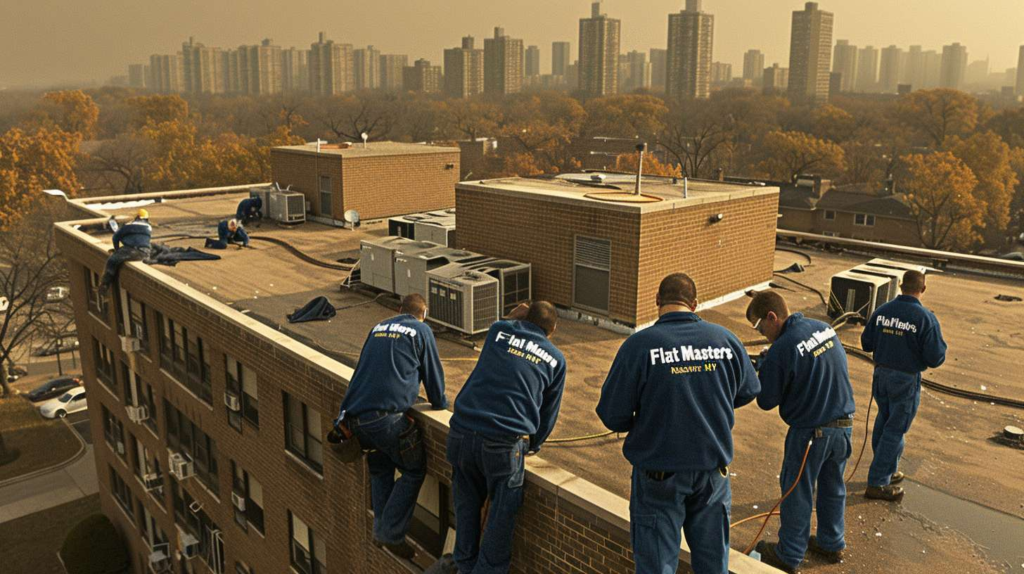
A flat roof being refelted by a worker in safety gear, showing layers of bitumen felt being applied.

What I dislike about "cheap fix" thinking isn't the budget concern - budgets are real, and I respect that. What frustrates me is when someone is quoted a surface-only price on a roof that's already failing underneath. Not because I want to upsell anyone, but because covering up a wet, saturated system doesn't stop the damage - it just delays the honest reckoning until next winter, when the ceiling is stained and the job costs twice as much. This article separates today-money pricing from next-winter-money consequences. Think of it like lab results: the inputs, the conditions, and the findings on that specific roof are what determine whether the quoted number is real or just optimistic.

Queens Flat Roof Refelting - Scenario Pricing

Estimates based on current Queens labor, material, access, and disposal conditions.

Scenario Typical Roof Size What Condition Looks Like Estimated Price Range
1. Garage roof, recover-style 250-350 sq ft Stable single layer, no ponding, edges intact - recover permitted by local code $1,200 - $2,000
2. Rowhouse roof, minor repairs 400-600 sq ft Some seam separation and edge cracking, no significant moisture trapped below surface $2,200 - $3,800
3. Two-family roof, partial tear-off 700-900 sq ft One saturated section near drain, rest of deck sound - targeted tear-off required $3,500 - $5,500
4. Full tear-off, insulation + flashings 900-1,200 sq ft Full tear-off needed, wet insulation at drains, base flashings at parapet must be replaced $5,500 - $7,500+
5. Looked like a refelt - needs replacement Any size Trapped moisture confirmed, deck integrity compromised - refelting not a responsible option Full replacement: $8,000+

📍 Local labor, access, disposal, and parapet detail complexity push Queens numbers upward. These ranges are estimates - actual pricing depends on field inspection findings.

⚡ Fast Facts Before You Call for a Quote

Typical Queens Range

$1,200 - $7,500+ depending on size, layers, moisture, and flashing scope. Garage recover vs. full two-family tear-off are not the same job.

Biggest Hidden Cost Driver

Wet insulation. Once moisture is trapped below the felt, tear-off and replacement of affected sections is unavoidable - and that changes every number in the estimate.

Average Inspection Focus Points

Drain flow and ponding zones, parapet base flashings, seam integrity, number of existing layers, deck surface condition, and edge metal tie-ins.

Cheap vs. Right-Way Quote Difference

Often $1,500-$3,000+ on a mid-size roof. The difference usually represents skipped tear-off, no flashing work, and zero moisture verification - things that come back as bigger bills.

Why the Bill Jumps Once We Check the Evidence

What a roofer is really pricing

Here's the blunt part nobody likes: a flat roof quote that starts at one number and climbs isn't a bait-and-switch - it's what happens when "just a refelt" meets an actual roof. And as Marisol Vega, with 19 years in flat roofing and a habit of diagnosing Queens drain and edge failures before the ladder is even down, I can tell you that the price rises the moment a simple surface job turns into removal, drying time, insulation replacement, drain re-leveling, edge metal work, or parapet flashing rebuilds. Each one of those findings is a legitimate cost item, not padding.

The pieces low quotes like to skip

I remember a damp Tuesday around 7:15 in the morning in Ridgewood when a landlord insisted he "just needed fresh felt" on a roof that had already swallowed two layers and was holding pond water like a birdbath. I climbed up with coffee still in my hand, pressed my boot near the drain, and water actually burped out from a seam patch someone had torched over wet insulation. That was one of those jobs where I had to explain that the refelting cost specific to his building wasn't high because roofers are greedy - it was high because the roof had been treated like a cover-up project for ten years. Queens rowhouse roofs are especially vulnerable to this pattern: tight rear-yard access makes proper material staging difficult, old parapet-heavy layouts trap debris and moisture at the base of walls, and neighborhoods like Ridgewood and Astoria are loaded with roofs that have three or four overlapping layers from different decades - each one hiding what the last contractor didn't want to deal with.

I had a Saturday call in Astoria after a windy March night, and the customer - a retired saxophone player, still in slippers - asked me why one quote for refelting was nearly double another. By 9:30 a.m. we were both on the roof, and I showed him exactly what the cheaper proposal skipped: no base flashing replacement, no moisture check, and the contractor wanted to tie new felt directly into crumbling parapet edges that couldn't hold a proper bond. The cheaper quote also had nothing for drain re-setting or disposal. He laughed and said, "So one price buys roofing, and one price buys optimism." I've used that line ever since when I explain how much to refelt a flat roof the right way.

Field Findings That Change Your Refelting Estimate

Field Finding Why It Matters Typical Cost Impact Can Refelting Still Make Sense?
Multiple existing layers Extra weight, code limits on overlays, and each layer traps moisture below Adds a lot - full tear-off may be required Only if tear-off is included first
Wet or compressed insulation Saturated boards can't support a new membrane and accelerate deck rot Adds a lot - section or full replacement needed Not without removing and replacing wet sections
Damaged deck sections Soft or rotted deck can't anchor new felt - structural issue that must be corrected first Adds a lot - may shift job to replacement Only if isolated and deck is otherwise sound
Base flashing replacement needed Cracked or de-bonded base flashings are one of the top sources of Queens flat roof leaks Adds a moderate-to-significant amount Yes - but flashings must be included in scope
Parapet repairs required Spalling or cracked parapets compromise the flashing bond and allow water entry at the wall Adds a moderate amount depending on extent Yes - parapet work is a line item, not a reason to replace
Drain reset or additional drainage needed Clogged, low-set, or improperly sloped drains create ponding that deteriorates any membrane Adds a moderate amount - skipping it means early failure Yes - but drainage must be corrected as part of the job
Difficult roof access Tight Queens rear yards, narrow hatch openings, and no street ladder access add time and labor Adds a little-to-moderate amount Yes - access cost is separate from scope decisions
Permit and disposal requirements Full tear-offs require proper debris removal; some Queens jobs require DOB permits Adds a little - but non-negotiable on compliant jobs Yes - this is administrative cost, not a scope issue

Lower Bid vs. Proper Refelt - What's Actually in the Proposal

⚠ Lower Bid Usually Includes

  • Surface felt layer only
  • Minimal or no seam work
  • No base flashing replacement
  • No moisture verification below surface
  • Tie-in to failing or crumbling parapet edges
  • No drain assessment or re-setting
  • No disposal line item
  • One number - no breakdown of what's included

✔ Proper Refelt Usually Includes

  • Tear-off of compromised layers where required
  • Substrate and deck condition check
  • Wet insulation identified and replaced
  • Base flashing replacement at parapet walls
  • Drain inspection, cleaning, or re-setting
  • Clean tie-ins at edges and penetrations
  • Debris cleanup and proper disposal
  • Line-item estimate so you can see every cost

Questions I'd Ask Before I Price Your Roof

What would I ask you before I even mention a price? First, approximate roof dimensions - not to calculate square-foot cost on the spot, but to understand the scope. Then: are there any active leaks right now, and do you see water ponding after rain, and for how long? Do you know how many layers are already up there? Is the problem showing up near a drain, a parapet wall, a hatch, or somewhere in the field of the roof? Are there access constraints - a narrow interior hatch, no exterior ladder access, a tight backyard? And finally, is the building occupied below the work area, because that affects scheduling and protection needs. These aren't small talk - every one of those answers changes what I'm looking for when I get up there.

📋 Before You Call for a Refelting Estimate - Gather These 8 Things

  1. Approximate roof dimensions - rough length × width is enough to start; exact measurements come during inspection
  2. Photos of drain areas - show whether there's pooling, debris buildup, or visible damage around drain collars
  3. Photos of parapet edges - cracks, spalling brick, or separated flashing at the base of the wall are key cost signals
  4. Leak location notes - where does water show up inside? Near a wall, below the drain, under a skylight or hatch?
  5. Age of current roof if known - helps estimate how many layers may have accumulated and what membrane type is likely present
  6. Number of prior patches or coatings - even rough knowledge helps a roofer anticipate what they'll find under the surface
  7. Access details - interior hatch size, exterior ladder access, driveway or yard availability for material loading and debris drop
  8. Leak timing - does water appear after wind-driven rain, or any rain? Wind-driven often points to flashing failure; any rain often points to membrane or drain issues

What Your Roofer Means by Condition Questions

Expand each item to understand what that finding suggests about your estimate.

🔽 Ponding Water

Ponding that sits for more than 48 hours after rain is actively degrading the membrane and almost certainly compressing the insulation below it. If your roof has a consistent low spot near a drain or parapet, the refelting estimate needs to account for drain re-setting or tapered insulation - not just new felt. Ignoring it and laying new material over a ponding zone is a next-year problem in the making.

🔽 Soft Spots When Walking the Roof

A soft or spongy feel underfoot usually means the insulation has absorbed moisture and is no longer structurally supporting the membrane. In the worst cases, it means the deck below is starting to deteriorate. Either way, a soft spot is not a candidate for recover - it's a tear-off zone at minimum, and potentially a deck repair situation. That changes the scope and the cost significantly.

🔽 Flashing Failure at Walls or Penetrations

If base flashings at the parapet are cracking, pulling away, or showing open gaps, that's where most Queens flat roof leaks originate - not in the field of the roof. A refelting job that doesn't include flashing replacement is not solving the leak. This finding adds cost, but skipping it means the new felt is working against a broken seal at every wall junction from day one.

🔽 Interior Staining Patterns

Where the stain appears on the ceiling doesn't always match where the leak enters the roof - water travels. But staining near an exterior wall usually points to flashing failure, while staining below the center of the roof is more often a membrane seam or drain issue. Either way, interior staining that's getting worse tells me the moisture has been moving for longer than the homeowner usually realizes, and that tends to mean more material has been affected than a surface inspection alone would show.

Small Findings That Turn a Simple Refelt into a Bigger Job

Drainage problems

A drain, a seam roller, and five extra gallons of trapped water can change the whole estimate. A drain that's set too low, clogged with years of gravel and debris, or simply undersized for the roof area it's supposed to serve creates ponding that no new membrane can outlast. And a recover - laying fresh felt over an existing surface - is only a responsible option when the substrate is genuinely dry, the layers are within code, and water is actually leaving the roof the way it's supposed to. When those conditions aren't met, new felt over a wet system isn't a repair. It's a delay.

One August afternoon in South Ozone Park, heat bouncing off the black surface like an oven door, I was reviewing numbers with a couple who had just bought a two-family home off Liberty Avenue. They were focused on square-foot price until I peeled back a corner near the hatch and found the old deck staining dark from a slow leak that had probably been traveling for months. I ended up sketching the full cost breakdown on the back of a bakery receipt: tear-off, insulation replacement in one section, new felt layers, flashings, cleanup - each one as its own line. That was the day I made it standard practice to tell people to always ask for a line-item estimate that separates tear-off, insulation work, flashing replacement, and cleanup. A single lump-sum number is easy to make look competitive by simply leaving items out. When you can see each line, you can see exactly what a cheaper quote is skipping.

Moisture below the surface

⚠ When a "Refelt" Quote Is Really a Cover-Up

Watch for any proposal that does one or more of the following:

  • Promises new felt over areas with confirmed ponding - without addressing drainage first
  • Skips drain inspection, cleaning, or re-leveling entirely
  • Makes no mention of flashing tie-ins at parapet walls or penetrations
  • Has no line item for insulation check or replacement
  • Doesn't confirm how many existing layers are present before quoting recover

Covering wet materials with new felt doesn't waterproof your roof - it just makes the next repair more expensive and harder to find. The damage continues. The bill for fixing it grows. That's next-winter money you didn't have to spend.

Flat Roof Refelting - Myths vs. Facts

Myth Fact
"Same square footage means the same price." Two 800 sq ft roofs in Queens can be $2,000 apart in scope once moisture, layers, and flashing conditions are checked. Square footage is just the starting point.
"New felt always fixes the leak." New felt fixes leaks caused by membrane failure. If the water is entering through cracked parapet flashings or a failed base tie-in, the felt isn't the problem - and replacing it won't stop the water.
"Old flashings can usually stay." On most Queens roofs over 10 years old, base flashings at parapet walls are cracking or de-bonding. Installing new felt against old, failing flashings means the weakest link in the system hasn't been addressed.
"Ponding is normal if the roof isn't leaking yet." Ponding accelerates membrane breakdown, compresses insulation, and adds structural load. "Not leaking yet" is just early-stage - the damage is already accumulating below the surface.
"The cheapest quote saves money." Not if it skips moisture verification, flashing work, and tear-off. The cheapest quote on a failing Queens flat roof usually produces a second job 18 months later - and that second job costs more than doing it right the first time.

How to Decide Whether Refelting Is Worth Paying For

Pricing a flat roof by square footage alone is like grading a science test with half the answers missing. The score looks fine until you check what's not there. Refelting is a legitimate, cost-effective result - but only when the inputs support it. Dry substrate, one manageable existing layer, repairable flashing edges, and functional drainage: those are the conditions that make a refelt a sound outcome. Flip the inputs - wet insulation, repeated overlays, failing flashings, chronic ponding - and the honest result isn't a refelt. It's a replacement. Calling it anything else is just changing the label on the same failing experiment.

If the test sample is contaminated, the result is useless - and roofs work the same way.

Should You Refelt or Plan for Replacement? - Decision Guide

START: Active leaks or interior water stains present?

YES → Inspect for moisture below surface

Probe insulation near drains and parapet bases. Check for soft spots or visible deck staining.

Wet insulation found?

Move toward replacement or partial rebuild. Covering wet insulation is not refelting - it's postponing a larger failure.

No wet insulation - one layer, flashings still serviceable?

Refelting with targeted tear-off may be viable. Drain and flashing scope still required.

NO leaks or stains → Assess surface and drainage

Check number of layers, condition of flashings, and ponding behavior around drains and walls.

Ponding severe or flashings failing?

Scope drainage and flashing rebuild before deciding. Refelting without correcting these is a short-term result.

One layer, dry insulation, serviceable edges?

Good candidate for refelting. Conditions support a clean, responsible result.

✔ Good Candidate for Refelting

⚒ Refelting Only with Targeted Tear-Off

⚠ Replacement Is the Financially Honest Call

Queens Refelting Cost - Questions Homeowners Actually Ask

🔽 Is refelting cheaper than replacing a flat roof in Queens?

Usually yes - if the substrate is in reasonable condition. A proper refelt on a mid-size Queens rowhouse typically runs $2,500-$5,500, while a full replacement of the same roof usually starts around $8,000-$10,000+. But a cheap refelt over a failing system often leads directly to replacement sooner than it should. Spending the right amount once almost always beats spending the wrong amount twice.

🔽 How long does a refelt job usually take?

A straightforward refelt on a small-to-mid-size Queens roof typically takes one to two days. If tear-off, insulation replacement, or significant flashing work is involved, add another day or more depending on extent. Access difficulties - tight hatches, no exterior ladder drop, occupied buildings - can also stretch the timeline. A crew that rushes a refelt to finish in half the time is usually skipping something.

🔽 Can you refelt over an existing flat roof?

Sometimes - but only when local code permits it, only one existing layer is present, the substrate is dry, and the existing surface is stable enough to bond to. Most Queens flat roofs I get called to already have two or more layers, which means tear-off is required before anything new goes down. Recovering over a wet or unstable surface isn't a shortcut - it's a liability.

🔽 What makes one quote thousands higher than another?

Almost always it's what the lower quote left out. Tear-off labor, insulation replacement, base flashing work, drain corrections, disposal fees, and access surcharges are all real costs - and they're easy to eliminate from a proposal to make the number look attractive. Ask any contractor for a line-item breakdown. If they can't or won't produce one, that tells you something. One quote buys actual roofing work; the other buys optimism - and Queens winters don't care which one you chose.

If your Queens flat roof is giving you signals - ponding, stains, failing edges, mystery leaks - don't guess at the number before you know what the roof is actually telling you. Call Flat Masters for a thorough on-site inspection and a line-item estimate that separates today-money from next-winter-money, so you know exactly what you're paying for and why every dollar is there. - Marisol Vega, Flat Masters

Faq’s

Flat Roofing FAQs: Everything Queens, NY Homeowners Need to Know

How do I know if my flat roof needs refelting or just repairs?
If you’re spending over $500 yearly on roof repairs or see widespread blistering and multiple leaks, refelting is likely your best option. Small isolated issues can often be spot-repaired, but extensive damage means it’s time for a complete refelt.
Delaying refelting when your roof shows signs of failure can lead to expensive structural damage. Water infiltration can rot deck boards and damage interior spaces, potentially doubling your costs. Fall is the ideal time for refelting in Queens.
Absolutely – a properly installed felt roof lasts 15-20 years with minimal maintenance. Compare that to ongoing repair costs and potential interior damage from leaks. It’s preventive maintenance that protects your entire home investment.
Most residential refelting jobs in Queens take 2-4 days, weather permitting. The timeline depends on roof size, material choice, and whether we find deck repairs needed. We always build weather delays into our scheduling.
Flat roof refelting requires specialized tools, materials, and expertise to ensure proper installation and waterproofing. DIY attempts often lead to leaks and void manufacturer warranties. Professional installation includes permits and guarantees.

Ask Question

Or

Flat With a Slight Pitch - Here's Why So Many Modern Roofs Are Built This Way

13 min read

Flat Roof Leaking Down a Wall? Here's What the Repair Will Cost

6 min read

Purlins in a Flat Roof? Here's What They Do and Why They Really Matter

13 min read

Renovating a Flat Roof House? Here's Where to Start Before You Spend a Penny

13 min read

Flat Roof Plywood Installation in NYC - Built as the Foundation Should Be

7 min read

Professional Manufactured Home Flat Roof Replacement Services

7 min read

Professional Flat Roof Glass Panels Installation & Repair Services

6 min read

Ventilating a Flat Roof Properly Stops Condensation Destroying It From the Inside

17 min read

What's the Average Small Flat Roof Cost for Your Home?

7 min read

Flat Roof Leaking Right Now? Here's How to Tarp It Until We Arrive

7 min read

How to Stop a Flat Roof from Leaking - Proven Solutions That Last

9 min read

Extension Flat Roof Leaking? Here's Where the Problem Almost Always Starts

14 min read

Expert Colonial Type Flat Roof House Architecture Roofing Solutions

7 min read

How Much Does It Cost to Felt a Flat Roof? The Numbers That Actually Matter

13 min read

How Much Does Flat Roof Coating Cost? Get an Honest Answer

7 min read

Interior Drain on Your Flat Roof Leaking? Here's Where the Problem Usually Is

13 min read

A Leak-Proof Flat Roof Isn't a Dream - It Just Takes the Right System

14 min read

How to Raise a Flat Roof: 5 Essential Steps for Homeowners

7 min read

Your Flat Roof Might Just Need Resealing - Here's How to Know and What's Involved

16 min read

Building a Flat Roof Over Your Porch? Here's Everything You Need to Know

13 min read

Your Flat Roof Dormer Is Leaking - Here's Where the Water Is Coming From

13 min read

How Much Does a Garage Flat Roof Replacement Actually Cost? Real Numbers Here

15 min read

Professional Flat Roof Skylight Replacement Services Near You

7 min read

Expert Second Storey Flat Roof Extension Solutions You Can Trust

6 min read

Waterproofing a Flat Roof Right the First Time Is the Only Way to Do It

17 min read
blue circle

Get a FREE Roofing Quote Today!

Schedule Free Inspection