
Purlins in a Flat Roof? Here's What They Do and Why They Really Matter

Purlins in a Flat Roof? Here’s What They Do and Why They Really Matter

Purlins in a Flat Roof? Here's What They Do and Why They Really Matter

Structure sets the rhythm long before the membrane starts complaining

You caulked it last fall. And the spring before that. And here you are again, staring at a ceiling stain that won't quit-because the waterproofing layer keeps taking the blame for something that may have started much deeper in the assembly. A surprising number of flat roof problems that look like membrane failures are really the surface reacting to what the supporting framing underneath is doing, or failing to do.

Before we talk about a flat roof purlin, what is the deck actually sitting on and spanning between? That question matters more than most owners realize. Purlins are part of the support story under the deck-they shape how loads travel, how the deck behaves across a span, and how stable the platform above actually is. Think of the whole assembly as a beat: span, support, spacing, repeat. That rhythm is either consistent or it isn't, and the membrane at the top has no vote on what happens below it. I'm Branko Iliev, with 26 years explaining hidden framing issues on Queens low-slope roofs where purlin lines quietly control the platform above-and this is the part of the roof most people never see until something goes wrong.
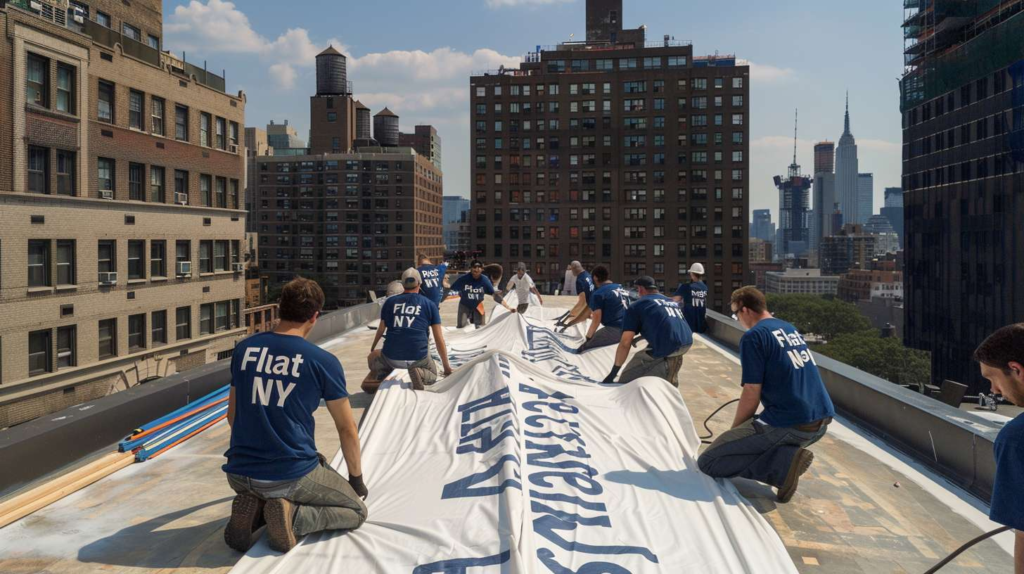
Roofers installing metal purlins on a flat roof structure, connecting beams to create a support system for roofing materials

Purlin Role Why It Matters What Failure Shows Up Above If It's Wrong
Support spacing Defines how far the deck must span between bearing points; too wide a gap and the deck flexes under load Visible sag lines, ponding water, and stress cracking in the membrane between bays
Deck backing Gives the deck a solid surface to fasten to; without consistent backing, fastener pull-through becomes a real risk Fastener blowout, membrane lifting at seams, and insulation boards that won't sit flat
Load transfer Carries dead loads, live loads, and snow loads from the deck down into primary beams or bearing walls Concentrated deflection at weak transfer points; interior ceiling damage tracking the purlin line
Stiffness between primary supports Reduces mid-span movement and keeps the deck plane stable under variable loading Deck bounce or drum sound when walked, which signals membrane is cycling in tension and compression
Influence on deck behavior Consistent purlin spacing produces predictable deck performance; irregular spacing produces inconsistent deflection Leaks that appear to "move" season to season-actually deck joints opening and closing as conditions change
Effect on roofing performance above A stable, well-supported deck gives the waterproofing system a fighting chance; an unstable one stresses seams and field sheets from day one Premature membrane failure, repeated patching cycles, and warranty disputes that ignore the real cause

Fast Truths About Flat Roof Purlin Systems

01 — Purlins are not decorative extras. They are load-bearing members whose spacing and attachment directly determine how the deck above them performs.
02 — Deck performance depends on them. A properly spaced purlin grid is what keeps a flat deck flat-without it, the deck becomes a flexible surface that punishes the waterproofing layer above.
03 — Membrane symptoms can begin below the waterproofing. The membrane reacts to what the structure underneath is doing-stress it from below and it will show it from above.
04 — Hidden framing rhythm affects leak and sag behavior. Inconsistent purlin spacing creates inconsistent deck stiffness, which produces the kind of random, hard-to-trace leak patterns that drive owners-and contractors-crazy.

Surface leak symptoms often make more sense once you listen to the structure underneath

The deck can be telling on the purlins before the membrane gets blamed

I still remember that one dead note in the span. Cold February morning in Maspeth-the owner of a small warehouse wanted another leak patch and nothing else, which is fair, that's what he called me for. But once I got under the deck, the pattern of sag between supports told a different story. I knocked my way along the underside, bay by bay, and the rhythm changed right where one purlin line had movement it had no business having. That was the moment I had to explain, again, that the membrane trouble everyone was seeing from the top started with what the deck was being asked to span-and what wasn't holding it up the way it should have been.

Knuckle on the steel and listen for the rhythm. That's not a metaphor-it's a diagnostic move that owners of Queens warehouses, industrial-style low-slope additions, and the practical flat roofs stacked across this borough almost never think to do. And honestly, why would they? The leak is on top, so the top gets patched. But the small warehouses around Maspeth, the flat-roofed additions on residential blocks in Woodside, the squat commercial buildings tucked under the elevated train lines-they're all roofs where owners have been chasing surface patches for years while the support rhythm underneath quietly kept changing. Deck, purlin, spacing, support. That sequence either holds together or it doesn't.

Myth Fact
"If it's leaking, the membrane must be the whole story." The membrane is where water exits-not necessarily where the problem started. Deck movement driven by weak purlin support stresses seams and laps from below.
"A patch solves the problem if the opening is sealed." Sealing a symptom doesn't stop the cause. If the deck is moving because purlin support is inconsistent, the next weak point opens on its own schedule.
"Flat means the structure below is simple." Low-slope roofs often have the most demanding secondary framing requirements precisely because water has nowhere to drain in a hurry and loads must transfer cleanly.
"Minor sag is only visual." Sag means the deck plane has changed. That change creates ponding locations, seam stress, and eventually, a penetration that finds the interior.
"Support lines don't matter unless the roof is collapsing." You don't need a structural failure to have a support problem. Subtle purlin movement, loose attachment, or oversized spans degrade performance long before anything dramatic happens.

⚠ When a Leak Patch Is Answering the Wrong Question

If you're seeing sag patterns that follow a consistent line, deck that moves or sounds hollow when walked, or leaks that reopen in roughly the same location after every patch-stop patching the membrane. Those are signs that the waterproofing layer is reacting to a support issue below it. Adding another layer of material on top does not change what the structure underneath is doing to the deck. A repeat patch without a framing check is just buying time, and not much of it.

Spacing and attachment arguments during construction are usually hidden versions of future leak arguments

Here's the blunt truth: waterproofing cannot outvote bad support. Before the membrane ever shows up on site, the flat roof purlin components and the deck installation sequence have already decided how much stress the waterproofing will live under for the next twenty years. Get the spacing wrong, skip a fastener, let a purlin sit loose against its bearing-and you've built the next leak into the structure before a single roll of membrane has been touched.

A roof frame works like sheet music-miss the spacing, and the whole performance goes crooked. I took a call from a contractor in Long Island City at about 6:50 a.m. on a bitter morning, coffee going cold before I even got there. His crew was in a full argument over a retrofit detail on a flat roof purlin setup before the decking went down. It sounded like a roofing argument. It was not a roofing argument. It was a load path argument, a spacing argument, an attachment argument-about whether the deck was going to behave once it was installed and weight started coming down. I like those moments, honestly, because they prove that roofing only looks simple if you ignore the skeleton underneath it.

My opinion? If you only look at the membrane, you're reading half the roof. And here's the insider move worth keeping: before anyone recommends a leak fix or a roof build-up, ask them what the deck is spanning between and whether the support rhythm below has been checked. Not as a gotcha-as a real question. Because if they don't have an answer, or they pivot straight back to the surface, you're probably about to pay for another patch that doesn't solve the structural beat driving the problem.

Two Ways of Reading a Flat Roof Problem

Surface-Only Diagnosis

Full Support-Path Diagnosis

What It Notices First
The membrane breach, blister, or open seam at the surface
What It Notices First
The deck plane behavior, sag pattern, and how the structure below is moving
How It Explains Sag
Chalks it up to age or material weight; calls it cosmetic
How It Explains Sag
Traces it to specific purlin spacing or bearing failure that changed the deck plane
How It Explains Repeated Patching
Blames material quality, weather, or bad luck; recommends another patch
How It Explains Repeated Patching
Recognizes the patch cycle as a symptom of unresolved deck movement from below
What It Misses About Load Path
Doesn't ask how loads travel through the assembly or where the weak transfer point is
What It Misses About Load Path
Nothing-load path is part of the question, not an afterthought
What It Changes in the Fix
Applies new surface material over whatever support condition already exists
What It Changes in the Fix
Addresses support issues first so the new membrane has a stable, non-moving platform
Long-Term Confidence in Result
Low-the same stress pattern will find the next weak point in the membrane
Long-Term Confidence in Result
High-membrane is no longer being asked to compensate for a framing problem

How to Think Through a Purlin-Related Flat Roof Concern

1

Identify the roof symptom above: note where the leak, sag, or membrane distress appears on the surface and document its location relative to the roof layout.

2

Inspect deck behavior: access the underside if possible and look for sag patterns, movement under foot traffic, or inconsistency in how the deck plane sits across the span.

3

Trace the support rhythm below: identify where the purlins are running, whether the bearing points are consistent, and whether any member shows movement, corrosion, or loss of contact.

4

Check spacing and attachment logic: confirm that purlin spacing matches the deck's design span and that fasteners or connections are holding the members in their intended position without slop or gap.

5

Decide whether the issue is waterproofing-only or support-influenced: only after completing steps one through four can you make an honest call about whether the membrane is the problem or the messenger.

The quiet grid under the roof is what lets the flat shape exist without argument

Owners usually understand it once they can see the platform, not just the covering

Before we talk about a flat roof purlin, what is the deck actually sitting on and spanning between? That question landed differently on a muggy June afternoon in Ridgewood. The homeowner kept asking why his roof looked perfectly flat from the street but required so much technical discussion once we were standing underneath it. Fair question. We were in an unfinished addition-bare steel, no ceiling, just the grid above us catching the afternoon light through the open gable end. I pointed to the shadow lines falling across the steel members and showed him how the flat roof purlin components weren't extras or over-engineering-they were the grid that the entire platform above was resting on, bay by bay. Once he saw that, he stopped thinking of them as contractor language and started seeing the quiet structure that was letting the roof hold its shape. The grid was always there. He just needed the shadows to make it visible.

Open the Hidden-Frame Questions

What is the deck spanning between?
+
The deck spans from purlin to purlin, and the distance between those members determines how much the deck flexes under load. A longer span means more movement; more movement means more stress on everything attached above it.
How does spacing affect the platform above?
+
Tight, consistent purlin spacing creates a stiff, predictable platform that lets insulation boards sit flat and membrane seams stay where they're bonded. Inconsistent spacing creates an uneven platform where some bays deflect more than others, and the roof surface above tells that story over time.
Why does this matter to the waterproofing later?
+
Waterproofing systems are designed to sit on a stable, non-moving substrate-they're not built to absorb the movement of a deck that's flexing because the support below it is uneven. When the substrate moves, seams and laps are the first to feel it, and the leak that shows up inside the building is just the end of a long chain that started in the framing.

Questions Owners Ask About Purlin Flat Roof Construction

What is a flat roof purlin?
A purlin is a horizontal framing member that runs perpendicular to the primary structural beams or rafters, providing intermediate support to the roof deck. On a flat or low-slope roof, purlins set the spacing rhythm that the deck spans across-they're the secondary grid that holds the platform together between the main structural points.
Why would purlins matter if the roof leak looks like a membrane issue?
Because membranes react to what the structure below them is doing. If the deck is flexing, cycling, or sitting on an inconsistent support grid, the membrane seams and laps absorb that stress-and eventually fail. The membrane is where the water exits; it's not always where the problem started.
Can poor purlin spacing affect a flat roof deck?
Directly and immediately. Wider-than-designed purlin spacing increases the deck's unsupported span, which increases deflection under load. That deflection changes the deck plane, creates ponding locations, stresses insulation and fasteners, and sets up the membrane for premature failure-all before weather or age has a chance to factor in.
When is a framing discussion really a roofing discussion?
Always, on a flat roof. The framing sets every condition the roofing assembly has to live with-deck span, substrate stability, load transfer, and the flatness of the platform itself. Any roofing discussion that skips the framing below is an incomplete one.
What should a contractor explain before blaming or patching the membrane again?
They should explain what the deck is spanning between, whether the purlin spacing and attachment are intact, and whether the sag or movement pattern matches a support issue rather than a surface one. If they can't answer those questions before reaching for the patch material, you're probably in the wrong conversation.

If you want the roof read all the way down to the support rhythm-not just patched at the top-call Flat Masters in Queens, NY, and we'll show you what the structure is actually saying.

Faq’s

Flat Roofing FAQs: Everything Queens, NY Homeowners Need to Know

How do I know if my flat roof purlins need repair or replacement?
Look for visible sagging, ceiling cracks, water pooling in new areas, or unusual creaking sounds. Even slight roof dips are red flags that need immediate attention. Our article explains all the warning signs and when to call for professional inspection before minor issues become major structural problems.
Minor repairs typically cost $150-300 per linear foot, while complete replacement runs $8-15 per square foot. However, multiple small repairs often cost more than doing it right initially. We’ve seen customers save $20,000+ by choosing proper replacement over repeated patch jobs.
Most installations take 3-7 days depending on building size and complexity. Weather and access challenges in Queens can extend timelines. We work efficiently to minimize business disruption, but proper installation can’t be rushed – your building’s structural integrity depends on doing it right.
Absolutely not recommended. Purlin systems require structural engineering calculations, proper load analysis, and building permits. Incorrect installation can cause catastrophic roof failure. Professional installation includes warranties and building department approvals that DIY work can’t provide.
Waiting turns $8,000 repairs into $45,000+ structural overhauls. We’ve seen buildings need complete structural rebuilds because owners ignored early warning signs. Purlin failure can cause roof collapse, water damage, and safety hazards. Early intervention saves money and prevents disasters.

Ask Question

Or

Flat Roof Coping Stones - Installed and Repaired by NYC Pros

8 min read

A Flat Roof Greenhouse Is a Brilliant Use of Space - If It's Built Right

16 min read

Shingles on a Flat Roof - Can You Really Use Them and Should You?

16 min read

Boarding Is the Foundation of a Good Flat Roof - Here's How to Lay It Right

15 min read

A Deck on a Flat Roof Needs Its Own Drainage Setup - Here's Why and How

14 min read

A Flat Roof Has a Slope - You Just Can't Always See It From the Ground Below

15 min read

Flat Roof Installation for NYC Residential Houses - Built to Code

9 min read

Your Complete Guide to How to Remove Old Flat Roof Safely

7 min read

Flat Roof Skylights Are Great Until Summer - Here's What Fixes the Heat Problem

14 min read

Base Sheet Goes Down First - and Getting It Right Matters More Than Most Know

13 min read

How to Keep Snow Off Flat Roof: 5 Essential Methods That Work

7 min read

How Much to Redo Flat Roof Cost: Your Complete Pricing Guide

7 min read

Shingle Underlayment on a Low-Slope Roof - What You Need Is Different From Standard

16 min read

Building a Flat Roof Over Your Porch? Here's Everything You Need to Know

13 min read

Professional Flat Roof with Skylight Construction Services

6 min read

What Do Flat Roof Materials Actually Cost? Here Are the Real Material Prices

13 min read

Felt Flat Roofs Don't Last Forever - Here's How to Know When It's Time

15 min read

What's the Average Flat Roof Raising Cost in Your Area?

7 min read

What's the Average Asphalt Flat Roof Cost for Your Home?

8 min read

How to Replace a Flat Roof: 5 Essential Steps for Homeowners

6 min read

Torch-On Felt Is One of the Best Systems Around - If You Know What You're Doing

17 min read

Professional Flat Roof Rooflights Installation & Repair Services

6 min read

Fibreglass Flat Roof Construction in NYC - Strong, Waterproof, Guaranteed

5 min read

How to Shingle a Flat Sloped Roof: Your Complete Guide

7 min read

How a Flat Roof Is Made Truly Waterproof - The Techniques That Hold Up Long-Term

18 min read
blue circle

Get a FREE Roofing Quote Today!

Schedule Free Inspection