
Refelting a Flat Roof Is a Big Job If You Get It Wrong - Here's the Right Approach
Inside. The first real move in how to refelt a flat roof isn't laying felt - it's proving the roof underneath is dry, solid, and actually worth covering. This walkthrough takes you through exactly how Queens flat roofs get checked, repaired, and only then refelted, so you're not paying someone to gift-wrap a problem.
Start Under the Surface Before You Touch a Roll
Soft spots, trapped moisture, a sagging deck, and years of old patch layers decide the job long before material choice does. I remember being on a refelting job in Ridgewood at 6:40 in the morning, coffee still too hot to drink, when I peeled back one corner and found three generations of patchwork under the cap sheet. The owner kept saying, "It was only leaking around the vent," but once the sun came up you could see the deck sagging between the joists like wet cardboard. What's underneath - not what's on top - sets the scope every single time.
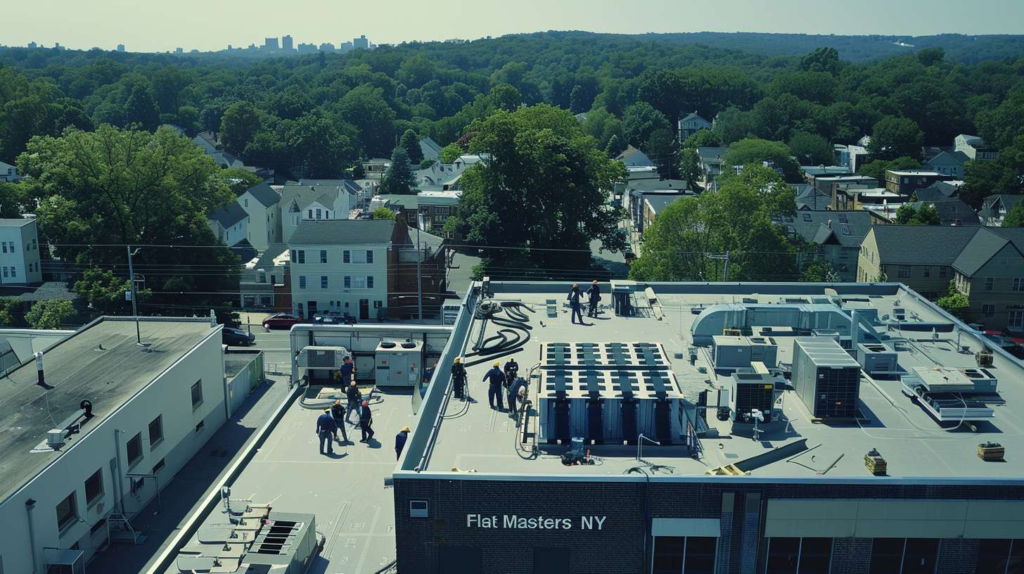
Here's my plainspoken opinion: pretending that refelting a flat roof is mostly about the top layer is where owners and cheap contractors fool themselves. A fresh cap sheet over a rotted, wet assembly looks better for about one billing cycle. Then the water finds the same soft path it's always traveled - because you never changed where the water was taught to go. You just gave it a cleaner ceiling to work through.
Any soft spots when you walk the roof?
Active leaks, water stains, or damp smell inside the building?
Is the existing felt bonded flat with no widespread blistering or splits?
Edge metal, terminations, and penetrations intact and sealed?
Never Cover Wet Insulation or Rotten Decking With New Felt
Trapped moisture under a new membrane does not dry out - it accelerates rot, causes blistering from below, creates persistent odor, hides ongoing structural decay, and can push water sideways into parapets, interior seams, and ceiling assemblies. A cleaner-looking surface on top changes nothing about the damage underneath.
Read the Water Path Like a Queens Roofer
Field of Roof
First thing I look for is the soft spot nobody mentions. Before anyone talks materials or pricing, I'm walking the field in a slow grid - feeling for give underfoot, eyeing blisters that have bubbled and cracked, scanning for splits along seams, and noting where ponding marks left a dark ring around a low area. I check the drain bowl for debris compression and then I go inside to read the ceilings. As Doreen Valenti, with 27 years of flat roofing experience and a specialty in diagnosing mystery leaks, I can tell you the ceiling stain is almost never directly below the source - water walks, and you have to follow the path it chose, not the path that's easiest to blame.
Perimeter and Terminations
On a Queens row building, the edges tell on everybody. Parapet bases are where water pools when scuppers clog with leaf debris after a storm - and in older masonry construction along blocks like those off Jamaica Avenue or near the elevated tracks in Woodhaven, you're dealing with parapet walls that have been repointed, painted, patched, and ignored for decades. Coping joints crack, termination bars lift, vent pipe flashings gap and pull away, and every one of those failures is the roof quietly teaching water a new route. Edge details don't just keep water out - they determine where it travels next when something goes wrong.
| What You Find | What It Usually Means | Refelt Decision | What Happens to Water If Ignored |
|---|---|---|---|
| Soft spots underfoot | Saturated insulation or rotted decking below | Stop. Open and inspect before any refelting. | Deck continues to rot; ceiling collapse risk grows |
| Widespread blistering | Moisture trapped between felt layers during install | Affected sections must be stripped and rebuilt | Blisters crack open under foot traffic; leak points multiply |
| Ponding marks / low areas | Inadequate slope or settled deck structure | Correct slope before new felt or problem repeats | Standing water accelerates membrane degradation and leaks at seams |
| Lifted or rusted edge metal | Wind has broken the termination seal at the perimeter | Replace edge metal before field membrane work starts | Wind-driven rain enters laterally under new felt from day one |
| Cracked or open pipe flashings | Rubber collar degraded or flashing not embedded in membrane | Rebuild penetration detail during refelting - not optional | Water enters at stack and travels horizontally to unrelated ceiling area |
| Surface splits along seams | Felt aged out or was installed without adequate adhesion | Test whether splitting is isolated or system-wide; act accordingly | Open seams funnel water directly to substrate with each rain event |
▶ Row-House Parapet Corners
The inside corner where two parapet walls meet is one of the most consistently neglected spots in Queens roofing. On attached row houses, the adjoining wall transition creates a stress point where membrane wraps fail, flashing separates, and water collects behind the felts. A good inspection always gets into those corners physically - you can't read them from the middle of the roof.
▶ Drain Areas After Leaf Buildup
Street trees in Queens neighborhoods mean gutters and scuppers clog every fall. The real damage happens when standing water sits for weeks - it softens the felt at the drain collar, compresses the insulation below, and leaves a rim of debris that holds moisture even after it rains again. A drain area that looks clean on a dry day can still be hiding compression damage an inch down.
▶ Vent and Stack Flashings on Older Multifamily Buildings
Three- and four-family buildings throughout central Queens often have multiple vent stacks that were flashed once in the 1970s and never touched again. The neoprene collars dry out, the metal base plates rust, and the pitch pockets crack. These aren't cosmetic problems - every open stack flashing is an open door. And because the leak often shows up feet away from the stack, it gets blamed on the wrong thing for years.
▶ Edge Metal on Windy Exposures Near Broad Avenues or Elevated Lines
Roofs facing wide corridors - especially buildings along elevated train lines where wind channels and accelerates - take a beating on the windward edge. Drip edge and gravel-stop profiles lift, fasteners back out, and the membrane face-nails pull through. Wind-driven rain on those exposures enters horizontally, not vertically, which is why people assume it's a window problem when it's actually the roof edge failing six feet to the left.
Strip, Dry, Repair, Then Build the New Layer Correctly
I learned this the sweaty way in August. In Astoria, a landlord insisted we could save money by leaving the soaked insulation in place because "it'll dry out." By 2:15 that afternoon, the heat coming off that black surface was brutal, and every step we took released a damp, swampy smell from underneath - the kind that tells you water has been sitting there long enough to start doing serious work. I told him water trapped under new felt is like putting a winter coat on a fever. You're not solving anything. You're just sealing the problem in tighter and paying for the privilege.
The actual refelting and replacement process, done right, goes in this order: remove failed felt sections, expose the substrate, pull out any wet or compressed insulation, repair or replace rotten deck boards, restore slope where low spots have developed, prime the substrate if the system calls for it, install the base sheet or underlayment with correct fastening, then roll the cap sheet or felt layers with proper laps and full adhesion. Only after the field is complete do you address penetrations - pipe collars, vent boots, equipment curbs - and then you seal and mechanically secure every edge termination.
Here's the insider truth that separates a competent refelt from one that fails by spring: seams matter, but terminations matter more. If a roofer can only talk about how neatly the field laps are rolled and can't explain how the edge metal ties into the wall, how the drain collar is integrated, or how the parapet cap ties back to the membrane - they're leaving the exact places water re-enters wide open. Sloppy terminations don't just leak; they teach water a new sideways path under the system you just paid for. That's the consequence that leads you right back to a second tear-off.
Mistakes That Make the First Rain Your Real Inspector
If I asked you where the water sits after a storm, could you answer me? I had a Sunday emergency call in Woodside after a handyman spent a windy spring weekend doing his own refelting job. He lined up the laps neatly enough - I'll give him that - but he skipped the edge details and termination points entirely, so the first hard rain pushed water sideways under the membrane before the adhesive had even fully cured. I was standing in a light drizzle with the owner's aunt holding an umbrella over my notebook, sketching on a piece of cardboard exactly how that roof had been taught to fail from the perimeter in.
Pretty laps fool people; the first sideways rain does not.
| ❌ Myth | ✅ Fact |
|---|---|
| You can refelt right over the old felt if it's mostly flat. | Only if the existing layer is fully bonded, dry, and approved for overlay - and the deck below is verified sound. "Mostly flat" is not a substrate assessment. |
| Wet insulation will dry out once the new membrane is on and the sun hits it. | A sealed membrane doesn't let moisture escape - it traps it. The insulation stays wet, continues compressing, and accelerates rot below. |
| If the field seams look good, the roof is good. | The field is the easiest part to get right. Failures almost always occur at edges, penetrations, parapet ties, and drain collars - not in the open field. |
| A small roof can be done in a weekend without permits or professional help. | Speed and permit avoidance are exactly how termination details and deck conditions get skipped. In NYC, unpermitted roofing work can also complicate insurance claims and resale. |
| Ponding after a storm is normal for flat roofs and doesn't need addressing. | Standing water for more than 48 hours degrades membrane chemistry, stresses seams, and is a code issue. It's a drainage design problem - and it needs to be corrected during refelting, not accepted. |
-
❌
Wet insulation was left in place. The contractor called it "minor" or said it would dry. It won't - and the new membrane just sealed the problem in.
-
❌
Deck repairs were skipped or not even checked. The roofer went straight to stripping and rolling without probing for rot or deck movement. Soft spots went unflagged.
-
❌
Ponding areas were covered without slope correction. Water still collects in the same bowl - it just has a newer ceiling to eat through.
-
❌
Edge metal and termination bars weren't replaced or properly embedded. The perimeter looks finished but isn't sealed - wind-driven rain enters laterally within the first storm season.
-
❌
Penetration flashings were tarred over instead of rebuilt. Pipe boots and stack collars were coated cosmetically rather than properly integrated into the new membrane system.
Use This Final Check Before You Hire Anyone in Queens
Here's the blunt version: new felt does not forgive rotten decking. Any contractor you're considering should be able to show you exactly where the roof is wet, where the deck is solid, and how the edge details - edge metal, parapet tie-ins, drain collars, scuppers - will be rebuilt as part of the job. If they can answer those three things clearly and specifically, you're probably talking to someone who knows what they're doing. If they skip straight to material specs and pricing without touching the substrate question, that's your answer right there.
A flat roof is a lazy river, not a dinner table - water is always sneaking somewhere. The contractor worth hiring is the one who can sketch you a water path, explain where the old system was teaching it to go, and show you precisely how the new one changes that route. That's the whole job. Everything else - the felt brand, the layer count, the price per square - is secondary to understanding where the water was taught to go and making sure the new work doesn't accidentally teach it somewhere worse. If you're in Queens and you want that kind of inspection before any new felt goes down, Flat Masters is ready to walk the roof with you and give you a straight answer.
▶ Can you refelt over an existing flat roof?
Sometimes - but only when the existing layer is fully adhered, dry throughout, and the deck below is structurally sound. Most roof systems in Queens have been patched enough times that there's already too much material thickness to add another layer responsibly. A core sample and moisture reading tell you whether overlay is a real option or just a way to put off the inevitable tear-off.
▶ How do you know if insulation under a flat roof is wet?
The clearest signs are soft spots underfoot, a musty or swampy smell when you get close to the surface, and visible compression or dark staining when you cut a test section. A moisture meter takes the guesswork out - I use one on every job. Wet insulation also tends to feel heavier and denser than dry, and on a hot day it'll release a faint steam smell when disturbed. Don't rely on visual inspection alone.
▶ How long does a refelting or replacement process usually take?
A straightforward residential flat roof in Queens - say, 1,000 to 1,500 square feet - typically takes two to three days when the deck is solid and conditions are good. Add a day or two if deck repairs are needed or if insulation replacement is extensive. Weather is the real variable in New York - a job that could be done in two days can stretch to five if you're working around spring storms. Any contractor who promises a one-day turnaround on anything but the smallest roof is cutting corners somewhere.
▶ What parts of the roof fail most often after a bad refelting job?
Edge terminations and penetration flashings fail first, nearly every time. The field seams - the part that's most visible and easiest to photograph - are usually fine. What fails is the tie-in at the parapet base, the edge metal that wasn't properly embedded, the drain collar that was just coated over rather than rebuilt, and the pipe boots that were tarred and left. Water always finds the termination edge - and if that detail wasn't done right, the first real rainstorm reveals it.