
Timber Flat Roofs Are the Most Common Kind - Here's How They're Built Properly
I've argued this point for years. Timber flat roofs aren't everywhere because they're simple to build - they're everywhere because they perform exceptionally well when wood detailing is handled with more discipline than most people expect to bring to a residential project. This article is a plain-English walk through the flat roof wood construction details that actually determine whether a timber assembly holds up through Queens winters, humid August nights, and everything in between.
Three inches at the edge can decide the next twenty years. Perimeter blocking, drain positioning, and deck continuity at transitions are consistently where assemblies begin to quietly fail - long before the membrane shows a single blister. And honestly, my opinion on this hasn't changed in three decades: timber flat roofs are dependable when every layer keeps its own job. They become troublesome the moment people expect wood or membrane to compensate for bad geometry. Treated like generic sheathing, timber will remind you it isn't.
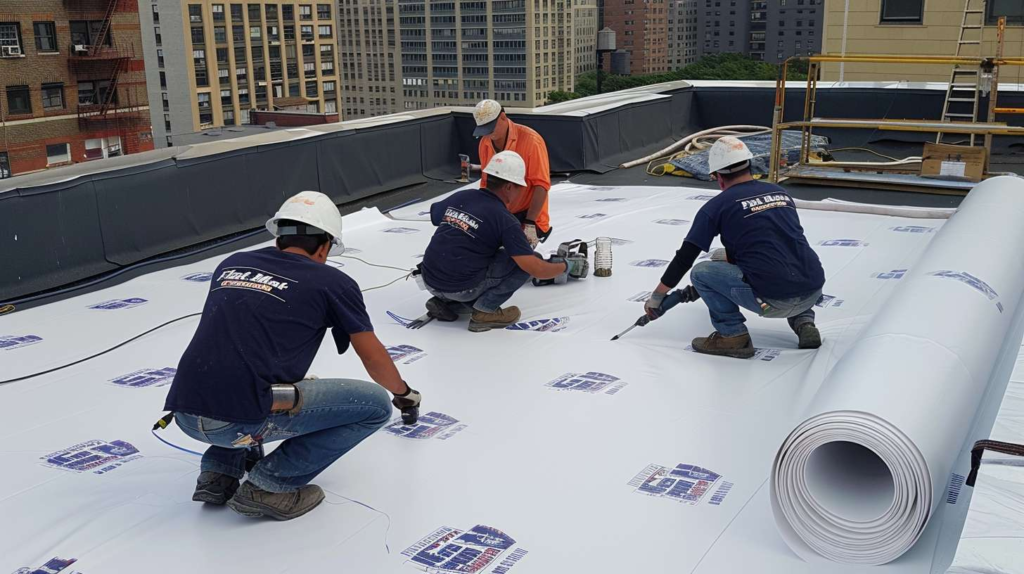
Why Timber Flat Roofs Show Up Everywhere Yet Still Get Built Wrong
| Myth | Real Answer |
|---|---|
| Wood flat roofs are basic residential assemblies - nothing complex about them. | Wood expands and contracts with every moisture and temperature swing. Queens gets freeze-thaw cycles, humid summers, and cold snaps - and timber moves through all of it. A flat wood roof detail has to account for that movement at every joint, edge, and penetration. There's nothing basic about that. |
| If the membrane is watertight, the framing detail is secondary. | Wood movement beneath a membrane doesn't stop when the surface is sealed. Deck joints that weren't gapped properly will telegraph movement upward, stressing seams and flashings from below. The membrane is the last line - it can't rescue a framing detail that was wrong from the start. |
| Ponding is only a surface issue. | Ponding water means drainage geometry failed - which is a slope and deck-layout problem, not a membrane problem. Sustained standing water in Queens summer heat accelerates vapor pressure inside the assembly, pushing moisture toward the wood deck from above and below simultaneously. |
| CLT details can be copied from commercial specs without adjustment. | CLT panels behave differently than dimensional framing - connection layout, vapor sensitivity, and drying potential all change. A commercial spec sheet is calibrated for different spans, penetration patterns, and climate exposure. Applying it directly to a Queens rowhouse or low-rise is a shortcut that tends to trap moisture exactly where you can't see it. |
| More sealant fixes weak transitions. | Sealant is a supplement, not a solution. A parapet transition or drain edge that wasn't detailed properly with the right blocking and flashing geometry will keep moving and pulling apart - and sealant on top of that just delays the next call by one winter cycle. |
Anatomy of a Proper Wood Flat Roof Detail Section
Here's the part people in Queens love to skip: a wood flat roof detail section has to account for moisture cycling, thermal expansion, and structural support at every transition point before membrane selection is even relevant. I'm Marta Echevarría, and I've spent 31 years in flat roofing with a specialty in diagnosing timber flat roof failures across Queens - and the same problems keep appearing on the same kinds of blocks. The assembly goes wrong when someone reaches for a product before they've solved the geometry. Queens doesn't make this easy: freeze-thaw cycles hit every February, parapet walls throw shade that slows surface drying well into spring, and those sticky, humid July nights mean an assembly that never fully dried out in summer goes into fall already compromised.
Deck, Slope, and Movement Control
I was on a two-family in Maspeth at 6:40 in the morning after a night of freezing rain, and the owner kept saying, "It's the membrane, it's definitely the membrane." It wasn't. When I pulled back one edge, the deck joints around the drain had been gapped badly - or rather, not gapped at all. The wood swelled, the flat wood roof detail around the drain telegraphed that movement right up through the surface, and what looked like a membrane failure was actually a framing problem that had been building since the day the panels went down. Coffee came second that morning. Proving the framing was the real culprit came first.
Edges, Drains, and Penetrations
Now, before anyone blames the membrane - and they always do - it's worth understanding that leaks originating at drains and parapets are almost never a membrane-first problem. Bad edge blocking leaves the membrane without stable termination. A drain that sits proud of the deck surface instead of slightly recessed creates a dam. A pipe penetration that wasn't properly reinforced at the deck level flexes independently of everything around it. The membrane gets blamed because it's what you can see and touch, but it's downstream of decisions made weeks earlier.
| Layer / Component | Primary Job | Job It Should Not Be Doing | Typical Failure If Confused |
|---|---|---|---|
| Structural Deck | Carry and distribute load across the framing below | Creating slope or acting as a drainage plane | Ponding, joint movement, and membrane stress from deck deflection |
| Blocking / Substrate Reinforcement | Provide solid, stable termination points at edges, parapets, and penetrations | Serving as the primary structural member or filling gaps left by poor framing | Membrane and flashing pull loose from unstable edges; water infiltrates perimeter |
| Slope-Forming Layer | Move water consistently toward drains at a minimum 1/4" per foot | Acting as insulation or providing structural support | Ponding pools at low points, accelerating membrane fatigue and vapor pressure below |
| Insulation | Control heat transfer and contribute to dew-point placement within the assembly | Creating slope or acting as a wear surface | Compressed insulation at transitions loses R-value; moisture condenses at wrong layer |
| Membrane | Provide the waterproof barrier over a stable, prepared substrate | Bridging bad transitions, compensating for missing flashing, or spanning movement | Seam splits, lap failures, and blister formation where the membrane is doing flashing's job |
| Flashing / Drain Edge Components | Seal and protect every transition point where the membrane cannot continuously cover | Being replaced by sealant beads or relying on the membrane to overlap and hold | Chronic parapet leaks, drain-collar infiltration, and recurring interior water staining |
-
Verify Span and Deck Type
Confirm whether you're working with dimensional lumber, plywood panels, or CLT - and match the framing span to actual load requirements before anything goes on top. Inspectors check that panel grade stamps are visible and that span ratings match the framing layout on the plans. -
Set Slope Strategy
Decide whether slope comes from tapered insulation, a framed curb system, or a hybrid - and confirm drain locations before any other layer is sequenced. Experienced roofers verify that every drain location sits at the genuine low point of the intended slope, not wherever the framing happened to land. -
Gap and Fasten the Deck Correctly
Install deck panels with consistent 1/8" expansion gaps at field joints and stagger seams so no four corners meet at one point. Inspectors look for missing gaps at deck-to-blocking transitions and check that fastener pattern matches the panel manufacturer's requirements for the given wind uplift zone. -
Reinforce Perimeter and Penetrations
Install solid blocking at all edges and around every penetration before any insulation or membrane goes down - this is not a step to revisit later. Roofers with field experience check that blocking height matches the planned insulation + cover board buildup so the membrane terminates level and fully supported. -
Install Insulation and Cover Strategy
Place insulation in the correct sequence for your vapor control position, and include a cover board where the membrane requires a stable, non-compressible substrate. Inspectors verify that insulation joints are offset between layers and that no fasteners from the lower deck layer penetrate upward through the vapor control plane. -
Complete Membrane Plus Flashing Transitions
Install field membrane first, then all flashings at parapets, drains, and penetrations - each terminating with the correct height, material compatibility, and mechanical support. Experienced roofers pull on every flashing edge and check that drain collars sit flush or slightly below the finished membrane plane, not above it.
Where CLT and Conventional Timber Assemblies Part Company
I remember a roofer in Elmhurst telling me, "Wood is wood," and I nearly handed him my resignation from the conversation. A flat roof CLT roof detail is not a scaled-up version of a plywood deck detail - panel thickness changes how moisture moves through the assembly, connection penetrations interrupt what would otherwise be a continuous vapor barrier, and the drying potential of a CLT panel is genuinely different from OSB or dimensional framing. CLT has more mass, holds moisture longer, and forgives bad sequencing less gracefully than a conventional deck that you can pull up and replace one sheet at a time. The details are not interchangeable, and treating them as if they are is how you end up with a choir room ceiling dripping in winter.
A manufacturer's CLT spec sheet is calibrated for specific spans, penetration patterns, parapet heights, and climate exposures - usually commercial or institutional buildings in climate zones different from Queens. Using that sheet without adjusting for your actual building's dimensions, humidity exposure, and penetration layout isn't an efficiency move. It's a liability.
Timber is not steel. Steel details can often be applied at scale. Timber details depend on moisture behavior, movement potential, and drying opportunity - all of which change with every building's orientation, parapet shadow, and interior use. A generic detail can misplace the vapor control layer, undersize the blocking at penetrations, or set drain collars that don't account for the actual panel thickness. That's not a paperwork error. That's a moisture trap.
Signals That Your Assembly Is Asking One Layer to Rescue Another
Field Clues Before Leaks Become Interior Damage
If you were standing next to me on the deck right now, I'd ask you one thing first: where exactly is the water supposed to leave this assembly?
Investigate edge blocking condition, deck panel movement at joints, drain sump geometry, and whether penetrations have independent support or are relying on the membrane to hold them in place.
This pattern almost always indicates a framing or flashing detail failure. Professional investigation is warranted - another patch will repeat in one or two seasons.
Inspect membrane surface and flashing for storm-specific puncture, uplift, or seam damage. Isolated storm events often mean surface repair is legitimate.
Look for trapped moisture, poor slope accumulation, or seasonal wood movement. If symptoms follow the calendar rather than weather events, the assembly's drying path or slope geometry needs attention.
Blunt truth - timber doesn't forgive lazy layout. One August afternoon in Astoria, during that sticky kind of heat where your shirt is done with you by 9 a.m., I walked a renovation with a young couple and their designer who wanted a roof deck over a timber flat roof with almost no buildup. I remember kneeling with a tape measure on warm plywood, telling them plainly: if you skip wood-specific construction details to save two inches of height, this roof will act like a sponge in a winter coat. Six months later they called to thank me for insisting on ventilation and proper edge blocking - because their neighbor's shortcut job had already started cupping at the corners. The insider tip, if you're in a constrained buildup situation, is this: protect the edge support and drainage geometry first. Those are the first places where a compressed detail reveals itself, and they're also the hardest to fix once the deck surface is finished.
Questions Worth Settling Before Anyone in Queens Starts Fastening Panels
A wood flat roof detail is a lot like packing a violin for air travel: raw strength is not the point. Controlled support at every pressure point, room for movement, and protection at the transitions that matter most - that's what determines whether it arrives intact. I saw this play out firsthand at a church annex near Woodside, where I was called in around 1:15 p.m. on a Sunday after a storm pushed water into the choir storage room. The previous crew had copied a flat roof CLT roof detail straight from a commercial spec sheet - same connection layout, same vapor control position, same drain geometry - without adjusting for the actual panel spans, the HVAC penetrations along the south wall, or the fact that Queens humidity swings are not what that spec sheet was calibrated for. I still remember standing under that overhang, listening to the custodian describe the drip "keeping time with hymn practice," and thinking: this is exactly what happens when timber gets treated like steel with feelings.
Before any build or retrofit starts, there are five things that need clear answers: Where does slope begin, and where does it end up? What's the drying path - and does anything block it? Who's responsible for edge restraint at every termination? Is the drain geometry confirmed at the actual deck level, not just on a drawing? And critically: who owns each layer's job, so that when something fails, the diagnosis doesn't require dismantling the entire assembly to find out which layer was covering for another one?
If a timber flat roof detail on your Queens property is already showing movement, recurring leaks, or edge trouble, Flat Masters can inspect the full assembly logic before another repair asks the membrane to solve a framing problem it was never built to handle. Call us - we'll start with the layer cake, not the surface.