
Installing Shingles on a Flat Roof - What's Possible and What the Limits Are
What it looks like versus what it is. Shingles are not designed for truly flat surfaces, so whether they're even possible on your roof comes down entirely to slope, how water actually moves across that surface, and where your roof transitions from one system to another. This article breaks down what's realistic, what's not, and why Queens roof layouts-with their parapets, rear extensions, and layered assemblies-make this question surprisingly easy to misjudge.
Slope decides the answer before materials do
"On a 2:12 section, I start paying attention; below that, I start saying no." Shingles are a shedding material-they're engineered to move water downward quickly, handing it off from one course to the next, and that handoff only works when gravity is doing enough of the work. When pitch drops below the threshold where water sheds reliably, shingles stop being a roofing system and start being an expensive cosmetic layer sitting on top of a drainage problem. That's the cosmetic-versus-structural divide right there, and it shows up on almost every call I take about flat roof shingle installation.
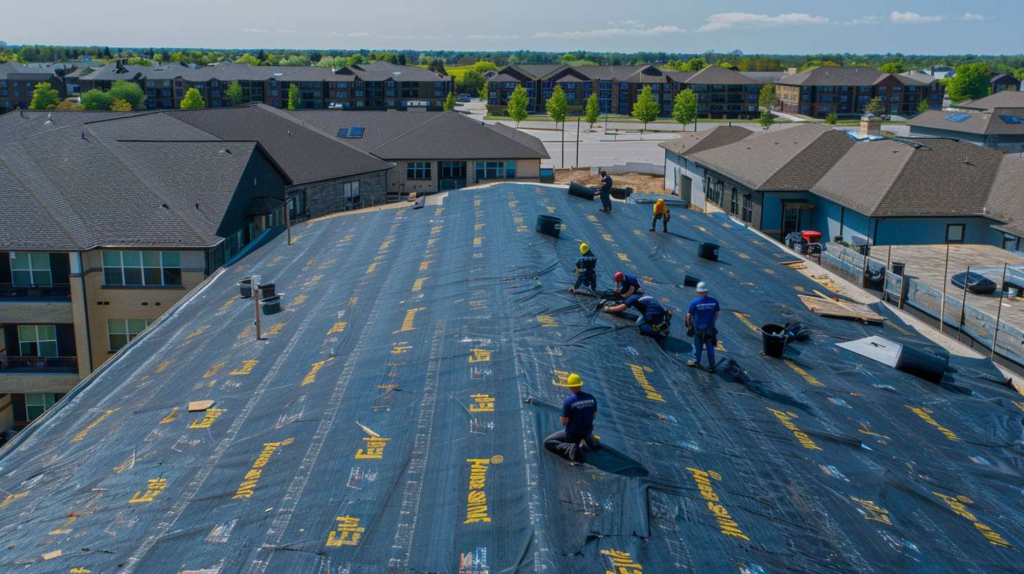
Homeowners often describe a roof as flat when it's actually low-slope-somewhere between 1:12 and 3:12-and that distinction matters more than the terminology. A low-slope roof might drain fine if it's detailed correctly with the right system; a truly flat or near-level surface will pond no matter what you lay on top of it. That's the cosmetic answer; now here's the structural one.
| Roof Pitch | Can Shingles Be Used? | Why It Fails or Works | Better System if Not Shingles |
|---|---|---|---|
| Under 1:12 | No. Not appropriate under any method. | Water pools between courses; capillary action drives moisture under tabs; deck rot is a near-certainty. | TPO, EPDM, or modified bitumen membrane system. |
| 1:12 to under 2:12 | No. Below manufacturer minimums for shingles. | Even with full ice-and-water shield, water movement is too slow and lateral; seams become entry points during any wind-driven rain. | Modified bitumen or single-ply membrane with proper edge detail. |
| 2:12 to under 4:12 | Conditionally. Low-slope shingles only, with enhanced underlayment. | Some manufacturers permit use at 2:12 with doubled underlayment and reduced exposure. Detailing must be exact-transitions and drains are high-risk zones. | Low-slope membrane at the lower ranges; standard shingles possible approaching 4:12 with correct prep. |
| 4:12 and up | Yes. Standard shingle territory. | Gravity does its job; water sheds cleanly between courses; manufacturer warranties apply under normal installation conditions. | N/A - shingles are the appropriate system at this pitch. |
⚠ Don't Skip This Part
Manufacturer installation instructions and local building code requirements are not suggestions-they're the line between a warranted roof and a liability. Installing shingles on a ponding or near-level surface doesn't just void the product warranty; it creates leak paths that travel laterally under courses, saturate the deck far from the visible entry point, and cause rot that won't show up until a replacement is already overdue. A roof that looks dry from the street can be actively failing from the drain inward.
Drainage behavior tells you what the roof will tolerate
Where water sits
"If you were standing next to me, the first thing I'd ask is, where does the water go after ten minutes of hard rain?" That one question cuts through most of the back-and-forth about materials. In Queens specifically, you're often dealing with parapets that trap water against the rear wall, rear extensions that slope back toward the house instead of away from it, scuppers that have been sealed over during repainting, and older porch tie-ins where the original drainage intent got buried under two or three later repair layers. I've pulled back flashing on Jamaica Avenue jobs and found drain paths that hadn't functioned correctly in over a decade-all while the owner thought the roof was fine because it wasn't visibly leaking into the living room yet.
Where water sneaks sideways
I remember one August afternoon in Ridgewood-around 3:30, hot enough that my boot soles felt soft-when a homeowner pointed to a bundle of leftover architectural shingles in his garage like he'd found free money. He wanted them installed on a nearly level section behind the parapet because "nobody sees it anyway." I walked him over to the drain and showed him the water line marks sitting about an inch and a half above the drain flange. That water had been sitting there long enough to bleach the substrate in a ring. And after enough jobs like that, Rosa Mendez, with 22 years in flat roofing, reads water marks before she reads the leftover material pile. Invisible water is still water. Shingles don't stop caring just because the roof is out of sight.
The sneaky failure mode on low-slope areas isn't the middle of the field-it's the transition. Water hits a shingle course at a low angle, finds the lap, and tracks sideways instead of continuing down. By the time it appears inside, it's moved three or four feet horizontally from where it entered. That's why a leak above a rear bedroom rarely means the rear bedroom roof is the problem. The entry point is usually further up, where the slope changes. That's the structural answer the drainage map gives you-if you know how to read it.
So before you think about shingles, are you judging the roof by how it looks from the yard or by what water does on it?
Should This Low-Slope Section Ever Receive Shingles?
↓ Shingles are not appropriate. Use a membrane system (TPO, EPDM, or modified bitumen).
↓ Continue to next question.
↓ Shingles are not appropriate. Ponding confirms drainage isn't adequate for shingles regardless of pitch reading.
↓ Continue to next question.
↓ Needs on-site evaluation before any material decision. Field coverage on low-slope requires full drainage mapping.
↓ Continue to final check.
↓ Shingles are not appropriate. Use a membrane system.
↓ Possible low-slope shingle application - requires professional installation with enhanced underlayment and verified transition details.
Places owners call flat even when the drainage detail changes everything
1. Rear Extension Behind a Parapet
This is the single most common problem spot in Queens rowhouses. The parapet traps water on all sides, drains are often a single center drain or rear scupper, and the section behind the parapet gets zero visual attention from the owner. When a drain clogs or a scupper seals up, water sits until it finds the lap in whatever material is up there. Shingles on this area are almost never appropriate-a self-adhered membrane with proper scupper detail is the right call.
2. Porch Roof Tie-In
Porch roofs are often nearly flat and tie into the main wall at a point where water from the upper roof also arrives. That's a high-volume drainage point hitting a low-slope area-often with a flashing detail that was done once, repaired twice, and caulked over three times. Shingles can survive at the outer edge if pitch is adequate, but the wall tie-in needs membrane treatment regardless.
3. Dormer-to-Low-Slope Transition
Dormers dump water onto whatever is below them. If the receiving area is a low-slope section, that concentrated flow accelerates lateral migration under any shingle courses. The failure typically appears inside the building at the ceiling directly below-but the water entered three feet back at the dormer's apron flashing. Trying to shingle through this transition without membrane reinforcement at the receiving zone is asking for trouble.
4. Garage Roof with Center Sag
This one's sneaky because the roof might have been built with pitch, but decades of load and deflection have created a low point in the middle that now ponds regardless of the original slope. If there's a sag, pitch measurements at the edges mean nothing for the center field. Any material you put on a sagging garage roof without correcting the substrate first is just cosmetic. The sag has to go first.
Bad online advice usually confuses neat appearance with watertight design
"Here's the blunt version: a shingle is a shedding material, not a ponding-water material." Throwing ice-and-water shield underneath, driving extra nails, or using up leftover bundles from a steep-slope job doesn't change what category of roof you're working with-it just delays the moment the deck starts softening. And honestly, some online tutorials make bad roof ideas sound completely reasonable just because they look tidy for five minutes on camera before anyone's poured a bucket of water on them.
| Myth | Real Answer |
|---|---|
| "Ice-and-water shield makes any flat roof safe for shingles." | Ice-and-water shield is a secondary moisture barrier-it's not a primary waterproofing system. It slows down failure on low-slope sections, but it doesn't change the physics of standing water migrating under shingle tabs. |
| "If nobody can see the roof, any material is fine." | Visibility has zero bearing on how water behaves. The most damage-prone sections in Queens are the hidden rear extensions that nobody inspects until water appears in the kitchen ceiling. |
| "Architectural shingles handle flat roofs better than 3-tab by default." | Architectural shingles are heavier and longer-lasting on steep slopes-but they carry the same minimum pitch requirements. Putting a premium architectural shingle on a 1:12 section doesn't upgrade the system; it just means a more expensive failed installation. |
| "A small puddle is normal and not a concern." | A small puddle is diagnostic information, not background noise. Ponding water-even shallow-means the roof is not draining to design, and every freeze-thaw cycle drives that water deeper into whatever membrane or lap is underneath. |
| "If it only leaks at the seam, the rest of the shingle field is fine." | A leak at a seam means water is already traveling laterally through the field. The visible seam is just where it broke through. The rest of the deck is likely absorbing moisture that hasn't made it to an interior surface yet-but it will. |
Transition details are where mixed roof systems succeed or fail
Tie-ins that deserve extra attention
"Last February in Woodside, I pulled up a repair that looked fine from the ladder and rotten from two feet away." The previous contractor had blended shingles into a low-slope tie-in-same thing that ended up causing a call from a bakery owner in Astoria the following spring. He was furious because the leak had appeared right above the proofing rack, not in the center of the room where he expected it. By 7 a.m. on a Saturday I was peeling back underlayment with damp plywood and yeast smell in the air, and the roof told the whole story without me needing to say much. Water had tracked sideways under the shingle courses from the low-slope tie-in, traveled four feet horizontally, and came through at the first penetration it found. That's not a freak accident-that's exactly what happens when a steep-slope material meets a low-slope drainage zone without a proper system transition between them.
Here's the practical detailing problem: step flashing assumptions that work at 6:12 fail at 2:12 because the overlap exposure changes. Underlayment laps sized for steep slope allow water to sneak back under them at low angles. Edge metal terminates incorrectly when the adjacent material changes systems. And drain-side terminations-where a shingle field meets a drain or scupper-become direct entry points if the edge isn't sealed to a membrane standard rather than a shingle standard. The insider detail worth knowing: the most revealing inspection point is almost never the center of the field-it's the transition where slope changes, where edge metal ends, or where water meets a drain path. A roof can look finished, neat, and even expensive at twelve feet while being structurally wrong in the eighteen inches around every penetration and edge condition. That's the cosmetic-versus-structural divide showing up in real material form.
How a Professional Evaluates a Questionable Flat Roof Shingle Request
Not just the edge-at the field center, near drains, and at every transition. One pitch reading from the gutter doesn't capture a roof with variable slope across its surface.
Water lines, dirt deposits, algae patterns, and staining around drains and scuppers all show where water moves and where it stops. This is read before any material decision is made.
Soft spots, spongy areas, delamination in the decking-these get identified before any overlay decision. A new roofing system over compromised decking is a short-lived solution.
Every HVAC curb, pipe boot, parapet, skylight, and slope change gets examined as a potential failure point. This is where most low-slope shingle leaks originate-not in the open field.
Material choice follows the inspection-not the homeowner's preference for aesthetics or the contractor's leftover stock. If the roof is truly flat, it gets a flat-roof system. If it's low-slope with adequate drainage, a qualified low-slope shingle application may be on the table.
Questions Queens property owners ask before making the wrong call
"Truthfully, Queens roofs get judged by the street view, but they fail from the drainage line." I was on a phone call at 6:15 one winter evening with a young couple in Maspeth who had watched three videos on flat roof shingle installation and were completely convinced that ice-and-water shield made the whole idea safe. When I went out two days later, the husband had chalk lines snapped across a section with barely any pitch. I grabbed a coffee lid from my truck, poured a little water on the surface, and we all watched it sit there. That tiny puddle-maybe two tablespoons of water going nowhere-ended the argument faster than any technical explanation I could have offered. The roof told them what they needed to hear.
If your roof is genuinely flat, the answer is a flat-roof system-membrane, properly detailed, with functional drains or scuppers. If it's low-slope, you'll want an actual pitch measurement, a drainage assessment after rain, and a full transition review before anyone starts talking shingles versus membrane. Aesthetics come last, not first. Flat Masters is based right here in Queens, and we do slope-and-drainage evaluations before we ever talk materials-because the roof's geometry has to drive the material choice, not the other way around. Call us and let's look at what you actually have before any decision gets made.
Common Questions About Shingle Installation on Flat or Low-Slope Sections
Before You Call - What to Know About Your Roof First
-
✓
Know your roof pitch if you have it. Contractor records, permit docs, or a simple pitch gauge can give you this-it's the first number any legitimate roofer needs. -
✓
Note whether water ponds after rain. Even a shallow puddle that clears slowly is diagnostic. If it stays for more than 48 hours, write that down. -
✓
Identify where the roof transitions. Spot where steep slope meets low-slope, where a parapet starts, where an addition ties in. Those transition points are where evaluations begin. -
✓
Take photos of drains and scuppers. A clogged or painted-over drain changes the drainage picture entirely. Photos from ground level or a safe vantage point help before anyone gets on the roof. -
✓
Confirm the age of existing roof layers. Queens roofs often have multiple systems layered over each other. Knowing when the last full replacement happened tells a roofer whether they're dealing with an overlay situation or a tear-off job. -
✓
Ask whether the proposal follows manufacturer pitch requirements. Before you agree to any shingle installation on a low-slope or flat section, get a straight answer on which manufacturer guide is being followed and what it says about minimum pitch for that product.
The geometry of the roof decides what belongs on it-not what material is on sale, not what the neighbor used, and not what looks cleanest from the curb. If you're not sure whether your roof section qualifies for shingles, don't guess based on a YouTube video. Give Flat Masters a call and we'll come out, measure the actual pitch, read the drainage, and give you a straight answer on what that roof needs-before anyone picks up a bundle of shingles.