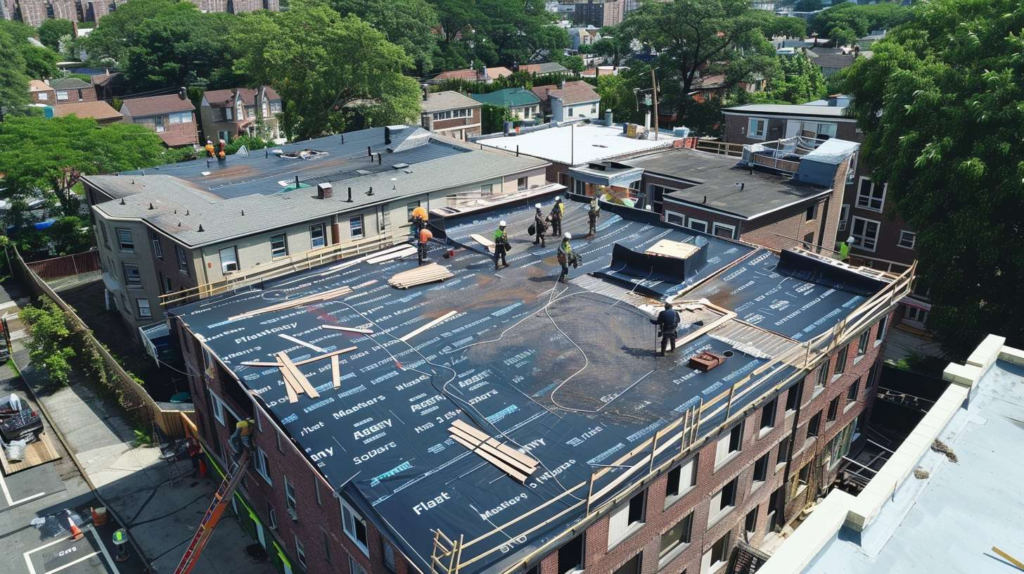
A Professional Flat Roof Seal Can Add Years of Life Without Major Disruption
Sealing extends roof life only when the failure is correctly identified
I think most people asking this already know something's off. Flat Roof Sealing Services work best as a targeted, diagnosis-first repair strategy - not as a magic coating you roll over a roof that has bigger unresolved problems underneath. If you're here, something has probably already happened: a water stain on a ceiling tile, a patch job that didn't hold, or a nagging feeling that the last contractor just bought you a few months.
Now test that idea. I remember being on a six-unit building in Astoria at 6:40 in the morning, coffee still too hot to drink, after a night of steady April rain. The owner kept pointing at one split seam and saying, "That has to be it." But the insulation beneath a completely different section was holding water like a soaked sponge. Leaks rarely enter where they appear - water travels, sometimes several feet, before it finds a ceiling to drip through. Watching what the water does, tracing its actual path rather than trusting the most obvious crack, is the whole experiment.
Myth vs. Reality: Common Assumptions About Sealing a Flat Roof
| Myth |
What actually happens on a flat roof |
| "A fresh coating seals every leak." |
Coatings applied over wet or deteriorated membranes trap moisture and accelerate failure. A coating is not a diagnostic tool - it covers what's underneath without fixing it. |
| "If the roof looks shiny, it's protected." |
Sheen fades. More critically, a reflective surface tells you nothing about what's happening at seams, flashing edges, or saturated insulation boards below the surface layer. |
| "The split seam you can see is always the source." |
Visible damage is often where water exits the membrane system, not where it entered. Leak migration through insulation and deck layers means the real entry point may be several feet away. |
| "Any roof cement works on any flat roof." |
Sealant compatibility is system-specific. Applying asphalt-based mastic to a TPO or EPDM membrane can degrade the existing material and void any remaining service life. |
| "If it isn't dripping today, sealing can wait indefinitely." |
Chronic ponding and open seams that aren't actively leaking are still allowing moisture infiltration. By the time the ceiling shows it, insulation may already be saturated and structural issues may follow. |
Quick Facts: What a Professional Sealing Assessment Checks First in Queens
1
Best use: Isolated seams, flashing transitions, pipe and curb penetrations, and localized membrane wear - not a full-surface replacement for system-wide degradation.
2
Not a fix for: Saturated insulation, failed or blocked roof drains, widespread membrane aging, or substrate rot - these require deeper intervention before any sealant makes sense.
3
Weather window: The surface must be dry and the ambient temperature within the sealant manufacturer's recommended curing range - Queens winters and sudden fall cold snaps close that window fast.
4
Goal: Extend service life without major disruption - when the roof is still fundamentally repairable and the failure has been correctly identified.
Diagnose the roof before choosing what to use
What a pro is actually checking during a roof walk
At 8 a.m. on a Queens roof, the first thing I trust is the surface condition, not anybody's guess. Before anyone can honestly answer "what to use to seal a flat roof," you have to know the membrane type, identify open seams, inspect every flashing transition and penetration, map the ponding pattern after rain, and check - seriously check - whether there's moisture trapped below the surface. As Rosa DelVecchio, with 27 years in flat roofing focused on leak tracing and membrane-specific repairs, puts it: the product choice is the last decision, not the first. Getting that backwards is exactly why the same leak gets "sealed" three times by three different contractors without ever actually stopping.
Queens makes this more complicated than most markets. The building stock is genuinely mixed - you'll walk from a 1940s built-up roof on a attached two-family off Hillside Avenue to a 1990s modified bitumen on a six-story co-op within the same block. Restaurant exhaust stacks punch through membranes in Flushing and Woodside and leave edges that need specific flashing details most standard coating jobs ignore. Tree debris from the older residential blocks in Forest Hills packs drains and holds moisture against seams through every freeze-thaw cycle from November to March. None of these conditions are theoretical. They show up on every third roof walk.
That sounds reasonable until you watch what the water does. A pro isn't just identifying damage - they're tracing where water enters versus where it appears, and checking whether prior sealant applications are compatible with what the roof membrane actually needs. Without that sequence, you're applying a product, not making a repair.
Before you buy a coating or approve a repair, do you actually know whether the roof is wet underneath?
Decision Tree: Seal, Repair More Deeply, or Replace?
START: Is the membrane generally intact?
↙ NO YES ↘
Are defects isolated to less than ~20% of roof area?
↙ NO YES ↘
System restoration or replacement evaluation
Targeted repair + sealant reinforcement at affected zones
Is water entering through seams, flashing, penetrations, or localized cracks?
↓ YES
Is the substrate dry and compatible with the sealant system?
↙ NO YES ↘
Moisture remediation first - then revisit sealing
✔ Professional sealing candidate
Note: Drainage defects - blocked drains, chronic ponding, settled insulation creating low spots - move the path toward repair or rebuild. No sealant covers a drainage problem.
What to Use to Seal a Flat Roof - By Roof System
| Roof Type |
Typical Sealing Material or Method |
Where It's Commonly Applied |
Important Caution |
| Modified Bitumen |
Torch-applied or cold-process bituminous sealant; fabric-reinforced flashing tape |
Seam laps, parapet flashings, pipe penetrations |
Lap seams need proper overlap and heat bond - cold-applied patches on torch-down require full adhesion to avoid lifting edges |
| Built-Up Roof (BUR) |
Asphalt-based roof cement; fibered coating for surface renewal |
Gravel-surface BUR flashings, exposed aggregate edges, penetrations |
Gravel must be cleared and area dried thoroughly - coating over aggregate traps moisture and accelerates delamination |
| EPDM (Rubber) |
EPDM-compatible lap sealant; seam tape; uncured EPDM flashing membrane |
Field seams, T-joints, perimeter termination strips |
Never use asphalt-based products on EPDM - they chemically degrade the rubber and destroy adhesion irreversibly |
| TPO / PVC |
Hot-air welding for seam repairs; thermoplastic-compatible caulk for penetration detailing |
Field seam failures, flashing terminations, curb edges |
Seam repairs require proper welding equipment and temperature control - adhesive-only repairs on TPO/PVC have poor long-term performance |
| Previously Coated Roof |
Compatibility testing required first; silicone over silicone, acrylic over acrylic - rarely interchangeable |
Any recoat over existing elastomeric or reflective coating |
Adhesion failure between incompatible coating layers is one of the most common causes of premature peel-back - don't skip the pull test |
Watch the drainage first, then talk about sealant
Here's my blunt view: a sealant is not a pardon for bad drainage. Chronic ponding - water that sits on a flat roof for more than 48 hours after rain - applies constant hydrostatic pressure against every seam and coating edge on the surface. Sealing over that condition is temporary theater. The best way to seal a flat roof often starts with correcting how water exits the roof entirely - whether that means clearing a blocked drain on the north side of the building, re-sloping a low spot with tapered insulation, or at minimum, documenting the drainage pattern before a single tube of sealant is opened.
⚠️
Warning: Why Sealing Over Chronic Ponding Usually Disappoints
Applying coatings or mastics over any of the following conditions almost always leads to premature failure:
- Damp or wet surfaces - moisture trapped below the coating creates blistering as it tries to escape during temperature cycling
- Blistered membranes - coating over existing blisters seals in trapped air and moisture, accelerating delamination
- Dirty or contaminated membranes - dirt, algae, and chalked surface coatings all destroy adhesion before the product even cures
- Chronic ponding zones near blocked drains - constant water contact softens many coatings and undermines edge adhesion over time
- Settled insulation creating low spots - without addressing the cause, any sealant applied in the ponding zone will repeat-fail
Common outcomes: trapped moisture, edge failure, premature peel-back, and a second call to a contractor - sometimes within the same season.
When to Act Fast vs. When You Can Schedule It
🚨 Urgent - Call Now
- Active interior leak during or after rain
- Open seam or torn membrane after a wind event
- Flashing pulled away from parapet or curb
- Ponding around a visibly clogged drain post-storm
- Occupied restaurant or multifamily space below a recurring leak
📅 Can Wait Briefly - Schedule Soon
- Small non-active surface crack with no interior sign
- Aging but intact prior sealant showing surface crazing
- Preventive resealing before a seasonal weather shift
- Isolated wear found during a routine inspection
How a professional sealing job is done without turning the building upside down
The sequence matters more than the bucket label
If you were standing next to me, I'd ask one question first: where does the water sit after a hard rain? That answer maps the work before a single product is opened. And here's the insider tip - the best time to identify trouble spots is right after a meaningful rain, then again once the surface has dried enough to walk safely. Those two looks, back to back, tell you more than any dry-weather inspection alone. Professional sealing minimizes disruption precisely because the work is targeted: inspect, clean, dry, reinforce, seal, verify. That sequence isn't bureaucratic - every step in it prevents a callback.
One August afternoon in Ridgewood, the surface temperature was so high my chalk line barely wanted to behave, and a restaurant owner was asking for "something quick" before a holiday weekend. Now test that idea: a fast smear-over is the roofing version of grading your own quiz wrong on purpose - feels fine for one day, then reality shows up. We cleaned, dried, and reinforced the trouble spots properly instead. That roof got several more serviceable years out of it, and his kitchen stayed open the whole time. The building doesn't have to go dark for a professional sealing job done right - localized work on flat roofs is exactly that: localized.
Professional Flat Roof Sealing: The Exact Sequence
1
Diagnose the leak path and confirm roof type. Skipping this step means every product choice that follows is a guess - and guesses create callbacks.
2
Confirm dry conditions and substrate stability. Applying sealant to a damp surface is the single most reliable way to guarantee a premature failure - temperature and moisture readings matter.
3
Clean and prep target areas. Dirt, algae, and chalked old coatings destroy adhesion before the new material even skins over - prep is not optional.
4
Reinforce seams, flashing, and damaged transitions as needed. Skipping reinforcement on open seams and pulled flashings means the sealant bears load it isn't designed to handle alone - it'll move and crack.
5
Apply compatible sealant or coating at correct thickness and pattern. Under-application is as problematic as the wrong product - mil thickness and coverage rate are specified for a reason.
6
Recheck after cure and after the next meaningful rain. A post-rain walk is the only honest test - skipping it means you won't know if the repair held until the ceiling shows you.
Fast Smear-Over vs. Professional Targeted Seal
❌ Fast Smear-Over Patch
- Minimal or no surface prep
- Unknown product-to-membrane compatibility
- High risk of trapping moisture underneath
- Cosmetic finish that hides but doesn't fix
- Short-lived result - often fails within one or two seasons
✔ Professional Targeted Seal
- Starts with diagnosis - failure type confirmed before work begins
- Surface cleaned, dried, and prepped properly
- Seams and flashings reinforced where needed
- Compatible materials selected for the specific membrane
- Lower disruption to tenants or operations
- Realistically extends serviceable roof life by meaningful years
Questions property owners in Queens usually ask before approving the work
The inconvenient truth is that shiny and sealed are not the same thing. I had a retired bus dispatcher in Middle Village call me during a windy cold snap, genuinely proud of the silver reflective coating he'd rolled on himself right before sunset the previous night. By noon the next day, half of it had skinned over badly and trapped moisture underneath - the prep was all wrong, the temperature dropped faster than the product could cure, and the timing made every other variable worse. That call is a better education on sealing a flat roof than any product label. The questions below are the ones that actually matter before any approval gets signed.
Flat Roof Sealing Services - FAQ
How do you seal a flat roof the right way? ▾
The right way starts with identifying the membrane type and locating the actual entry point of any water intrusion - not just the most visible damage. From there, the surface is cleaned, dried, reinforced at vulnerable transitions, and sealed with a product that's chemically compatible with the existing system. A recheck after the next rain is part of the job, not optional.
What is the best way to seal a flat roof if it keeps leaking in the same area? ▾
Repeat leaks in the same area almost always mean the source hasn't been correctly identified, or a drainage problem is keeping that zone saturated. Before any new sealant goes down, worth doing a moisture scan or probe to confirm whether insulation is wet - if it is, remediation comes first. Sealing over a saturated substrate is how the same call gets made three times.
What should be used to seal a flat roof - coating, mastic, fabric-reinforced repair, or something else? ▾
The answer depends entirely on what's already on the roof. Modified bitumen, EPDM, TPO, BUR, and previously coated surfaces each require specific and often non-interchangeable materials. Fabric-reinforced repairs are typically used at seams and flashing transitions where stress movement is a factor. There's no universal answer - and a product that works well on one membrane can chemically degrade another.
Can sealing a flat roof really add years of life? ▾
Yes - when the roof is still fundamentally sound and the sealing targets the actual failure points rather than just the surface appearance. A properly diagnosed and executed sealing job on a repairable flat roof can extend serviceable life by several meaningful years without major disruption. The qualifier is always the condition of the substrate and drainage - those two factors determine whether sealing is a smart investment or an expensive delay.
Will a professional sealing job disrupt tenants or business operations? ▾
Localized professional sealing is designed to be minimally disruptive - in most cases the building stays fully operational. The scope is targeted, not a full tear-off, and the work happens above the occupied space. Odor from certain products and rooftop access coordination are the main practical considerations to discuss with your contractor before scheduling.
Pre-Approval Checklist: Verify These Before Approving Flat Roof Sealing ▾
-
✔
Roof type identified. Know whether you're working with modified bitumen, BUR, EPDM, TPO/PVC, or a previously coated system - this determines every product decision that follows.
-
✔
Leak source tested, not guessed. The contractor should be able to explain how they traced the entry point - not just point at the most visible damage and call it the source.
-
✔
Wet insulation ruled in or out. If insulation is saturated, sealing over it guarantees failure - confirm whether moisture is present below the membrane before approving any surface repair.
-
✔
Drainage condition documented. Chronic ponding zones and blocked drain locations should be noted with photos or written observations - drainage issues must be factored into the repair scope or sealing will disappoint.
If you want to know whether professional sealing will realistically add years to your flat roof without major disruption, contact Flat Masters for a roof-specific assessment. We'll walk the surface, trace the actual failure, and give you a straight answer - not a sales pitch. - Rosa DelVecchio, Flat Masters, Queens, NY