
Shingles on a Small Flat Roof - Here's What You Need to Know Before You Start
Most cases like yours are very fixable. But whether shingles belong on your small flat roof depends entirely on slope - not square footage - and this article is going to walk you through pitch, drainage, and every checkpoint worth hitting before you buy a single bundle.
Slope Decides This Before Materials Ever Do
First thing I check is pitch, with a level and a tape - not hope. I've seen plenty of people walk onto a small flat roof already knowing they want shingles, because that's what they saw on a video, or that's what was there before, or that's just what roofs have. And they copy that answer without ever understanding the problem, which is that a roof that looks "almost pitched enough" is still a low-slope roof, and water doesn't grade on a curve. Slope is either sufficient or it isn't.
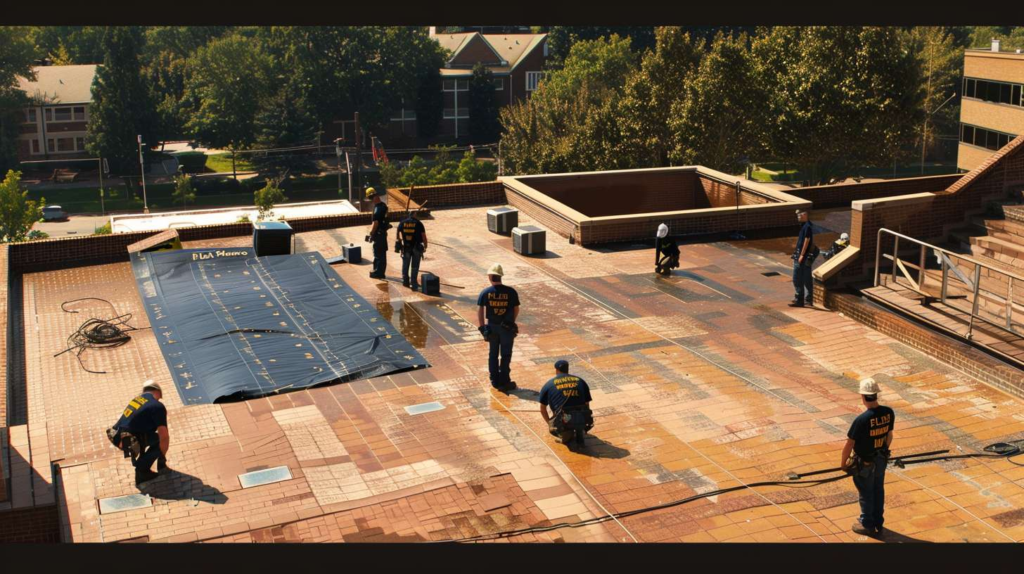
The thresholds aren't complicated, but they matter more than people expect. Below 2:12 - meaning less than 2 inches of rise for every 12 inches of run - shingles have no business being up there, period. Between 2:12 and 4:12, you're in a gray zone that most shingle manufacturers explicitly limit or void entirely, and where runoff slows down enough to give water time to find every gap. At 4:12 and above, shingles can work if the decking, underlayment, edge detail, and flashing are done right. And honestly, trying to outsmart water on a tiny roof by using thicker shingles or extra adhesive is one of the most common - and most preventable - mistakes I see in Queens. The roof doesn't get more forgiving just because it's small.
▶ START: Measure slope over 12 inches of run
Do not shingle. Full stop. A low-slope membrane system is the correct material here - no exceptions, no workarounds.
Standard shingles are risky and often inappropriate. Verify local code, product specs, drainage path, and flashing conditions. A membrane is usually the smarter call here - even if it's technically possible with shingles, the margin for error is thin.
Shingles may be appropriate - if the decking is solid, underlayment is installed correctly, edge detail is clean, and flashing is done right at every wall transition.
| What People Assume | Real Answer |
|---|---|
| "It's only a small roof, so water won't really matter much." | Water volume doesn't determine risk - slope and drainage speed do. A small, nearly flat roof holds water just as stubbornly as a large one, sometimes worse at wall junctions. |
| "Architectural shingles are thicker, so they can handle lower slopes." | Thickness doesn't compensate for slope. Manufacturer installation specs still require 4:12 minimum in most cases. Thicker shingles on a low slope still let water work underneath the laps. |
| "Extra underlayment makes shingles fine on nearly flat decking." | Underlayment is a secondary layer, not a waterproofing system. On low slopes, water moves slowly enough to find seams and nail holes. Peel-and-stick underlayment buys time - not a solution. |
| "If the old roof had shingles, new shingles are fine too." | Old shingles failing is usually the evidence, not the endorsement. What was there before may be exactly why you're dealing with leaks right now. |
| "DIY videos prove it works if you seal everything tight." | Videos show the install. They skip the callback six months later when wall flashing separates or a tab seals crooked on a warm day and lifts in the next windstorm. |
Drainage Tells You Whether This Roof Is Lying to You
What to Inspect at the Edge
If you were standing next to me, I'd ask one question first: how fast does water leave this roof? Not whether it eventually drains - but how fast, and by what path. Ponding is the obvious red flag, but slow runoff is almost as bad, because it gives water time to migrate backward under laps and work into wall intersections. Here in Queens, rear extensions and side-entry roofs - the kind you see on attached rowhouses over toward Jamaica Avenue, or tucked behind the main structure on an older semi-detached in Woodhaven - often meet walls at awkward angles that redirect water sideways instead of toward the edge. Those transitions hold runoff longer than any owner expects, and they're the first place I crouch down and look hard.
Why Walls Make Small Roofs Fail Faster
One November afternoon in Ridgewood - cold enough that adhesive strips were acting lazy - I got called to a small rear flat roof over a deli storage room. The owner kept saying, "It's small, so it should be simple," which is usually the exact moment I know I'm about to find three layers of bad decisions stacked on top of each other. Sure enough, somebody had tried to force shingles onto a roof with almost no pitch, and the runoff had backed up at the wall flashing like traffic at the Queensboro Bridge. That sounds like a simple drainage problem. But here's where it goes sideways: the wall flashing failure looked like a flashing problem, the owner had already paid someone to re-flash it twice, and nobody had ever questioned the slope. The water had nowhere to go fast enough, so it went into the wall instead.
| Condition You See | What It Usually Means | Risk Level | Best Next Move |
|---|---|---|---|
| Water clears quickly with visible pitch toward edge | Adequate slope; runoff path is working | Lower | Confirm slope measurement, then evaluate materials |
| Water lingers on the surface after rain stops | Insufficient slope or blocked drainage path | High | Stop. Do not install shingles. Assess slope and membrane options. |
| Drain path blocked by wall or parapet detail | Runoff has no clean exit; water pools against the wall | Very High | Redesign drainage path first. Shingles are not appropriate. |
| Staining or soft decking at edge or wall junction | Water intrusion already underway; decking likely compromised | Critical | Full assessment required before any material decision. Decking may need replacement. |
Three spots fail first on small flat roofs with borderline pitch - and none of them are cosmetic:
- Wall intersections: Where the roof plane meets a vertical wall is where backed-up water enters the building. Shingle laps don't seal against a wall the way membrane flashing does.
- Outer drip edge: On a nearly flat pitch, water can travel back under the drip edge instead of over it - especially if the edge is set slightly off-level.
- Low mid-roof areas: Any subtle dip or sag in the middle of the deck becomes a pond. Even a quarter-inch depression holds water long enough to drive it through nail holes and laps.
Missteps Homeowners Repeat When They Try to Force the Answer
Here's the blunt truth nobody likes on DIY videos: the pattern is almost always the same. Someone buys shingles first, measures the roof area second, skips slope entirely, and assumes that sealed adhesive strips will handle whatever drainage problem might show up. I saw this exact sequence on a Saturday after a spring rain in Astoria - a homeowner had a little flat roof over a side entry, bundles of architectural shingles stacked neatly, underlayment still in the wrapper, and genuine confidence. He had measured everything except pitch. I pulled out my level, showed him the reading in under thirty seconds, and he just stared at it and said, "So all the YouTube comments were wrong?" Yes. They copied the answer without understanding the problem. The other piece nobody mentions in those videos: reusing old flashing because it "looks okay" is how water finds the same path it always used, just faster now with new materials covering it.
- ❌Assuming roof size is the deciding factor - A 6×10 roof with a 1.5:12 pitch is not a "small shingle job." It's a low-slope roof that needs a membrane system.
- ❌Skipping the pitch measurement entirely - Area calculations and material estimates are worthless if slope hasn't been confirmed first. Level and tape, thirty seconds. Do it.
- ❌Ignoring manufacturer minimum slope requirements - Most shingle manufacturers specify 4:12 minimum, with limited warranties or voided coverage below that threshold. That's not fine print - that's the product not being designed for your roof.
- ✅Treating underlayment as the waterproofing layer - Peel-and-stick or felt underlayment is a secondary moisture barrier. It slows water intrusion; it doesn't stop it at low slopes where water has time to travel backward under laps.
- ❌Overlooking wall flashing entirely - Every wall intersection on a small flat roof is a high-risk zone. Shingles don't terminate against a wall the way membrane flashing does. This is where leaks start and where callbacks come from.
- ❌Failing to plan the runoff direction before picking materials - If you can't describe the exact path water takes from the high point to the drip edge before you start, you're guessing. And water doesn't respond well to guesses.
Alternatives and Rare Cases Where Shingles Actually Make Sense
When a Membrane Is the Smarter Answer
I'm going to save you a headache here: a significant number of roofs people call me about - roofs they're already calling "flat" - should get a membrane system, not shingles, and knowing that before you spend money on material is the whole point of this conversation. As Darlene Pizzo, with 19 years in flat roofing and a specialty in the little porch tops, extensions, and awkward low-slope sections around Queens, I can tell you that the right material decision on these small roofs is almost always made in the first five minutes on-site - with a level and an honest look at where the water goes, not with a tape measure across the width.
If water slows down on that roof, shingles are not your clever workaround.
On a roof that actually measures out at 4:12 or better, shingles can make sense - and they look right on certain extensions and additions where the pitch is legitimate. But most of the roofs homeowners bring me photos of don't get there. The ones that do still need solid decking, the right underlayment, clean drip edge all the way around, and step flashing at every wall. Skip any one of those and the pitch advantage disappears fast.
One August morning in Maspeth - around 7:15, already muggy, one of those Queens summer days where the air is just refusing to cooperate - I was standing on a tiny kitchen extension roof while the homeowner handed me coffee through the window. Her nephew had shingled right over nearly flat decking because he'd watched a barn renovation video. By 9:00, I was peeling up tabs that had already sealed themselves crooked in the heat, and the water stains inside lined up almost perfectly with every shortcut he'd taken: no step flashing at the wall, no starter course, adhesive strips that had bonded before the shingles were straight. The insider move - and I mean this simply - is to trace the water path mentally before you discuss finish materials at all. Pour water in your mind from the high point: where does it exit? If you can't answer that clearly and immediately, stop and figure it out before a bundle comes off a truck.
| Possible Upside | Real Drawback |
|---|---|
| Familiar material, widely available, and easy to match to adjacent sloped sections | Only genuinely viable at 4:12 or above - most "small flat roofs" don't get there |
| Lower upfront material cost versus some membrane systems on small areas | Edge detail and wall flashing complications raise real-world install cost on small sections |
| More contractor availability for repairs if damage occurs | DIY-friendly reputation leads to careless installs on inappropriate slopes - most callbacks come from this exact pattern |
| Can look more finished than membrane on visible small sections like porch or addition roofs | Aesthetics don't matter if the pitch is wrong - a nice-looking shingle job on a 2:12 roof will leak, and it will leak where you least expect it |
Get a Straight Answer Before You Spend a Dollar on Materials
If you've got a small flat roof in Queens and you're not sure whether it needs shingles or a membrane system, don't guess - and don't let a YouTube comment decide for you. Call Flat Masters for a slope-and-drainage evaluation. We'll tell you exactly what that roof can take, and what it can't, before anything gets ordered or installed.
- Darlene Pizzo, Flat Masters | Queens, NY
