
What Does It Cost to Repair a Garage Flat Roof? The Numbers You Need Right Here
Repair pricing stays reasonable only while the roof is still mostly telling the truth
You shouldn't have to guess at garage flat roof repair cost while water is finding its way into your storage, your ceiling, or your car. For most Queens garages, a repair lands somewhere between $350 and $1,800-but that number moves fast depending on how much membrane has failed, whether the edge boards are still firm, how water drains off the roof, and honestly, how long the leak has been running the show before anyone called.
For a basic garage repair, here's the range most people want first: you're typically looking at the lower end of that window when the issue is localized, the perimeter wood is sound, and there's no widespread moisture sitting under the surface doing quiet damage. I'm Collette Ramirez, and I've been pricing and repairing garage flat roofs in Queens for 18 years-long enough to know that small roof size hides a lot of perimeter truth. "Just the garage" is the mindset that gets people into trouble. That phrase is how a $500 repair becomes a $2,200 conversation because the roof was telling people something at the edges for two seasons before anyone looked.
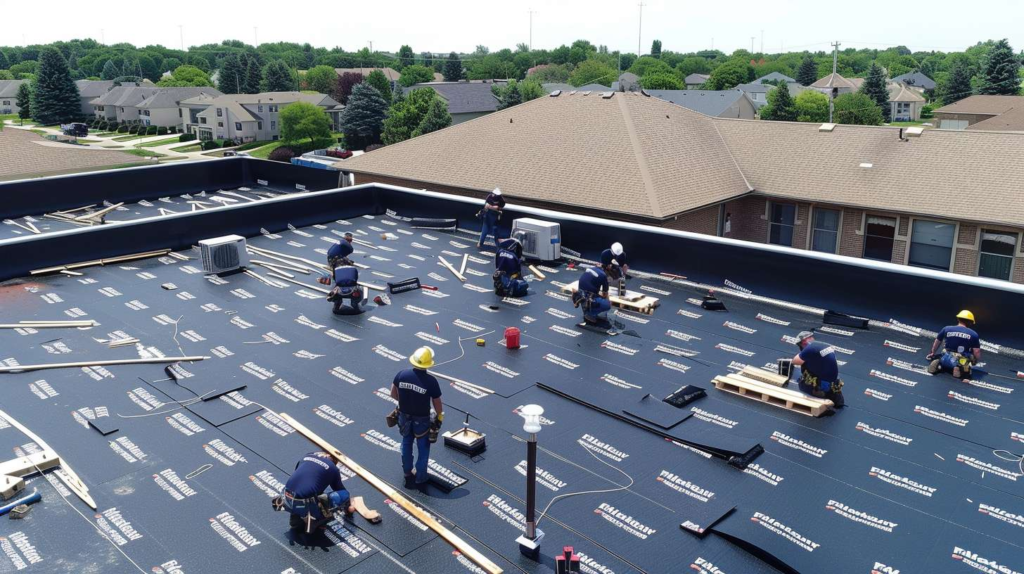
The perimeter is where small garage roofs usually stop pretending to be cheap
Edge boards and runoff habits tell the story first
I still remember that screwdriver sinking into the edge board. Cold February afternoon in Glendale-homeowner met me at the curb wanting a number before I even pulled my tools out. I get it. But once I was up on that garage, the split membrane was almost beside the point. The outer edge board had gone soft enough that my screwdriver went in like I was pressing it into wet cardboard. He said, "But it's such a small roof." Small roof, yes. Small problem, no. The edge had been absorbing runoff quietly for at least two seasons, and that one board changed the whole scope and the whole conversation.
Here's the blunt truth: "just the garage" is how repair jobs turn into replacement jobs. Queens detached garages-especially the ones sitting back on rear lots off Jamaica Avenue corridors or tucked behind row houses in Woodhaven-have a drainage reality that most owners don't think about until it bites them. Water doesn't flow cleanly off rear-lot structures the way it does off a well-maintained main roof. Edge timber takes the hit first, quietly, and by the time a homeowner notices a ceiling drip, the perimeter has often already made up its mind about what this job is going to cost. Repair now, repair soon, or replace later-those aren't scare tactics, they're just the three lanes this road has.
| Condition Found | Why It Matters | What It Does to the Repair Number | Repair Territory or Drifting Toward Replacement? |
|---|---|---|---|
| Split membrane only | Isolated failure in the waterproofing layer, no surrounding damage | Keeps the estimate modest; patch or section repair is straightforward | ✔ Repair territory |
| Soft edge board | Rot in the perimeter wood undermines the membrane's anchor point | Adds carpentry cost; scope expands depending on how far the rot runs | ⚠ Repair with early warning flags |
| Old patch layering | Multiple previous repairs mean the surface adhesion is unreliable and history is working against you | Raises material and labor cost; may require stripping before a new repair holds | ⚠ Borderline-depends on layer count |
| Standing water at one section | Chronic ponding accelerates membrane degradation and drives moisture into the deck | Drainage correction adds to cost; deck damage may add more | ⚠ Repair now before it drifts further |
| Drain blockage and debris wear | Blocked drains and debris abrasion compound each other, trapping water and grinding the membrane | Adds drain clearing and membrane reinforcement; not huge on its own but layered with other issues it adds up | ✔ Still repair territory if addressed soon |
| Hidden moisture under one side | Moisture spread that isn't visible from above has already reached the deck or insulation | Dramatically raises scope; may require deck replacement on the affected section | ✖ Drifting toward replacement logic |
A quote that prices only the visible split-while ignoring soft edge boards, repeat ponding, or a history of old patches underneath-isn't saving you money. It's just delaying the real cost by one season.
A fair estimate looks at what caused the membrane to fail, not just where it failed. If the person quoting you hasn't mentioned edge condition, drainage, or patch history, ask them directly. The answer tells you a lot about how long that repair is actually going to last.
Time is what makes garage repair math ugly, not just damage
Before we talk garage flat roof repair cost, how long has water been getting its way up there? That question matters more than square footage, more than material type, and honestly more than most things on the estimate sheet. Duration changes everything. The longer water has worked the perimeter-softening timber, spreading under the membrane, soaking into the deck-the less likely the job holds to the lower end of any range you've seen quoted.
A garage roof is like the neglected back hallway of a building-ignored until one day the damage is doing introductions. I had a garage behind a Ridgewood row house where the owner called after noticing water dripping onto holiday decorations in storage. Windy October morning, old patching across half the surface, leaf buildup sitting against the low section, and one area that had clearly been holding water through every single rainfall. What I remember most is how relieved he looked when I separated the two parts out loud: here's what's still repairable right now, and here's the section that becomes a replacement conversation if you wait another season. That clarity-not a low number, just an honest breakdown-was what he actually needed.
My opinion? People underestimate garage roofs because they overestimate how forgiving small structures are. A small roof has just as much perimeter per square foot of surface as a big one-sometimes more, proportionally-and that perimeter is where damage compounds fastest. Here's the insider tip I give every customer worth their time: ask your roofer to show you which part of the estimate is fixing today's leak, and which part is paying for how long the roof was left to stew before anyone called. Honest pricing separates those two things. If a quote can't explain the difference, that's worth asking about before you sign anything.
- ✔How long has this roof been leaking?
- ✔Is the edge wood-all the way around-still firm?
- ✔Has water been pooling or ponding after rain?
- ✔Are old patches affecting how new work will adhere?
- ✔Is the drain route part of what's causing the problem?
- ✔What portion of this roof is genuinely still repairable?
- ✔What would make this a replacement conversation by next season?
A fair garage repair number should separate the leak from the history that made the leak expensive
The price should explain itself
For a basic garage repair, here's the range most people want first-and then I'll tell you what happened on a Bayside job that made me start drawing two columns on every garage estimate I write. The customer called because he could nearly reach his garage roof from the top of a ladder and figured that accessibility had to mean cheap. Accessibility is not a pricing system, and I told him that as kindly as I could manage. Once I got up there, the edge condition had gone soft on two sides, debris had been sitting in the low corner so long it had worn a groove in the membrane, and old moisture spread had reached about a third of the decking. I wrote two columns on his sheet: "repair if now" sitting at one number, and "repair if after another winter" sitting considerably higher-because by then, the replacement conversation would already have started. He made the right call. He called while it was still a repair. That's the whole point of writing it out that way.
| Myth | Fact |
|---|---|
| "Small roof means small bill." | A small roof has as much perimeter per square foot as a large one. The edge is where cost compounds-and small roofs have a lot of edge relative to surface. |
| "If I can reach it with a ladder, it should be cheap." | Accessibility affects logistics slightly. It doesn't determine edge condition, moisture spread, or how long the leak has been running. |
| "Patching the visible split is the whole repair." | The visible split is where water exited. The perimeter, the drain route, and the substrate below the split are where the real story lives. |
| "The garage can wait-it isn't the main house." | "Just the garage" thinking is exactly what turns a $600 repair into a $2,000 job. Garages fail quietly, especially at the edges, and they don't announce the transition from repair to replacement until you're already past it. |
| "A low quote proves the roof is a simple job." | A low quote that ignores edge condition, ponding history, or old patch layering isn't accurate pricing-it's incomplete pricing. The rest shows up later, usually at the worst time. |
If you want a garage repair quote that's honest about both the cost of the leak and the cost of how long it's been leaking, call Flat Masters. We'll show you exactly what's still repairable, what's already past that point, and what it takes to fix it right while the repair math still works in your favor.