
Velux Flat Roof Windows Let in Serious Light - Here's Everything You Need to Know
You called because something felt off. And here's what experience tells me almost every time: the problem people blame on the glass - the drip, the stain, the fog - is actually living in the curb height, the flashing transition, the membrane tie-in, the roof slope, or the humidity building up inside the room below it.
Why the Assembly Matters More Than the Pane
At 7 a.m. on a Queens roof, the details tell on everybody. I sketch these out on scrap underlayment with a carpenter pencil because it helps: think of a flat roof window as four separate paths crossing in one spot. Sunlight has a path. Drainage has a path. Vapor has a path. Heat has a path. When all four are accounted for in the design and build, the window performs. When even one gets ignored - drainage pooling near the curb, vapor with nowhere to go, heat baking a membrane that was never meant for that exposure - the failure shows up exactly where it shouldn't, and the homeowner points at the glass.
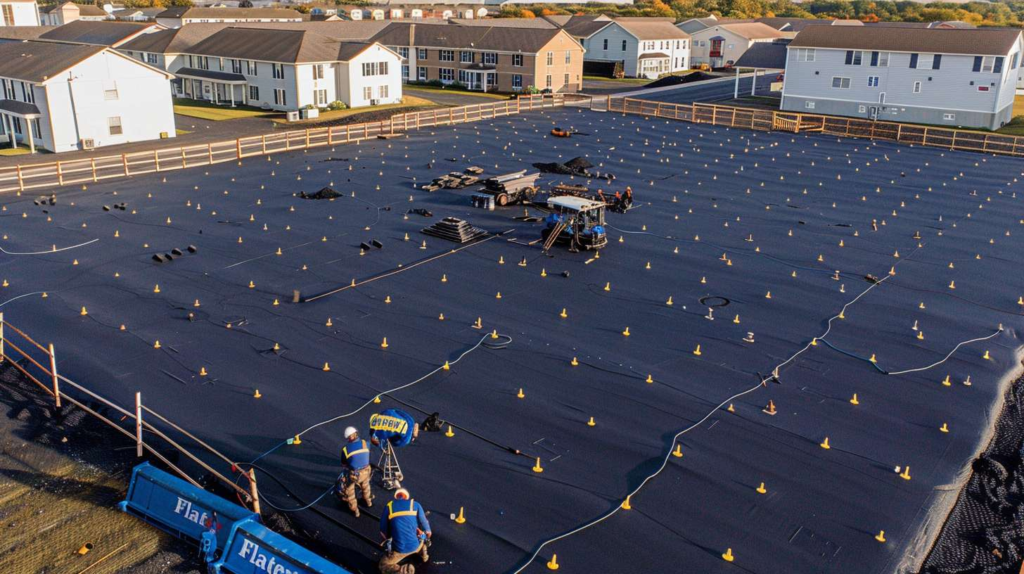
Here's my unpopular opinion: the window is rarely the villain. I'm Rosa Mendel, and I've been solving flat roof problems in Queens for 22 years, with a specific focus on the kind of tricky curb details that show up on older rowhouses all over this borough. One July morning in Astoria, I climbed up to look at a so-called skylight job another contractor had done, and by 7:15 a.m. the membrane around it was already soft enough to show every bad decision. The customer was an accountant and had put a white bath towel under the drip because, in his words, "it looked less alarming than a bucket." What went wrong wasn't the glass - it was the lazy transition work around the curb, which is exactly why I get particular when people ask about Velux brand flat roof windows versus generic units. The Velux unit in that Astoria install was fine. Everything built around it was not.
| Myth | What's actually happening on a flat roof |
|---|---|
| "If water shows up near the opening, the glass seal failed." | Water travels. It enters at a curb gap, a flashing corner, or a membrane seam several inches away and follows the path of least resistance to wherever you see it drip. The pane is usually the last suspect worth checking. |
| "All flat roof skylights install the same way." | They don't. Curb height requirements, membrane tie-in method, and drainage planning vary by product, roof system, and slope condition. Treating a Velux flat roof window like a generic unit is how callbacks happen. |
| "Condensation always means a leak." | Condensation forms on the interior pane surface when warm moist air inside hits cold glass. That's a humidity and ventilation problem, not a roof failure. The fix is usually a bathroom exhaust fan upgrade, not a new unit. |
| "Brand alone guarantees no leak risk." | Velux makes a solid product. But no manufacturer can waterproof a sloped curb that's too short, a membrane that was rushed at the corners, or a roof that already had drainage issues before the opening was cut. |
| "Any roofer can drop one into a flat roof in a day." | The unit itself might go in fast. The curb build, substrate prep, membrane integration, and flashing transitions done correctly? That's the work. Skipping steps on a flat roof means water finds every shortcut you took. |
| Issue source | What you notice inside | First inspection point | Unit itself usually at fault? |
|---|---|---|---|
| Glass / pane issue | Fogging between panes, visible crack, seal failure between glazing layers | Inspect glazing seal and pane integrity directly | Yes - rare but possible |
| Curb / flashing transition | Dripping at or near window frame, staining on ceiling collar | Curb height, corner flashing detail, transition to roof membrane | No - installation issue |
| Roof membrane tie-in | Water appears away from frame, follows ceiling joist or deck | Membrane seams, field around opening, ponding areas nearby | No - roof system issue |
| Indoor humidity / condensation | Droplets on interior glass surface, especially mornings or after showers | Bathroom exhaust, whole-home humidity level, room ventilation | No - interior environment |
Picking the Right Velux Unit for a Queens Flat Roof
Fixed glass, venting, and dome-style decisions
I once stood in sleet over a fresh opening and learned this the expensive way - not every window choice serves the room it's meant to light. The homeowner in that Sunnyside install was a ceramic artist who needed a velux window for flat roof positioned over her worktable because she couldn't trust lamp color for glaze work. That February, once the dried-in unit was in and the sky cleared, she called the next morning not about leaks but to say she could finally tell cobalt blue from almost-cobalt blue without carrying tiles down to the front stoop. The product selection drove that outcome. In western Queens - the top-floor studios above Skillman Avenue, the converted rowhouse apartments along 34th Street in Astoria - roof exposure, neighbor sightlines, and the quality of natural light at different times of day all play into which Velux flat roof window actually belongs in that opening.
Product choice also has to match what the roof assembly can support. A venting unit on a low-traffic top floor with no exhaust fan nearby makes sense. The same unit on a hard-to-reach roof where nobody's going up for routine cleaning creates a different kind of headache. Think about curb height compatibility, drainage direction, solar heat gain on south and west exposures, and whether privacy from neighboring buildings matters. A dome-style acrylic unit might clear water faster on a very low slope, but it won't give you the same light quality as flat glazing. These are decisions worth making before the order goes in - not after the opening is cut.
- ☼ Room purpose - Light quality needs differ between a studio, a bathroom, and a hallway landing
- ○ Desired light level - Size and glazing type directly affect how much light enters and how much heat comes with it
- 👁 Privacy from neighboring buildings - In Queens, you're often looking directly into somebody else's second floor; glazing choice matters here
- ▲ Roof drainage pattern - Placing an opening in a ponding zone creates problems regardless of the unit's quality
- 🌧 Interior humidity load - High-moisture rooms need ventilation planning, not just a skylight
- 🔧 Maintenance and access reality - A venting unit on a roof you can't safely reach twice a year is a liability, not a feature
Leak, Condensation, or Heat Problem? Sort It Before You Blame the Window
What do I ask first when someone mentions a skylight leak? Where does it appear, and exactly when. During rain? That points toward active water entry at the curb, flashing, or membrane field. Only after a shower or cooking? That's humidity doing what humidity does when it has nowhere to go. First thing on a winter morning, only on the glass surface? Condensation - almost certainly not a roof failure. I had a stormy Sunday callback in Ridgewood where a family thought moisture on the interior pane meant their velux flat roof windows skylights had given out completely. Their teenage son met me at the roof hatch holding a flashlight like we were doing surgery, rain tapping on the cap so hard we had to talk in bursts. Turned out a newly redone bathroom on that floor had doubled the moisture load inside, and the cold glass was just doing what cold glass does. No leak. A ventilation fix and a dehumidifier sorted it.
Now pause there, because that's where people mix up two different problems. Active water entry and interior condensation look similar to a panicked homeowner staring at a wet ceiling on a Sunday - but they have completely different causes and completely different fixes. A heat complaint is a third thing entirely: the room bakes in afternoon sun but stays bone dry. Each of those paths points somewhere different. And honestly, here's the insider move worth doing before you call anybody: photograph the moisture at three moments - during rain while it's actively happening, about 30 minutes after rain stops, and first thing in the morning on a dry day. Those three photos often tell a roofer more in 30 seconds than an hour of guessing on-site.
Don't order replacement glass or let a contractor condemn the unit before you've checked bathroom exhaust capacity, measured whole-home humidity, and confirmed whether the moisture appears only on the room-facing side of the pane. Replacing a perfectly functional window because of a ventilation problem is an expensive mistake - and it happens more often than it should.
- Weather condition when the issue appeared - rain, wind-driven rain, dry cold morning, or unrelated to weather
- Exact location of moisture - on the glass surface, at the frame, on the ceiling collar, or farther away
- Whether the room had recent shower, cooking, or other high-humidity activity before you noticed it
- Photos of the ceiling and interior frame at the three key moments described above
- Approximate age of both the roof system and the window installation - especially if different contractors did each
Installation Sequence That Keeps Daylight From Turning Into a Callback
What a careful roofer should do before the unit is ever set
Blunt truth: daylight is easy; waterproofing is the exam. Any opening cut in a flat roof will let light in - that part's not the hard part. A Velux unit performs exactly as well as the curb built to receive it, the substrate prepared underneath it, the membrane tied into it, and the drainage planned around it. Skip or rush any one of those, and the window will get blamed for a problem that started three steps earlier in the sequence.
A flat roof window is a little like a terrarium dropped into a raincoat. The raincoat has to wrap the terrarium completely - every seam directing water away, every corner handled, every transition sealed before the next layer goes down. Common avoidable errors I see at Flat Masters: curbs built too short for the membrane thickness, ponding zones left directly beside new openings, rushed inside corners where the flashing laps fail first, and installers who don't account for the roof's actual slope behavior under standing water. None of those are Velux problems. They're planning and execution problems.
Confirm the opening position relative to drainage paths, structural framing, and roof field. No opening near a ponding zone or weak structural bay.
Curb must meet minimum height requirements for the membrane system being used - typically at least 8 inches above the finished roof surface. This is the most commonly under-built element.
Deck must be clean, dry, and structurally sound around the opening perimeter. Don't skip this step on older Queens rowhouses where original decking may have soft spots.
Membrane wraps up the curb face and transitions to the flashing. Every corner and lap gets proper technique - no shortcuts at inside corners, which is where failures almost always begin.
Unit goes in according to Velux installation requirements - not improvised. Fastening, gasket seating, and leveling all matter here.
Hose test the perimeter before any interior trim goes up. Inspect the interior frame, ceiling collar, and visible deck from below. Sign off when it's dry, not when it looks done.
| Pros of Professional Installation on an Existing Flat Roof | Cons Worth Knowing Before You Commit |
|---|---|
| Reliable, consistent daylight in rooms that have never had it - transforms how a space feels and functions | Costs more than a patch job - proper curb work, membrane integration, and water testing take time and skill |
| Strong long-term weather performance when the assembly is built correctly from curb to glazing | Requires precise curb construction - not every flat roof has the framing layout or deck condition to support it cleanly |
| Improved room usability - better light quality, ventilation options, and energy behavior versus no skylight at all | Opening the roof can expose pre-existing deck weakness or membrane problems that weren't visible before - adds scope |
| Better long-term confidence than generic shortcut installs that look fine at completion but fail within two seasons | Timing matters - this isn't work to schedule around a storm window; it needs dry conditions and proper lead time |
Questions Worth Asking Before You Approve the Work
If your contractor talks only about the glass, what are they not talking about?
They're not talking about curb height, membrane tie-in method, drainage path planning, condensation risk in your specific room, or who handles the transition between the roof system and the window frame. Those are the things that determine whether your install works for ten years or becomes a callback in two. Ask directly: how high is the curb going to be, how does the membrane wrap it, where does water go if it gets past the first line of defense, and who is responsible for the roof-window seam - not just who ordered the unit.
-
✓
Licensed and insured roofing contractor - verify both, and confirm coverage includes flat roof work specifically -
✓
Demonstrated experience with flat roof membrane transitions - ask to see examples or past work on similar roofs in the area -
✓
Familiarity with Velux brand flat roof windows - not just generic skylight experience; Velux spec installs have specific requirements -
✓
Willingness to explain curb height and water-path details before work starts - if they can't describe the drainage plan, they haven't thought it through