
Your Garage Flat Roof Is Leaking - Here's the Most Likely Reason and the Fix
Leak stains lie before the roof does
Nobody likes finding a brown drip on the garage ceiling, especially when it's landing on something you actually care about. That drip feels like it's pointing straight up to the problem - and that sounds logical, but here's what the roof is really doing: the water entered somewhere else entirely, traveled sideways along the decking or membrane underside, and only showed itself at the lowest, easiest exit point.
At the rear corner of a Queens garage, I start with the edges before I trust the middle. Water leaves clues the way an experiment leaves evidence - cause, path, result - and the path is almost never a straight vertical line. On garages across Queens, the perimeter details fail first: edge metal lifts, base flashing cracks at wall intersections, runoff gets trapped between the membrane and a parapet. The cause is usually small. The path can be three feet long before you see a single drop inside.
| Myth | What the roof is actually doing |
|---|---|
| The stain marks the exact leak location | Water travels laterally under the membrane or along decking before dropping inside. The stain is the exit, not the entry. |
| Flat roofs always fail in the center | On garage roofs, edge metal, base flashing, and drain areas fail far more often than center field membrane. Perimeter details take the most stress. |
| If it only leaks in heavy rain, the whole roof is shot | Heavy-rain-only leaks usually point to a drainage problem or wind-driven entry at an edge - not widespread membrane failure. One specific detail is often the culprit. |
| A dry ceiling after one storm means the problem is gone | The entry point is still there. A dry spell just means the trigger condition hasn't repeated. Same roof, same weakness, same result next hard rain. |
| One patch automatically solves a repeat leak | If water entered at an edge or flashing and traveled to a different spot, patching where the drip appeared doesn't close the actual entry. The water just finds the same path again. |
Quick Reality Check for Queens Homeowners
Most Common Leak Origin
Edges, flashing, and drain areas - not the center field membrane
Most Misleading Symptom
The interior drip appears several feet away from where water actually entered the roof assembly
Worst Trigger in Queens
Freeze-thaw cycles after snow accumulation and wind-driven rain hitting edge details and wall joints
Best First Move
Document exactly where the drip appears, when it starts, and whether it continues after the storm ends
Edges, drains, and wall joints cause the trouble most often
Here's the part homeowners never enjoy hearing: the issue usually isn't age alone. It's a failed detail. Edge metal that lifted during a cold snap, base flashing that cracked at a wall transition, a scupper or drain bowl that's blocked and forcing water to find another way out, or an old patch that was never properly tied into the membrane. I'm Rosa Mendez, and with 19 years in flat roofing and a specialty in garage-specific flat roof leaks across Queens, I've found that the detail failures always have more to say than the field membrane does.
I remember a February morning in Ridgewood, around 7:10, still half-dark, when a retired postal worker called me out because his flat garage roof was leaking right onto the hood of a Buick he only drove on Sundays. Everybody thought the seam over the center was the issue. It wasn't. The leak was starting at the edge metal where meltwater had been sneaking backward under the membrane after a freeze-thaw week. One patch over the center seam would have done absolutely nothing. The actual fix was re-securing and sealing the edge metal along the front of the garage where wind had gotten underneath it.
I had a man in Woodside tell me his garage roof was fine except when it rained hard. He'd already paid someone to coat the whole thing. Still leaked. Queens rear garages sit in tight spots - neighboring parapets on one or two sides, overhanging trees from the big maples that line blocks off Jamaica Avenue, drainage that was never designed for the runoff coming off an adjacent wall. Snow drifts pack against a parapet and sit. When it melts, the water doesn't fall off - it creeps sideways and finds the first unsealed transition. Leaf debris clogs scuppers in October and nobody checks again until March when the freeze-thaw damage has already been done for weeks.
| Leak Source | Where Water Enters | Where You Notice It Inside | Typical Trigger | Proper Fix |
|---|---|---|---|---|
| Edge metal / backwater entry | Under lifted or loose edge metal at roof perimeter | Near front or side wall, often offset from edge | Freeze-thaw, wind-driven rain | Re-secure and seal edge metal; replace if deformed |
| Split base flashing at wall | Cracked or separated flashing where roof meets vertical wall | Side or rear wall interior, low on ceiling | Thermal expansion, age, poor original install | Rebuild base flashing; don't just caulk over a crack |
| Clogged scupper | Ponding water forced over or around scupper opening | Roof-side wall, ceiling near parapet | Heavy or prolonged rain after debris buildup | Clear and resize scupper; inspect surrounding membrane |
| Ponding around drain bowl | Membrane breakdown under standing water at low point | Roughly centered or wherever the low deck point falls | Heavy rain; poor original slope; settled decking | Correct drainage slope; replace drain assembly; re-membrane area |
| Failed seam near perimeter | Open or lifted membrane seam within 18-24 inches of edge | Off-center; often appears mid-ceiling | Wind uplift, age, UV degradation | Properly weld or bond seam; verify surrounding membrane integrity |
| Crooked prior patch | Water bypasses poorly installed patch and enters at its edges | Same location as previous leak or slightly shifted | Any rain; especially heavy rain under pressure | Cut out failed patch; properly tie in new membrane section |
Why detached garages fail differently from the main house
Open to see the clue patterns that point to the real source.
Follow the water path before choosing a repair
Can I ask you where the drip shows up after the rain stops? Not during - after. That timing tells a different story. A drip that starts the moment rain hits the roof suggests active entry under hydrostatic pressure, which usually means an open seam, lifted edge, or cracked flashing. A drip that shows up 20 minutes after the storm passes means water pooled somewhere above you first, traveled along the deck or framing, and is now releasing at the lowest weak point it found. Same stain. Very different problems. The path matters more than the destination.
Trace Your Garage Flat Roof Leak: A Quick Decision Path
YES - Heavy rain only
Does water appear near the side wall?
Yes → Likely base flashing failure at wall transition. Inspect and rebuild base flashing.
No → Is there visible ponding on the roof after rain?
Yes → Likely blocked scupper or undersized drain. Inspect and clear/resize scupper or drain.
No → Likely wind-driven entry at edge metal. Inspect perimeter edge detail.
NO - Leaks in light or moderate rain too
Does the drip continue after rain stops?
Yes → Water is pooling in assembly. Likely open seam or failed edge with lateral travel. Full perimeter inspection needed.
No → Has another contractor already patched one spot on this roof?
Yes → Old patch may be crooked or unbonded. Test patch perimeter; cut out and re-tie if needed.
No → Active entry at unsealed detail. Schedule targeted repair - inspect edge, drain, and flashing in sequence.
⚠ Don't Chase the Stain With a Single Patch
Patching directly above an interior stain is often the wrong move. Water may have entered the roof assembly several feet away, traveled underneath the membrane or along the top of the decking, and surfaced at the lowest interior point it could find. A patch placed above the stain leaves the actual entry point completely open. The result: same leak, same spot, next rain. Fix the entry - not the evidence.
Patches fail when they ignore sideways water movement
Blunt truth: a patch is not a repair if water can still travel sideways.
One August afternoon in Maspeth, sticky enough that my shirt was glued to my back by noon, I checked a detached garage behind a two-family home. The owner kept saying, "It only leaks in hard rain, never light rain." That detail mattered - and here's the insider read on it: when a flat garage roof leaks only in hard rain, look for overwhelmed drainage or wind-driven entry at an edge before blaming the field membrane. Turned out the scupper was undersized and half-blocked with maple seeds, so ponding water kept pushing under a patch another contractor had slapped on crooked. The patch covered a symptom. The actual condition - an undersized drainage outlet collecting debris - never got touched. Correcting it meant clearing the scupper, upsizing the opening, and properly cutting out and tying in the membrane around the drain perimeter. After that, the roof handled the next August downpour without a drip.
What a real repair changes
| Option | Pros | Cons |
|---|---|---|
| Targeted Repair | Lower immediate cost; faster turnaround; appropriate when the rest of the membrane is in good shape; addresses the specific failed detail directly | If adjacent membrane is aging, other details may fail within a season; not a long-term solution on a roof past its service life |
| Partial Reroof (Garage Only) | Resets the membrane lifespan; allows proper slope correction; eliminates multiple aging details at once; better value over a 10-15 year horizon for Queens detached garages | Higher upfront cost; takes 1-2 days on a standard Queens garage; overkill if the membrane is relatively young and only one detail failed |
Act before the next storm tests the same weak spot
The one I still bring up was a Saturday in Astoria right before a family barbecue. Their son called in a panic because brown drips were coming through the garage ceiling next to the side wall, and he assumed the whole roof was shot. When I got up there, the main field was fine - not a crack, not a bubble. The actual problem was a split at the base flashing where the garage roof met the neighbor's parapet, and water had been taking the scenic route for weeks, running along the top of the wall framing before dropping through. That barbecue happened. But if that call had waited until Monday, a saturated ceiling board and soaked framing would've turned a flashing repair into a much larger job.
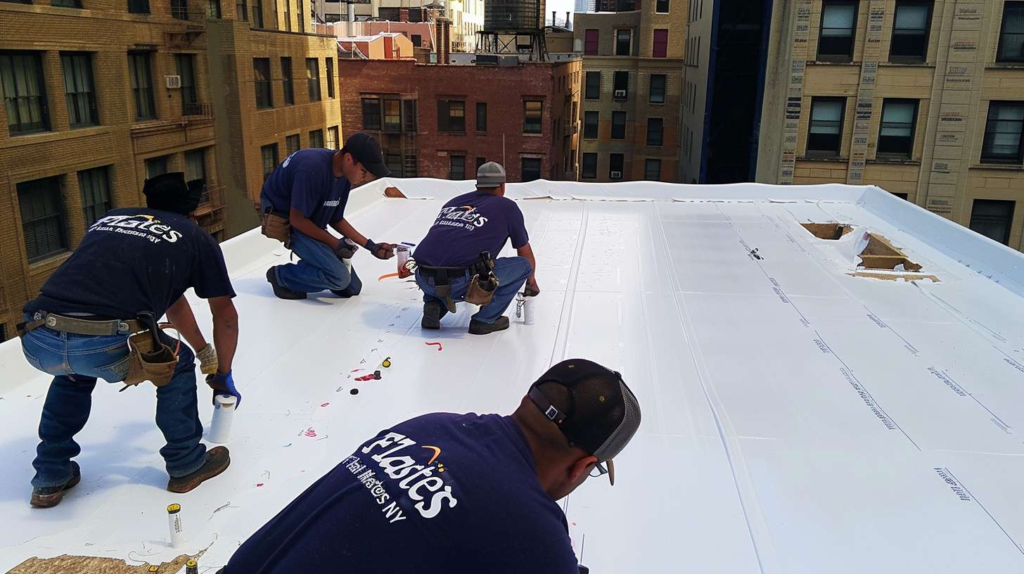
A flat roof leak behaves like a bad lab experiment - same ingredients, same result, every time. The entry point doesn't seal itself between storms. Every rain cycle pushes more water through the same path, wetting the decking underneath, saturating insulation if there is any, and eventually working into the framing around the garage perimeter. Stored items, an opener mounted to the ceiling, the drywall itself - all of it absorbs the repeat exposure. The faster you document the clues and get eyes on the actual entry point, the smaller the repair stays. Flat Masters has traced garage flat roof leaks from Ridgewood to Rockaway, and the ones that cost the least were always the ones where the homeowner called after the first storm, not the fifth.
What to note before you call
Before You Call: 6 Things to Check First
Where does the drip appear? Note the exact location inside the garage - wall side, center, corner, or along a ceiling seam.
Does it leak in light rain, heavy rain, or only after snow melt? The trigger tells you more than the stain does.
Does the drip continue after the storm ends? If yes, water is traveling inside the assembly before exiting.
Take photos of any visible roof ponding or blocked scupper. Even a phone photo from the ground helps narrow the diagnosis.
Note any previous patch or coating work. If another contractor already worked on it, that patch area is a primary suspect.
Is the garage attached or detached, and does it share a wall or parapet with a neighbor? Shared walls create shared flashing problems.
Questions people ask when the garage leak seems minor
Common Questions About Flat Garage Roof Leaks
If your garage flat roof is leaking in Queens, Flat Masters can trace the true entry point and repair the actual failure - not just chase the stain to the wrong spot. Call us before the next storm runs the same test on the same weak detail.