
Asphalt Shingles on a Flat Roof - They Might Not Be What You Think They Are
Why the Surface Looks Fine Until the Water Proves Otherwise
Pull out the invoice from the last repair and read what it actually says. If it says "shingles replaced" or "re-shingled rear section" and you're standing over a roof that barely tips enough to cast a shadow difference - that invoice is telling you something the contractor probably didn't say out loud. Here's the counterintuitive part: many Queens roofs described as flat with shingles aren't truly flat, and they're not steep enough for shingles either. They live in that in-between zone, and when you give water the wrong conditions, the result isn't bad luck - it's a repeatable experiment with a predictable outcome every single time.
At three-eighths of an inch per foot, the roof starts telling on itself. That's the minimum slope most manufacturers list for standard asphalt shingle application, and even at that threshold, the drainage speed is marginal at best. The assumption that anything with a little visible pitch can carry shingles skips over how capillary action works: water doesn't just flow, it wicks backward under shingle tabs when drainage slows. Wind pushes it. Debris redirects it. And on a low-slope section, that moisture doesn't exit - it lingers, sits, and quietly rots the deck underneath while the surface above looks perfectly neat from the alley.
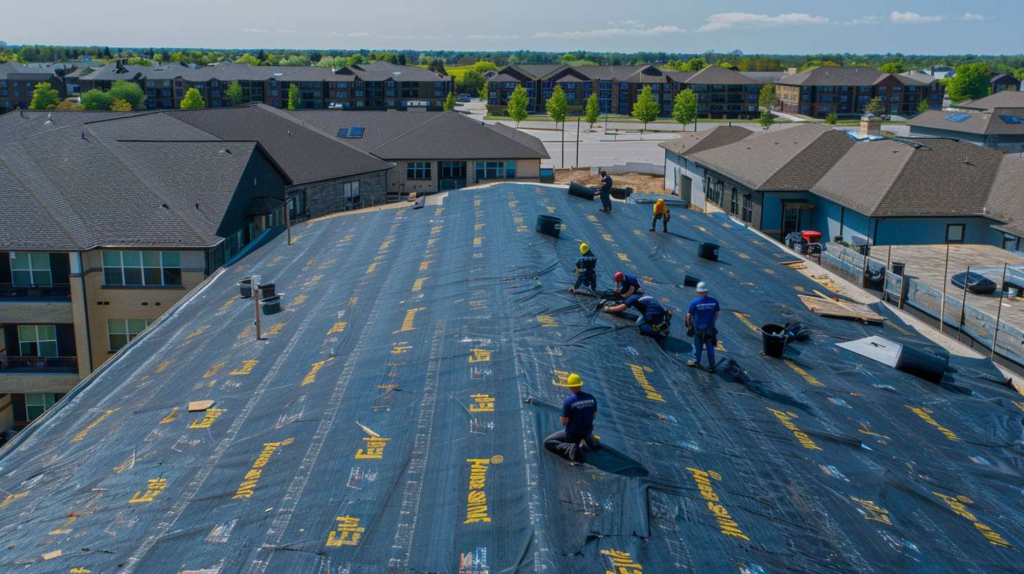
| Myth | What the Roof Actually Does |
|---|---|
| "If it looks sloped from the yard, shingles are fine." | Visual slope from street level is deceptive. A rear extension can appear pitched from the yard while sitting at 1/4" per foot - well below the drainage threshold needed for asphalt shingles to shed water before it backs under the laps. |
| "New shingles stop leaks no matter the pitch." | New shingles on a low-slope section seal the surface temporarily but don't change how water moves - or doesn't move. The deck underneath keeps absorbing moisture with each slow-draining rain cycle, regardless of how fresh the material on top looks. |
| "Only old roofs trap moisture." | Moisture retention is a function of pitch and drainage speed, not age. A brand-new shingle job on a low-slope section starts trapping moisture under the tabs from the first heavy rain. Age is irrelevant when the geometry is wrong from day one. |
| "A rear extension behaves like the front main roof." | Rear additions in Queens are routinely built flatter than the front slope - often because they were added later, by different hands, with less structural clearance. The rooflines look continuous, but the water behavior at each section is completely different. |
| "If it leaks only in sideways rain, the shingles are still acceptable." | Wind-driven rain is the clearest diagnostic signal that shingles are wrong for that section. It means water is being pushed backward under the laps faster than gravity moves it forward - which is exactly what happens when slope is insufficient and shingles are the wrong system. |
Warning: Low-Slope Sections Hiding Under Shingles
Shingles on low-slope rear additions, enclosed porch roofs, and mixed rooflines across Queens may look clean and intact from below while repeatedly allowing water backup, moisture trapped under tabs, and slow-developing deck rot. The surface passes visual inspection. The plywood underneath does not.
Where Queens Rooflines Fool People Most Often
Rear Extensions and Porch Sections
Here's the part people don't enjoy hearing. The dangerous area is almost never the whole roof - it's one low-slope section, usually the rear extension, the enclosed porch, or that addition somebody bolted on in the eighties. In Queens, attached-home geometry compounds this. Narrow alley views make a low-pitch rear section look steeper than it is. Debris builds up in the drainage path between buildings because there's nowhere else for leaves and grit to go. Wind behavior between attached structures pushes rain sideways through that corridor, straight at the laps - and, as Marta Zielinska, with 19 years in flat roofing and a specialty in low-slope leak diagnosis across Queens, keeps pointing out, the section that's been re-shingled three times in eight years is almost always the rear addition, not the front slope.
Mixed Rooflines That Were Made to Match
I once stood on a rear extension in Elmhurst and knew within ten seconds.
I once stood on a rear extension in Elmhurst and knew within ten seconds - the softened sheathing under my boot said everything the invoice hadn't. The visual clues are consistent once you know what you're looking for: darkened plywood at the edges, ponding marks left by water that sat long after the rain stopped, debris lines showing exactly where runoff stalled and redirected. I remember a humid July morning in Ridgewood, around 7:15, when a landlord handed me an estimate and kept insisting the tenant's leak was impossible because the roof had brand-new shingles. Climbed up, found a low-slope rear extension barely pitched enough to fool the eye from the alley. The shingles looked neat from standing height. Under the tabs, everything was holding moisture like a bad science project. That's the Ridgewood pattern - and it repeats on similar rear additions from Glendale to Corona.
| Roof Area | What It Looks Like From the Ground | How Water Behaves | Typical Failure Point | Better Direction |
|---|---|---|---|---|
| Front Main Slope | Clearly pitched, visible from the street | Drains quickly after rain; shingles shed water as designed | Standard wear, flashing at ridge and valleys | Asphalt shingles appropriate; inspect flashing and ridge |
| Rear Extension Low-Slope Section | Looks pitched from alley; feels flat once on the roof | Drains slowly; moisture lingers under tabs; debris clogs runoff | Deck rot under laps; repeated interior ceiling stains | TPO, EPDM, or modified bitumen low-slope membrane |
| Porch Roof | Often indistinguishable from main roof at street level | Catches crosswind rain; water pushed sideways under shingle laps | Laps fail during wind-driven rain; fascia and soffit rot | Low-slope membrane system; proper edge termination |
| Top-Floor Addition Roof | Hidden behind parapet or upper structure; rarely seen | Ponding common; no clear drainage path to edge | Pooling destroys shingle seal strips; water enters through deck seams | Flat roof membrane with proper drain or scupper |
| Mixed Roofline Transition | Appears continuous; front and back look "matched" | Water changes behavior mid-roof; pools at the transition valley | Transition flashing fails; valley becomes a collection point | Separate systems for each section; transition flashing upgraded |
Attached Homes With Narrow Drainage Paths
Tree-Debris Rear Additions
Porch Roofs Hit by Crosswind
Patched Transitions Between Membrane and Shingles
How to Judge the Roof by Water Behavior Instead of by Appearance
If I asked you where the water sits after midnight, could you answer me? Daytime inspection is the most misleading tool in roofing because it only shows you what the roof looks like when it's dry. The real diagnostic happens after flow slows, after temperature drops, and after debris has redirected runoff away from its intended path. One windy November afternoon in Astoria, I was called to a porch roof that another crew had patched - the owner met me in slippers, furious that the leak only happened during sideways rain. That detail told me everything. When I got up there and used my glove to lift one corner of a shingle, the plywood underneath was darker than coffee. Water wasn't racing off that section - it was being pushed backward at the laps, exactly what happens when the slope is wrong and shingles are the wrong system. The sideways-rain leak wasn't a fluke. It was the roof running the same experiment, getting the same result, every time conditions were right.
A shingle is not a magic lid. That sounds reasonable, but here's where the roof disagrees with most repair logic: people ask "are the shingles new?" when the right question is "where does the water exit, and how long does it stay on the surface after rain stops?" Those two questions tell you more about future failure than the age of any material. Don't skip asking what happens during wind-driven rain specifically - if the leak only appears in certain storm directions, the pitch is your problem, not the product. Worth doing before any repair call: step outside after the next rain and look at whether that rear section is still holding surface water an hour later while the front slope is already dry.
What Usually Works Better Once the Diagnosis Is Honest
Repairing the Symptom Versus Correcting the Roof Type
Think of it like setting a paper towel on a dinner plate versus hanging it on a line. A paper towel on a flat plate holds water - which is exactly what it's doing in that position. Hang it from a line at a real angle and it sheds. Asphalt shingles are engineered for the line, not the plate, and when you put them on a section with insufficient pitch, you've just set the paper towel down and asked it to drain. At about 5:40 p.m. on a sticky August evening in Jackson Heights, I was inspecting a mixed roofline on a three-family where the front slope had true shingles and the back addition had been made to match with shingles too. The owner's nephew had done the work and stood there defending it the whole time. I pointed to the ponding marks and asked him where exactly he thought the water was supposed to go once the sun dropped and debris clogged the one tiny drain path at the back edge. That conversation is still clear in my head - the cleanest example I've seen of confusing looks appropriate with functions properly.
Here's the part people don't enjoy hearing - and this time it's not about the roof type, it's about the decision ahead of you. The right answer on a low-slope section is usually not another patch. It's changing what kind of roofing system that section carries. A proper low-slope membrane - EPDM, TPO, or modified bitumen - is built to handle slow drainage, wind-driven water, and prolonged moisture exposure. Shingles are not. And honestly, Marta would rather sit down with a customer and disappoint them with that truth than approve a repair she already knows will fail in the next hard storm. That's not a sales position - it's the only thing that makes sense after 19 years of watching the same sections get patched on the same cycle.
| Pros of Shingle Application on Low-Slope Sections | Cons of Shingle Application on Low-Slope Sections |
|---|---|
| Matches the appearance of the main steep-slope roof visually | Highly vulnerable to wind-driven rain - water pushed backward under laps during any sideways storm |
| Lower upfront material cost compared to membrane systems | Moisture retention under tabs is immediate - begins trapping water from the first slow-drain rain event |
| Hidden deck rot risk - plywood deteriorates silently beneath a surface that still looks intact from below | |
| Repeated patch cycles required - wrong system in wrong conditions produces the same failure on a predictable schedule | |
| Fundamental mismatch with low-slope drainage behavior - capillary action and slow runoff defeat shingle lap design regardless of shingle quality or age |
If a section of your Queens roof keeps getting described as flat, porch-like, or "just sloped enough for shingles," that description is doing a lot of work to avoid a harder conversation - have Flat Masters measure the actual pitch and trace the water path before you pay for another patch that's going to teach you the same lesson again.