
Flat Roof Not Draining Properly? The Slope May Need Correcting - Here's How
I'm going to level with you. If water is sitting on your flat roof well away from the drain or scupper - not near it, not inching toward it, but just parked there - the problem is almost certainly the roof's pitch, not the drain itself. This guide is about recognizing when flat roof slope repair is the actual fix, so you stop spending money on the wrong thing.
Ponding Far From the Drain Means the Roof Is Telling on Itself
On a Queens roof, the puddle tells on everything. Where water collects after a rainstorm isn't random - it's a map of the roof's lowest point. Water votes with gravity every time, and if that lowest point is eight feet from the nearest drain, then the drain is not your primary problem. The slope is.
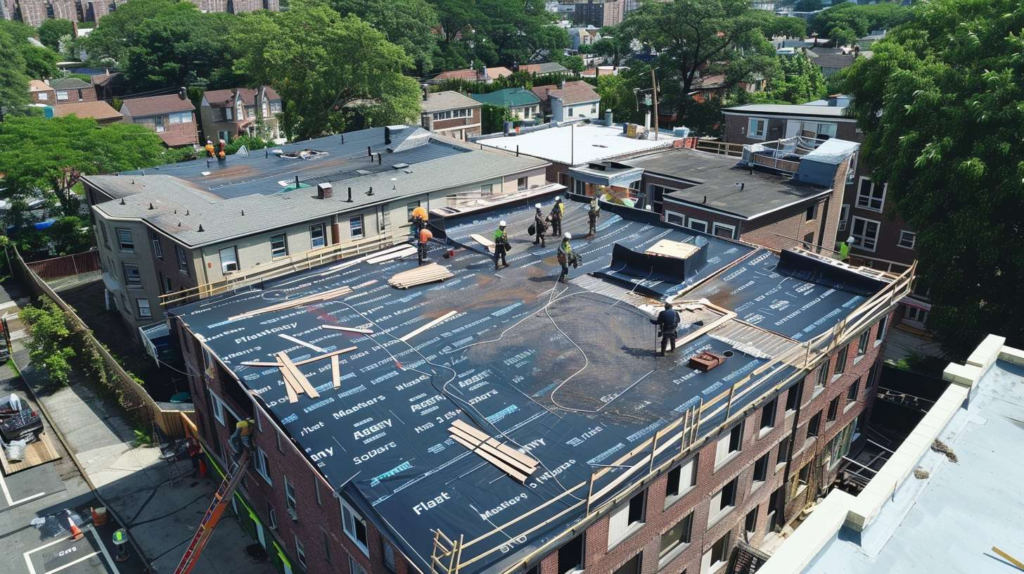
People want to blame debris first. A clogged strainer, a leaf mat over the scupper, a downspout that's been partially blocked since October - and sure, those things happen. But here's what gets overlooked: if you clean the drain and the puddle is still sitting in the same spot two days after rain, the debris was never the issue. Where the water lands and stays is the evidence. Everything else is just noise.
Is This a Drain Blockage Problem or a Flat Roof Slope Repair Problem?
NO
Monitor only. Minor evaporation pooling is common and not an immediate concern.
YES ↓
Is the pond sitting directly at the drain or scupper opening?
YES
Inspect blockage - strainer, scupper throat, or downspout. Start there.
NO ↓
Does water remain in the same roof area after repeated drain cleanings?
YES
Likely slope issue. Get a professional slope evaluation - this is a flat roof slope repair situation.
NO
Inspect membrane wrinkles, crushed insulation, or a rooftop obstruction redirecting flow.
Common Misunderstandings About Ponding Water on Flat Roofs
| Myth | Fact |
|---|---|
| If the drain is open, the roof slope is fine. | An open drain only matters if water can reach it. A low spot elsewhere on the roof creates its own gravity path - one that doesn't lead to the drain at all. |
| Any puddle on a flat roof is normal. | Standing water past 48 hours puts sustained pressure on membrane seams, accelerates UV degradation, and is the primary driver of premature flat roof failure. |
| More patching will stop second-day leaks. | A leak that shows up after day two of rain usually means trapped water is finally finding a seam. Patching the seam doesn't remove the trapped water - the slope does. |
| Scuppers always fix ponding by themselves. | A scupper positioned correctly in a parapet wall only works if the roof field actually pitches toward it. Install one in the wrong spot and the water still won't reach it. |
| A roof that looks flat should drain evenly. | No flat roof is truly flat - code requires a minimum ¼-inch-per-foot slope. When that pitch is lost to settling, compressed insulation, or poor original install, water finds the lowest point and camps there. |
What a Roofer Checks Before Saying the Slope Needs Repairing
Field Signs That Point to Pitch Failure Instead of Surface Damage
Here's the part people don't love hearing: you can't diagnose a slope problem from the ground, from a photo, or from a neighbor's opinion. A proper assessment starts with simple measurements, water-behavior mapping, and some honest observation of what the roof is doing between storms. I'm Elena Varga, and with 19 years fixing low-slope and flat roofs across Queens, I can tell you that the physical evidence on the roof almost always tells the story before any probing or testing begins - if you know what you're looking at.
If I were standing next to you by the drain, I'd ask one question first: where exactly does the water sit, and how far is that from the outlet? Not whether you cleaned it last fall, not whether the roofer before me called it a flashing issue. Just: where does the water go? That answer shapes everything - which repair method is appropriate, what materials are needed, and whether the membrane even needs to be disturbed at all.
That sounds logical, but gravity doesn't care.
Observable Clues and What They Usually Indicate on a Low-Slope Roof
| What You See | What It Usually Means | Best Next Step |
|---|---|---|
| Water pooled 8-15 feet from the drain | Roof pitch directs water away from the outlet - classic slope failure | Professional slope evaluation; don't clean the drain first |
| Leak appears after the second day of rain | Trapped standing water is saturating through a seam over time | Map ponding location; do not patch seams until slope is confirmed |
| Circular stain around a low spot mid-field | Repeated ponding in a "birdbath" - likely compressed or missing insulation below | Probe insulation depth; consider localized tapered build-up |
| Golf ball or pour test drifts away from drain | Visible confirmation that the field pitches in the wrong direction | Document with photos; schedule slope correction assessment |
| Ponding concentrated near an HVAC curb | Curb transition created a dam or low point where water collects | Inspect curb flashing and surrounding membrane; may need infill slope correction |
| Soft, spongy feel underfoot near pooling area | Insulation is waterlogged and likely crushed - losing its designed height | Core sample or probe to confirm; wet insulation must be replaced, not covered |
Professional Slope-Diagnosis Sequence Before Any Flat Roof Slope Repair Is Proposed
Map Ponding Locations After Rainfall
Walk the roof within 24-48 hours of rain and mark or photograph every area holding water. Note the distance and direction from each outlet.
Inspect Drain and Scupper Function
Check strainers, scupper throats, and downspouts for blockage - but only to rule them out, not to assume they're the cause. Confirm water can physically reach each outlet.
Use a Straightedge to Identify Low Areas
A 48-inch level or straightedge across the roof field quickly reveals where pitch is lost or reversed. This is faster and more accurate than guessing from a puddle's edge.
Check Perimeter, Penetrations, and Curb Transitions
Parapet walls, HVAC curbs, pipe boots, and skylights all create potential dam points. Each one gets checked for improper height relative to the surrounding field.
Determine the Correct Correction Method
Based on findings: tapered insulation added to a localized low area, a partial tear-off and substrate re-level, or a broader re-slope with drain repositioning. The right call depends on how much of the field is affected.
Repair Paths Change Depending on Why the Roof Lost Pitch
Localized Low Spot Versus Broad Structural Fall Issue
I saw this exact nonsense on a brick six-family in Sunnyside. The owner had been blaming the drain for two seasons - kept having it cleaned, kept paying for it. I got on the roof at 6:40 in the morning after a sticky August night and poured one bucket of water ten feet from the drain. It sat there like it was waiting for a bus. That was the moment I told him directly: this isn't a drain problem first, this is a slope problem pretending to be a drain problem. Different cause, different fix - and that distinction matters because not every slope failure covers the whole roof. Some are isolated birdbaths from a single crushed insulation board. Others are broad, field-wide pitch reversals from an original installation that was never right.
The main correction options come down to a few approaches: adding tapered insulation over the affected area to redirect water toward the outlet, rebuilding a section of the substrate to restore proper height, adjusting drain or scupper positioning to meet water where it actually flows, or reworking the flashing transitions at curbs and parapets that are acting like dams. And here's something that doesn't get said enough - the cheapest-looking repair is often the one that lays a fresh membrane directly over the old low spot and calls it done. It looks clean on day one. It fails the exact same way after the next long rain, because the water path underneath never changed.
Localized Slope Correction vs. Broader Roof Re-Slope Work
Evaluating Common Flat Roof Slope Repair Approaches
| Approach | Pros | Cons |
|---|---|---|
| Drain Cleaning Only | Low cost, fast, eliminates blockage as a variable | Solves nothing if water never reaches the drain in the first place; problem recurs immediately |
| Localized Tapered Insulation Build-Up | Targeted fix for a specific low spot; minimal disruption; preserves existing membrane where it's healthy | Not effective if the broader field pitch is wrong; requires accurate mapping first |
| Partial Tear-Off and Re-Level | Corrects underlying substrate issues; allows inspection of deck; durable long-term fix when done right | Higher cost and disruption; requires more planning and weather windows; not always necessary for isolated issues |
| Full Re-Cover Without Correcting Slope | Fresh membrane surface; may extend life if underlying insulation is intact | Water paths remain unchanged. The new membrane fails at the same low spot. This is the most expensive mistake made on Queens flat roofs - paying full re-cover costs for a temporary result. |
Queens Conditions Make Small Slope Errors Turn Into Big Leak Cycles
A flat roof isn't really flat any more than the Grand Central Parkway is empty. Queens roofs carry a specific load of variables that makes even small pitch defects punish you fast: the freeze-thaw swings between January and March that shift membrane and insulation with each cycle, the rooftop equipment that every landlord has stacked up over the decades, the parapet walls on old multifamily buildings that trap water from the inside, and the patch-over-patch histories that mean half the roof's original geometry is buried under somebody else's repair decisions from 2011. One March in Jackson Heights, with sleet coming sideways off Northern Boulevard, I got a call from a landlord who had already paid for two separate patching jobs. The tenant above told me the leak only ever showed up after the second day of rain - which is exactly the kind of timing that points to trapped water, not an open seam. I took a straightedge across the field near the HVAC curb and found a shallow belly that had been holding water against the membrane long enough to work through it. The patches were fine. The slope wasn't.
I had a homeowner in Middle Village meet me on the roof at sunset - in loafers, which I'll never stop mentioning - pointing at the scupper like it owed him money. I rolled a golf ball across the field to show him the pitch, and that ball curved away from the outlet like it had made a decision years ago. He laughed. Then he stopped laughing when he understood what it meant. That roof wasn't draining toward the scupper - it was draining away from it, and no amount of cleaning the scupper edge was going to change that geometry. My honest opinion, and I say this after nearly two decades at Flat Masters serving roofs from Ridgewood to Astoria: owners who keep funding membrane patches on a mis-sloped roof aren't maintaining their building - they're funding a leak on a payment plan. The roof keeps aiming water the wrong direction, and every patch just gives the next rain something new to work around.
⚠ Why Repeated Patching Without Correcting Slope Wastes Money
If water is consistently pooling in the same off-drain location after every storm, paying for another seam patch, drain cleaning, or coating application is not solving the problem - it's just resetting the clock. Trapped moisture beneath the membrane accelerates material breakdown from underneath, keeps targeting the same structural weak point, and leaves the insulation wet and losing R-value each cycle.
The correct fix addresses the water path first. Everything else is cosmetic until the slope is right.
Before You Call About Repairing Slope Issues - Check These 6 Things
-
1
Note where ponding sits relative to the drain or scupper - measure the distance roughly if you can. This is the single most useful piece of information you can give a roofer. -
2
Time how long water remains after rain stops - anything past 48 hours is standing water, not runoff. -
3
Photograph the same area after multiple storms - consistency in location is strong evidence of a slope issue, not random surface defects. -
4
Note if leaks inside always start on day two of rain - that timing pattern points directly to trapped standing water working through the membrane, not fresh water entry. -
5
Identify any rooftop units, curbs, or parapet walls near the pond - these are common dam points that can redirect water or create low spots at their transitions. -
6
Don't apply temporary roof cement before the inspection - it changes the surface read and can obscure the exact location of the underlying issue.
Questions Owners Usually Ask Before Approving Flat Roof Slope Repair
Two feet of straightedge can save you two years of repeat leaks. Here are the questions that come up every time someone realizes the roof may need slope correction rather than another patch - answered plainly.
Quick Facts - Queens Flat Roof Slope Service
Issue to Watch
Water lingering on the roof for more than 48 hours after rain - especially away from the drain or scupper
Most Misleading Symptom
A leak that only shows up after the second day of rain - owners blame the membrane, but trapped standing water is usually the real driver
Best Homeowner Evidence
Photos of the same ponding area taken after multiple different storms - consistency of location is the clearest sign of a slope problem
Local Coverage
Astoria, Sunnyside, Jackson Heights, Ridgewood, Middle Village, and surrounding Queens neighborhoods
