
Why Do Some Houses Have Flat Roofs? It's Not Just an Architectural Choice
Context explains the roof better than the roofline alone ever will
Here's the part nobody mentions when they ask why do some homes have flat roofs: most of those houses weren't built that way for style points. They reflect practical decisions-about space, about additions squeezed onto tight urban lots, about the era when the house was built and what builders were actually trying to solve at the time. The roofline is usually the last chapter of a longer story, not the opening line.
Before we ask why some homes have flat roofs, what kind of house are we really looking at? The answer shifts completely depending on whether we're talking about an older rowhouse extension, a modern infill build, a mixed roofline house, or a rear addition that went up twenty years after the original structure. Owen Lasker, with 15 years helping Queens homeowners understand why flat roofs belong to the larger story of the house, the block, and the period it came from, has worked through every one of those scenarios-and the explanation is almost never "somebody just liked how it looked." Let's zoom out for a second: the roof form usually follows the house form, and the house form usually follows the lot, the block, and what a family needed when they ran out of space.
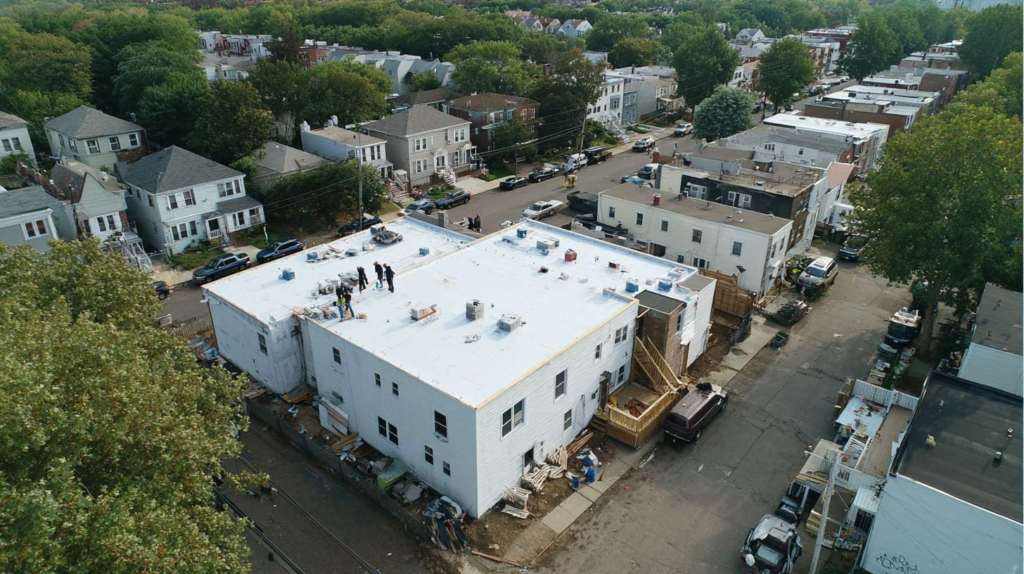
Tight lot depth, interior headroom goals, and rear-extension massing all favor a flat roof. The addition had a different job than the original house.
Design period, parapet traditions, or a block-wide pattern of flat-roofed rowhouses explains the shape. It matched the neighborhood's architectural language.
The front facade held the original roofline. The back grew outward as an extension, switching to flat to solve a massing and headroom problem on a limited footprint.
Urban lots and rear additions explain a huge share of flat roofs in Queens
The back of the house often answers what the front never could
On a Queens block, one roofline rarely tells the whole story. I remember standing on a rear extension in Jackson Heights on a crisp October morning when a homeowner asked me, out of nowhere, why do some homes have flat roofs if pitched roofs seem so much more "normal." We were looking across a whole patchwork of neighboring homes-old additions, modern boxes, parapets, mixed rooflines-and the block itself was the answer. I ended up pointing from house to house along 85th Street explaining how style, space, and construction choices had shaped those roofs far more than any abstract idea of what a roof is "supposed" to look like.
Here's the blunt truth: a flat roof is often a decision about space before it's a decision about style. One rainy spring afternoon in Astoria, I was inspecting a leak over a kitchen addition when the owner said, "I never understood why would a house have a flat roof unless someone cut corners." That comment stuck with me, because the roof in question wasn't a shortcut at all-it was the practical result of an older extension built to maximize interior space within a tight footprint. The leak was real, sure, but the design choice made complete sense once we talked about the house instead of just the water stain. That's the pattern you see constantly across Queens: rear extensions on 25-foot-wide lots where a pitched roof would either eat the headroom or complicate the framing without adding anything useful. Flat was the right call.
| House Situation | What the Flat Roof Helps Accomplish | Why It Made Sense |
|---|---|---|
| Rear kitchen extension | Preserves full ceiling height throughout the new space | A pitched roof on a short rear run wastes headroom and makes the addition feel cramped |
| Boxy modern addition | Keeps the building form clean and rectilinear | Flat roof geometry matches the massing of contemporary infill design without awkward transitions |
| Full-width rear addition on a tight lot | Stretches usable floor area to the lot line without raising the profile | Narrow urban lots can't accommodate pitched roof runs without exceeding zoning height or losing space inside |
| Mixed roofline house | Allows two different roof forms to coexist on one structure | The original house and the addition were doing different jobs; different roof forms solved each problem separately |
| Parapet-fronted urban house | Creates a consistent street-facing profile that matches neighboring buildings | Block-pattern conventions in dense neighborhoods made parapet and flat-roof combinations the standard for attached and semi-attached rowhouses |
| Flat-back / pitched-front condition | Lets the street face hold the original architectural language | The front facade wasn't touched; the rear grew outward under a flat roof because that's what the extension's footprint required |
Tight Footprints
Addition Logic
Era and Style
Front and back roof forms often differ because the house is doing two different jobs at once
I still remember that kid asking the smartest question on the whole site. It was a windy November day in Ridgewood, and while I was checking a parapet detail, a teenager on the job site asked why some houses switch from pitched in front to flat in back-like, what went wrong. Nothing went wrong. I grabbed a scrap of insulation and sketched the house massing right on it, showing him how the original house held its pitched roofline as a street-facing identity, while the rear extension-added years later, pushing to the back of the lot-switched to flat because that was the only logical move once you factored in lot depth, interior headroom, and the fact that a pitched roof back there would have required a ridge that cleared the original structure awkwardly. His dad later told me that was the first explanation that made the roof feel intentional instead of random.
A house roof is a bit like a sentence-you understand it better once you stop reading one word and look at the full structure. When a house grows over time, the roofline grows with it, and not always in the same direction. The front facade often keeps one architectural language because it's the public face-the part that talks to the street, that matches the neighbors, that holds the original design intent. The back is where the house does its working-out: extensions get added, kitchens get enlarged, and the roof over all of it needs to solve the practical problem of the moment. Different moments, different solutions. That's why mixed rooflines aren't weird; they're honest.
My take? People ask about flat roofs like there must be one universal reason, some single explanation that covers every house on every block. There isn't. And honestly, that's the more interesting answer. Worth doing before you judge any roof: ask what problem that roof form solved when it was built. Was it space? Headroom? Lot fit? The design style of the period? Cost efficiency on a narrow run? The answer will tell you far more than the shape itself ever could. I'm Owen Lasker, and in 15 years of flat roofing work across Queens I can count on one hand the number of times a flat roof showed up on a house for no good reason.
-
✓
Is it original or added later? Original flat roofs usually reflect era and block pattern; later ones usually solve an addition problem. -
✓
Is it on the front, back, or a mix? Front flat roofs often follow neighborhood conventions; back flat roofs almost always follow extension logic. -
✓
What space does it cover? A kitchen, bedroom addition, or rear extension covered by a flat roof tells a very different story than a flat-roofed main structure. -
✓
What lot constraint is visible? Narrow width, shallow depth, or adjacency to another structure often makes the case for a flat roof before any design decision is even needed. -
✓
Does the roofline match the era? Post-war urban housing, mid-century rowhouse construction, and certain infill periods all trended toward flat or low-slope roofs as a standard choice. -
✓
Was headroom a priority? If the flat-roofed space needed to feel full-height and livable, the roof form wasn't a shortcut-it was a deliberate decision in favor of the interior. -
✓
What design problem was being solved? Ask this one last and it usually ties everything else together. Space, headroom, lot fit, style, or cost-one of those is almost always the real answer.
Once you zoom out, the flat roof usually stops looking random and starts looking intentional
Architecture makes more sense when the roof gets put back into the whole composition
On a Queens block, one roofline rarely tells the whole story-and by now you can probably see why that phrase keeps coming back. The roof belongs to the house, the house belongs to the lot, the lot belongs to the block, and the block belongs to a particular moment when builders were making decisions that made complete sense given the space they had, the era they were in, and the problems they were trying to solve. Flat roofs on houses aren't an anomaly. They're a record of practical thinking, and once you read them that way, the whole streetscape starts to look a lot more intentional than it did before.
| Myth | Fact |
|---|---|
| "Flat roofs on houses are only a modern style choice." | Flat roofs have appeared on urban residential buildings across multiple eras-post-war rowhouse construction, early-20th-century attached housing, and contemporary infill alike-driven by lot constraints and construction logic as much as aesthetics. |
| "A flat roof always means somebody cut corners." | A flat roof that's performing as expected-draining properly, sealed correctly, maintained appropriately-isn't a shortcut. It's a roof form that was chosen because it solved the right problem for the right space. |
| "Pitched roofs are normal; flat roofs are the odd choice." | On dense urban blocks in places like Queens, flat roofs are extremely common. There's no single "normal"-there's what the lot, era, and house type made sensible at the time of construction. |
| "If the front of the house is pitched, the back should be too." | The front and back of many houses were built at different times to solve different problems. Mixed rooflines often reflect honest, phased construction rather than inconsistency or poor design. |
| "Flat roofs on houses are random." | Almost nothing about a house roof is truly random. Put it back in context-lot shape, era, additions, block pattern-and a reason almost always appears. The roof form follows the building's story. |
▸ Why do some homes have flat roofs?
▸ Why would a house have a flat roof on an addition?
▸ Why do some houses switch from pitched in front to flat in back?
▸ Are flat roofs on homes usually a style choice or a practical one?
▸ Does a flat roof mean the house was built cheaply?
Does the roof on your house look random only because you haven't zoomed out yet? There's usually a story behind the shape-and once you find it, the roof starts making a lot more sense. If you'd like help understanding what your roof is actually doing and whether it's doing it well, give Flat Masters a call. We've been working on Queens roofs long enough to read the whole house, not just the top of it.