
Choosing the Right Drain for a Flat Roof Makes More Difference Than Most Realize
I'm going to be straight with you: a significant number of flat roof leaks that get blamed on membrane failure actually start with the wrong drain style, wrong drain size, or a drain placed in the wrong spot entirely. This article will show you how to judge roof drains for flat roofs by actual performance - not by catalog photos or the lowest price on a product page.
Why Membranes Get Blamed for Drain Mistakes
I'm going to say something that might feel uncomfortable if you've already paid for a membrane replacement: the membrane was probably not the original villain. Wrong drain choices - style, sizing, grate design, sump depth - quietly set up conditions where even a solid membrane eventually loses. Water sitting in the wrong place long enough will find every seam, every penetration, every inch of flashing that isn't perfect. And here's the thing: it's easier to point at a blister than to trace a drainage path.
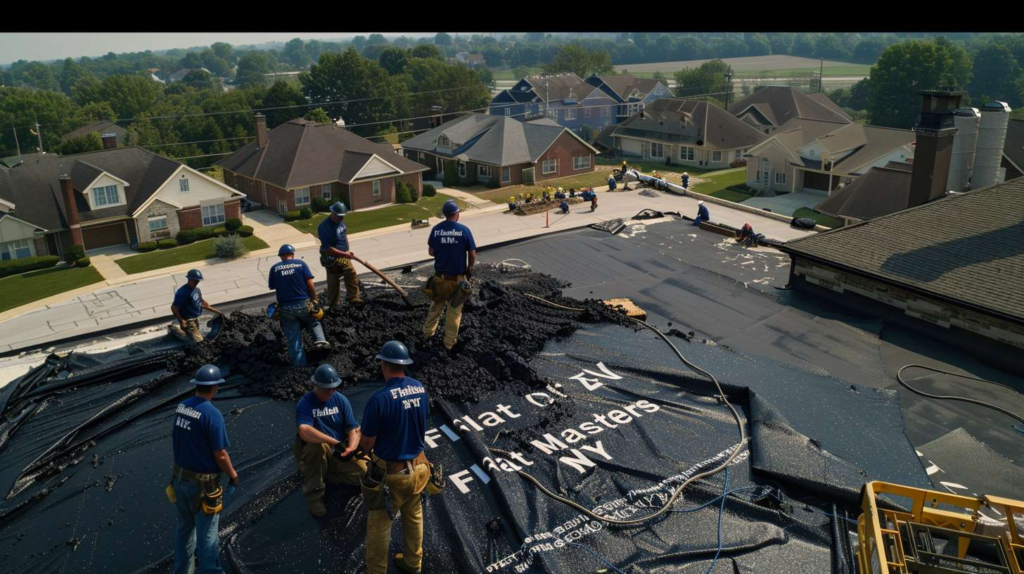
On a Queens roof, the first thing I look at is never the blister - it's the water's exit. Leaks show up feet, sometimes rooms, away from where the real problem lives, because standing water doesn't care about your property lines. It keeps pressure on seams, works at penetrations, and stresses flashing until something gives. Every hour that water sits on that roof, gravity is keeping score. The drain that "kind of works" is actually losing that argument slowly, one storm at a time.
| What Owners Believe | What the Roof Actually Shows |
|---|---|
| If water reaches the drain eventually, the drain is fine. | Speed matters. Water that ponds for 24-48+ hours before draining is already stressing seams and accelerating membrane wear, even if the drain is technically open. |
| Any drain grate works if the pipe size is right. | The pipe size sets maximum capacity, but the grate opening pattern, dome height, and debris-handling profile determine whether you ever get close to that capacity in real Queens conditions. |
| Ponding always means the roof needs replacement. | Ponding often means the drain height is off, the strainer is undersized for debris load, or the drain isn't sitting at the actual low point. Many "failed" roofs just need proper drain work. |
| A cheap online drain body is basically the same as a commercial-grade one. | Clamp ring quality, body wall thickness, and material consistency differ significantly. A flimsy clamp ring under thermal cycling will gap against the membrane and create exactly the leak you were trying to prevent. |
| Only membrane thickness determines leak resistance. | Membrane thickness is one variable. How long water sits on it, where it pools, and how often the drain area cycles through wet-dry-freeze is what actually ages a roof faster than its spec sheet predicts. |
⚠ Watch Out: The Drain That "Works" But Costs You Anyway
A roof drain flat setup can pass a quick visual inspection - water does eventually leave - and still be quietly damaging your roof on every storm cycle. Three specific consequences show up repeatedly on Queens buildings:
- Freeze-thaw stress: Water held on the roof through overnight temperature drops expands into seams and penetrations. A drain that sits too high delays exit just long enough for this to happen repeatedly through winter.
- Debris choke points: A strainer not sized for local debris load - tree matter, gravel, HVAC discharge - clogs fast and turns a working drain into a dam. The roof holds what should have left.
- Accelerated seam wear: Every extra hour of standing water keeps mechanical and thermal stress on seams near the drain area. This isn't dramatic - it's slow, and it's how a five-year-old roof starts looking like a ten-year-old one.
Which Drain Features Actually Change Roof Performance
Body Material and Durability
Here's the part people don't enjoy hearing: drain product selection matters because no two roofs drain flat the same way. Foot traffic, debris type, line conditions, and membrane system all change what the right component looks like. I'm Marisol Vega, and after 19 years in flat roofing with a specialty in solving stubborn ponding problems on older Queens mixed-use buildings, I can tell you that the roofers who skip this conversation are the ones whose callbacks start about eight months after installation.
I remember one July afternoon in Elmhurst - the kind of sticky heat where the roof felt soft under my boots, somewhere around 4:40 in the afternoon. The owner of a bakery on Corona Avenue kept insisting the membrane was defective. He'd had two crews look at it. But when I watched the roof drain after running water across it, I saw a shallow lake building around a dome strainer that was badly matched to the debris load from the sycamore trees next door. The openings were choking on leaf fragments before the real volume hit. We swapped the drain assembly, adjusted the sump depth, and the entire "roof problem" turned back into what it really was: a drain product selection problem. The membrane was fine. It had just been holding water it never should have held.
Practical guidance: match the drain body material to the roof's use conditions and age, not the supplier's default recommendation. Cast iron holds up under heavy-use roofs but needs proper coating maintenance in wet climates. PVC bodies are lighter and corrosion-resistant but can become brittle with age and are more sensitive to clamp-ring torque. The clamp ring quality - often ignored - determines how well the drain integrates with the membrane; a cheap ring that warps under thermal cycling defeats the purpose of an expensive membrane. The strainer profile has to account for the actual debris this roof sees, not a generic spec. And the outlet size has to match the drainage area, not just whatever the previous drain happened to be.
Strainer or Dome Shape Versus Debris Load
| Drain Component or Type | Best Use Case | Main Advantage | Main Limitation | Queens-Specific Caution |
|---|---|---|---|---|
| Cast Iron Drain Body | Commercial rooftops, older buildings with heavy-use histories | Extremely durable under load; handles heavy foot traffic without deforming | Heavy; requires protective coating to resist rust in wet conditions | Many Queens mixed-use buildings have original cast iron drains 30+ years old - inspect for corrosion at the outlet before deciding to keep or replace |
| PVC Drain Body | Residential flat roofs, lightweight re-roofing projects | Corrosion-resistant, lightweight, cost-effective for low-traffic roofs | Can become brittle with age; sensitive to improper clamping during installation | Queens winters put real freeze-thaw stress on PVC - verify wall thickness and clamp compatibility before install |
| Aluminum Dome Strainer | Roofs with moderate debris, standard residential/commercial use | Rust-resistant, keeps debris above the drain opening, good surface area | Dome height can be too shallow for heavy debris loads; needs regular clearing | Sycamore, linden, and ailanthus debris near residential Queens blocks can clog a shallow dome in one storm - size up |
| Low-Profile Flat Grate | Rooftop decks, pavers, or access-heavy roofs where dome height is an obstacle | Flush with surface, avoids trip hazard in pedestrian areas | Clogs faster than domed options; smaller effective opening under debris | Queens rooftop terraces are increasingly common - don't install a flat grate without a maintenance plan; they're cleaning calls waiting to happen |
| Heavy-Duty Pedestrian-Rated Grate | Roofs with regular foot traffic: mechanical access, rooftop HVAC servicing | Resists deformation under repeated load; maintains opening under traffic | Higher cost; heavier; some designs reduce visible open area compared to domed options | On older Queens six-family roofs where super access is constant, this is worth the cost difference - cheap grates twist fast under weekly traffic |
✔ What to Check Before Approving Any Drain Product
- 01Outlet size: Confirm the drain outlet matches the drainage area calculation - not just the existing pipe connection. Upsizing the roof while keeping the original outlet is a setup for ponding.
- 02Strainer opening pattern: Verify the open area percentage and slot size against the specific debris this roof actually sees - leaves, gravel, HVAC discharge, or sediment.
- 03Membrane compatibility: The drain body and clamp ring must be rated for the membrane system being installed. Mixing systems creates gaps at the most important transition on the roof.
- 04Foot-traffic resistance: If anyone regularly walks near or over this drain, confirm the grate or strainer is rated for that load. Pedestrian-rated and decorative ratings are not interchangeable.
- 05Debris exposure from trees or parapets: Parapet walls and nearby trees create debris concentrations that overwhelm undersized strainers fast. Check what's upwind and overhead before specifying strainer capacity.
- 06True low-point alignment: Confirm the drain is positioned at the actual low point of the roof, not just where the previous drain happened to be. These are often different locations on patched or re-sloped roofs.
Where a Roof Drain Sits Can Matter More Than the Catalog Spec
I once stood on a Roosevelt Avenue roof at sunset and watched the whole mistake reveal itself. I'd been called to an Astoria restaurant after a tenant sent videos of water dripping through a light fixture, and everyone on site was arguing about flashing. When I got up there, the roof drain on a flat roof had been set too high relative to the actual low spot - water had to build into a genuine pond before it could even reach the drain opening. The super looked at it and said, "So the drain works, just not soon enough?" And that was exactly right. The drain was late, and gravity had already won the argument by the time the water finally left. Every storm was a repeat performance of the same slow loss.
Does Your Ponding Problem Point to Drain Selection, Drain Height, or Slope Correction?
→ NO
Monitor and maintain. Keep strainers clear and schedule annual drain inspections before storm season.
→ YES
Continue below to identify the likely cause.
→ YES
Likely issue: Drain height / sump alignment. The drain may be set too high relative to the low point. Water has to rise before it enters - the drain is physically late. Evaluate sump depth and finished drain elevation.
→ NO
Continue below.
→ YES
Likely issue: Wrong strainer type or capacity. The strainer profile isn't matched to the debris load this roof actually receives. Change the strainer style - larger dome, different slot pattern, or higher-capacity assembly.
→ NO
Continue below.
→ YES
Likely issue: Drain location mismatch. Evaluate drain relocation to the true low point or tapered insulation to redirect flow to the existing drain.
→ STILL UNCLEAR
Combined or hidden issues: Multiple factors may be at play - slope, drain height, and product selection together. A professional inspection with a drainage assessment is the right next step.
How Cheap Components Turn Decent Roofs Into Basins
What Budget Drains Fail at First
Blunt truth: a roof drain flat system is only as smart as its lowest opening - and if that opening is a flimsy stamped-metal grate held in place by hope and two thin threads, the whole roof is working against itself. One November morning in Ridgewood, just after a cold rain, I was on a six-family building with a landlord who had ordered the cheapest roof drains for flat roofs he could find online. By 8 a.m. I had my glove in near-freezing water pulling out a grate that had twisted under foot traffic - HVAC service, super access, a neighbor's satellite dish repair crew - and blocked half the line with debris it couldn't pass. The membrane on that roof was workable. The pitch was reasonable. One cheap drain turned the whole thing into a basin. That job stuck with me because the fix would have cost less than the drain itself if someone had bought right the first time.
That sounds logical, but here's what the roof actually does: it doesn't forgive cheap components quietly. Marisol's plain opinion after watching hundreds of these situations - the cheapest drain is often the most expensive part on the roof once you add up callbacks, interior damage investigations, repeat clog removals, and accelerated membrane wear around the drain area. Not gonna lie, the math on "saving" $40 on a drain body stops looking smart after the first interior water damage call. Commercial-grade assemblies cost more because the clamp rings hold under thermal cycling, the body walls don't deflect, and the strainer profiles are engineered for flow - not just for looking acceptable in a product photo.
| Budget / Low-Cost Online Drain | Commercial-Grade Drain Assembly |
|---|---|
| ✓ Lower upfront purchase price - sometimes 40-60% cheaper on the product itself | ✓ Higher initial cost offset by dramatically longer service life - fewer replacements over the roof's lifespan |
| ✓ Fast shipping and easy availability online | ✓ Clamp ring integrity holds under freeze-thaw cycling - maintains the membrane seal through Queens winters |
| ✗ Thin grate material deforms under foot traffic - often within the first year on active roofs | ✓ Traffic-rated grate options available; holds shape through repeated mechanical and pedestrian loads |
| ✗ Clamp rings often inconsistent in thickness - gaps at membrane interface lead to slow leaks at the drain collar | ✓ Membrane-specific compatibility verified by manufacturer - reduces leak risk at the drain transition |
| ✗ Higher replacement frequency - often needs full swap within 3-5 years on active roofs | ✓ Longer replacement cycle - 10-15+ years on properly installed and maintained assemblies |
| ✗ Clog resistance is minimal - strainer slot patterns often prioritize cost over flow engineering | ✓ Engineered strainer profiles handle real debris loads - fewer service calls, more consistent flow after storms |
| ✗ Freeze-thaw failure risk is real - thin PVC bodies and cheap clamp rings are where leaks start in March | ✓ Designed for thermal cycling performance - body walls and seals specified for temperature range, not just average conditions |
Questions Worth Asking Before You Approve Any Drain Work in Queens
If I asked you where the water goes after the storm, could you point to it without guessing? That question is a practical filter, and not many owners or property managers can answer it confidently. And honestly, that's where drain problems hide - in the gap between what the proposal describes and what the roof actually does with water. Older Queens mixed-use buildings are especially unpredictable: rear additions with different pitches, roof sections patched by three different crews over fifteen years, uneven substrate from previous overlay jobs, and tree debris patterns that change block by block depending on whether the property backs up to a yard on 82nd Avenue or sits exposed on a corner in Jamaica. A drain spec that works on one building may be completely wrong for the building two lots over. One-size-fits-all recommendations are how ponding problems get "fixed" and then come back six months later.
A bad drain is like giving subway riders one narrow turnstile at rush hour - the system technically works, it's just always behind. Flow capacity on a flat roof isn't just about the pipe; it's about how fast water can move from the surface into the drain opening given the strainer's available area, the sump depth, and the volume that arrives in a heavy Queens downpour. Here's the insider detail worth holding onto: when you're evaluating a drain proposal from Flat Masters or anyone else, don't just ask for the drain model number. Ask to see the finished drain elevation relative to the low point, the sump detail, and the strainer specification matched against the debris exposure for that specific roof. A roofer who can answer those three questions without hesitation is doing the actual diagnostic work. One who hands you a product sheet and a price is guessing - and on a flat roof in Queens, gravity doesn't reward guessing.
Before You Call About Roof Drains for Flat Roofs - Verify These 7 Things First
-
1
Where ponding forms: Note the exact location on the roof where water collects - is it centered near a drain, or away from it entirely? -
2
How long water stays after rain: Hours, or days? Water still present 48 hours after a storm is the threshold that changes what solutions are needed. -
3
Nearby tree debris sources: Are there trees overhanging or adjacent to the building? What type - linden, sycamore, ailanthus? This directly affects strainer selection. -
4
Repeated clogging at the same drain: If it's the same drain every time, the strainer is wrong for the conditions - not just unlucky. -
5
Roof foot-traffic level: Who goes up there and how often? Mechanical techs, supers, satellite installers - foot traffic that warps grates is a pattern, not a one-time event. -
6
Age of current drain assembly: Do you know when the existing drain was installed? Original drains on pre-1980 Queens buildings may be corroded at the outlet even if the visible parts look intact. -
7
Whether interior leaks align with the ponding area: If the ceiling stain is directly below where water pools longest, that's a strong signal. If it's far away, the water is traveling - and the entry point is not obvious.
Flat Roof Drain Questions Queens Property Owners Ask Most