
Laying Felt on a Flat Roof Looks Straightforward - Until You Get to the Details
Technically, the challenge of laying felt on a flat roof has nothing to do with keeping lines straight. It's about controlling run direction, overlap sequence, bond quality, and the detail work at every edge, corner, and termination-because that's exactly where water goes to find out whether the installation was honest.
Direction and Overlap Matter Before Neatness Does
Start with the run direction, or you're already arguing with water. Felt doesn't care how tidy the field looks from the ladder-it responds to gravity, and if you've laid it without thinking about the water path first, the overlap sequence you were so proud of is actually holding moisture in instead of shedding it off. The direction of the run determines whether each successive sheet laps over the one below it in the direction water wants to travel, and getting that wrong from the first roll means every sheet after it compounds the problem.
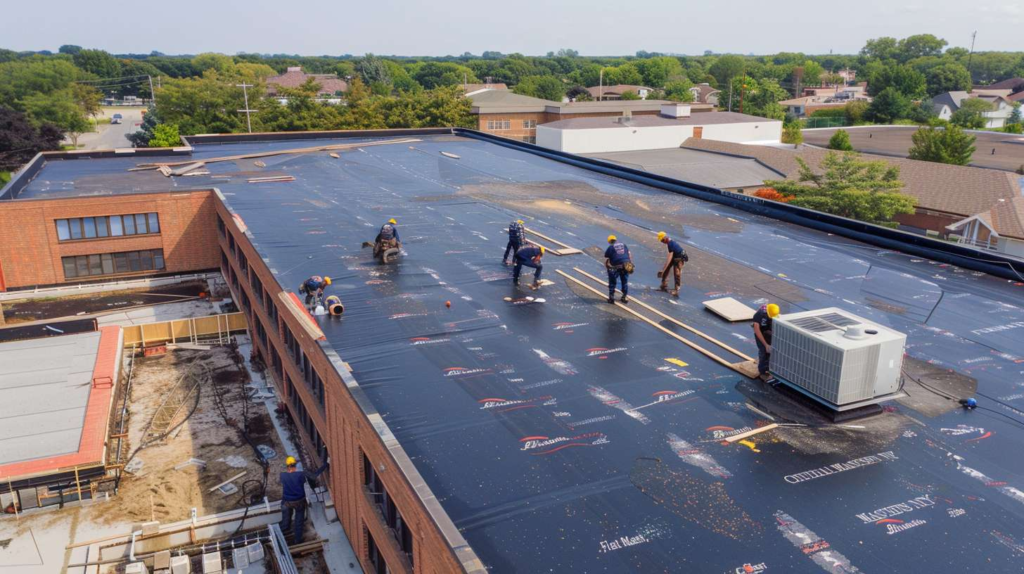
I'm Keisha Rowe, and I've spent 14 years in Queens doing felt work that holds at laps, edges, and terminations instead of just looking tidy in the middle-and the single most common mistake I see is people treating felt like wallpaper when it's actually closer to wrapping a moving joint. Tension matters. Smoothness matters. Overlap direction matters. And the vulnerable turns-the corners, the curbs, the perimeter-are exactly where everything either holds or comes apart. Think of it like a horse's leg wrap done wrong: one bunch in the wrong spot, one loose edge, and the protection you thought you had is working against you.
-
1
Inspect the substrate for soft spots, trapped moisture, and any surface irregularities that will telegraph through the felt. -
2
Choose run direction with the water path in mind, not the visual convenience of the longest dimension. -
3
Plan the overlap direction so every successive sheet laps in the same direction water sheds. -
4
Identify every edge, corner, and curb detail before unrolling anything-those are the spots that need to be pre-thought, not figured out on the fly. -
5
Begin laying only after you understand how the sheet will behave at every turn, because the field is the easy part.
The Field Teaches Less Than the Edge, Because the Trouble Starts When the Sheet Has to Turn
Before you ask how to lay felt on a flat roof, ask what happens when the sheet reaches an edge, a corner, or a curb. I remember a windy March afternoon in Glendale-the homeowner had watched three tutorials and figured the rest was "just staying straight." When I saw the garage roof he'd started near 75th Avenue, the field lines actually looked decent from the ladder. But the trouble showed immediately at the change of direction near the edge, where the material had wrinkled and the overlap was actively fighting itself. I pulled out my forearm right there in the driveway and showed him why flat roof felt has to be laid with the water path in mind, not just the eye, because the sheet doesn't stop at the field-it has to turn, and turns don't forgive guesswork.
My opinion? Most people think the middle of the roof is the skill test. It isn't. The middle is where you build confidence. The edges are where you demonstrate competence. And honestly, in Queens-on garages, bay extensions, those small rear roofs over back additions that are everywhere from Ridgewood to Woodhaven-the detail areas take up a proportionally massive share of the job. A small Queens garage roof might have eight feet of genuine open field and six different edge and corner conditions. Not gonna lie: that math means the details are the job, not the finishing touch.
Why DIY Felt Jobs Fail at the First Change of Direction
- Focusing only on straight runs gives you a roof that passes a quick visual inspection and fails the first heavy rain-the field is not where water tests the installation.
- Underthinking corners and terminations is the single most common reason a DIY felt job leaks within the first season-turns require deliberate fold and bond technique that tutorials rarely cover long enough.
- Assuming a small roof is easier is a trap-smaller area means the detail-to-field ratio is higher, and every corner becomes a proportionally larger share of the whole job. Less room to hide mistakes, not more.
Small Roofs Make Detail Mistakes Show Up Faster
A 200-square-foot roof over a bay extension still has four corners, two or more edges, and a perimeter that needs proper termination. The physics don't scale down just because the area does. What shrinks is the forgiving open field that lets average technique look passable-and what stays the same, at full consequence, is every spot where the felt has to do something other than simply lie flat.
Laps, Corners, and Terminations Are Where Gravity Checks Whether the Install Was Honest
I still remember that lap peeling open like a bad bandage. It was a sticky July morning in Astoria-I was repairing a small rear extension where another contractor had laid roofing felt fast enough to impress a stopwatch and slow enough to disappoint gravity. The field runs were mostly passable. But the corner turn-ups and termination points were a mess, and that lap? It looked bonded until it mattered. I could smell hot bitumen while I peeled it back, and what I found underneath told the whole story: the installer had worked from the middle out, covering ground quickly, and left every edge and corner to figure itself out. The roof teaches from the edges in. That contractor had it backwards.
Here's the blunt truth: straight lines do not equal watertight work. Flat roof felt overlap direction, corner turn-up height, edge trim bonding, and termination sealing are the proving ground-not the open field. A lap running the wrong way doesn't reveal itself on day one. It reveals itself six months later when water has had time to work its way under the edge on a cold night, expand, and pry the bond open from below. By the time the ceiling shows a stain, the felt has been failing for a while. That's the cruel patience of a bad detail.
Felt work is a lot like wrapping a horse's leg-wrong tension, bad overlap, one bunch in the wrong place, and the whole protection system is compromised. I learned that before I ever touched a roof, working at a dressage stable out on Long Island where a poorly wrapped leg could mean an injured horse by morning. The same principle translates exactly: if you want to judge whether someone actually knows how to lay felt on a flat roof, don't watch how fast they cover the middle. Watch what they do when the sheet reaches an edge turn or corner. That's where technique either shows up or doesn't.
| Myth | Fact |
|---|---|
| "If the lines are straight, the felt was laid well." | Straight runs tell you nothing about overlap direction, bond integrity, or edge execution-water isn't impressed by parallel lines. |
| "Small roofs are easier." | Small roofs have the same number of corners, edges, and terminations as larger ones-with less open field to absorb mediocre technique in between. |
| "The middle of the roof is the hard part." | The middle is where you roll felt and stay warm. The perimeter is where you prove whether the installation actually works under real weather conditions. |
| "A bonded-looking lap is enough." | A lap that looks bonded on a cool day can open under summer heat or winter freeze-thaw cycling-full adhesion across the entire lap width is the only standard that holds. |
| "Corners are just finishing details." | Corners are where flat roof felt installation either stands up or comes apart-they require pre-planning, relief cuts, and deliberate fold technique, not an afterthought trim. |
On a Small Roof, the Detail Work Becomes the Job Faster Than Most People Expect
Less Area Does Not Mean Less Consequence
Start with the run direction, or you're already arguing with water-and that rule doesn't get any more forgiving just because the roof is small. A Sunnyside call stays with me: late September, bright and cool, homeowner kept saying "but it's only a small roof" like the square footage was going to negotiate on his behalf. He wanted to know how to lay felt on flat roof sections over a bay extension and whether a full crew was really necessary. I walked him through run direction first-because that's always first-then surface prep, then overlaps, and then I showed him, right there on his own roof edge, why the small size actually made the detail areas proportionally more important, not less. That particular bay extension had four external corners, a party wall edge, and a front fascia termination, all within about 90 square feet of total area. Less field, same consequences, and honestly zero room to hide a shortcut. Small roofs can be genuinely unforgiving that way, and the sooner a homeowner hears that from someone who's done a few hundred of them across Queens, the better.
If you want flat roofing felt laid with run direction, edge details, and overlap sequence handled before the trouble starts, call Flat Masters-we've been doing this work in Queens long enough to know that the roof doesn't care how fast the field got covered. Call Flat Masters today and get felt work that holds at the laps, the corners, and the edges, not just down the middle.