
Reroofing a Flat Roof Doesn't Always Mean Stripping It Back - But Sometimes It Does
Diagnosis Before Demolition
Would a different diagnosis change the cost significantly? The oldest-looking flat roof in Queens doesn't always need a full tear-off - but the wettest-looking one sometimes absolutely does. That single distinction is what separates a smart reroofing decision from an expensive one, and it starts before a single layer gets pulled.
Three test cuts tell me more than ten opinions. Flat roof reroofing is a field experiment: you make a cut, you observe what's underneath, you react to evidence. That's how I've always worked - and that's the standard Marlene "Marly" Sosa, with 27 years in flat roofing and a specialty in sorting recover-or-strip decisions on Queens roofs, applies to every job before anything else gets discussed. You test, you find out what's real, and then you build a scope that explains the findings rather than the one that sounds most dramatic.
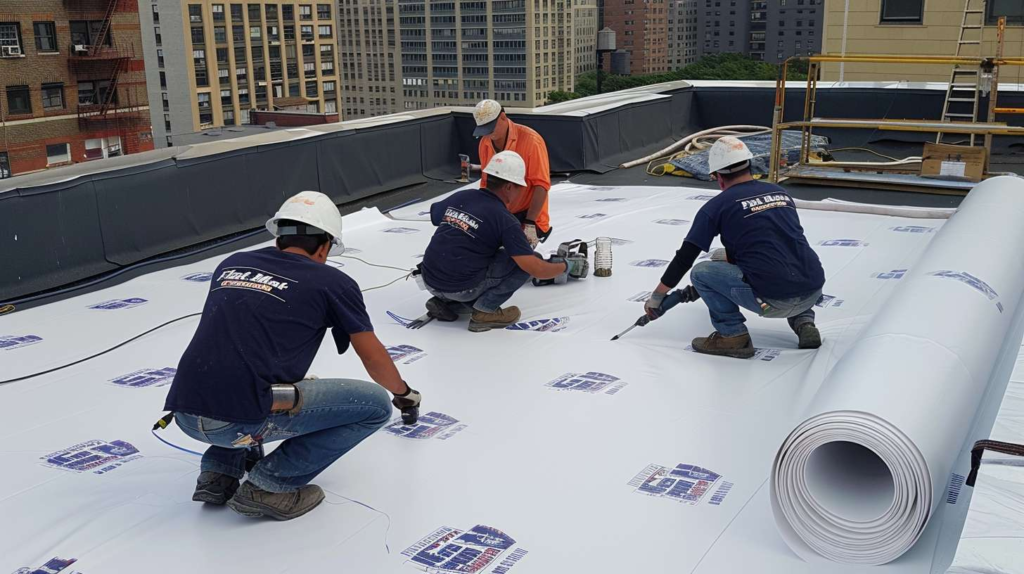
Flat Roof Reroofing - Quick Facts for Queens
Main Decision Driver
Moisture saturation and deck condition - not the age of the membrane
Best First Step
Test cuts and core inspection - no guessing, no selling from the sidewalk
Common False Assumption
Age alone decides everything - an old roof with a dry deck can still qualify for recovery
Queens Complication
Parapets and drains often fail before the field membrane does - that changes the whole conversation
Decision Tree: Can This Flat Roof Be Recovered - or Does It Need a Strip?
Multiple active leaks across the field?
Test cuts show wet or saturated insulation?
Is the deck soft, rusted through, or structurally unstable?
Is the existing membrane well-attached, with failures concentrated only at drains or flashing?
Signals That Push the Job Toward a Recover
When the Roof Looks Rougher Than It Really Is
I'll say this plainly: a reroof flat roof project can often stay in recover territory when the substrate is dry, the deck is solid, and failures are sitting right where you'd expect - at seams, drains, or perimeter flashing. One July afternoon in Astoria, with the heat coming off Steinway Street at around 92 degrees and zero breeze, I had a landlord fully convinced he needed a complete tear-off because another contractor told him "old roof means strip it." I cut three test spots. What came back was a surprisingly dry substrate with one bad drain area and a seam field that someone had patched more times than I could count. We ended up doing reroofing services for flat roofs with a recovery system - not stripping the whole assembly - and he called me about two months later mostly to say he was still shocked I talked him out of a bigger bill. That's Queens in a nutshell: older small multifamily and mixed-use buildings along streets like Jamaica Avenue often carry years of patch history that looks far worse than what's actually going on in the assembly below it.
When reroofing services for flat roofs are done right, a recovery approach is less disruptive to tenants and faster to complete. There's no dumpster load of old materials, no exposed decking between shifts, and no multi-day tear-down sequence. If the evidence supports it, a recover system closes the loop on isolated failures without resetting a perfectly stable assembly.
| Roof Finding | What It Usually Means | Recover More Likely When | Strip More Likely When |
|---|---|---|---|
| Surface cracking & alligatoring | Aged membrane surface, UV damage | Insulation below is dry, deck is firm | Cracking extends into insulation or deck |
| Ponding water near one drain | Drain clog or slight slope failure | Limited to one area, rest of deck drains well | Ponding is widespread across multiple zones |
| Multiple patch layers visible | Long repair history, surface irregularity | Patches are dry, deck beneath is stable | Patches are hiding trapped moisture or rot |
| Flashing failure at parapet walls | Edge or perimeter detail breakdown | Field membrane is intact, damage is edge-only | Moisture has tracked inward from parapet failure |
| Blisters in field membrane | Trapped air or moisture pockets | Blisters are isolated, test cuts show dry insulation | Blisters are widespread, insulation is wet throughout |
| Leak reports from interior | Active penetration, not necessarily total failure | Single entry point traced to one flashing or seam | Leaks appear from multiple unrelated locations |
Good Signs That a Recover System May Work
- ✅ Dry test cuts - no wet insulation, no moisture migration found at inspection points
- ✅ Stable deck - no soft spots, no rusting through, no structural give underfoot
- ✅ Isolated ponding near one drain - not field-wide, traceable to a single drainage failure
- ✅ Patchy but limited seam failure - localized, not spreading across the full membrane
- ✅ Serviceable center field - middle of the roof is intact and not compromised by moisture
- ✅ Flashing defects concentrated at edges and parapets - perimeter issues only, central membrane is holding
What Usually Forces a Full Strip
One August roof in Elmhurst taught me something that sounds obvious but gets ignored all the time: an ugly-looking roof and a wet roof are not the same thing. Surface deterioration, heavy patch layers, and chalky membrane are visual noise. They don't automatically mean the assembly below is saturated. But once moisture is genuinely widespread - once it's sitting in the insulation, tracking across the deck, showing up in test cut after test cut - a recover just seals failure inside a new layer. That's not a fix. That's a delay with a higher future bill attached.
Here's the part people do not enjoy hearing. I remember a damp Tuesday around 7:10 in the morning in Ridgewood, standing on a two-car garage roof with coffee still too hot to drink, and the owner kept asking me how to reroof a flat roof garage without ripping everything off. I pressed one heel into a blistered section and water pushed sideways under the membrane like a sponge being squeezed. That's the moment when the conversation has to change - kindly but plainly. Garage roofs especially tempt owners toward cheap overlays because the square footage looks manageable and the cost feels controllable, but wet insulation or a spongy substrate means overlaying is the wrong experiment. The data says strip. Worth doing: ask your contractor for photos from each test cut location, and ask specifically where the moisture stops - not just where the leaks showed up on the ceiling below, because interior leak locations rarely tell the whole exterior story.
⚠️ Do Not Bury a Wet Flat Roof
Recovering over saturated insulation, soft deck areas, or trapped moisture doesn't solve the problem - it accelerates it. Expect accelerated rot, blistering through the new membrane, seam failure within years instead of decades, repeated interior leaks, and a future replacement that now costs more because the wet materials have to come out anyway. A recover system is only as good as what it's installed over.
Price Changes When the Assembly Changes
Why Two Similar-Looking Roofs Can Price Very Differently
If you were standing next to me at the parapet, I'd ask you this: should the money go into a second membrane layer on top of a stable, dry assembly - or into removing wet materials, replacing rotted decking, and rebuilding flashing details that have been leaking since before you owned the building? Those are not the same project, and they don't cost the same. Flat roof reroofing pricing changes more from hidden conditions than from square footage alone. A 1,000-square-foot roof with dry insulation and a solid deck is a fundamentally different job than a 1,000-square-foot roof where the insulation has been wet for three winters. The test cuts tell you which one you're actually dealing with.
Queens Flat Roof Reroofing - Cost Scenarios
Ranges are illustrative. Final pricing depends on test cut findings, roof access, deck condition, and exact scope. These are not binding estimates.
Small Garage Roof - Recover System
Dry substrate, limited failures at seams or one drain, deck confirmed stable
$2,500 - $4,500
Small Garage Roof - Full Tear-Off with Limited Deck Repair
Wet insulation removal, partial decking replacement, new membrane installation
$4,500 - $8,000
Mid-Size Commercial / Mixed-Use - Recover System
1,500-3,000 sq ft, dry findings, isolated flashing repairs at perimeter
$8,000 - $16,000
Mid-Size Tear-Off with Wet Insulation Removal
Full strip, saturated insulation removal, deck repairs, new full assembly
$14,000 - $26,000
Tear-Off with Substantial Flashing and Drain Rebuilds
Full strip plus parapet flashing replacement, drain upgrades, extensive edge detail work
$20,000 - $38,000+
| Factor | Pros | Cons |
|---|---|---|
| Recover System - Upfront Cost | Lower initial investment; no demolition labor | Can't justify cost if hidden moisture is found mid-project |
| Full Tear-Off - Upfront Cost | Eliminates all hidden risk; clean slate pricing | Higher initial spend, especially with deck repairs |
| Project Duration & Disruption | Recover: faster, fewer days, less exposure for tenants | Tear-off: longer timeline, more noise, debris removal needed |
| Hidden Risk Reduction | Tear-off: all conditions exposed and addressable | Recover: any missed moisture stays in the assembly |
| Long-Term Reset | Tear-off resets the full roof assembly life; recover extends it | Recover does not reset - it adds years, not a full new timeline |
Questions Worth Asking Before You Approve the Scope
Lesson from the roof: the right scope is the one that explains the evidence, not the one that sounds toughest.
A flat roof is a layer cake, and nobody should frost over a soggy middle. After a night storm in Ozone Park - it was around 5:30 in the evening - I was up on a small mixed-use building where the downstairs tenant was convinced the whole roof needed to go. When I traced the moisture, the central field was still serviceable. The real problem was along the parapet, where three generations of repairs had trapped water and split the flashing clean through. That job is still my clearest example of why flat roof reroofing isn't a yes-or-no religion. And honestly, I have little patience for contractors who jump straight to full tear-off or straight to overlay without proving why. That's not toughness - that's skipping the experiment and going straight to the conclusion. The evidence drives the scope, not the other way around.
Before You Approve Flat Roof Reroofing Work - Verify These 6 Things
-
1Ask how many test cuts were made - one cut near an obvious blister is not a complete evaluation of the assembly
-
2Ask whether insulation was dry or wet at each cut - you want specifics, not a general "it looked okay"
-
3Ask whether the deck was physically checked - walked, pressed, and visually inspected for soft spots or rust-through
-
4Ask where failures are concentrated - field vs. edges vs. drains is a critical distinction that changes the whole scope
-
5Ask whether parapets, drains, and flashing are included in the scope - a new membrane with failing edge details is a short-lived investment
-
6Ask for photos marking recoverable vs. non-recoverable areas - if a contractor can't show you the evidence, they haven't found it yet
Common Queens Flat Roof Reroofing Questions
