
Felt Flat Roofs Don't Last Forever - Here's How to Know When It's Time
Not every failing felt flat roof announces itself with a dramatic waterfall through the ceiling. In fact, flat roof felt replacement becomes necessary far more often than owners expect-because the real damage spreads underneath the surface, quietly and out of sight, long before the top sheet looks bad enough to act on. By the time it looks catastrophic from the ladder, you've usually lost weeks or months you didn't know you were losing. Around Queens, that pattern repeats itself on attached homes, two-families, and older walk-up buildings where recurring moisture near drains, parapets, and low-ponding zones keeps working through the assembly even when the top sheet still looks passable from a doorway.
Surface Clues That Usually Mean the Problem Is Already Below
Nineteen years up on Queens roofs has taught me this: the stuff you can see is the evidence. The stuff you can't see is the reaction still happening. Think back to a middle-school science class for a second-you'd watch a color change in a beaker and know a chemical reaction was already underway, even though you couldn't see the molecules. Felt roofs work the same way. A blister, a seam pulling apart, a water stain on a ceiling tile-those are the color changes. The reaction is trapped moisture moving through insulation and into deck material, usually faster than any property owner wants to believe. Listen first-roofs gossip, and they almost always say more than what's visible at surface level.
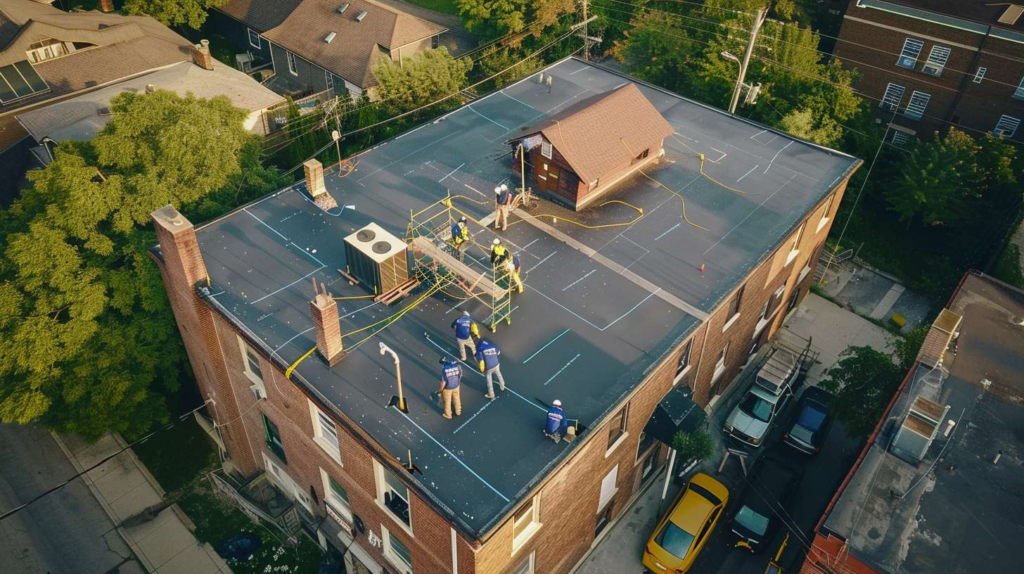
Here's the blunt part: patching the top layer or rolling on a fresh coating is not the same thing as solving wet insulation, a softened deck, or failing seams below. A patch can stop a drip. It cannot undo what saturated insulation is doing to the structure underneath it right now. That distinction matters, and it's exactly what I-Maritza Velez, with 19 years in flat roofing and a specialty for catching trapped moisture under felt before it becomes a deck repair-push back on every time a property owner tells me a coat and a prayer is enough to get through another winter.
| Myth | Fact |
|---|---|
| "If the leak stops, the roof can wait." | A leak stopping means surface water found a temporary path-not that the assembly dried out. Moisture trapped below the felt continues to degrade insulation and deck material even in dry weather. |
| "A fresh coating means no replacement needed." | Coatings address the top surface only. If the felt underneath already holds moisture, a new coating seals that moisture in-often accelerating deterioration below the layer you just paid to protect. |
| "Only big blisters matter." | Small blisters near parapets and drains are frequently the first signal of widespread delamination underneath. Waiting for large blisters usually means the insulation layer is already compromised. |
| "One wet spot means one small repair." | Water travels horizontally through insulation before it shows up indoors. A single interior stain can reflect a moisture zone several feet wider than the drip location above it. |
| "If edges look okay, the roof is structurally fine." | Edge conditions and field center conditions are different animals. Drain zones, parapet transitions, and low spots in the middle of the roof are where felt material replacement becomes necessary-independent of how clean the perimeter looks. |
⚠️ Early Warning Signs That Often Point to Flat Roof Felt Replacement
- 🔩 Split seams near drains - Seams adjacent to drain bowls are under constant water stress. A split there is rarely isolated to that one spot.
- 💧 Recurring interior stains - If the same ceiling tile shows water damage after every rain event, the moisture pathway is established and active.
- 👣 Soft spots underfoot - Any section that compresses or feels spongy when you walk on it likely has wet, compromised insulation beneath the felt.
- 🌡️ Blisters near parapet walls - Heat trapped between the parapet and the membrane causes accelerated delamination; blisters here often indicate widespread felt failure.
- 👃 Musty odor after opening cut sections - A damp, basement-like smell from a test cut is a strong indicator of long-term trapped moisture and possible organic decay in the insulation.
- 🌧️ Standing water in the same area after rain - Chronic ponding in a fixed location means drainage is failing and the assembly below that zone is absorbing far more water than it should.
Ridgewood to Astoria: What Failure Looks Like Before Owners Believe It
The foggy-morning seam test
At 6:40 one foggy morning in Ridgewood-one of those August nights that never actually cools off-I was on a two-family off Myrtle Avenue when the owner told me flat roof felt replacement could absolutely wait until fall. The leak had "stopped for now," which is the four most expensive words a property owner can say. I pulled back a split seam near the drain and water shimmered underneath the felt, like a small, sad science demonstration I hadn't asked to see. By 7:15 I was crouching next to him showing how the insulation had already started turning to mush. That's the Queens reality: the humidity, the overnight fog, the freeze-thaw cycles from November through March, and the way drain layouts on older attached homes and two-families direct water toward the same low zones every single time-it doesn't give a compromised felt roof a chance to dry out between events.
Why coatings can hide a worse roof
Now let's check that assumption that a coating buys you another season. One August afternoon in Astoria, during the kind of heat where the black roof surface goes soft under your boots, I had a customer who wanted to save money by coating over old felt again. He'd done it once before and figured one more time was fine. I cut a neat square-maybe eight inches across-to show him what was underneath, and the smell that came out was like a wet basement trapped in a toaster. That was not a coating job anymore. Replacing felt on a flat roof wasn't really optional at that point-it was already overdue and the coating that had been applied previously had sealed the moisture in and accelerated the decay underneath it.
Neighborhood roof geometry in Queens matters here. Parapet walls on row houses and two-families create shadow zones where the felt-to-parapet flashing transition traps water. Drain placement on older buildings-especially pre-1980 construction in neighborhoods like Woodside, Jackson Heights, and Maspeth-frequently produces repeating wet zones in the same corners year after year. Replacement decisions built on surface appearance alone are always working with incomplete information. What's underneath the membrane is what determines scope.
| What You Notice | What It Often Means Underneath | Likely Recommendation |
|---|---|---|
| Seam split by drain | Chronic water pooling has weakened the bond; insulation in drain zone likely wet | Test cut to assess insulation; partial or full felt replacement probable |
| Blistering near parapet | Flashing transition failing; moisture entering between felt layers at parapet base | Inspect flashing and top two feet of roof field; section replacement likely |
| Repeated leak after coating | Coating masked seam failure or open lap; water is bypassing the new surface layer | Full felt material replacement on flat roof; coating is no longer a viable option |
| Soft insulation under test cut | Insulation has absorbed significant moisture; structural deck may show softening | Assembly rebuild likely needed; deck inspection before new felt is installed |
| Odor/moisture under top layer | Organic decay in insulation; moisture has been trapped for an extended period | Full replacement of felt and insulation; deck condition must be confirmed |
⚠️ Warning: The Hidden Risk of Coating Over Old Felt
Applying a new surface coating over felt that already contains trapped moisture can temporarily improve appearance-and that's exactly the problem. The new coat seals in what's already wet, blocking any chance of vapor escape. Beneath that fresh-looking surface, deterioration continues at an accelerated pace. Insulation that might have been salvageable gets saturated further, and deck material that was borderline begins to soften. By the time the coating itself starts to fail, the assembly underneath has often declined past the point where a simple felt replacement is sufficient. If there's any sign of moisture below the felt, coating is not a repair-it's a delay with consequences.
Before You Ask How to Replace Flat Roof Felt, Ask Whether the Layers Below Deserve Saving
If I'm standing next to your bulkhead, I'm probably asking one question first: where does the water sit after rain? Not where the leak shows up inside-where the water parks on the roof for hours after the storm passes. That answer tells me more about replacement scope than a full visual of the top surface ever could. Replacement planning starts with drainage behavior, how far moisture has spread laterally through the insulation, and what a test cut reveals about deck integrity. And honestly, my firm opinion is this: too many owners focus their attention on the top sheet because it's the only part they can reach and see. But the top sheet is just the lid. What matters is what the jar is holding.
Should You Repair, Partially Replace, or Fully Replace Your Felt Flat Roof?
NO ↓
Single-point repair may be appropriate if no sub-surface compromise is found
NO ↓
Targeted felt replacement in the affected zone; insulation may still be salvageable
NO ↓
Complete assembly evaluation required; deck condition must be confirmed before new felt is installed
Moisture is localized; section replacement with insulation swap is the likely scope
Drain Zones, Parapets, and Other Places Roofs Start Gossiping
Why two inches matter
Two inches from the drain can tell me more than the whole roof edge. The drain bowl area takes the full brunt of every rain event-it's where water volume is highest, where debris accumulates and holds moisture, and where the felt-to-drain flashing transition is most likely to crack or separate. Low spots and corners adjacent to parapet walls are equally revealing. Flashing transitions that have lifted even slightly become an open door for water to enter between layers, and by the time that shows up inside the building, the moisture zone has almost always spread well beyond the opening. That's why any serious evaluation of replacing felt on a flat roof has to prioritize these high-evidence zones rather than starting from the cleanest-looking section and working inward.
A tired felt roof behaves like a student who stops raising their hand-you only notice the problem after they've been struggling quietly for a while. The bubbling, the staining, the visible delamination-that's the late-stage evidence, not the beginning of the experiment. The reaction started somewhere less obvious, and it's been running its course. I got a call from a landlord in Elmhurst during a Sunday rainstorm because water was dripping through a light fixture on the top floor. When I arrived, the tenant had pots lined across the hallway like she was hosting a percussion concert. The old felt had blistered so badly near the parapet wall that it looked like it had been sun-damaged for years-which it had. That building's roof had been "fine" according to everyone until Sunday afternoon, because nobody had walked the parapet base after a rain to check where water was actually sitting.
📋 Before You Call for a Flat Roof Inspection - Note These First
Having this information ready speeds up the evaluation and gives the inspector a more accurate picture before they arrive.
- Where water appears indoors - ceiling, wall, fixture; note the exact room and location
- Where ponding remains after 24 hours - walk the roof after a dry day following rain and mark or photograph any standing water areas
- Roof age if known - even an approximate decade helps establish how many felt layers are likely present
- Whether a coating was applied previously - note approximate timeframe if possible; this affects how the assessment is scoped
- Whether leaks happen during wind-driven rain - this points toward parapet and flashing failures rather than field or drain issues
- Whether any area feels soft or smells musty - if you've walked the roof, note any spots that compress underfoot or have an odor near seams or cuts
Questions Homeowners Should Settle Before Scheduling the Work
Do you want a cheaper-looking answer, or a dry building?
Those aren't always the same thing, and worth being honest about that upfront. Before any work begins, the inspection should confirm exactly what scope is needed: felt-only replacement, insulation swap, deck repair, or a full assembly rebuild. That answer determines the right material, the right labor, and the right price-and it can't be guessed from the surface. Here's the insider tip that doesn't get said enough: a strategically placed test cut near a drain or parapet transition gives you a more honest answer in thirty seconds than an hour of walking the cleanest section of the roof. One cut in the right spot-and I've been doing this in Queens, NY for nearly two decades, including plenty of jobs on the kind of two-family brick buildings that line 74th Street in Jackson Heights-tells you everything about whether you're doing a felt swap or a full tear-off. Don't skip the cut to save the awkward conversation. Skip it, and you'll have a worse conversation later.
❓ Flat Roof Felt Replacement - Questions We Get from Queens Property Owners
What a Professional Flat Roof Felt Replacement Evaluation Should Include
-
1
Inspect drainage patterns
Walk the roof after or during rain if possible. Identify where water pools, where it drains slowly, and where it's held near drains, low spots, or parapet corners.
-
2
Identify seams, blisters, and open laps
Catalog visible surface failures and note whether they're isolated or part of a pattern. Widespread seam issues across multiple zones are a different conversation than a single blister.
-
3
Perform a targeted test cut if needed
A cut near the drain or parapet transition-not at the clean center of the roof-reveals what the insulation and deck are holding. Odor, moisture, and compression are all diagnostic signals.
-
4
Check insulation and deck condition
Confirm whether insulation is dry, compressed, or saturated. Check deck material for softness, rot, or deflection. This step determines whether replacement is felt-only or a full assembly job.
-
5
Recommend patch, section, or full replacement scope
A clear recommendation should come from the evidence collected-not from the quickest or cheapest default answer. The scope should match what the assembly actually needs, nothing more and nothing less.
If you suspect flat roof felt replacement is already overdue, Flat Masters can inspect your roof assembly, identify whether moisture has spread below the felt, and help you understand exactly what the next step should be-before that step gets bigger. Give us a call and let's take a look before Queens weather makes the decision for you.