
The Details Are What Make a Flat Roof Work - Here Are the Ones That Matter Most
If the repair relied on surface application instead of addressing the source, it will fail again. The large, open field of a flat roof is almost never the first place a system breaks down - the failures live at the lines, the edges, the terminations, and every spot where one material hands off to another, and this article will show you exactly which specialized flat roof details matter most on Queens roofs and why repeating a surface patch keeps missing the real problem.
Why The Open Roof Field Gets Blamed For Problems It Did Not Start
If the repair relied on surface application instead of addressing the source, it will fail again. The broad membrane sitting in the middle of a flat roof tends to be the most durable thing up there - it's exposed to weather, yes, but it's also continuous, uninterrupted, and not asked to negotiate the geometry that every line, corner, and material change is. Leaks are almost always line failures, not surface failures. Water follows the line where a wall meets a roof, where a membrane terminates into a parapet, where a pitched tile section hands off to a low-slope extension. That's where the roof tells the truth about how it was built.
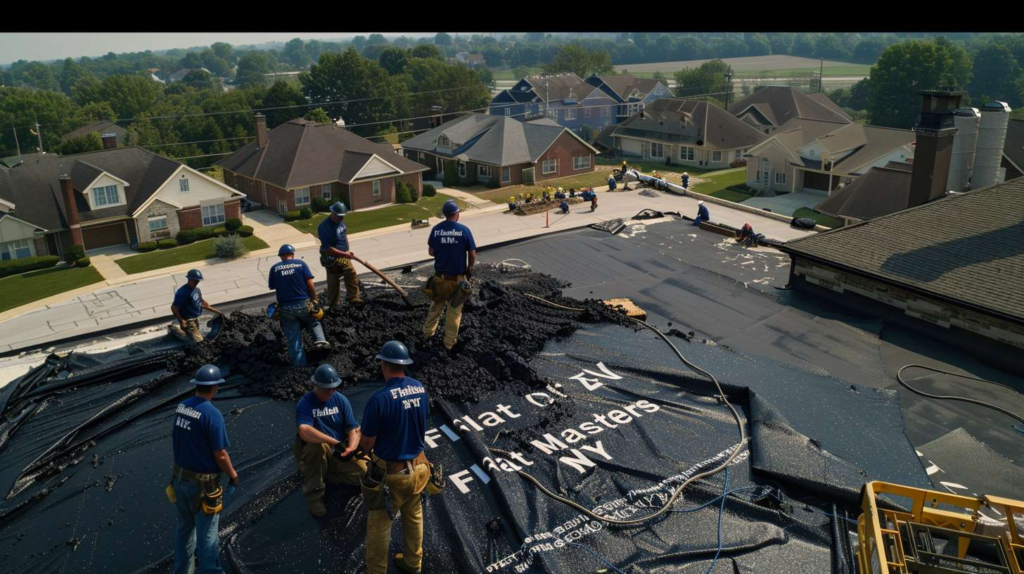
At the parapet, everything tells on itself. Terminations, wall transitions, edge conditions, and changes in elevation reveal workmanship quality faster than any field membrane ever will - and I say that as someone who's spent a lot of time tracing water back to places that had nothing to do with where it showed up indoors. I'm Darlene Velez, with 27 years in flat roofing and a specific focus on solving stubborn transition leaks in Queens, and in my view, edge and transition work is the line that separates a real flat roofer from someone who just knows how to roll out membrane. Rolling out membrane is the easy part. Getting the edge right is the job.
| Myth | Fact |
|---|---|
| "If the middle looks good, the roof is fine." | Most failures begin at edges, penetrations, or transitions - not the open field. |
| "More coating always buys time." | Coating over a bad detail doesn't seal it - it hides the leak path and delays a real fix. |
| "A leak appears directly below the hole." | Water enters at one line and travels - sometimes several feet - before showing up indoors. |
| "New membrane fixes old geometry." | Bad slope or a trapped transition still fails regardless of how new the surface material is. |
| "All flat roof details are basically the same." | Balconies, dormers, parapets, and tile tie-ins all move and drain differently - and fail differently. |
Where Specialized Details Actually Break Down On Queens Roofs
Dormers, balconies, and parapets are not interchangeable problems
Here's the part homeowners never enjoy hearing: the location where water stains your ceiling is almost never the location where water enters the roof. I remember standing on a three-family in Ridgewood at 6:40 in the morning, coffee going cold in my left hand, looking at a leak that had stained the daughter's bedroom ceiling twice in one month. The owner kept pointing at the middle of the roof. The real problem was a sloppy flat dormer roof detail where the membrane died early at the sidewall - patched with mastic three different times, which is a polite way of saying nobody wanted to fix the actual transition. Queens housing stock makes this worse because you're often dealing with layered additions, dormers, rear extensions, and mixed-era repairs all on the same building, sometimes from three or four different decades of work, and each seam between them is a line waiting to open up.
Change-of-material lines are where shortcuts announce themselves
When I ask where the water actually enters, not where you see it, most people pause. One humid July afternoon in Astoria, I was on a rear extension where a customer had a deck built over a low-slope section. Everybody blamed the membrane, but once we opened it up, the failure was in the flat roof balcony details - bad fastening at the railing penetrations and no real drainage plan whatsoever. I still remember the customer's face when I told him the leak was coming from four inches above where he'd been staring at for six months. Railing posts that penetrate a membrane without a proper sleeve and compression fitting are just open channels, especially when the deck pitch drains water directly toward the building wall instead of away from it.
Bluntly, a flat roof is only as smart as its dumbest edge. A ridge tile to flat roof detail or a flat roof to tiled roof detail involves two materials that expand, contract, and shed water at different rates - and if the transition doesn't account for differential movement, it will open up in the first cold snap or the second heavy rain. The same goes for a hybrid flat roof detail where a new membrane system meets an older built-up section: that change-of-material line is where the roof thinks it can relax, and it can't. Flat roof details DWG files and standard drawings are useful references for contractors planning an assembly, but no drawing rescues poor field execution at a live transition.
| Detail Type | Typical Failure Point | Common Water Path | Corrective Principle |
|---|---|---|---|
| Parapet Termination | Membrane termination bar lifts or sealant cracks at wall face | Water tracks behind the flashing and into the wall assembly | Full mechanically-fastened termination with counterflashing cap, not caulk alone |
| Flat Dormer Roof Detail | Sidewall flashing terminates too low or membrane doesn't run far enough up the vertical | Travels down the sidewall framing into the ceiling plane below | Membrane must rise a minimum 8" on vertical, step flashing integrated above |
| Flat Roof Balcony Details | Railing post penetrations without proper sleeves; deck pitch draining toward building | Water bypasses post base, enters substrate, and follows framing to interior | Sealed post sleeves, positive drainage slope away from wall, continuous waterproofing under deck finish |
| Flat Roof TPO Roofing Details | Seam weld failure at T-joints, or termination bar not fully seated at penetrations | Enters at open T-joint and spreads under membrane before interior staining appears | Properly heat-welded seams tested after installation; mechanically fastened terminations at all edges |
| Flat Roof to Tiled Roof Detail | Differential movement separates the membrane from the tile underlayment at the change line | Runoff from the tile section backs up and sits against the membrane termination | Flexible transition flashing, proper upstand height, and drainage path that moves water away from joint |
| Ridge Tile to Flat Roof Detail | Mortar or caulk used at junction instead of proper flashing; no allowance for movement | Water enters at the cracked mortar line and follows the ridge structure down | Lead or flexible soaker flashing integrated under ridge tile with overlap onto flat membrane |
| Hybrid Flat Roof Detail | New membrane bonded to old built-up section; joint opens as two systems move at different rates | Water enters at the change-of-system seam and saturates insulation before surfacing indoors | Compatible transition detail engineered for both systems; old substrate must be dry before new membrane overlaps |
| Flat Green Roof Detail | Root barrier not continuous to edge; drainage layer compressed or improperly sloped | Roots breach waterproofing membrane at edge; trapped water at drain causes prolonged saturation | Full root-resistant membrane, correctly sloped drainage layer, edge restraint that keeps growing medium away from termination |
Not all transitions fail for the same reason
Dormer-to-Flat Tie-In
Balcony Edge and Railing Penetrations
Tile-to-Flat Connection
Green Roof Build-Up Over Low-Slope Sections
How To Judge Whether A Detail Was Designed To Shed Water Or Trap It
A roof detail is like a geometry proof - skip one step and the whole thing collapses. When you're looking at a detail on your own roof, trace the slope line with your eye: follow where the membrane rises, where it terminates, where it meets a wall, and where it changes material. If at any point water would have to travel uphill, pool against a termination, or navigate a joint that relies on caulk as the only seal, the geometry is wrong and no surface product will save it. And here's the insider read on repeat repairs: if you're seeing the same seam patched two or three times, heavy caulk use at a wall line, or brown staining below a transition, the geometry was never corrected - the failure line is still open, it's just temporarily decorated.
If water has to negotiate a clever-looking corner, the corner usually wins.
Surface-Only Repairs Make These Situations Worse
- Mastic smears over open transitions - mastic does not bond durably to wet or moving surfaces; it hides the entry point temporarily and usually peels within one freeze-thaw cycle.
- Coating over wet insulation - traps moisture in the assembly, accelerates substrate decay, and gives you a warm stain instead of a cold one.
- Caulking moving joints at tile-to-flat transitions - any joint between two materials that move at different rates will open the caulk seam; a flexible flashing detail is the only fix.
- Reinstalling deck finishes before balcony edge waterproofing is corrected - deck boards or pavers placed over an unrepaired edge detail mean you'll be pulling them up again in twelve months to do the job properly.
Which Detail Conditions Need Immediate Correction And Which Ones Can Be Scheduled
Urgency depends on what the failed line is connected to
I learned this on a windy roof in Sunnyside, and 39-degree drizzle is not a great classroom but it does get the point across. A contractor had tied a newer white TPO membrane into an older built-up section right where the flat area met a pitched roof with tile - and the flat roof to tiled roof detail was a clumsy termination that had been smeared with mastic and left to figure itself out. That sounds logical as a temporary measure, but the roof behaves differently when two materials expand at different rates across a Queens winter: the joint opened, water pooled against the transition, and by the time I got there it had been saturating the edge insulation for at least one full season without the owner knowing it. The field membrane looked perfectly fine from four feet away. The entry line was everything.
For Queens property owners trying to triage their situation: active interior staining below a parapet, water coming in around balcony posts, and ponding against any hybrid membrane tie-in or tile transition - those go to the front of the list, full stop. A failed open TPO termination or saturated insulation doesn't wait. On the other hand, cosmetic scuffing on the field membrane, aging sealant that hasn't yet moved, or accessible cap metal with no moisture underneath can be assessed in a scheduled inspection and planned into a proper repair sequence rather than an emergency call.
Questions Worth Asking Before Anyone Touches The Problem Area
A competent roofer should be able to name the specific line where the failure originates - not just point at a material or suggest a product. Ask them to trace the entry point, explain what's happening at the termination or transition, and describe how the repair changes the geometry rather than just covering it. With flat green roof details and flat roof TPO roofing details especially, the sequencing of the assembly matters as much as the material choice: a TPO seam that's welded before the substrate is verified dry, or a root barrier that doesn't extend continuously to the edge restraint, fails not because the material was wrong but because the order of operations was wrong. You'll want to hear a clear sequence from whoever you hire - not just a material name and a day rate.
Can a leak at a flat dormer be fixed without replacing the whole roof?
Why do balcony edges keep leaking even after sealant is added?
Are flat roof details DWG drawings enough for a contractor to follow?
What makes a TPO detail fail even when the field membrane looks new?
How does a green roof change the waterproofing detail at edges and drains?
If a leak keeps returning at a parapet, dormer, balcony edge, tile tie-in, or any other specialized flat roof detail, call Flat Masters - we'll diagnose the actual line that failed instead of sending you a bill for another coat of mastic over the same broken geometry.
