
Flat Roof Houses Get Hot in Summer - Here's How to Deal With It Effectively
I look for one thing first. If a flat roof house is overheating, the real question isn't why the AC is struggling - it's how much solar heat the roof is absorbing and passing straight down into the living space. That's where the problem starts, and that's where the fix has to start too.
Heat gain at the roof is the first thing to measure, not the last thing to guess at
Before we talk about how to keep a flat roof house cool, how hot is the roof assembly actually getting? That's the question most people skip. They feel hot, they turn the thermostat down, and the AC runs harder - but if the roof surface is still absorbing heat and driving it downward, you're just asking a machine to fight a physics problem. The heat moves in a chain: sun hits the surface, surface heats the assembly beneath it, the assembly radiates downward into the ceiling, and the ceiling dumps it into the room you're living in. I'm Teresa Vukovic, with 18 years solving overheating complaints on Queens flat roof houses by measuring where heat enters instead of just guessing at comfort - and every fix I've seen work traces back to breaking that chain at the right point.
NO → Move to Step 2.
NO → Move to Step 3.
NO → Move to Step 4.
Surface temperature is often telling the truth before the thermostat catches up
By late afternoon, the roof has usually already decided how the room will feel
At 4 p.m., the ceiling usually tells the truth. One brutal July afternoon in Jackson Heights, I stepped into a top-floor bedroom and my glasses fogged for a second from the temperature swing. The homeowner wanted to know how to cool down a flat roof house because the AC never seemed to catch up after lunch. Once I got on the roof, it was a familiar story: dark aging surface, poor thermal performance in the assembly, and heat baking in the layers above the ceiling. I set my infrared thermometer on the windowsill and watched the owner's face when he saw how much hotter the ceiling area read compared to the interior wall. That single measurement turned a vague comfort complaint into a concrete roof problem with a specific fix.
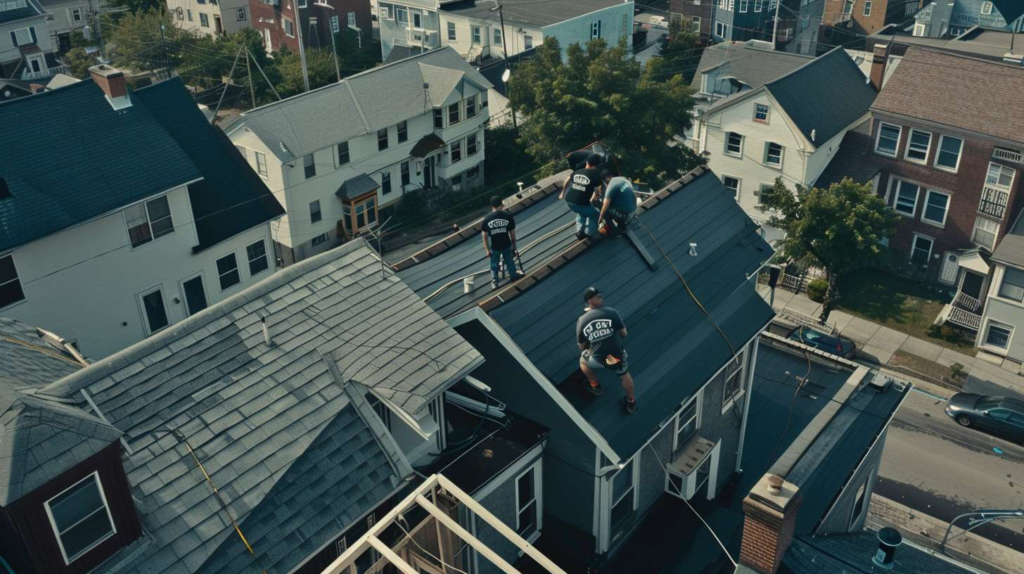
A flat roof in summer can behave like a frying pan lid - if it stores heat all day, the room underneath pays for it all evening. And that's not an abstract problem in Queens. Top-floor bedrooms off Jamaica Avenue, rear extensions in Woodside, family rooms sitting directly under a flat addition built in the '80s - these spaces become genuinely miserable by late afternoon because the roof above them has been soaking up sun since morning. The west-facing extensions are the worst. By 3 p.m., the sun is hitting them at full angle, and if that surface has any age on it, the heat path from roof to room is almost completely unobstructed.
| What You Notice | What It May Mean Above the Ceiling | Why It Matters |
|---|---|---|
| Hot ceiling surface | The roof assembly is actively radiating stored solar heat downward through the ceiling plane | Room temperature won't stabilize until the ceiling stops acting as a radiant heater |
| AC running constantly after lunch | Solar gain at roof level is continuously replenishing heat faster than the system can remove it | More cooling capacity is not the fix - reducing the load entering from above is |
| Cooler walls than ceiling | Heat is entering primarily from the roof plane, not through walls or windows - the roof is the source | Confirms the problem is roof-side, which focuses where to spend the fix budget |
| Room worst in late afternoon | The assembly has been storing heat all day and reaches peak radiation output in the afternoon hours | The timing maps directly onto a surface and assembly problem, not an airflow or duct issue |
| Flat-roof room hotter than nearby rooms | Rooms under the flat roof section have direct exposure to the heat-collecting assembly; adjacent rooms don't | Isolates the flat roof assembly as the specific cause rather than a whole-house system failure |
| Heat lingers into evening | The assembly has absorbed so much thermal mass during the day that it continues releasing heat for hours after sunset | Surface and assembly thermal performance are both weak - evening lingering heat is a two-layer problem |
Throwing a bigger AC unit or extra window units at a flat roof house that's still absorbing and radiating heavy solar gain every afternoon doesn't solve the problem - it just makes the equipment work harder to lose the same fight. Until the roof-side heat gain is addressed, every dollar spent on extra cooling is partially wasted. Measure the source first. Spend on the fix second.
Roof-level fixes usually work better than room-level frustration when the heat path is obvious
I still remember those two takeout containers proving the point in ten minutes. It was a Sunnyside extension job - the homeowner was convinced the answer had to be more vents, and honestly, sometimes it is. But this one was different. The surface was dark and degraded, the insulation in the assembly was undersized for a Queens summer, and no amount of airflow was going to fix what the roof was doing to the rooms below. I grabbed a black container and a white one from the bag on the counter, set them on the parapet in full afternoon sun, and came back ten minutes later with the infrared thermometer. The black one was significantly hotter. The homeowner got it immediately. Same sun, same roof, same airflow - different surface behavior. That's the conversation that matters.
Here's the blunt truth: your AC should not have to wrestle the roof alone. When the heat path is obvious - surface absorbing, assembly conducting, ceiling radiating - there are practical roof-side strategies that actually interrupt it. A reflective coating applied to an aging dark surface can meaningfully reduce how much solar energy the roof takes in on a hot day. Improving or adding to the assembly's insulation layer slows how fast that absorbed heat travels downward. Targeted ventilation, and I mean targeted - not just "add vents everywhere" - helps where heat is genuinely trapped above the ceiling with nowhere to move. Each of these works because it addresses a specific point in the chain. None of them is magic on its own if the other layers are still failing.
My opinion? Most people try to cool the room before they slow the heat. And I understand why - it feels like the immediate solution, and the AC is already there. But here's the insider question worth asking before spending money on any fix: which part of the heat path does this actually interrupt? Surface? Assembly? Ceiling? Room air? If the answer is vague, the fix probably is too. Vague "cooling help" isn't a plan. A plan identifies whether the surface is the culprit, whether the assembly is conducting too fast, whether heat is trapped above the ceiling, or whether all three are happening at once - and then works from the top of the chain down.
- ✔Roof surface color and condition - is it dark, aged, or degraded enough to be absorbing solar gain aggressively?
- ✔Assembly thermal weakness - is insulation value adequate, or is heat conducting through the roof build-up too quickly?
- ✔Ceiling hot spots - where is the ceiling surface hottest, and does it map to a specific section of the roof above?
- ✔Drain or vent interaction - are any drainage or vent penetrations creating thermal weak points or disrupting airflow where it matters?
- ✔Afternoon sun exposure angle - which roof sections face west or take direct afternoon sun that maximizes stored heat?
- ✔Room use below - a toddler's room, a home office, or a bedroom needs a different urgency level than an occasional storage room.
- ✔Which intervention targets which heat layer - surface fix, assembly fix, ceiling fix, or room-air fix - and whether the plan addresses the right one.
Heat complaints usually calm down once the problem is measured instead of narrated
You do not need drama; you need a heat map
At 4 p.m., the ceiling usually tells the truth - and honestly, that's the best time to show up. I had a Ridgewood family call Flat Masters during a bad heat wave because their toddler's room under a flat roof extension was getting genuinely miserable by late afternoon. I got there around 5 p.m., which is roasting if you're on the roof but ideal if you're trying to diagnose, because the heat path is fully visible at that hour. The ceiling in that room was radiating noticeably, the assembly above it had been baking all day, and the surface condition confirmed it. We talked through how to keep a flat roof house cool by reducing heat gain at the roof level first - coating the surface, addressing the assembly's thermal resistance - instead of continuing to ask a window unit to do the impossible. The family had their answer in an hour because we measured instead of guessed.
▶ What is the surface doing?
Use an infrared thermometer on the roof surface and compare it to a shaded area - the difference tells you how much solar energy the surface is absorbing and keeping. If the surface is dark, aged, or granule-depleted, that number will be high and the fix is at the surface level.
Don't guess the surface condition from inside the building - get on the roof and measure it directly, because what looks "okay" from the street can be a significant heat collector up close.
▶ What is the assembly doing?
Ask when the insulation was last assessed and whether the assembly has any thermal break - older flat roof additions in Queens frequently have minimal insulation depth that was adequate in 1985 but struggles against current summer temperatures.
If the ceiling surface temperature is within a few degrees of the roof surface temperature by late afternoon, the assembly is conducting heat almost unopposed - and that's the layer that needs attention before anything else.
▶ What is the room still feeling after sunset?
If the room is still hot at 9 or 10 p.m. with the AC running, the assembly stored enough thermal mass during the day that it's still releasing it hours later - which is a strong indicator that both surface treatment and insulation improvement are needed, not just airflow changes.
Evening lingering heat is evidence, not inconvenience - note the time the room finally cools down and bring that information to whoever is assessing the roof, because it helps map exactly how much heat the assembly is storing.
How do I cool down a flat roof house effectively?
How do I keep a flat roof house cool without just overworking the AC?
Is the roof surface really that important?
Do vents always solve heat problems on a flat roof house?
What should be measured before choosing a fix?
If your flat roof house is still making the AC fight a battle it shouldn't have to fight every summer, call Flat Masters and let us measure the heat path honestly - surface, assembly, ceiling, room - before you spend another dollar guessing at a solution. We're in Queens, and we know exactly how this plays out on a July afternoon. - Teresa Vukovic, Flat Masters